Connect with us
Anglostratits

Business

Mauritius Country Focus Report 2026: Mauritius Must Mobilise Development Financing at Scale to Achieve High-Income Ambition

Published

on

Mauritius

The report projects that economic growth in Mauritius will slow to 3% in 2026 before recovering to 3.8% in 2027, supported by financial services, wholesale and retail trade, and tourism on the supply side, and by household consumption on the demand side

PORT LOUIS, Mauritius, August 12, 2026/APO Group/ –Mauritius must mobilise development financing at scale to deepen structural transformation, drive sustainable and inclusive growth, and realise its vision of becoming a high-income economy, according to the African Development Bank’s (www.AfDB.org) 2026 Country Focus Report (CFR) (https://apo-opa.co/4woGEqE) and the Bank-commissioned Mauritius Productivity Study, both released on 29 July 2026.


The CFR, titled Mobilising Mauritius’ Development Financing at Scale in a Fragmented World, reviews the country’s recent macroeconomic performance and outlook, quantifies its development financing gap, and proposes reforms to strengthen financial systems in a rapidly changing global environment.

The report projects that economic growth in Mauritius will slow to 3% in 2026 before recovering to 3.8% in 2027, supported by financial services, wholesale and retail trade, and tourism on the supply side, and by household consumption on the demand side.

Key growth drivers in 2025 included financial services, wholesale and retail trade, and tourism—with tourist arrivals reaching an all-time high of 1.44 million—while final consumption expenditure was the main contributor on the demand side.

However, the report cautions that structural bottlenecks are hindering deeper economic transformation and long-term economic growth. These include labour market rigidities, skills mismatches and an ageing population; infrastructure deficits in the water and energy supply and in port logistics; and gaps in information and communications technology (ICT).

Inflation is projected to accelerate to 5.7% in 2026 — breaching the central bank’s monetary policy target range of 2-5% — due to the impact of the conflict in the Middle East, before easing to 3.9% in 2027 as global commodity prices ease.

The recommendations presented are a call for collective action

Despite the government’s strong commitment to fiscal consolidation, public debt remains elevated, constraining fiscal space. Nevertheless, the fiscal deficit is projected to narrow to 6% of GDP in 2026 and 3.7% in 2027 on the back of growth-friendly consolidation measures, with public debt projected to fall below 80% of GDP in 2029.

In his opening remarks, Prof. Kevin Urama, Chief Economist and Vice President for Economic Governance and Knowledge Management, said: “By adopting good practices in domestic revenue mobilisation, improving efficiency in public expenditure planning, public finance and debt management, mobilising investment from Africa’s institutional investors, the African diaspora and high-net-worth individuals, and addressing informality, the continent can mobilise capital at scale to finance its development.”

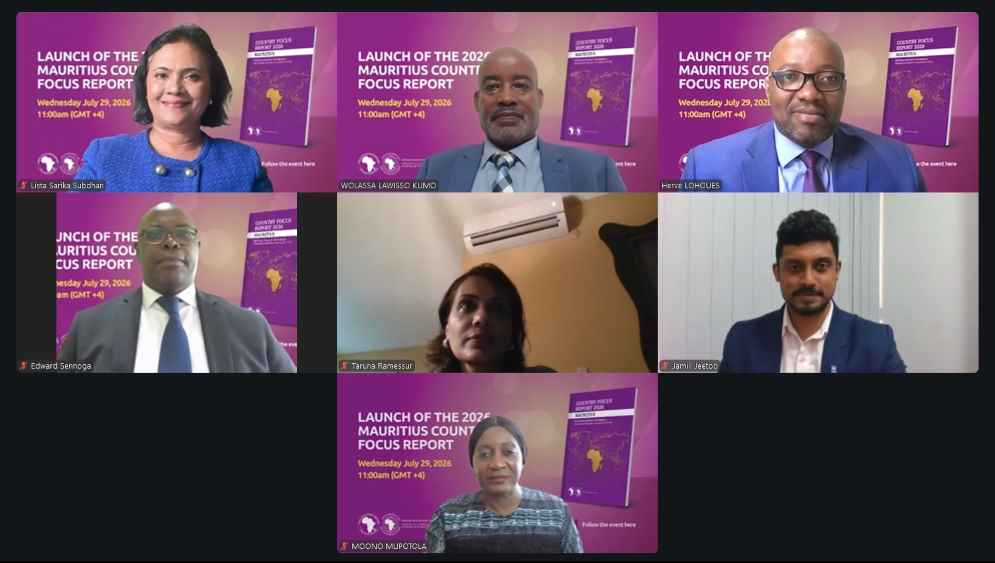
In her welcoming remarks, Moono Mupotola, the Bank’s Deputy Director General for Southern Africa and Country Manager for Mauritius, said the Country Focus Report and the Mauritius Productivity Study are more than analytical publications: together, they provide an evidence-based roadmap for strengthening Mauritius’ resilience, enhancing productivity, and mobilising the resources needed to achieve the country’s long-term development ambitions.

“The recommendations presented are a call for collective action. Real progress will require continued collaboration between the public and private sectors, development partners, academia, civil society, and financial institutions to translate these ideas into concrete reforms, investments, and lasting results. By building on its strong institutional foundations and embracing the reforms outlined in these studies, Mauritius is well positioned to strengthen its competitiveness and secure economic transformation,” Mupotola said.

The Bank also presented the key findings of the Mauritius Productivity Study, commissioned to inform the preparation of the Mauritius Vision 2050 and the Ten-Year National Development Plan. The study assesses the causes of productivity slowdown and challenges hindering deeper structural transformation, and how to boost digitalisation, Industry 4.0 adoption and competitiveness. It identifies emerging growth pillars, including the ocean economy, the digital and knowledge economy, the circular economy, and the creative and cultural industries.

The Mauritius CFR 2026 report (https://apo-opa.co/4woGEqE) was presented by Wolassa Kumo, African Development Bank’s Principal Country Economist for Mauritius. Taruna Ramessur, Consultant and Associate Professor at the University of Mauritius, presented the key findings of the Mauritius Productivity Study.

The virtual launch brought together senior officials from the Ministry of Finance, other government officials, development partners, private sector representatives, civil society, and senior officials from the Bank Group. They offered strategic insights on both reports.

Jamiil Jeetoo, UNDP National Economist for Mauritius and Seychelles, stressed that development finance should be assessed not only by the volume mobilised, but by the productivity and resilience it generates.

Distributed by APO Group on behalf of African Development Bank Group (AfDB).

Events

Showcase Indian Ocean Convenes Private and Institutional Capital Across the Region’s Luxury Corridor

Published

on

real estate summit

The re-positioned, fourth edition of the flagship real estate summit highlights the Indian Ocean corridor as a proving ground for the world’s most recognisable luxury hospitality brands and independent operators, representing one of Africa’s most compelling investment stories

PORT LOUIS, Mauritius, September 23, 2026/APO Group/ –Showcase Indian Ocean, formerly the API Mauritius & Indian Ocean Property Forum, is returning as a high-impact capital and investment summit that focuses on Mauritius as the centrepiece of a wider regional story where island destinations are maturing through capital investment, tourist demand and innovation.


Backed by API Events’ decades of B2B real estate, capital and hospitality events experience and headline-sponsored by Cushman & Wakefield | Broll, the event takes place at the InterContinental Resort Mauritius on 8 October. Now in its fourth edition, the event has been rebuilt around the transition from high-churn sales to institutional-grade investment, with a programme spanning regulatory changes, private credit, capital structuring and the integration of Agentic AI into dealmaking.

A maturing hospitality investment market

“The Indian Ocean is home to some of the most iconic destinations globally and the hospitality sector’s relative maturity is evidence of this, while the region still presents numerous entry opportunities for those not present,” says Wayne Godwin, Group Managing Director: International Markets, Broll Property Group.

Spearheaded by investment, real estate and hospitality leaders, the Indian Ocean Showcase programme will explore how capital is deploying across a corridor extending from Mauritius to the Maldives, Seychelles, Zanzibar, Madagascar, Réunion and Mozambique.

From growth potential to investable opportunity

The summit will also explore the growing prominence of GCC family offices and sovereign wealth funds in resort investment, alongside the shift from passive fund allocations into direct deals in hospitality, branded residences and mixed-use property.

“For investors, the opportunity across this market is not simply about identifying where growth is happening, but understanding where the fundamentals are strong enough to support investable real estate. Connectivity, infrastructure, demand and the ability to execute will increasingly determine which opportunities translate into successful transactions,” says Calvin Crick, Managing Director at Cushman & Wakefield | Broll Transactions.

Emphasis will be placed on capital-light development models and the use of branded residences to compress developer entry requirements, evidenced by a wave of branded openings from global and independent hotel groups. The investment case is further underpinned by tourism demand, with Mauritius, the Seychelles and Zanzibar all posting record visitor arrivals in 2025.

Understanding distinct markets and occupier needs

We’re excited to continue our legacy in the Indian Oceans region with this repositioned event

While hospitality remains a key component of the region’s investment story, the opportunity extends across a broader real estate landscape.

“The Indian Ocean should not be viewed as a single real estate market. Mauritius, Madagascar, Seychelles and Réunion each have distinct economic, regulatory and occupier dynamics, creating different opportunities for businesses looking to establish or expand their presence in the region. For occupiers, understanding these local market conditions will be critical to making informed real estate decisions,” says Natasha Bruwer, Managing Director: Occupier Services, Cushman & Wakefield | Broll.

The broader agenda will examine the growth drivers shaping the region, alongside lessons learnt from mature markets and against the backdrop of new flagship projects. It will also explore emerging investment themes, including the Mauritius Real Estate Index, green bond structuring against DFI and institutional ESG bankability requirements, and emerging asset classes such as senior living, digital-nomad multi-stay models, resort logistics and asset tokenisation.

A dedicated design and development track will examine how two decades of master-planning quality have shaped long-term investor confidence in the market.

Beyond hospitality

“Beyond hospitality, the combination of high ease of doing business, economic maturity, and growth makes this an attractive region for commercial, industrial, retail, residential, and other real estate asset classes. As Cushman & Wakefield | Broll, we are delighted to support this event and are pleased to have this exciting partnership in place,” says Godwin.

“We’re excited to continue our legacy in the Indian Oceans region with this repositioned event, designed to answer questions of capital structure, regulatory positioning and long-term institutional confidence across the entire corridor,” says API Events Commercial Director, Murray Anderson.

“The decision to move from a traditional property forum to a capital, investment and hospitality-focused summit reflects the rapidly changing geopolitical environment, surging tourism demand and the maturation of Indian Ocean island economies.”

Event snapshot:

8 October, InterContinental Mauritius Resort

300+ global attendees (investors, operators, developers and financiers).

60+ speakers across 14 sessions

Distributed by APO Group on behalf of API Events.


Continue Reading

Energy

Democratic Republic of the Congo (DRC) Brings Oil Development Push to African Energy Week (AEW) 2026 as Hydrocarbons Minister Leads Sector Agenda

Published

on

African Energy Chamber

The Democratic Republic of the Congo is advancing new petroleum data, exploration and infrastructure initiatives as Minister of State for Hydrocarbons Acacia Bandubola Mbongo prepares to address investors and industry leaders at African Energy Week 2026

CAPE TOWN, South Africa, September 23, 2026/APO Group/ –The Democratic Republic of the Congo is stepping up efforts to develop its hydrocarbons industry, with Minister of State for Hydrocarbons Acacia Bandubola Mbongo set to speak at African Energy Week (AEW) 2026 in Cape Town, where she will present the country’s evolving oil and gas agenda to international investors and industry stakeholders.


Her appearance comes as Kinshasa moves to strengthen some of the infrastructure needed to support a more active petroleum sector. In July, the country launched its first national petroleum and gas data bank, inaugurated by Bandubola in Kinshasa. The platform is intended to centralize and improve access to geological and petroleum information, providing a more structured basis for exploration and investment.

Exploration is also moving up the government’s agenda. On September 15, Bandubola chaired discussions on accelerating the development of oil blocks 1 and 2 in the Albertine Graben, an area in eastern DRC where the government has been seeking to advance petroleum activity. The latest discussions underscore Kinshasa’s focus on moving prospective acreage toward development rather than leaving resources at the exploration stage.

The DRC has an enormous opportunity to build a stronger domestic oil and gas industry, but realizing that potential requires more than resources underground

At the same time, the DRC is looking beyond its borders for technical expertise. In May, Bandubola signed an agreement with Algeria’s energy minister covering cooperation in hydrocarbon exploration and production, as well as technical expertise and petroleum data. The partnership reflects Kinshasa’s efforts to draw on experience from established African oil and gas producers as it builds out its own sector capabilities.

The government is also working on the downstream side of the industry. Earlier this year, the hydrocarbons ministry outlined projects aimed at improving fuel supply in three provinces, including additional storage and distribution infrastructure. Such investments form part of a broader effort to strengthen the systems needed to supply a country with significant distances between producing areas, population centers and markets.

Bandubola’s role also has a regional dimension. The DRC is taking on a leadership position within the African Petroleum Producers’ Organization in 2026, giving the Minister an additional platform to engage with other African oil and gas producers on investment, technical cooperation and the development of the continent’s petroleum resources.

For investors, the DRC’s challenge is increasingly about translating prospective resources into a functioning industry – supported by credible data, exploration activity, infrastructure and partnerships. AEW 2026 provides a platform for the government to outline how it intends to do that and where international capital and expertise could fit into the next stage of development.

“The DRC has an enormous opportunity to build a stronger domestic oil and gas industry, but realizing that potential requires more than resources underground. It requires credible data, infrastructure, technical expertise and investment partnerships that can turn geological potential into productive assets and economic opportunity,” said NJ Ayuk, Executive Chairman of the African Energy Chamber. “Acacia Bandubola Mbongo’s participation comes at an important moment as the country works to put those building blocks in place and engage investors on the opportunities emerging across its hydrocarbons sector.”

Distributed by APO Group on behalf of African Energy Chamber.


Continue Reading

Business

MSGBC 2026 Puts Technology at the Center of the Basin’s Next Energy Phase

Published

on

Etu Energias

Five technical presentations at MSGBC Oil, Gas & Power 2026 will examine the technologies and engineering strategies needed to turn the basin’s resource base into producing, connected and commercially viable projects

DAKAR, Senegal, September 23, 2026/APO Group/ –The MSGBC basin is entering a different stage of its energy development. Discoveries are moving into production, operating assets are generating new data, and companies are using improved seismic interpretation and development concepts to evaluate the next wave of acreage. The challenge is increasingly about execution: turning geological potential into projects that can be financed, built and operated competitively.


Taking place in Dakar from December 1–3, MSGBC Oil, Gas & Power 2026 will feature five technical presentations examining the technologies and engineering approaches shaping that transition, from subsurface interpretation and deepwater development to gas monetization and digital operations.

Sharper Subsurface Intelligence

The presentation, “Basin Architecture & Subsurface Potential: Mapping the Next Phase of MSGBC Exploration” will examine how new seismic data and production experience are refining understanding of the Atlantic margin. TGS Principal Exploration Advisor Felicia Winter will present the latest regional subsurface assessment.

TGS’s Mauritania MegaSurvey covers more than 100,000 square-kilometers, while its Jaan 3D project adds approximately 28,300 square-kilometers across Senegal, The Gambia and Guinea-Bissau. New drilling and production data are providing additional calibration points for geological models, helping companies assess petroleum systems and evaluate both established and frontier acreage with greater confidence.

Turning Discoveries Into Production

As exploration matures, engineering decisions become critical to determining whether discoveries can move efficiently toward first production. The presentation, “From Discovery to First Production: Engineering Development Concepts for Frontier Deepwater Assets” will examine concept selection, phased development and capital-efficient engineering for deepwater projects. Subsea production systems, long-distance tiebacks and flow-assurance requirements will feature among the considerations involved in developing complex offshore resources.

For operators, the objective is to manage technical complexity while keeping development costs and schedules under control – a priority as more MSGBC discoveries move into the development pipeline.

Building the Offshore Project Base

The “Deepwater Engineering & Offshore Project Delivery in the MSGBC Basin” session will focus on the next challenge: executing projects at scale. The presentation will cover subsea installation, FPSO and FLNG integration, contracting and offshore logistics, while examining how standardized engineering and modular construction can improve cost and schedule performance across successive developments.

A growing project pipeline is also expected to increase demand for drilling, marine, fabrication and engineering services. Coordinating contractors and securing specialized equipment will become increasingly important as multiple projects advance across the basin.

Finding More Markets for MSGBC Gas

Gas development presents another opportunity to move beyond individual projects toward a more integrated regional energy system. “Gas Processing, LNG Infrastructure & Regional Gas Monetization Pathways” will examine how MSGBC gas can serve LNG exports while also supporting domestic power generation and industrial demand. Projects including Yakaar-Teranga and BirAllah illustrate the range of monetization options emerging across the basin.

Regional infrastructure could further expand those options. The proposed African Atlantic Gas Pipeline, for example, could connect West African gas resources with markets along the Atlantic corridor, creating potential links between upstream production, processing, LNG and power infrastructure.

Making Complex Assets Smarter

As production expands, digital technologies are becoming increasingly important to managing complex offshore operations. The “Digital Oilfields & Intelligent Energy Operations” presentation will examine digital twins, real-time subsea monitoring, predictive maintenance and automated emissions tracking, with a focus on how these tools can improve reliability and reduce unnecessary intervention.

For operators, the commercial case is straightforward: remote monitoring, automated diagnostics and centralized technical support can help manage geographically dispersed assets without increasing operating costs at the same rate as production and infrastructure.

That shift from discovery to delivery will be central to MSGBC Oil, Gas & Power 2026, bringing together the companies, technical specialists, investors and policymakers working to turn the basin’s resource potential into the next generation of energy projects.

For more information visit www.MSGBCOilGasandPower.com. To secure your participation at the MSGBC Oil, Gas & Power 2026 conference and exhibition, please contact: sales@energycapitalpower.com.

Distributed by APO Group on behalf of Energy Capital & Power.


Continue Reading

Trending