Connect with us
Anglostratits

Business

Radisson Hotel Group and Accenture Redefine Travel Discovery on ChatGPT

Published

on

Radisson Hotel

New Radisson Hotels app in ChatGPT helps travelers move from trip intent to relevant hotel options, live rates, and direct booking paths, advancing Radisson Hotel Group’s agentic commerce strategy

AI is radically transforming how people search for and book hotel stays, and we are committed to being at the forefront of this shift

BRUSSELS, Belgium, July 29, 2026/APO Group/ –Radisson Hotel Group (www.RadissonHotels.com) has collaborated with Accenture (NYSE: ACN) in launching an AI-powered hotel discovery app in ChatGPT, helping travelers move from trip intent to search, comparison and planning through natural conversation.


Available as @RadissonHotels in ChatGPT, the app enables travelers to search for Radisson Hotels properties across over 100 countries, and more than 1,000 hotels through natural conversation. Through starting a new ChatGPT conversation with @RadissonHotels at the start of the prompt, travelers can ask for advice to plan a family-friendly weekend stay in Amsterdam, or a hotel in Paris with a gym and spa near the Eiffel Tower. The app will respond with relevant Radisson Hotels properties with live inventory and rates, location context, amenities, hotel details, and interactive map-based results. When ready, travelers are directed to complete the reservation through the Radisson Hotels website.

The launch marks an important step in Radisson Hotel Group’s move toward agentic commerce (https://apo-opa.co/4w1xwbb): a shift from traditional, channel-based booking journeys to AI-led experiences where discovery, comparison, and decision-making happen through conversation. As travelers increasingly turn to AI to ask questions, narrow down options, and plan trips, hospitality brands need to be visible, accurate, and actionable at the moment of intent.

This shift is already underway. According to Accenture’s Consumer Pulse Research (https://apo-opa.co/4fqvOLv), 87% of travelers are open to collaborating with an AI-powered travel agent to find the best option, and 71% of travelers say that at least half of their spend for hotels or airlines will be influenced by AI over the next 12 months. Radisson Hotel Group is seeing the change firsthand, noting that organic and direct web traffic channels that have historically driven online bookings are giving way to new touchpoints like ChatGPT.

“AI is radically transforming how people search for and book hotel stays, and we are committed to being at the forefront of this shift,” said Gianni Di Fede, chief commercial officer, Radisson Hotel Group. “With Accenture, we are reimagining hotel discovery for the next generation of travelers—meeting guests in the planning moment with a branded experience that makes it easier to find, compare, and book Radisson Hotels properties.”

The collaboration began with Radisson Hotel Group using an MCP accelerator that is part of Accenture’s AI Merchant Center, an agentic readiness and intelligence platform. This helped structure, validate, and optimize how Radisson Hotels’ content, inventory, rate, and booking signals could be monitored for AI-led discovery. Accenture then worked with Radisson Hotel Group to design the app experience, shaping how travelers interact with it and how it works across devices. The app connects directly to Radisson Hotel Group’s existing systems, delivering real-time hotel information that helps travelers move from a broad idea to a relevant shortlist more quickly. Over time, the companies plan to expand this experience to include deeper personalization, loyalty recognition, in-chat booking, reservation management, trip modification, and AI concierge capabilities.

“Agentic commerce is fundamentally changing how people discover and choose brands. As journeys become more conversational and intent-driven, companies have to rethink how they show up — not just to be found, but to be chosen, and to deliver value in that moment,” said Ndidi Oteh, CEO of Accenture Song. “Radisson Hotel Group is taking a step in that direction, creating a more direct and meaningful way to connect with travelers when decisions are being made.”

The app is part of Radisson Hotel Group’s broader digital transformation and direct booking strategy. Accenture has supported the Group in modernizing its digital and data foundation (https://apo-opa.co/4pPQ78O), uniting its brands on a single global platform and enabling more personalized marketing across more than 1,000 hotels. With the Radisson Hotels app in ChatGPT extending that foundation into a new AI-native discovery channel, the Group will remain visible, relevant, and bookable as traveler behavior continues to evolve.

“With travel, planning is becoming easier for consumers, but more competitive for brands,” said Emily Weiss, senior managing director and global Travel lead, Accenture. “Travelers want to compare options quickly, narrow down choices and book with confidence, often in a single journey. That puts pressure on brands to show up with accurate, up-to-date, and easy-to-navigate information at every step. With Radisson Hotel Group, the focus was on making hotel content more accessible, so travelers can find what they need, explore options, and move to booking more seamlessly.”

This work builds on Accenture and ChatGPT’s parent company OpenAI’s broader partnership (https://apo-opa.co/4pOOVlZ) to help organizations use AI in more practical, decision-driven ways, unlocking new opportunities for growth, stronger customer connections, and more efficient operations. Accenture is an OpenAI Elite Partner and was recently named OpenAI’s AI Transformation Partner of the Year

Distributed by APO Group on behalf of Radisson Hotel Group.


Business

African Energy Leaders Call for Action on South-South Oil and Gas Partnerships

Published

on

African Energy Chamber

At AEW 2026, industry representatives from Africa and the Caribbean say joint ventures, enforceable local-content rules and regional financing are needed to turn petroleum resources into domestic industrial growth

CAPE TOWN, South Africa, October 17, 2026/APO Group/ –African and Caribbean energy leaders called for stronger cross-border investment, technology transfer and enforceable local-content requirements to ensure emerging oil and gas producers capture more value from their resources during the session South-South Energy Partnership: Advancing Africa’s Oil and Gas Future in 2026 at African Energy Week (AEW) 2026 in Cape Town.


Ndapwilapo Selma Shimutwikeni, CEO, RichAfrica Consultancy, said partnerships could accelerate skills development.

“From a business perspective, we need to build partnerships that encourage joint ventures between experienced countries and emerging countries like Namibia,” she said. “We need to look beyond just oil production and actually look at the entire value chain.”

Building on Shimutwikeni’s remarks, Gilbert Yevi, Lead Consultant, Grenada Hydrocarbon Technical Working Group, called for partnerships that share risks and benefits rather than simply replace one source of financing with another.

We want cooperation and a collaboration in risk sharing, skill sharing, and sharing in the benefits

“We want cooperation and a collaboration in risk sharing, skill sharing, and sharing in the benefits,” he said.

Yevi also advocated regional training centers to pool expertise and help emerging producers access established industry capabilities.

Expanding on the topic of local content, Eric Williams, Principal Consultant and President, Royal Triangle Energy Solutions, said policies must be linked to a broader national development strategy, using petroleum resources to build domestic industries rather than focusing solely on exports.

“The Trinidad model is about using the molecules to develop the country,” he said, arguing that this vision should shape negotiations with upstream investors and the terms of petroleum contracts.

Omar Farouk Ibrahim, Regional Chair for Africa, World Energy Council, said national sovereignty concerns continued to limit practical regional cooperation, despite public commitments to collaboration.

“The first question they ask is: ‘Will the industry be in my territory?’ If it’s not, why should I? And for as long as we have this mentality, believe me, this cooperation and collaboration we’re talking about will just be theory,” he said.

Across the discussion, speakers emphasized that cooperation must translate into financing, enforceable commitments and local capabilities that endure beyond individual projects.

Distributed by APO Group on behalf of African Energy Chamber.


Continue Reading

Business

Nigeria NOW! opens its project boardrooms to global investors in Abuja

Published

on

Nigeria

With Nigeria’s annual mining revenue up more than tenfold to above N70bn, Nigeria NOW! brings global investors to Abuja on 19 and 20 November, where the Minister of Solid Minerals Development is Chief Host

First and foremost all international investors coming to Abuja should understand that Nigeria is ready and open for business

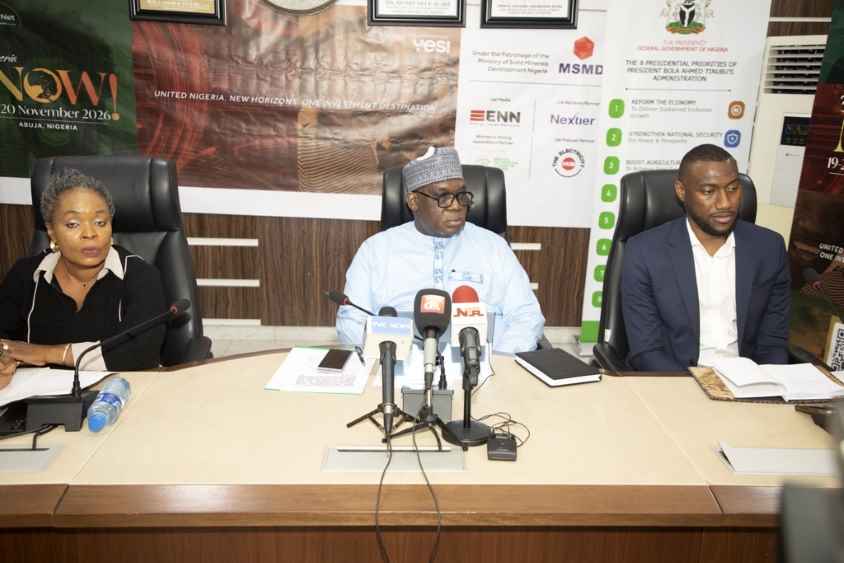
LONDON, United Kingdom, October 21, 2026/APO Group/ –Platinum group metals, gold, nickel, copper, lithium and rare earth elements lie together in one mineral province in Kaduna State, which the Minister of Solid Minerals Development announced in June as world-class and the Nigerian Geological Survey Agency has verified. The Ministry opens its doors to global investors at Nigeria NOW!, held at the Bola Ahmed Tinubu International Conference Centre in Abuja on 19 and 20 November.


Processing is following the discoveries, as lithium facilities of $600m in Nasarawa State and $200m near Abuja sit alongside a $400m rare earth processing project in Nasarawa, and mining lease applicants must now submit value-addition plans. Annual mining revenue has risen from about N6bn before the current administration to more than N70bn by the end of 2025.

The routes to export markets are moving too, as the Federal Executive Council has approved deep seaports at Bakassi and Ondo as public-private partnerships, with the Bakassi port alone valued at $2.27bn.

With a month to go, investors and developers travelling to Abuja will meet these projects at close quarters. In investor boardrooms, the Government of Nigeria will review specific projects in depth, from large-scale infrastructure to multilateral programmes such as Mission 300.

Speaking to Energy News Network in September, Tunde Arisekola, Senior Advisor, Geological and Minerals Information at the African Minerals Development Centre, who joins the minerals session on the first day, said that “first and foremost all international investors coming to Abuja should understand that Nigeria is ready and open for business”. In the same interview he described Nigeria’s economy as “stable, safe, peaceful and welcoming to all international investors”.

The programme opens with a welcome from the Chief Host, H.E. Dr Oladele Henry Alake, Minister of Solid Minerals Development, followed by sessions on how the Ministry of Power will drive capacity into Nigeria’s industrial hubs and on the policies opening the minerals sector to foreign investment, including domestic processing and value addition. The second day turns to the pipeline of transport and port infrastructure and the $1bn Domestic Green Bond, and closes with an investors’ clinic on the 2025 Tax Act.

Lagos State Government, a Nigeria NOW! partner, now regulates its own electricity market after NERC transferred oversight to the Lagos State Electricity Regulatory Commission. Hon. Biodun Ogunleye, Lagos State Commissioner for Energy and Mineral Resources, told Energy News Network that “capital follows bankable cashflows”. The state’s job, he said, is “to create both the infrastructure plan and the commercial architecture that makes that plan financeable”.

On Friday 20 November, YES! Nigeria runs alongside the main programme under the theme “Empowering Today’s Entrepreneurs, Building Tomorrow’s Industrialists”. Abuja University and Philomath University are partners, and the Youth Sustainable Development Network is Community Partner. Its opening session hands the stage to young Nigerians already at work in the sector, among them Damilola Hamid Balogun of YSDN and Emmanuel Terwase of Boost Power.

Nigeria NOW! is held under the patronage of the Minister of Solid Minerals Development, with the Lagos State Government, the Nigerian Indigenous Women in Mining & Natural Resources Organisation, Women in Mining, Nextier and The Electricity Hub as partners.

Distributed by APO Group on behalf of EnergyNet Ltd..


Continue Reading

Business

Global Islamic finance industry assets to reach US$10.5 trillion by 2030 as adoption broadens

Published

on

Global Islamic finance

The report draws on the Islamic Finance Development Indicator (IFDI), a global benchmark that assesses the development of the Islamic finance industry across 140 countries through five key areas, Financial Performance, Governance, Sustainability, Awareness, and Knowledge

For ICD, these developments reinforce the importance of ensuring that Islamic finance serves as a practical instrument for inclusive and sustainable economic transformation

KUALA LUMPUR, Malaysia, October 21, 2026/APO Group/ –LSEG, in collaboration with the Islamic Corporation for the Development of the Private Sector (ICD) (www.ICD-ps.org), the private sector arm of the Islamic Development Bank (IsDB) Group, today announced the results of the 2026 edition of the Islamic Finance Development Report at the Kuala Lumpur Islamic Finance Forum (KLIFF) in Malaysia.


Key findings of the report include:

  • The global Islamic finance industry maintained a strong growth trajectory in 2025, with total assets reaching US$6.5 trillion, up 9% year-on-year. Growth was supported by the continued expansion in Islamic banking, record sukuk issuance, strong Islamic fund performance, and new regulatory frameworks.
  • Malaysia, Saudi Arabia, the United Arab Emirates, Indonesia, and Pakistan retained their positions as the world’s most developed Islamic finance markets. These countries continued to benefit from comprehensive regulation, strong institutional development, active financial markets, and well-established knowledge ecosystems.
  • Several markets recorded notable gains in performance, including Türkiye, Tanzania, Kenya, Benin, Azerbaijan, and Uzbekistan, highlighting the growing momentum across both established and emerging Islamic finance markets.

The report also identified several structural trends that are shaping the industry’s development. Regulatory reforms and stronger market infrastructure are supporting growth beyond core markets, particularly across Africa and Central Asia. Sustainability guidelines are increasingly prioritised, although activity remains concentrated in developed markets. Digitalisation is also advancing, with FinTech, open banking, and tokenised sukuk influencing financing, issuance, and settlement while widening access to financial products. However, talent development is lagging industry expansion, emphasising the need for stronger specialist education.

Khalid Khalafalla, Acting Chief Executive Officer of ICD, said: “For ICD, these developments reinforce the importance of ensuring that Islamic finance serves as a practical instrument for inclusive and sustainable economic transformation. ICD remains committed to advancing private-sector development across its member countries through targeted financing and the promotion of Islamic financial solutions.”

Mustafa Adil, Head of Islamic Finance, LSEG, added: “Looking ahead, global Islamic finance assets are projected to exceed US$10.5 trillion by 2030, supported by continued Islamic banking expansion, growing sukuk issuance momentum, emerging-market adoption and demand for sustainable and digital financial solutions.”

The report draws on the Islamic Finance Development Indicator (IFDI), a global benchmark that assesses the development of the Islamic finance industry across 140 countries through five key areas, Financial Performance, Governance, Sustainability, Awareness, and Knowledge. It provides a holistic view of the global Islamic finance landscape, measuring progress in alignment with Islamic principles and supporting stakeholders in identifying opportunities for growth and reform.

Read full report: Link (https://apo-opa.co/3TTw9yq)

Distributed by APO Group on behalf of Islamic Corporation for the Development of the Private Sector (ICD).


Continue Reading

Trending