Connect with us

Business

Mauritius Country Focus Report 2026: Mauritius Must Mobilise Development Financing at Scale to Achieve High-Income Ambition

Published

on

Mauritius

The report projects that economic growth in Mauritius will slow to 3% in 2026 before recovering to 3.8% in 2027, supported by financial services, wholesale and retail trade, and tourism on the supply side, and by household consumption on the demand side

PORT LOUIS, Mauritius, August 12, 2026/APO Group/ –Mauritius must mobilise development financing at scale to deepen structural transformation, drive sustainable and inclusive growth, and realise its vision of becoming a high-income economy, according to the African Development Bank’s (www.AfDB.org) 2026 Country Focus Report (CFR) (https://apo-opa.co/4woGEqE) and the Bank-commissioned Mauritius Productivity Study, both released on 29 July 2026.


The CFR, titled Mobilising Mauritius’ Development Financing at Scale in a Fragmented World, reviews the country’s recent macroeconomic performance and outlook, quantifies its development financing gap, and proposes reforms to strengthen financial systems in a rapidly changing global environment.

The report projects that economic growth in Mauritius will slow to 3% in 2026 before recovering to 3.8% in 2027, supported by financial services, wholesale and retail trade, and tourism on the supply side, and by household consumption on the demand side.

Key growth drivers in 2025 included financial services, wholesale and retail trade, and tourism—with tourist arrivals reaching an all-time high of 1.44 million—while final consumption expenditure was the main contributor on the demand side.

However, the report cautions that structural bottlenecks are hindering deeper economic transformation and long-term economic growth. These include labour market rigidities, skills mismatches and an ageing population; infrastructure deficits in the water and energy supply and in port logistics; and gaps in information and communications technology (ICT).

Inflation is projected to accelerate to 5.7% in 2026 — breaching the central bank’s monetary policy target range of 2-5% — due to the impact of the conflict in the Middle East, before easing to 3.9% in 2027 as global commodity prices ease.

The recommendations presented are a call for collective action

Despite the government’s strong commitment to fiscal consolidation, public debt remains elevated, constraining fiscal space. Nevertheless, the fiscal deficit is projected to narrow to 6% of GDP in 2026 and 3.7% in 2027 on the back of growth-friendly consolidation measures, with public debt projected to fall below 80% of GDP in 2029.

In his opening remarks, Prof. Kevin Urama, Chief Economist and Vice President for Economic Governance and Knowledge Management, said: “By adopting good practices in domestic revenue mobilisation, improving efficiency in public expenditure planning, public finance and debt management, mobilising investment from Africa’s institutional investors, the African diaspora and high-net-worth individuals, and addressing informality, the continent can mobilise capital at scale to finance its development.”

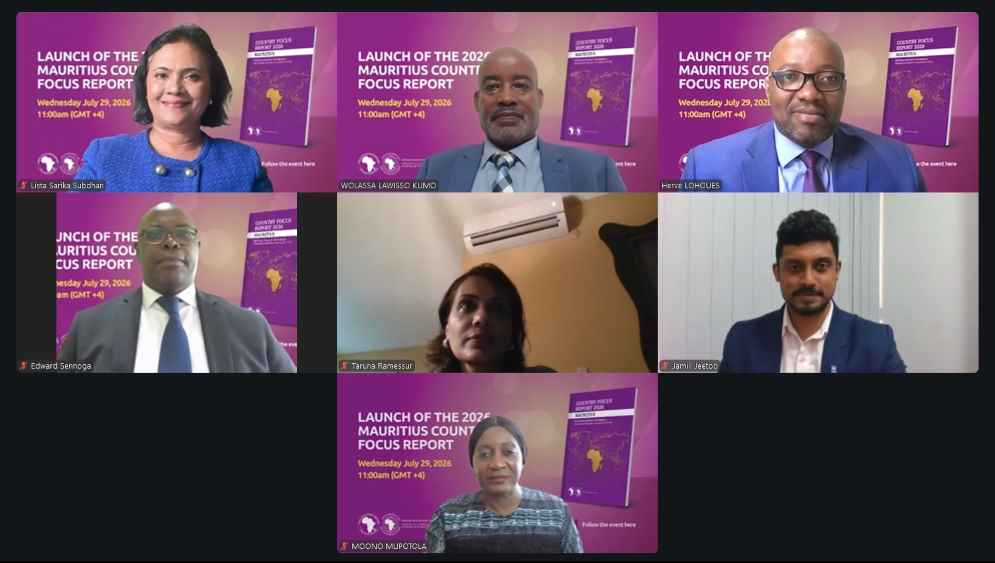
In her welcoming remarks, Moono Mupotola, the Bank’s Deputy Director General for Southern Africa and Country Manager for Mauritius, said the Country Focus Report and the Mauritius Productivity Study are more than analytical publications: together, they provide an evidence-based roadmap for strengthening Mauritius’ resilience, enhancing productivity, and mobilising the resources needed to achieve the country’s long-term development ambitions.

“The recommendations presented are a call for collective action. Real progress will require continued collaboration between the public and private sectors, development partners, academia, civil society, and financial institutions to translate these ideas into concrete reforms, investments, and lasting results. By building on its strong institutional foundations and embracing the reforms outlined in these studies, Mauritius is well positioned to strengthen its competitiveness and secure economic transformation,” Mupotola said.

The Bank also presented the key findings of the Mauritius Productivity Study, commissioned to inform the preparation of the Mauritius Vision 2050 and the Ten-Year National Development Plan. The study assesses the causes of productivity slowdown and challenges hindering deeper structural transformation, and how to boost digitalisation, Industry 4.0 adoption and competitiveness. It identifies emerging growth pillars, including the ocean economy, the digital and knowledge economy, the circular economy, and the creative and cultural industries.

The Mauritius CFR 2026 report (https://apo-opa.co/4woGEqE) was presented by Wolassa Kumo, African Development Bank’s Principal Country Economist for Mauritius. Taruna Ramessur, Consultant and Associate Professor at the University of Mauritius, presented the key findings of the Mauritius Productivity Study.

The virtual launch brought together senior officials from the Ministry of Finance, other government officials, development partners, private sector representatives, civil society, and senior officials from the Bank Group. They offered strategic insights on both reports.

Jamiil Jeetoo, UNDP National Economist for Mauritius and Seychelles, stressed that development finance should be assessed not only by the volume mobilised, but by the productivity and resilience it generates.


Distributed by APO Group on behalf of African Development Bank Group (AfDB).

Business

Mercuria Deepens African Critical Minerals Play Ahead of African Energy Week (AEW) 2026 Bronze Partnership

Published

on

Mercuria joins AEW 2026 as a Bronze Partner, showcasing its expanding investment strategy across Africa’s critical minerals, mining finance and energy sectors

CAPE TOWN, South Africa, August 12, 2026/APO Group/ –As commodity markets enter a new era defined by a rising demand for critical minerals, Mercuria Energy Group is rapidly expanding its global footprint through major acquisitions, strategic joint ventures and infrastructure investments. Against this backdrop, the company will participate as a Bronze Partner at African Energy Week (AEW) 2026, taking place in Cape Town from October 12–16, where it will engage African governments, national oil companies and industry leaders on the next generation of energy investment opportunities.

Mercuria’s latest expansion reflects a strategy centered on controlling physical assets alongside its global trading operations. In June 2026, the company signed a marketing agreement and inventory prepayment facility with Lotus Resources. The agreement will support the commercialization of approximately 1.3 million kg of uranium from Malawi’s Kayelekera Mine over 30 months, strengthening the country’s role in global nuclear fuel supply while demonstrating growing investor confidence in African mining assets.

The company is also deepening its presence in the Democratic Republic of Congo (DRC), one of the world’s most strategic critical mineral producers. In February, Mercuria completed its first purchases of responsibly sourced copper and cobalt from Enterprise Générale du Cobalt following a strategic agreement to strengthen traceability across artisanal mining supply chains. The partnership supports greater transparency while expanding international market access for Congolese minerals.

Access to innovative financing and global commodity markets will be essential to unlocking Africa’s full energy and mining potential

Mercuria continues to increase its financial commitment to Africa’s mining sector through large-scale prepayment financing that provides producers with development capital in exchange for long-term supply agreements. This approach is helping miners secure financing outside traditional banking channels while supporting new production across minerals essential to electrification, battery manufacturing and advanced technologies.

The company has also been linked to discussions surrounding the proposed development of Western critical mineral supply chains anchored by the DRC’s Kipushi Mine. By supporting financing structures for copper, zinc and other strategic minerals, Mercuria is reinforcing Africa’s role as a long-term supplier of resources required for global industrial growth and the energy transition.

These investments are supported by a significantly strengthened financial position. Mercuria reported an 88% increase in first-half 2026 profit and subsequently retained earnings to expand its equity base rather than distribute dividends. In June 2026, the company further enhanced its capacity to finance large-scale investments by securing a $3.84 billion multicurrency revolving credit facility, providing additional liquidity to support future projects, including across African markets.

“Access to innovative financing and global commodity markets will be essential to unlocking Africa’s full energy and mining potential,” says NJ Ayuk, Executive Chairman, African Energy Chamber. “Mercuria’s growing investment across African critical minerals and resource value chains makes the company a valuable addition to AEW 2026, where industry leaders will shape the partnerships needed to drive the continent’s next phase of growth.”

Mercuria’s participation at AEW 2026 comes as African producers seek greater access to capital, trading expertise and commercial partnerships capable of accelerating resource development. As countries pursue new investment across hydrocarbons, critical minerals and associated infrastructure, the company’s integrated approach to financing, marketing and commodity trading offers a relevant model for unlocking large-scale projects across the continent.

Distributed by APO Group on behalf of African Energy Chamber.

Continue Reading

Business

The dtic, Standard Bank, MTN & DHL Join Forces to Help African Small and Medium-sized Enterprises (SMEs) Compete and Grow Across Borders

Published

on

Multi-stakeholder partnerships to equip African businesses with the finance, digital capabilities, trade knowledge and logistics support needed to succeed in regional and global markets

Our ambition is not only to help SMEs trade more, but to help them grow sustainably, create jobs and unlock new opportunities across the continent

JOHANNESBURG, South Africa, August 12, 2026/APO Group/ –South Africa’s Department of Trade, Industry and Competition (the dtic), Standard Bank, MTN, and DHL (www.DHL.com) have announced a series of strategic partnerships aimed at helping SMEs across Sub-Saharan Africa scale their businesses, access new markets and participate more effectively in regional and global trade.


Launched under the banner of DHL’s GoTrade, this series of initiatives are aimed at helping African businesses overcome some of the most common barriers to growth, including limited access to finance, export readiness challenges, digital adoption gaps and market access constraints.

Since 2021, GoTrade has launched in more than 50 countries, supporting more than 24,000 SMEs globally, including more than 8,000 women-owned businesses. Across Sub-Saharan Africa specifically, more than 8,000 SMEs have participated in GoTrade programmes and capacity-building initiatives. DHL will be investing 300 million Euro on the African continent by 2030, as part of this investment the company will continue investing programs that extend participation in trade and support sustainable growth.

“Across Sub-Saharan Africa (SSA), SMEs represent more than 90% of businesses and provide approximately 70% of employment, making them one of the continent’s most important engines of economic opportunity and inclusive growth. Despite their significance, many of our entrepreneurs continue to face barriers related to financing, digital adoption, trade knowledge and market access, limiting their ability to participate fully in regional and global trade.

We are excited to work with our partners to create a collaborative ecosystem aimed at addressing these challenges through practical interventions that support businesses at every stage of their export journey,” said Hennie Heymans, CEO DHL Express SSA.

The partnerships announced bring together complementary expertise from government, financial services, telecommunications and international logistics to create a practical support ecosystem for businesses looking to grow through trade.

The partnership between the dtic and DHL supports the department’s broader objectives around industrialisation, export growth and emerging exporter development. The collaboration will focus on trade education, capacity-building programmes, business clinics, trade missions, corridor activation initiatives and increased awareness of key trade frameworks, including the African Continental Free Trade Area (AfCFTA) and other trade agreements that create new opportunities for African businesses.

“This partnership between the dtic and DHL demonstrates the power of collaboration in advancing trade and economic development,” said Acting Deputy Director-General Willem van der Spuy. “By working together with private-sector partners, we can provide businesses with practical support that enhances competitiveness, drives export participation and enables more emerging exporters (especially SMEs) to benefit from regional and global trade opportunities. Government’s role is to convene the right partners around a common framework, and this initiative reflects exactly that: the dtic setting the direction, with DHL and its partners Standard Bank and MTN strengthening delivery on the ground.”

Through its partnership with DHL, Standard Bank will bring its pan-African footprint, trade-finance expertise and cross-border trade ecosystem to help SMEs access new markets and participate more effectively in regional and global value chains. Standard Bank’s role in the partnership is to help SMEs translate export ambition into bankable, executable trade opportunities by combining finance, advisory support and access to trusted trade networks. In addition to banking and trade-finance solutions, the bank will connect businesses to its Export Readiness Programme, which provides entrepreneurs with the knowledge, advisory support and practical tools needed to compete internationally. First launched in KwaZulu-Natal in 2025, the programme has since expanded to Gauteng and the Western Cape.

Standard Bank’s strategic partnership with the Industrial and Commercial Bank of China (ICBC) also enables business matchmaking, trade linkages and market-access opportunities between African and Chinese businesses. In 2025, the bank connected clients from four African markets with Chinese importers across product categories including rooibos tea, coffee, cocoa, nuts and wine, helping to unlock meaningful new export opportunities for African businesses.  Standard Bank’s trade and payments capabilities also help SMEs navigate one of the most complex aspects of international expansion: moving money safely, efficiently and across borders. By combining banking infrastructure with trade expertise and partner networks, the bank is helping African businesses participate in global trade with greater confidence.

“Access to finance alone is not enough. SMEs also need access to buyers, markets, trade knowledge and trusted networks. Through our Export Readiness Programme, our international partnerships and our collaboration with DHL, Standard Bank is helping African businesses build the practical capabilities and connections they need to trade beyond their domestic markets. This partnership strengthens our ability to support SMEs across key trade corridors, including within Africa, and to help them grow with greater confidence,” says Bill Blackie, Chief Executive of Business & Commercial Banking at Standard Bank Group.

Through its collaboration with DHL, MTN will help SMEs digitise and grow their operations by providing digital skills training, access to connectivity and cloud solutions that enable secure data storage, team collaboration, remote working and business scalability, digital payment capabilities, online marketing support. The partnership will also provide SMEs with mentorship opportunities, and guidance on expanding into new markets through exporting.

“Digital transformation is a critical enabler of business growth and competitiveness,” said David Behr, MTN Group Chief Enterprise Business Officer. “By combining MTN’s reach and digital capabilities with DHL’s international trade expertise, we can help SMEs embrace technology, improve business performance and access new opportunities across Africa and beyond.”

Together, the partners aim to create a stronger pipeline of export-ready businesses equipped to compete in increasingly interconnected markets. The collaborative initiatives are expected to support entrepreneurship, job creation and economic inclusion across African markets.

“African SMEs have the ambition and innovation needed to compete globally, but they cannot do it alone. Success in international trade requires access to the right combination of knowledge, finance, technology, policy support and logistics capability. By bringing together the strengths of the public and private sectors, we are creating an ecosystem that will help more businesses become export-ready, connect to international markets and contribute meaningfully to Africa’s economic growth agenda. Our ambition is not only to help SMEs trade more, but to help them grow sustainably, create jobs and unlock new opportunities across the continent,” added Heymans.

Distributed by APO Group on behalf of DHL Express.


Continue Reading

Business

A New Category Is Emerging in the Premium Residential Market — the “Presidence”

Published

on

Experts say a self-contained, service-led residential format built for multigenerational ownership is emerging at the very top of the market — and that demand for it is rising worldwide.
Pitch Notes:
A new tier is forming at the very top of the residential market — the “presidence”: a self-contained, 200-hectare-plus community of private residences anchored by an international five-star hotel, built to be lived in and passed down across generations. With the number of individuals worth over US$30m up by 160,000 in five years and branded residential schemes growing 19% in 2025 alone, experts argue this format now warrants a category of its own — press release attached.

SINGAPORE – Media OutReach Newswire – 13 August 2026 – Experts in premium residential real estate note that a distinct new category is forming at the top of the market, and that demand for it is rising around the world. Property market specialists describe the emerging tier as the presidence: a self-contained community of private residences bound together by shared infrastructure and anchored by a five-star hotel under an international brand — a format designed to be lived in and passed down across generations, rather than simply owned.

The trend reflects a structural shift in global wealth. According to Knight Frank’s Wealth Report 2026, the number of individuals worth more than US$30 million climbed from 551,435 to 713,626 between 2021 and 2026 — a gain of more than 160,000, equivalent to 89 people crossing that threshold every day. Forbes, meanwhile, records 3,428 billionaires worth a combined US$20.1 trillion.

This wealth is also increasingly mobile. Henley & Partners projects that 165,000 high-net-worth individuals will relocate internationally in 2026 — a 16 per cent rise on the record 142,000 of 2025 — as affluent families build cross-border portfolios of homes and residence rights rather than tying themselves to a single jurisdiction. The appetite for professionally serviced, brand-anchored homes is visible in the development pipeline: Savills reports that the number of branded residential schemes worldwide grew 19 per cent in 2025, to around 910, and is on course to reach 1,747 by 2032, with the Middle East and North Africa the fastest-growing region over the past five years, at 187 per cent.

As the apex of the wealth pyramid rises, specialists say, demand at the very top is moving away from headline price-per-square-foot toward space, privacy, wellbeing, autonomy and a home that can be held and handed down across generations. The case for treating this as a distinct category was set out in a recent column by real estate adviser Ku Swee Yong, CEO of International Property Advisor Pte Ltd and an adjunct faculty member at Singapore Management University, where he teaches Real Estate Investments & Finance.”Luxury residence has a new crown, and it has a name: presidence,” he writes.

According to the expert, a property of this kind should meet several defining criteria: it should occupy an exceptional location among peer residences, be built to the highest standards of quality, provide space, a healthy natural environment, security and self-sufficiency, and create a place where owners and their families can live out every stage of life — building careers, raising children, enjoying leisure, prioritising health and wellbeing, welcoming family and friends, and ultimately passing the home down through generations. Privacy in this case does not mean isolation: rather than retreating behind their own gates, members of the presidence become part of a carefully formed community of peers, surrounded by people with comparable values, interests and ways of life.

These principles are, in practice, being formalised into a fuller set of criteria that distinguish a presidence from a conventional luxury development. At its most complete, the format is defined by:

A five-star hotel operated by an international brand present in at least three countries, located within the development;
A single estate of 200 hectares (around 500 acres) or more;
Full-spectrum infrastructure within one perimeter — indoor and outdoor sport, a central clubhouse, wellness, dining, parks and natural areas, a medical centre, recreation and security, plus a lifestyle anchor such as a golf, equestrian or yacht club;
A clear separation of public and private zones, with residences kept behind their own multi-layered security perimeter and isolated from guest-facing spaces such as the hotel, restaurants and spa;
A 24/7 premium service model featuring a dedicated resident care team, concierge services, standardised service-level agreements (SLAs), and a digital platform for managing every household and lifestyle need;
A unified architectural code governing the style and coherence of every building on the estate;
An equal-neighbour principle, under which a community of like-minded owners who can enjoy privacy while remaining part of an engaging social environment is formed.
Fully integrated examples remain rare worldwide, and demand, specialists say, is running ahead of supply as the number of ultra-wealthy households continues to grow.

Prosvet Communication Studio
Prosvet Communication Studio is a full-cycle communication studio working across PR and communications strategy, media relations and influence, personal branding, digital PR, events and production.

Continue Reading

Trending

Exit mobile version