Connect with us
Anglostratits

Business

Global consumer agentic AI spending will soar to $3.35trn in 2030
Published

on

Marketing
  • 3.8% of global consumer spending will be agent-facilitated in 2030, tripling from this year’s 1.3% equivalent to $944bn
  • Top ten global markets will account for two-thirds (67.9%) of the global consumer agentic AI spend in 2030
  • US share of global agentic AI spend in 2030 will reach 31.9%
  • Telecoms & utilities, financial services and travel & transport will lead agent-to-agent transactions

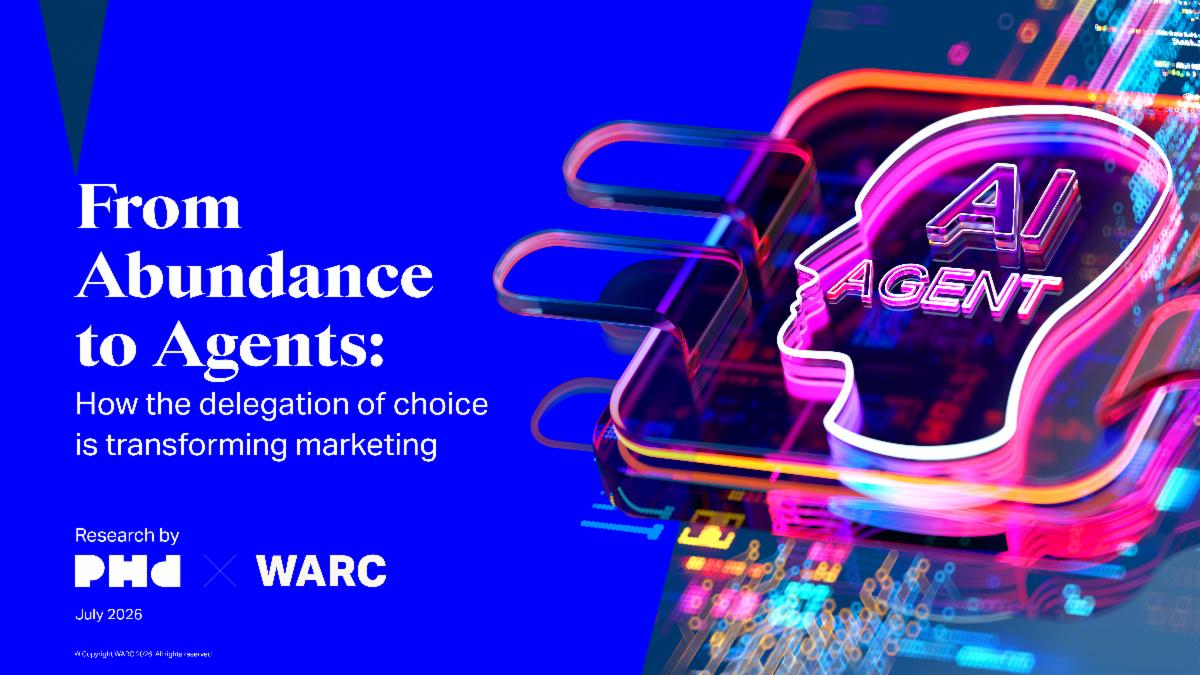
New WARC x PHD research: From abundance to agents – how the delegation of choice is transforming marketing. Introducing the Four Modes Framework

21 July 2026 – Marketing is operating in an age of abundance. Today’s consumers face more content and choices than they have the attention or means to manage. AI agents are emerging as fundamental tools to help consumers cut through the noise and make decisions faster. New research by PHD in partnership with WARC reveals how quickly they are reshaping the customer journey.

The study finds that total agent-facilitated consumer spending will triple from $944bn this year to $3.35trn in 2030. While consumers will still make most purchase decisions on their own in the next few years, AI agents will increasingly shape what gets seen, shortlisted and bought – and will increasingly mediate the boring, complex or repetitive tasks along the way.

As decision-making increasingly evolves from human consumers to machine intermediaries, this study explores the scale, timeline and implications for brands, agencies and the wider marketing ecosystem.


Rohan Tambyrajah, Worldwide Chief Strategy Officer, PHD, says: “This research brings category level empiricism to the open-ended industry conversation about the growth opportunity with consumer facing AI and Agentic AI. It underscores the need for brands to design for both meaning and machine logic, and through Four Modes Framework offers marketers practical guidance on how best to implement against a category-level business case.”

James McDonald, Director of Data, Intelligence & Forecasting, WARC, and author of the research, says: “This landmark study finds that agentic AI is already facilitating the path to purchase for many consumers, and will become deeply embedded over the coming years to influence $3.35trn in household expenditure by 2030.

“This is true not just in high-frequency categories such as travel, CPG, and utilities, but increasingly more so in sectors that have traditionally leveraged brand marketing as a core strategy. By mapping adoption across product sectors, markets and media, our research ensures practitioners are not caught flat-footed as they approach the new frontier.”

Methodology of the research

The research draws on data provided by Acxiom and uses a weighted index approach to evaluate key factors such as decision complexity, transaction value, purchase frequency, data availability, media mix, and market regulation to make a holistic assessment of how much consumers will spend on AI channels in 2026 and 2030. The analysis covers the global viewpoint of ten markets: Australia, Brazil, China, France, Germany, India, Mexico, South Korea, UK & US. Additionally, it includes industry expert views and category analysis.

Key findings from the research outlined in ‘From abundance to agents – how the delegation of choice is transforming marketing’ are:

Categories and markets leading on agentic AI consumer spend

Agentic AI – artificial intelligence systems that understand goals, plans steps, and act autonomously – are making their mark on high-frequency categories like travel & transport, food, and media & publishing. By 2030, AI-facilitated spending will surge across all industries, especially where purchases are frequent and data-rich.

The top three markets for agentic AI consumer spending in 2030 will be:

US: The US will lead agentic AI spending at $1.1trn (31.9% of the global total), driven by consumers already comfortable with digital commerce and brands with the resources to deploy agents at scale.

China: China will be the second-largest market at $505.8bn (15.1% of global spend), powered by high platform integration, government support, and consumers ready to embrace delegated commerce.

UK: The UK will capture 3.9% of global agentic AI spending ($131.2bn), driven by strong talent, major investments, and government backing for AI-led transformation.

How agentic AI will affect consumer spending: introducing The Four Modes Framework

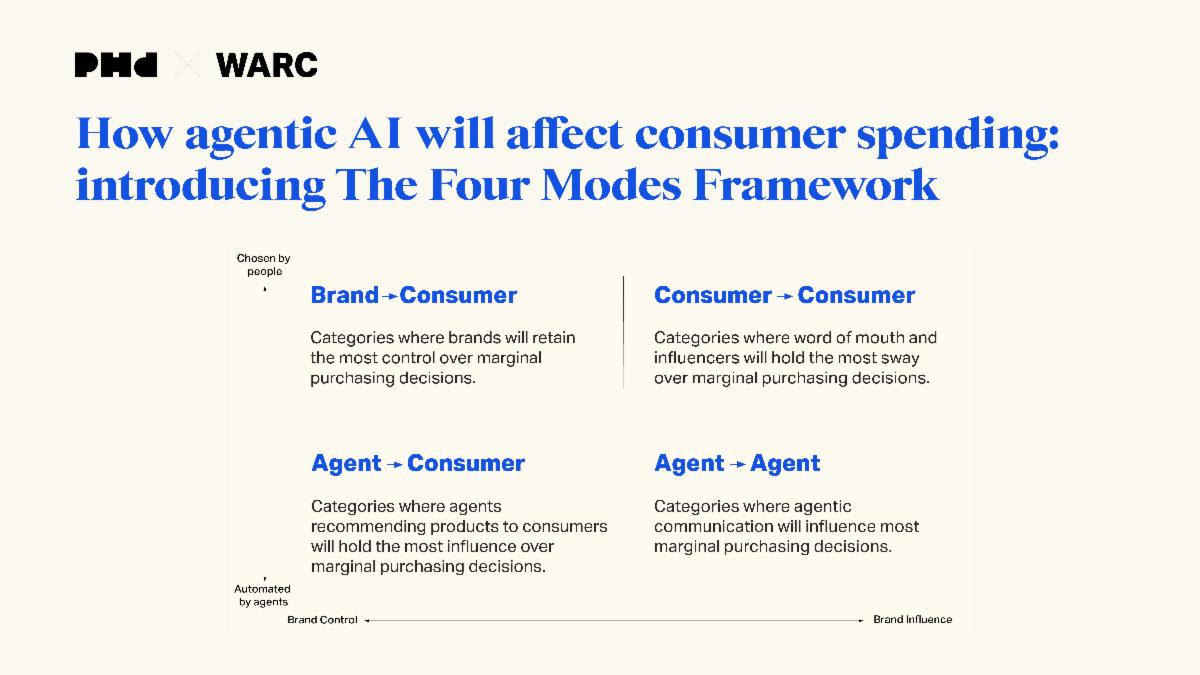
Agentic AI will not impact all industry categories evenly. PHD’s Four Modes Framework defines where marketing must evolve as brands extend focus to influencing machines. Each mode of marketing requires strategy, capability design and creativity—and all four will coexist, with their importance varying by category, purchase occasion and customer journey stage. The framework serves as a navigation tool to see the category impact of agentic AI on marginal purchasing decisions in 2026 and 2030, while recognising that brand advertising, salience, and equity remain fundamental to success.

Agent → Agent:

Agent adoption will surge where purchases are repetitive, searchable, and measurable—not necessarily high-volume or low-value, just routine enough for AI to own the entire journey.

The three industry categories where agentic AI will have the greatest impact are:

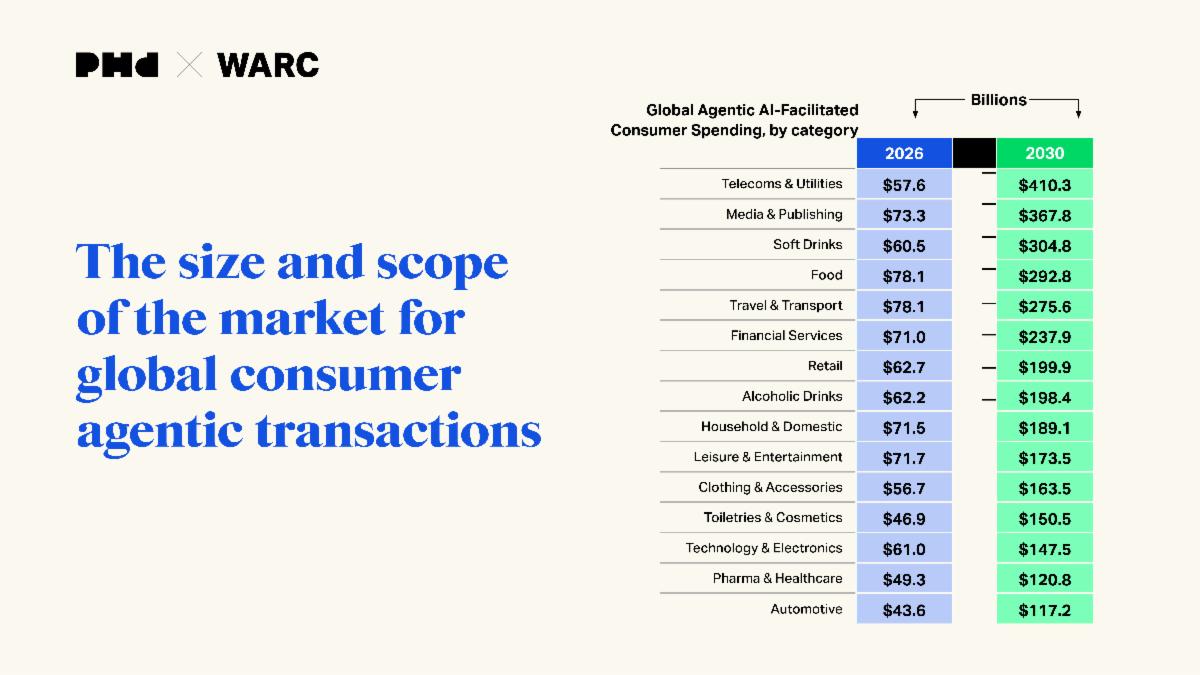
1. Telecoms & Utilities will grow 611.9% from $57.6bn in 2026 to $410.3bn by 2030 – making it the largest category for AI agents. Information-dense, frequent billing, and comparison-led contract switching make these infrequent but high-value purchases ideal for AI delegation.

2. Financial Services decisions are too sensitive to fully delegate, but too complex not to be agent-assisted. Total agent-facilitated consumer spending will increase 235.3% to $237.9bn by 2030.

3. Travel & Transport will lead agent-facilitated spending at $78.1bn in 2026, surging 252.8% to $275.6bn by 2030 as AI agents take control of discovery, planning, and booking.

Agent → Consumer:

1. Alcoholic Drinks: This category is habitual and identity-driven – brand loyalty still rules. AI agents will influence $62bn in spending in 2026, advising on party ideas, drink pairings, and occasions. By 2030, agentic spending will grow 219.0% to $198.4bn as agents dominate both replenishment and discovery.

Soft Drinks: Starting small at $60.5bn in agent-influenced spending in 2026, it will see massive growth of 403.5% to $304.8bn by 2030. Habit-driven, low-value replenishment is perfect for AI automation—optimising price, convenience, and repeat purchasing.

2. Food: This category is primed for early use of agentic AI thanks to is high frequency, low decision complexity. Agents will influence $78.1bn globally in 2026, surging 274.8% to $292.8bn by 2030.

3. Media & Publishing: At $73.3bn, this category is already one of the most impacted by agentic AI. Subscriptions, recommendations, and content consumption are digitally native and measurable. By 2030, agentic AI spending will increase 401.8% to $367.8bn.

4. Retail: will see agent-facilitated spending grow 218.7%—from $62.7bn in 2026 to $199.9bn in 2030 driven by omnichannel shopping and AI comparison. The challenge for retailers will be to remain part of the consumer shopping journey, not just a fulfillment provider.

Brand → Consumer

High-value, infrequent purchases such as automobiles, electronics, and categories with privacy constraints such as pharma & healthcare, leave less room for agentic AI transaction. Trust is important as consumers must feel confident before delegating expensive or privacy-sensitive decisions.

Consumer → Consumer

Categories such as toiletries & cosmetics, clothing & accessories are heavily influenced by word of mouth and creators and are less affected by agentic AI than others. The impact may be smaller, but it won’t be completely absent.

The brand imperative

Brands must learn new skills to successfully market to machines. The shift to agentic AI will require marketers to have:

  • A strong foundation of structured, machine-readable data
  • Distinctive and differentiated brand assets
  • A unified brand story that resonates with both humans and AI interfaces

‘From abundance to agents – how the delegation of choice is transforming marketing’ report is available to read in full here.


Business

SLB commissions new fluids systems plant in Pemba to support Mozambique’s offshore energy development

Published

on

Mozambique

New facility expands in-country drilling and completion fluids capability, advancing the next phase of SLB’s growth in Mozambique

PEMBA, Mozambique, October 9, 2026/APO Group/ –SLB (NYSE: SLB) (www.SLB.com) announced the opening of a new fluids systems plant in Pemba, Mozambique. The new facility strengthens in-country capacity to prepare, store and deliver drilling and completion fluids for offshore operations, reinforcing the infrastructure needed as Mozambique’s offshore activity grows and its role as a strategic energy hub for East Africa continues to expand.

The commissioning of the plant, also known as a liquid mud plant, coincides with SLB marking 70 years of operations in Mozambique. It reflects the company’s long-term commitment to investing in people, infrastructure and capability that support the country’s long-term offshore energy development plans.


With an initial storage capacity of 21,000 barrels, the liquid mud plant provides a scalable platform for future growth, supporting multiple customers and rising offshore activity while improving logistics and enhancing operational flexibility.

As SLB marks 70 years in Mozambique, this investment reflects our confidence in the country’s future and our commitment to supporting its energy ambitions

“As SLB marks 70 years in Mozambique, this investment reflects our confidence in the country’s future and our commitment to supporting its energy ambitions,” said Miguel Baptista, Central, East and Southern Africa, Managing Director, SLB. The new liquid mud plant strengthens local energy infrastructure, expands opportunities for local content development, and enhances our ability to support customers as they deliver some of Africa’s most significant offshore energy resources.”

The liquid mud plant project was delivered with strong local participation and that momentum is expected to continue into operations. During project delivery, more than 100 jobs were created in Pemba with nationals representing 80% of the workforce, reflecting a focus on building local capability.

The project was delivered with a strong focus on safety, operational integrity, and quality, achieving more than 67,000 hours worked without a recordable safety incident.

This key infrastructure strengthens SLB’s ability to support consistent service quality and enhance supply chain readiness for increasing offshore activity across Mozambique, supporting customers execute safely and efficiently while developing local skills and expertise.

Key Points:

  • SLB has commissioned a new fluids system plant in Pemba, expanding in-country drilling and completion fluids capability for offshore operations.
  • With an initial storage capacity of 21,000 barrels, the facility provides a scalable platform to support growing offshore activity in Mozambique.
  • The investment marks the next phase of SLB’s growth in Mozambique, strengthening local capability and supporting long-term offshore energy development.

Distributed by APO Group on behalf of SLB.


Continue Reading

Business

South African Energy Storage Association (SAESA) welcomes 4,600 MW battery storage prioritisation and calls for integrated energy planning

Published

on

Battery energy storage systems (BESS) are becoming critical system infrastructure, supporting flexibility, reducing avoidable curtailment, shifting energy into periods of demand and strengthening security of supply

JOHANNESBURG, South Africa, October 9, 2026/APO Group/ –The South African Energy Storage Association (SAESA) (www.SAESA.org.za) welcomes the prioritisation of 4,600 MW of battery energy storage under the first Integrated Resource Plan (IRP) 2025 Section 34 determination.


The timing is significant. Recent Integrated Energy Plan (IEP) modelling and assumptions discussions highlighted a fundamental shift that South Africa’s energy planning now needs to capture: we cannot plan the future power system by counting megawatts of generation alone.

We must plan for when energy is available, where it is available, how it moves through a constrained grid and how it is stored and dispatched when the system needs it most.

The announcement reinforces that shift. Battery energy storage systems (BESS) are becoming critical system infrastructure, supporting flexibility, reducing avoidable curtailment, shifting energy into periods of demand and strengthening security of supply.

For SAESA, the message for the IEP is clear: storage, flexibility and system services must be modelled as integral components of South Africa’s future electricity architecture, with their contribution considered from the outset of generation planning.

“The IEP must plan the power system we are becoming, not simply model the power system we have inherited,” says SAESA.

The IEP must plan the power system we are becoming, not simply model the power system we have inherited

Partnership with C&I Energy + Storage Summit

SAESA is an association partner of the C&I Energy + Storage Summit, created by VUKA Group, taking place on 28–29 October 2026 at The Maslow Hotel, Sandton, Johannesburg.

The summit brings together commercial and industrial energy users, project developers, financiers, regulators and solution providers to explore practical approaches to energy security, procurement and storage deployment.

For businesses assessing how storage can support their operations, the event offers an opportunity to meet SAESA and engage with the wider energy community on the decisions shaping South Africa’s evolving electricity system.

Commercial and industrial energy decision-makers are invited to apply to attend as hosted buyers. Qualifying buyers receive complimentary summit access and curated opportunities to engage with industry partners.


Meet SAESA at C&I Energy + Storage Summit: Join the Hosted Buyer Programme

The Hosted Buyer Programme connects commercial and industrial energy decision-makers with solution providers shaping South Africa’s evolving private energy market.

Qualified energy buyers receive complimentary access to the summit and curated engagement with industry partners exploring energy procurement, storage deployment and project development.

Apply for the Hosted Buyer Programme (https://apo-opa.co/4ehLijJ)

Distributed by APO Group on behalf of VUKA Group.


Continue Reading

Business

Afreximbank welcomes launch of Africa Credit Rating Agency as an important step in strengthening Africa’s financial architecture

Published

on

Expanding credible rating coverage can improve the information available to investors and support the development of deeper domestic and regional capital markets

PORT LOUIS, Mauritius, October 8, 2026/APO Group/ –African Export-Import Bank (Afreximbank) (www.Afreximbank.com) welcomes today’s launch of the Africa Credit Rating Agency (AfCRA), an important milestone in strengthening Africa’s financial architecture and expanding the continent’s capacity to generate credible, independent analysis of African credit risk.


Credit ratings play an important role in determining access to capital, influencing investor perceptions and shaping the cost at which governments, institutions and businesses can finance development. It is therefore essential that assessments of African credit risk are independent, rigorous and evidence-based, while reflecting a complete understanding of the structures, institutions and economic realities being assessed.

The establishment of AfCRA adds an important African-led source of credit opinion to the market. Its value will not be measured by whether it produces more favourable ratings, but by the credibility of its analysis, the quality of its data and transparency of its methodology, and its ability to deepen understanding of African sovereigns, sub-sovereigns and corporate credit.

This is particularly important given that many African issuers remain unrated, while local-currency and sub-sovereign markets continue to have limited rating coverage. Expanding credible rating coverage can improve the information available to investors and support the development of deeper domestic and regional capital markets.

AfCRA must set a new benchmark for the continent, maintain its independence, and remain wholly owned and controlled by Africans

Alongside fellow members of the Alliance of African Multilateral Financial Institutions (AAMFI), Afreximbank has consistently maintained that African Multilateral Financial Institutions should be assessed on the basis of their fundamentals, performance, legal frameworks, mandates and operating models. Ensuring that these institutional characteristics are properly understood is essential to achieving informed, balanced and credible assessments of African risk.

Commenting on the uniqueness of the African market, and need for AfCRA’s rating methodology to reflect this, Mr Denys Denya, Senior Executive Vice President, Afreximbank, said: “The rating methodology AfCRA develops must recognise the uniqueness of our environment and its institutional structures. The Agency must set its own standards and not follow those set elsewhere — it must build a unique identity that conforms to an ‘African best practice.”

Highlighting the need for the autonomy of the Africa Credit Rating agency as it takes off, Mr Denya added: “Most importantly, AfCRA must set a new benchmark for the continent, maintain its independence, and remain wholly owned and controlled by Africans. We must all use it, and in return expect a complete assessment of where we (Africa) stand: the strengths the market has ignored, and the weaknesses we still need to fix.”

AfCRA should therefore be seen as complementary to existing international and regional rating agencies, broadening the range of credible analysis available to investors and issuers while strengthening competition, transparency and analytical capacity within Africa’s credit markets.

As Africa seeks to mobilise the scale of capital required for industrialisation, trade, infrastructure and economic transformation, credible African institutions that improve information, strengthen market confidence and deepen the continent’s financial markets will become increasingly important.

Afreximbank congratulates the African Union, the African Peer Review Mechanism (APRM) and all those involved in bringing AfCRA from concept to launch, and looks forward to the contribution the Agency will make to deeper, more transparent and more efficient African capital markets.

Distributed by APO Group on behalf of Afreximbank.


Continue Reading

Trending