Connect with us

Business

Global consumer agentic AI spending will soar to $3.35trn in 2030

Published

on

Marketing
  • 3.8% of global consumer spending will be agent-facilitated in 2030, tripling from this year’s 1.3% equivalent to $944bn
  • Top ten global markets will account for two-thirds (67.9%) of the global consumer agentic AI spend in 2030
  • US share of global agentic AI spend in 2030 will reach 31.9%
  • Telecoms & utilities, financial services and travel & transport will lead agent-to-agent transactions

New WARC x PHD research: From abundance to agents – how the delegation of choice is transforming marketing. Introducing the Four Modes Framework

21 July 2026 – Marketing is operating in an age of abundance. Today’s consumers face more content and choices than they have the attention or means to manage. AI agents are emerging as fundamental tools to help consumers cut through the noise and make decisions faster. New research by PHD in partnership with WARC reveals how quickly they are reshaping the customer journey.

The study finds that total agent-facilitated consumer spending will triple from $944bn this year to $3.35trn in 2030. While consumers will still make most purchase decisions on their own in the next few years, AI agents will increasingly shape what gets seen, shortlisted and bought – and will increasingly mediate the boring, complex or repetitive tasks along the way.

As decision-making increasingly evolves from human consumers to machine intermediaries, this study explores the scale, timeline and implications for brands, agencies and the wider marketing ecosystem.


Rohan Tambyrajah, Worldwide Chief Strategy Officer, PHD, says: “This research brings category level empiricism to the open-ended industry conversation about the growth opportunity with consumer facing AI and Agentic AI. It underscores the need for brands to design for both meaning and machine logic, and through Four Modes Framework offers marketers practical guidance on how best to implement against a category-level business case.”

James McDonald, Director of Data, Intelligence & Forecasting, WARC, and author of the research, says: “This landmark study finds that agentic AI is already facilitating the path to purchase for many consumers, and will become deeply embedded over the coming years to influence $3.35trn in household expenditure by 2030.

“This is true not just in high-frequency categories such as travel, CPG, and utilities, but increasingly more so in sectors that have traditionally leveraged brand marketing as a core strategy. By mapping adoption across product sectors, markets and media, our research ensures practitioners are not caught flat-footed as they approach the new frontier.”

Methodology of the research

The research draws on data provided by Acxiom and uses a weighted index approach to evaluate key factors such as decision complexity, transaction value, purchase frequency, data availability, media mix, and market regulation to make a holistic assessment of how much consumers will spend on AI channels in 2026 and 2030. The analysis covers the global viewpoint of ten markets: Australia, Brazil, China, France, Germany, India, Mexico, South Korea, UK & US. Additionally, it includes industry expert views and category analysis.

Key findings from the research outlined in ‘From abundance to agents – how the delegation of choice is transforming marketing’ are:

Categories and markets leading on agentic AI consumer spend

Agentic AI – artificial intelligence systems that understand goals, plans steps, and act autonomously – are making their mark on high-frequency categories like travel & transport, food, and media & publishing. By 2030, AI-facilitated spending will surge across all industries, especially where purchases are frequent and data-rich.

The top three markets for agentic AI consumer spending in 2030 will be:

US: The US will lead agentic AI spending at $1.1trn (31.9% of the global total), driven by consumers already comfortable with digital commerce and brands with the resources to deploy agents at scale.

China: China will be the second-largest market at $505.8bn (15.1% of global spend), powered by high platform integration, government support, and consumers ready to embrace delegated commerce.

UK: The UK will capture 3.9% of global agentic AI spending ($131.2bn), driven by strong talent, major investments, and government backing for AI-led transformation.

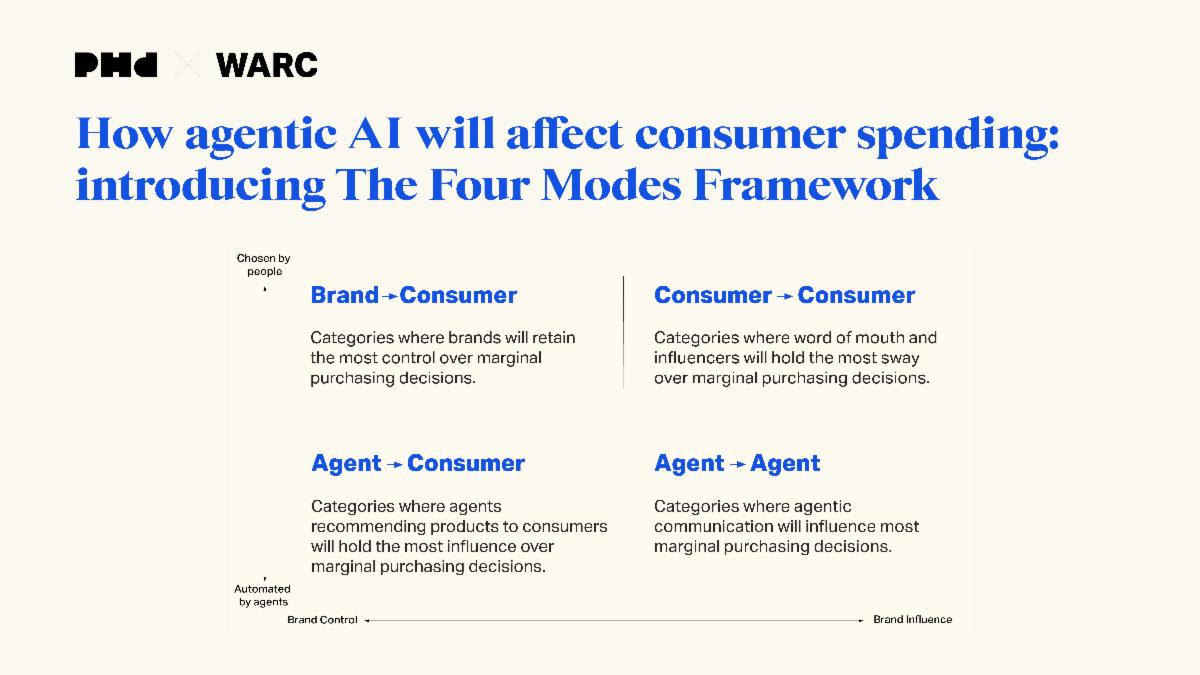
How agentic AI will affect consumer spending: introducing The Four Modes Framework

Agentic AI will not impact all industry categories evenly. PHD’s Four Modes Framework defines where marketing must evolve as brands extend focus to influencing machines. Each mode of marketing requires strategy, capability design and creativity—and all four will coexist, with their importance varying by category, purchase occasion and customer journey stage. The framework serves as a navigation tool to see the category impact of agentic AI on marginal purchasing decisions in 2026 and 2030, while recognising that brand advertising, salience, and equity remain fundamental to success.

Agent → Agent:

Agent adoption will surge where purchases are repetitive, searchable, and measurable—not necessarily high-volume or low-value, just routine enough for AI to own the entire journey.

The three industry categories where agentic AI will have the greatest impact are:

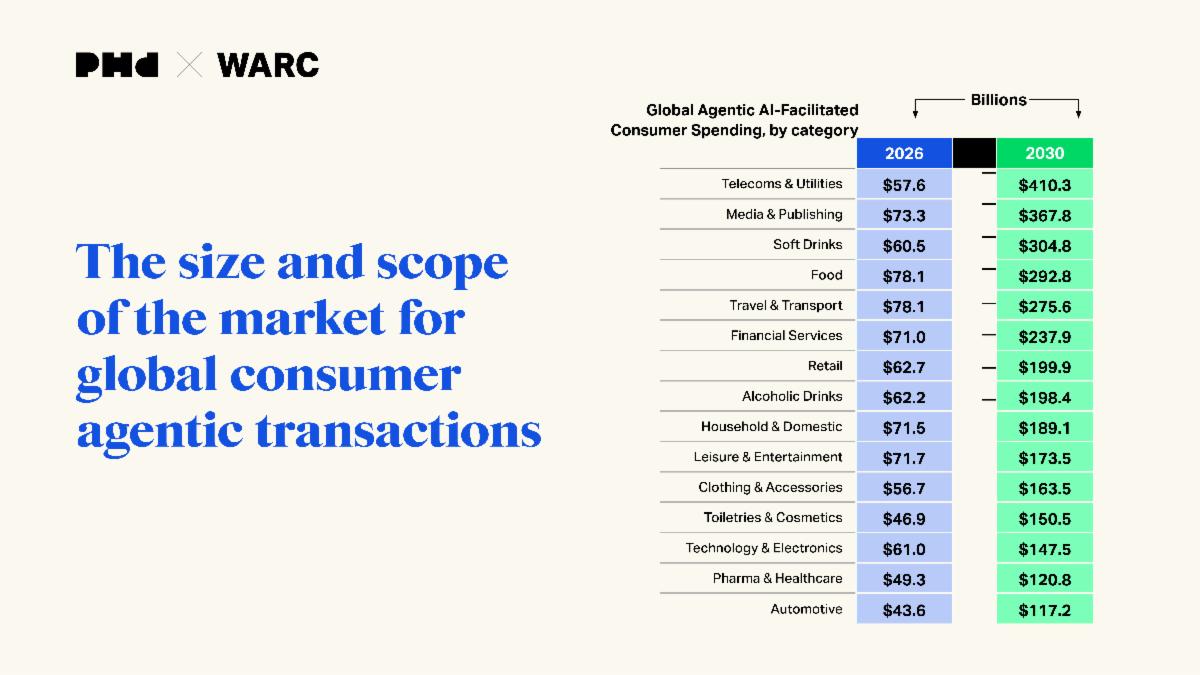
1. Telecoms & Utilities will grow 611.9% from $57.6bn in 2026 to $410.3bn by 2030 – making it the largest category for AI agents. Information-dense, frequent billing, and comparison-led contract switching make these infrequent but high-value purchases ideal for AI delegation.

2. Financial Services decisions are too sensitive to fully delegate, but too complex not to be agent-assisted. Total agent-facilitated consumer spending will increase 235.3% to $237.9bn by 2030.

3. Travel & Transport will lead agent-facilitated spending at $78.1bn in 2026, surging 252.8% to $275.6bn by 2030 as AI agents take control of discovery, planning, and booking.

Agent → Consumer:

1. Alcoholic Drinks: This category is habitual and identity-driven – brand loyalty still rules. AI agents will influence $62bn in spending in 2026, advising on party ideas, drink pairings, and occasions. By 2030, agentic spending will grow 219.0% to $198.4bn as agents dominate both replenishment and discovery.

Soft Drinks: Starting small at $60.5bn in agent-influenced spending in 2026, it will see massive growth of 403.5% to $304.8bn by 2030. Habit-driven, low-value replenishment is perfect for AI automation—optimising price, convenience, and repeat purchasing.

2. Food: This category is primed for early use of agentic AI thanks to is high frequency, low decision complexity. Agents will influence $78.1bn globally in 2026, surging 274.8% to $292.8bn by 2030.

3. Media & Publishing: At $73.3bn, this category is already one of the most impacted by agentic AI. Subscriptions, recommendations, and content consumption are digitally native and measurable. By 2030, agentic AI spending will increase 401.8% to $367.8bn.

4. Retail: will see agent-facilitated spending grow 218.7%—from $62.7bn in 2026 to $199.9bn in 2030 driven by omnichannel shopping and AI comparison. The challenge for retailers will be to remain part of the consumer shopping journey, not just a fulfillment provider.

Brand → Consumer

High-value, infrequent purchases such as automobiles, electronics, and categories with privacy constraints such as pharma & healthcare, leave less room for agentic AI transaction. Trust is important as consumers must feel confident before delegating expensive or privacy-sensitive decisions.

Consumer → Consumer

Categories such as toiletries & cosmetics, clothing & accessories are heavily influenced by word of mouth and creators and are less affected by agentic AI than others. The impact may be smaller, but it won’t be completely absent.

The brand imperative

Brands must learn new skills to successfully market to machines. The shift to agentic AI will require marketers to have:

  • A strong foundation of structured, machine-readable data
  • Distinctive and differentiated brand assets
  • A unified brand story that resonates with both humans and AI interfaces

‘From abundance to agents – how the delegation of choice is transforming marketing’ report is available to read in full here.


Business

Africa’s first full-stack hydrogen hub powers up in Namibia

Published

on

The CMB.TECH Namibia facility in Walvis Bay brings together solar power generation, green hydrogen production, and energy storage in a single operational ecosystem

CAPE TOWN, South Africa, August 24, 2026/APO Group/ –Namibia is demonstrating what is possible in Africa’s energy transition with the continent’s first fully integrated green hydrogen facility.


The CMB.TECH Namibia facility in Walvis Bay brings together solar power generation, green hydrogen production, and energy storage in a single operational ecosystem, demonstrating how clean energy can be produced at industrial scale while supporting industrial decarbonisation and long-term energy resilience.


This landmark project marks a key step in sustainable energy infrastructure. It integrates solar power generation, green hydrogen production, and energy storage within one ecosystem. This shows how clean energy can be produced at scale to support industrial decarbonisation and long-term energy resilience.

“Africa’s first fully integrated green hydrogen facility demonstrates that large-scale clean energy production is not a future ambition, but a present-day reality. Operating successfully in one of the world’s most demanding environments, it showcases the viability of green hydrogen as a cornerstone of the continent’s energy transition,” Sabine Dall’Omo, CEO, Siemens Sub-Saharan Africa, tells ESI Africa (https://apo-opa.co/4d0HFy3), part of VUKA Group.

Hydrogen for local industrialisation in Namibia

The hydrogen produced at CMB.TECH will initially power local industrial applications, like dual-fuel trucks, generators and Namibia’s first hydrogen-powered freight locomotive. In the future, the plant will expand and integrate more with port infrastructure, transforming maritime decarbonisation by refuelling ships with ammonia from green hydrogen.

This will boost Namibia’s renewable energy use and reduce dependence on fossil fuels, especially in the hard-to-decarbonise shipping sector.

As the technology partner underpinning the operation, Siemens provides the integrated electrical, automation and safety infrastructure that enables seamless coordination across the site, creating a high-availability platform that supports the future of green industrial development.

Namibia is one of the sunniest countries in the world, with about 300 sunny days a year, and solar power can be harnessed in abundance. In Walvis Bay, that solar power drives an electrolyser that splits water into hydrogen and oxygen. To produce marine fuel, the hydrogen will be combined with nitrogen from the air to create ammonia, which is then liquefied.

Africa’s first fully integrated green hydrogen facility demonstrates that large-scale clean energy production is not a future ambition, but a present-day reality

“In a region where reliable energy is essential for economic growth and social development, what matters most is a system that simply works,” says Dall’Omo. “The CMB.TECH plant can only deliver on its promise if all technologies operate seamlessly as one. That is where Siemens makes the decisive difference. Working as a ONE tech company and serving as the unified interface for automation, control, and power distribution, we ensure the facility runs reliably from day one.

“Our long presence in the region, deep understanding of local conditions, and close collaboration across our businesses help reduce complexity, solve issues quickly, and keep operations stable. In short, we bring the entire system to life, enabling the plant to become a dependable, future-shaping asset for the customer and the wider community.”

Integrated hydrogen economy

CMB.TECH is a “Living Lab” for an integrated hydrogen economy. “The facility includes a solar-powered off-grid electrolyser for renewable hydrogen production, a refuelling station for hydrogen-powered vehicles and industrial applications, and an on-site Hydrogen Academy for local talent development,” says Roy Campe, Chief Technology Officer at CMB.TECH.

The plant’s 5MWp solar park covers 6.5 hectares and feeds a hydrogen production facility with a 5MW Proton Exchange Membrane electrolyser and a 5.9MWh battery. The fully off-grid electrolyser produces green hydrogen using electricity from the solar park and energy stored in the Battery Energy Storage System (BESS).

CMB.TECH built the facility and is using the green hydrogen for its local industrial applications, making the company its own first customer and ensuring a guaranteed buyer from day one. “Many green hydrogen projects are stalling because, while they invest heavily in solar energy and green hydrogen production, there is often no commercial offtake agreement in place to secure demand for the hydrogen produced,” says Dall’Omo.

“Beyond its role as an energy production facility, the project illustrates how green hydrogen can accelerate the decarbonisation of transport and logistics value chains. From supporting local mobility solutions to enabling future maritime refuelling infrastructure, it provides a tangible pathway toward lower-carbon industrial and shipping ecosystems,” says Wiebke Polomka, Senior Manager: Southern Africa, Afrika-Verein der deutschen Wirtschaft.

Hydrogen Academy in Namibia

In addition to ecological and economic effects, knowledge transfer is central. The Hydrogen Academy on site trains drivers, technicians, and scientists and strengthens the labour market. Today, 24 of the facility’s 25 employees are Namibian and received training through the Hydrogen Academy.

“By partnering with local universities and institutions like the Namibia Institute for Mining Technology, the project is training a new generation of engineers and technicians. This creates a sustainable pipeline of local expertise, positioning Namibia as an exporter of not just green molecules, but also the technical knowledge required to operate and maintain a hydrogen economy,” says Johannes Shimbilinga, Municipal Mayor of Walvis Bay.

The plant also provides a model for collaborative energy transformation. “The project underscores the importance of ecosystem-led execution in delivering complex energy transitions,” Dall’Omo concludes. “By bringing together developers, systems integrators, technology partners, and cross-border industry stakeholders, it demonstrates how strategic collaboration can unlock sustainable industrial growth and long-term economic resilience.”

The current 5MWp solar park occupies only a fraction of the available land. “The next step is to increase capacity to 250MW, then to 500,” says Campe. “We want to turn Namibia into a global energy hub and export energy to Europe and the rest of the world. Today we have 7,000 solar panels. In the future, there could be millions.”

Distributed by APO Group on behalf of VUKA Group.


Continue Reading

Business

Africa Finance Corporation launches Infrastructure Climate-Resilient Fund Nigeria to mobilise domestic institutional capital

Published

on

ICRF Nigeria forms part of ACP’s US$750 million Infrastructure Climate-Resilient Fund (ICRF), a pioneering vehicle designed to strengthen the resilience of Africa’s infrastructure

LAGOS, Nigeria, August 24, 2026/APO Group/ –AFC Capital Partners (ACP), the asset management subsidiary of Africa Finance Corporation (AFC) (www.AfricaFC.org), has launched the Infrastructure Climate-Resilient Fund Nigeria (ICRF Nigeria) as a dedicated platform to mobilise domestic institutional capital for investment in climate-resilient infrastructure projects across Nigeria and the wider African continent.


Registered with the Securities and Exchange Commission (SEC) as a closed-end fund, ICRF Nigeria is designed to channel capital from pension fund administrators (PFAs), insurers, asset managers and other Nigerian institutional investors towards a diversified portfolio of commercially viable high-impact infrastructure opportunities.

ICRF Nigeria forms part of ACP’s US$750 million Infrastructure Climate-Resilient Fund (ICRF), a pioneering vehicle designed to strengthen the resilience of Africa’s infrastructure by embedding climate considerations throughout the asset lifecycle—from planning and design to construction and operation. The Fund addresses a critical challenge for the continent: ensuring that the infrastructure underpinning Africa’s growth can withstand increasingly severe and unpredictable climate impacts.

ICRF has attracted participation from leading global and African institutional investors, including a US$253 million first-loss commitment from the Green Climate Fund (GCF)—its largest equity investment in Africa to date—alongside the European Investment Bank (EIB), Development Bank of Southern Africa (DBSA), Cassa Depositi e Prestiti (CDP), the Nigeria Sovereign Investment Authority (NSIA), and several African pension funds. ACP expects to mobilise up to US$3.7 billion in total financing through ICRF and build a diversified portfolio of 10 to 12 infrastructure projects across Africa.

Samaila Zubairu, AFC’s President and CEO, commented: “Africa is not short of capital. The continent holds more than US$4 trillion in domestic resources, including significant pools of long-term capital in pensions, insurance and sovereign wealth funds. Yet too much of this wealth remains invested in low-risk, short-term instruments rather than being channeled into productive sectors such as infrastructure, industry and innovation.

ICRF Nigeria gives Nigerian institutional investors a dedicated route into high-quality, climate-resilient infrastructure investments across Nigeria and Africa

“The opportunity before us is to create investment vehicles that connect Africa’s long-term savings with its long-term development needs. ICRF Nigeria is an important step in that direction, enabling Nigerian institutional capital to participate in the infrastructure that will drive more resilient and sustainable growth across Nigeria and the continent.”

Ayaan Adam, CEO of ACP, said: “ICRF Nigeria gives Nigerian institutional investors a dedicated route into high-quality, climate-resilient infrastructure investments across Nigeria and Africa. By combining institutional capital with AFC’s infrastructure expertise and the catalytic power of blended finance, we can address both the financing needs of critical infrastructure and the growing risks posed by climate change.

“Importantly, this creates an avenue for Nigeria’s long-term savings to contribute to infrastructure development while giving investors access to a diversified portfolio of opportunities across the continent.”


ICRF combines concessional and commercial capital to overcome barriers that have historically constrained investment in climate adaptation across Africa. Through blended finance and targeted de-risking mechanisms, the Fund integrates climate resilience into infrastructure from the outset, helping to unlock private capital for investment in projects that might otherwise be difficult to finance.


The Fund’s target sectors are critical to Africa’s economic transformation, including renewable energy, transport and logistics, digital infrastructure and industrial development. Its investment approach considers both physical and transition climate risks, including exposure to extreme weather, emissions pathways and climate governance. Each investment undergoes climate risk screening and assessment to embed resilience throughout the infrastructure lifecycle.

The Green Climate Fund plays a catalytic role through its provision of first-loss capital and technical assistance for climate risk assessment and monitoring, helping to de-risk investments and crowd in additional institutional capital.

Distributed by APO Group on behalf of Africa Finance Corporation (AFC).


Continue Reading

Business

Dentons, Clifford Chance to Spotlight Legal Pathways to Mining Investment at African Mining Week (AMW) 2026

Published

on

Senior legal experts will explore how regulatory certainty, financing structures and strategic partnerships can help move Africa’s mineral projects from investment opportunity to production

CAPE TOWN, South Africa, August 25, 2026/APO Group/ –Africa’s mining sector is entering a new investment cycle, driven by growing demand for critical minerals, efforts to expand domestic processing and a push to develop the infrastructure needed to move projects from discovery to production. As governments revise mining codes and seek greater local value creation, the legal and regulatory frameworks underpinning these projects are becoming increasingly important to investors.


That dynamic will be explored at African Mining Week (AMW) 2026, taking place in Cape Town from October 14–16, where legal and advisory specialists will join industry leaders to examine how regulatory frameworks, financing structures and strategic partnerships can accelerate mineral development.

As part of the “Accelerating Mineral Production: The Energy, Water & Waste Nexus” panel, Iyunola Adekanye, Partner at Dentons, and Ope Osinubi, Senior Associate at Clifford Chance, are expected to discuss the legal and policy considerations shaping investment across Africa’s mining value chain. The session comes as mining companies and governments increasingly look beyond resource development itself to address the energy, water and infrastructure constraints that can determine whether projects reach production.

Dentons has been expanding its mining and natural resources capabilities as activity grows across Africa’s critical minerals sector. In June 2026, the firm opened a new office in Kolwezi, the mining hub of the DRC, strengthening its presence in one of the continent’s most important copper and cobalt markets. The move gives the firm a closer base from which to support mining companies and investors navigating the DRC’s regulatory environment, transactions and project development.

The expansion comes as the DRC seeks to attract greater investment into exploration, mining and downstream processing while increasing the domestic value captured from its mineral resources. Dentons’ wider African mining practice spans 17 countries and provides legal support across mining transactions, regulatory matters, project development and investment, reflecting the increasingly cross-border nature of Africa’s mineral supply chains.

Clifford Chance, meanwhile, advises mining companies, financiers and strategic investors on transactions spanning project finance, acquisitions, infrastructure and resource development. Its work across Africa includes advising financial institutions such as Deutsche Bank, the African Development Bank, Banque Ouest Africaine de Développement, Standard Bank and Stanbic IBTC Bank on financing transactions supporting infrastructure and resource-sector development.

The firm has also advised on major energy and mining-related financings, including a $250 million financing for Aradel Energy in Nigeria, highlighting the growing intersection between resource development, energy infrastructure and access to capital.

At AMW 2026, Adekanye and Osinubi will examine how stronger regulatory frameworks and well-structured partnerships can help reduce investment risk, mobilize capital and address the infrastructure gaps holding back mineral production.

As Africa seeks to move further up the mineral value chain, the ability to align government policy, investor protections, financing structures and infrastructure development will be critical. The discussion at AMW 2026 will highlight the legal architecture behind that investment push – and the role advisors can play in turning ambitious mining strategies into bankable projects.

Distributed by APO Group on behalf of Energy Capital & Power.


Continue Reading

Trending

Exit mobile version