Connect with us
Anglostratits

Business

African Development Bank Group’s (AfDB) New African Financial Architecture for Development gets off to a bold start at Abidjan meeting

Published

on

African Development Bank

This is a historic moment: the Abidjan Consensus redefines the future of financing on our continent – Dr Sidi Ould Tah

ABIDJAN, Ivory Coast, April 20, 2026/APO Group/ –The African Development Bank Group (www.AfDB.org) on Thursday concluded a landmark Consultative Dialogue on a New African Financial Architecture for Development (NAFAD, formerly NAFA), with a bold roadmap to address Africa’s development financing gap.


The day-long dialogue held 9th April, resulted in the adoption of an 11-point “Abidjan Consensus” on NAFAD. NAFAD is designed to overcome the structural obstacles to mobilising resources on a large-scale, to plug Africa’s $400 billion annual development finance gap.

Among the commitments made by participants was a resolution to unlock Africa’s vast domestic savings, and channel them into productive investment on the continent. They also pledged continuous coordination and annual reviews to ensure sustained momentum and track progress.

The New African Financial Architecture for Development is a core part of Bank Group President Dr Sidi Ould Tah’s Four Cardinal Points strategic vision.

Thursday’s Consultative Dialogue, which took place in the Ivorian commercial capital, Abidjan, involved nine “Labs,” in which a broad spectrum of Africa’s top financial sector stakeholders brainstormed to produce concrete instruments, platforms and frameworks towards building a new financial architecture for the continent.

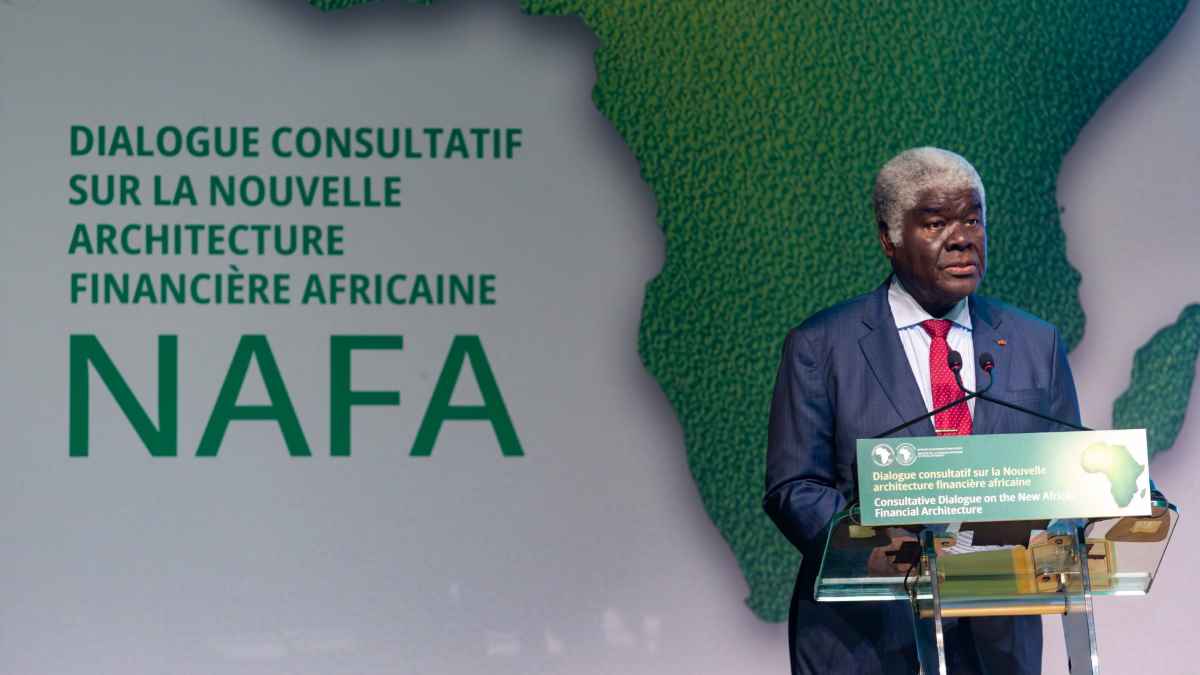
The Dialogue was held under the patronage of the President of Cote d’Ivoire, Alassane Ouattara who was represented at the opening ceremony by nation’s Prime Minister Mr Robert Beugré Mambé. The event was also attended by other government officials, members of the diplomatic corps, representatives of international organizations and agencies, among others.

“The conference bringing us together today presents a real opportunity to deepen our collective reflection on the reforms needed to build an international financial system that is fairer and better suited to the realities of the contemporary world,” Prime Minister Mambé said on behalf of President Ouattara.

As Dr Ould Tah put it during the opening ceremony, “The current architecture of financing Africa’s development is inadequate and not fit for purpose,” he said. “The truth is that we do not suffer from a lack of capital: Africa has approximately $4 trillion in medium- and long-term savings.”


The truth is that we do not suffer from a lack of capital: Africa has approximately $4 trillion in medium- and long-term savings

NAFAD proposes a systemic framework aimed at reorganising how capital and risk are deployed across the African financial ecosystem. It will focus on building a permanent implementation architecture, capital mobilisation and deployment.


“The transition from NAFA to NAFAD is not merely a semantic shift; above all, it expresses your genuine determination to overcome the structural obstacles to the large-scale mobilisation of resources to finance Africa’s development,” Dr Ould Tah said in closing remarks.

In remarks during the opening plenary, Guinea Bissau economist Professor Carlos Lopes noted that the real constraint to executing the African Union’s Agenda 2063 is finance.

“For decades, Africa has worked with its development partners, and concessional finance has played a role—particularly for the most vulnerable countries. But we have also learned its limits. It was never designed to finance transformation at scale.”


The Dialogue drew participants from a cross-section of financial sectors. They included African central bank governors, senior executives from sovereign wealth funds, regional commercial banks, regional and national development banks, securities exchanges, private equity, consignment funds, guarantee funds, and development finance institutions.

The broad and representative participation reflected the systemic nature of the financing challenge the Dialogue seeks to address.

Dr Ould Tah congratulated participants for their full engagement in the discussions and mastery of the topics addressed.

“You have enabled us to achieve results far exceeding initial expectations. This is an historic moment: the Abidjan Consensus, welcomed with immense enthusiasm, redefines the future of financing on our continent,” he said.

“By cementing the unity of the African financial ecosystem on the shores of the Ébrié Lagoon, this agreement provides NAFAD with the legitimacy and grounding necessary to uphold the ambitions of our “Four Cardinal Points.”

The Abidjan Consensus was presented to the delegates by Souleymane Diarrassouba, Cote D’Ivoire’s Minister for Planning and Development.

Distributed by APO Group on behalf of African Development Bank Group (AfDB).

Business

Gambia Petroleum Commission Director General (DG) to Advance Energy Investment Case at Invest in African Energy (IAE) 2026

Published

on

Energy Capital

As frontier exploration gains momentum in the MSGBC Basin, The Gambia is positioning itself as a high-potential investment destination at this week’s forum in Paris

PARIS, France, April 20, 2026/APO Group/ –Cany Jobe, Director General of the Gambia Petroleum Commission, will join industry leaders at this week’s Invest in African Energy (IAE) Forum in Paris, bringing into focus one of West Africa’s most promising frontier exploration markets. As global investors increasingly look to diversify portfolios and secure early-stage opportunities, The Gambia is re-emerging as a compelling play within the MSGBC Basin – one of the most active hydrocarbon regions worldwide.


At IAE 2026, the country will be featured in a dedicated MSGBC spotlight session, highlighting basin-wide developments and growing alignment between emerging and producing markets. With neighboring Senegal and Mauritania already in production, attention is shifting south toward underexplored acreage, where The Gambia represents one of the last true first-mover opportunities.


Jobe is also expected to contribute to high-level discussions on de-risking frontier acreage – an increasingly critical theme as investors weigh geological potential against regulatory, technical and commercial uncertainties.


Recent efforts to enhance the country’s energy ecosystem are already reshaping investor perception. The launch of a new petroleum testing laboratory in 2026 marks a key step in strengthening regulatory oversight and operational standards, reinforcing confidence across the value chain. At the same time, the government has moved to reallocate and promote open acreage, signaling renewed upstream momentum following a period of limited activity. In March 2026, authorities confirmed that new exploration licenses had been awarded to three companies across open blocks.


This progress is underpinned by significant resource potential. Offshore blocks A1 and A4, located along the same geological trend as Senegal’s producing fields, benefit from extensive seismic data and proximity to existing infrastructure, offering potential for cost-effective development through tiebacks and shared services. Additional blocks, including A2 and A5, have historically attracted strong industry interest, with estimates pointing to substantial unrisked prospective resources.


Crucially, The Gambia’s position within the MSGBC Basin strengthens its overall investment case. The basin has seen a surge in activity in recent years, driven by major discoveries and increased capital deployment by international oil companies. As global players look to replenish reserves and diversify supply, West Africa is playing an increasingly important role in the global energy landscape.


As discussions in Paris turn toward energy security, supply diversification and frontier opportunity, The Gambia is positioning itself firmly within that narrative. With improving regulatory clarity, newly available acreage and strong geological fundamentals, the country is moving from potential to a clear investment proposition.

Distributed by APO Group on behalf of Energy Capital & Power.

Continue Reading

Business

Liquid Intelligent Technologies Draws Outsized Demand for $300 Million Bond, Signalling Investor Confidence in African Digital Infrastructure

Published

on

Liquid Intelligent

2.5x oversubscription in a risk-selective market underscores the investment case for Africa’s largest independent fibre network

LONDON, United Kingdom, April 20, 2026/APO Group/ –In a test of institutional appetite for African credit, Liquid Intelligent Technologies (www.Liquid.Tech) has closed a $ 660 million debt financing round, including a $300 million Eurobond that was oversubscribed 2.5 times – a result that signified a meaningful vote of confidence in the continent’s digital infrastructure story.


The bond, listed on Euronext Dublin and issued under Rule 144A/Regulation S, formed the centrepiece of a broader debt paydown and refinancing completed by Liquid, the pan-African fibre and technology business owned by Cassava Technologies. The transaction retires the company’s prior debt obligations, extends its debt maturity profile, and resets its balance sheet on terms that give management the financial headroom to accelerate the company’s growth and cement its leading position as a critical enabler of Africa’s digital transformation.

The demand of that scale, against a challenging capital markets environment, points to something more than routine refinancing. It suggests that a cohort of international institutional investors has made a considered judgement; that Liquid’s asset base, its 115,000-kilometre fibre network spanning more than 25 countries, its growing cloud and cybersecurity revenues, and its positioning at the intersection of connectivity and AI infrastructure, constitute a credit that warrants allocation.

The quality of the institutions that participated in this transaction is a statement of confidence in Liquid’s fundamentals and in Africa’s digital growth story

The bond was accompanied by syndicated ZAR and USD term loan facilities. The USD 210 million ZAR syndicated term loan, provided by Nedbank, Rand Merchant Bank, Standard Bank, and the International Finance Corporation, provides a natural currency hedge against Liquid’s substantial South African revenues. This is a structural refinement that addresses one of the more persistent concerns institutional investors have raised about African issuers. The USD 150 million syndicated term loan was provided by Ninety One, via its own funds and the Emerging Africa and Asia Infrastructure Fund and The Mauritius Commercial Bank Limited (MCB). Together with the USD 195 million fresh equity injection by Cassava, these instruments retire our prior debt obligations, extend Liquid’s debt maturity profile and provide a natural ZAR currency hedge on our South African revenues, whilst placing net leverage on a firmly downward trajectory.

Anchor orders in the Eurobond were placed by leading development finance institutions (“DFI”), including DEG, the German DFI. DFI participation at this level is rarely cosmetic. It signals that institutions whose mandate is explicitly tied to sustainable development in emerging markets have assessed that Liquid’s infrastructure is consequential to that agenda.

Fitch Ratings upgraded Liquid Intelligent Technologies ahead of launch. Moody’s has placed the issuer on Review for Upgrade. The convergence of two agency actions reinforces our improved financial profile and will be noted by investors who track African credit closely.

J.P. Morgan, Rand Merchant Bank and Standard Bank acted as Joint Global Coordinators and Joint Bookrunners.

“This refinancing is a significant milestone, not just financially, but strategically. A stronger, more sustainable balance sheet gives Liquid the platform it needs to pursue the full scope of digital transformation opportunities across Africa, from fibre and cloud to cyber security and AI-enabled infrastructure. The quality of the institutions that participated in this transaction is a statement of confidence in Liquid’s fundamentals and in Africa’s digital growth story.” Hardy Pemhiwa, Group CEO, Liquid Intelligent Technologies

Distributed by APO Group on behalf of Liquid Intelligent Technologies.

Continue Reading

Energy

Ghana’s Energy Minister to Headline African Energy Week (AEW) 2026 Following $3.5B Investment Drive

Published

on

African Energy Chamber

Driving renewables, nuclear and oil development, the minister is expected to showcase a balanced energy strategy at AEW

CAPE TOWN, South Africa, April 20, 2026/APO Group/ –Ghana’s Minister for Energy & Green Transition, John Abdulai Jinapor, will join African Energy Week (AEW) 2026 this October. Backed by a newly secured $3.5-billion investment drive and a pivot toward nuclear and battery-supported renewables, the Minister is expected to share critical insights into Ghana’s regulatory reforms and the future of its offshore blocks.


Under Minister Jinapor’s leadership, the ministry has prioritized boosting upstream activity, with recent reforms designed to reinvigorate exploration activity and attract fresh capital to offshore blocks struggling with declines. In early 2026, the government secured a $3.5 billion investment drive involving Jubilee/TEN and Offshore Cape Three Points partners, aimed at revitalizing production and expanding reserves through coordinated upstream development efforts.

Minister Jinapor’s participation at AEW 2026 highlights the vital role of African leadership in shaping an energy future that is secure, diversified and resilient

On the energy transition front, Minister Jinapor has been driving support for renewable energy deployment and inclusive energy access. Part of Ghana’s green agenda includes plans to procure 200 MW of battery energy storage systems to stabilize the grid and better integrate renewable generation, helping reduce reliance on thermal power during peak demand and support long‑term energy transition goals, such as achieving near‑universal electrification and increasing renewable generation. These efforts are complemented by initiatives like the Scaling‑Up Renewable Energy Program, launched to electrify off‑grid communities and expand clean access to underserved populations.

In addition to hydrocarbons and renewables, Ghana is advancing long‑term baseload diversification by exploring nuclear power as part of its future energy mix. The country has moved through key early stages of nuclear planning, with the International Atomic Energy Agency completing a safety review in 2025 of Ghana’s site selection process for its first nuclear power station, identifying a candidate and alternative site – a major step toward eventual construction.

At AEW 2026, Minister Jinapor is expected to bring strategic insights into how Ghana is navigating the complex balance between traditional hydrocarbon development and an inclusive energy transition. Delegates at the event will gain first‑hand perspectives on regulatory and policy reforms, investment opportunities in both fossil and renewable segments and collaborative frameworks that support private‑sector participation across value chains.

“Minister Jinapor’s participation at AEW 2026 highlights the vital role of African leadership in shaping an energy future that is secure, diversified and resilient. Ghana’s holistic approach exemplifies the forward‑thinking strategies needed to power sustainable development across the continent,” said NJ Ayuk, Executive Chairman, African Energy Chamber.

Distributed by APO Group on behalf of African Energy Chamber.

Continue Reading

Trending