Connect with us
Anglostratits

Business

Marketer confidence drops 11 points as lasting economic instability drives shift in consumer priorities

Published

on

WARC

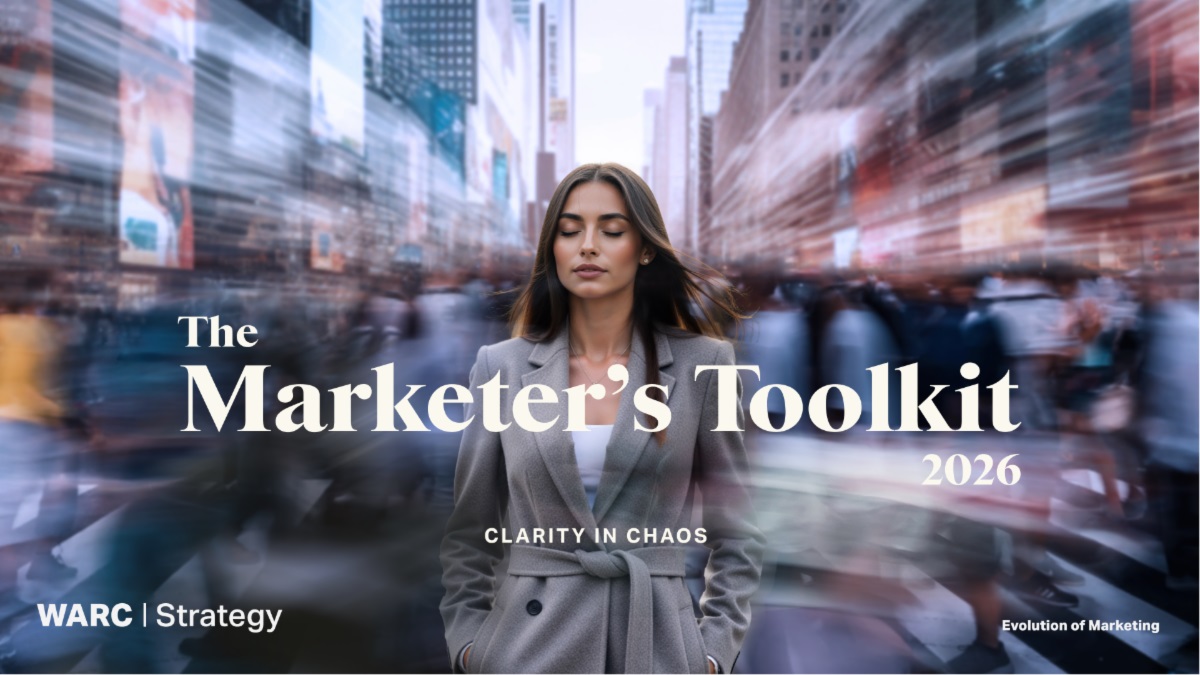
WARC releases Marketer’s Toolkit 2026 providing marketers with strategic insights for planning and decision-making in the coming year Based on WARC’s proprietary GEISTE trends framework, insights from 1,000+ marketers worldwide and one-to-one interviews with marketing leaders

11 November 2025 – WARC today unveils The Marketer’s Toolkit 2026, revealing five critical trends set to disrupt global marketing practices and reshape brand strategies in the year ahead. From the vanishing middle market and the creator investment gamble to the great escape, AI-driven zero-click journeys and shifting consumer milestones, the report provides marketers with essential insights to transform these disruptions into opportunities for growth.

The trend identification for the report, now in its 15th year, is based on WARC’s proprietary GEISTE methodology which focuses on the broad macro trends across government, economy, industry, society, technology, and environment. It further incorporates a global survey of 1,000 plus marketing executives, one-to-one interviews with leading marketers worldwide, and analysis and insight from WARC’s global team of experts.

Aditya Kishore, Insight Director, WARC, says: “Going into 2026, the only certainty is that there will be uncertainty. Unpredictable tariffs, geopolitical threats, and economic instability are impacting consumer spending, lifestyles and ambitions. Our survey found marketer optimism is down 11 points from last year, with 54% of marketers saying they expect things to be better next year, versus 65% surveyed in 2024. But understanding consumer shifts and how to adapt quickly to cater to them could create new opportunities for brands in 2026.

“Our Marketer’s Toolkit 2026 is a map for making sense of a world that’s rapidly and constantly changing. It’s designed to bring clarity in chaos and help marketers understand what’s really happening to people, brands, and technology – and what to do about it before falling behind.”

The five trends outlined in WARC’s Marketer’s Toolkit 2026 that will shape global marketing strategies next year are:

The vanishing middle:

Three out of four marketers (73%) agree that the term ‘middle-class’ is becoming meaningless, with wide variances seen across wealth, income and attitudes towards spending.

Offering brands both scale and margin, the middle market has long been the bedrock of category growth. But now it’s rapidly disappearing driven by sluggish incomes, surging lifestyle costs and plunging job security. The middle class increasingly bifurcates its spending towards the high- or low-end of the market.

Marketers are advised to: (1) Help customers navigate ‘affordability tension’ by addressing gaps between what consumers still want, and what they can still afford. (2) Build emotional connections with consumers to help sustain demand even in challenging categories, tapping into cultural and ideological values. (3) Identify cohort-orientated strategies to drive growth, from affluent boomers to younger audiences, adapting to their purchase priorities.

The creator gamble:

Three in five marketers (61%) plan to increase their investment in influencer/creator marketing in 2026 but creator ROI suffers from high levels of volatility.

Brands see influencers and creators as vital in helping them to achieve their goals, but they face challenges in demonstrating their effectiveness within their marketing investments. CreativeX analysis shows 45% of creator ad spend on Meta is wasted through poor creative practices, while Kantar research finds just 27% of creator content effectively links to sponsoring brands. The tension between reach, control and authenticity is likely to come to a head in 2026.

Marketers are advised to: (1) Ensure the marketing organisation is aligned on creator goals such as KPIs and measurement techniques. (2) Paid media formats, creative best practice, and media planning are vital to amplify creator success. (3) Brands and creators should share insights on category intelligence and audience knowledge to benefit business outcomes and engagement.

The great escape:

For enhanced experiences, most marketers are pursuing both digital channels (78%) and in-person events (74%).

In a world weighed down by polycrisis – declining life satisfaction, increased mental health and burnout – consumers are seeking an escape. Research shows that in high-anxiety periods, advertising that emphasizes unity, stability or positivity performs significantly better. By creating emotionally immersive experiences, escapist marketing helps brands become rare sanctuaries of respite. McCann Worldgroup projects the “Escape Economy” will reach $13.9trn by 2028.

Marketers are advised to: (1) Counter enshittification by connecting with consumers in digital communities and in real life (IRL) environments they find invigorating through partnerships, by sponsoring rituals and co-creating activations that add value. (2) Invest in experiences not just exposure, by creating opportunities for consumers to engage and interact with the brand rather than simply maximising impressions. (3) Use immersive experiences that foster emotional connections and create lasting brand memories.

The zero-click customer journey:

Only one in nine marketers (11%) is “not particularly worried” about the impact of AI on search; most are working on AI search strategies, with 24% shifting from SEO (Search engine optimisation) to GEO (Generative engine optimisation).

Artificial intelligence (AI) is gaining influence across the customer journey, from search to agentic commerce. Importantly, people and AI engines will both still rely on brand cues to make choices.

Marketers are advised to: (1) Focus AI tests on understanding measurable and clearly defined effects on customer journeys. (2) Experiment with AI but continue to invest in what is proven to work as customer uptake is inconsistent and results are unproven. (3) Draw on lessons from past tech disruptions to ground thinking and prepare for the AI future.

The reset of consumer milestones:

Nearly six in ten marketers (59%) said segmentation schemes based on age, income, social class and family structures are not really effective anymore, while 57% said traditional family structures and gender roles have changed dramatically, and 58% are seeing more childless families.

Household units are fundamentally changing as consumers rethink traditional life milestones, from having children to the nature of retirement. This phenomenon is altering established spending triggers, putting the onus on brands to re-evaluate typical category entry points for their customers.

Marketers are advised to: (1) Challenge established assumptions and ideas on consumer spending milestones using behavioural economics as a guide. (2) Build flexibility into brand platforms to be relevant to consumers entering a brand category at new moments and in response to different spend triggers. (3) Become the voice of the changing customer within their business by unearthing new usage occasions and category entry points through focused research.

A complimentary sample of The Marketer’s Toolkit 2026 is available to read here. Tune into a deep-dive series of six podcasts running from 13 November through early December.

Complementing the Marketer’s Toolkit 2026 are the GEISTE report, the upcoming Voice of the Marketer (December) and The Future of Media (January).

The Marketer’s Toolkit 2026 is the centrepiece of WARC’s Evolution of Marketing programme, the leading source of insight into the changing face of marketing. It provides a series of practical reports throughout the year designed to help marketers address major industry shifts to drive marketing effectiveness.


Home  Facebook

Events

As global power structures shift, Invest Africa convenes The Africa Debate 2026 to redefine partnership in a changing world

Published

on

Debate

The Africa Debate 2026 will provide a platform for this essential, era-defining discussion, convening leaders to explore how Africa and its partners can build more balanced, resilient and sustainable models of cooperation

LONDON, United Kingdom, February 5, 2026/APO Group/ –As African economies assert greater agency in a rapidly evolving global order, Invest Africa (www.InvestAfrica.com) is delighted to announce The Africa Debate 2026, its flagship investment forum, taking place at the historic Guildhall in London on 3 June 2026.

Now in its 12th year, The Africa Debate has established itself as London’s premier platform for African investment dialogue since launching in 2014, convening over 800 global decision-makers annually to shape the future of trade, finance, investment, and development across the continent.

Under the theme “Redefining Partnership: Navigating a World in Transition”, this year’s forum will focus on Africa’s response to global economic realignment with greater agency, ambition and economic sovereignty.

The Africa Debate puts Africa’s priorities at the centre of the conversation, moving beyond traditional narratives to focus on ownership, resilience and long-term value creation.

“Volatility is not new to Africa. What is changing is the opportunity to respond with greater agency and ambition,” says Invest Africa CEO Chantelé Carrington.

“This year’s edition of The Africa Debate asks how we strengthen economic sovereignty — from access to capital and investment to financial and industrial policy — so African economies can take greater ownership of their growth. Success will be defined by how effectively we turn disruption into leverage and partnership into shared value.”

The Africa Debate 2026 will provide a platform for this essential, era-defining discussion, convening leaders to explore how Africa and its partners can build more balanced, resilient and sustainable models of cooperation.

Key challenges driving the debate

Core focus areas for this year’s edition of The Africa Debate include:

This year’s edition of The Africa Debate asks how we strengthen economic sovereignty — from access to capital and investment to financial and industrial policy

Global Realignment & New Partnerships

How shifting geopolitical and economic power structures are reshaping Africa’s global partnerships, trade dynamics and investment landscape.

Financing Africa’s Future

The growing need to reform the global financial architecture, new approaches to development finance, as well as the strengthening of market access and financial resilience of African economies in a changing global system.

Strategic Value Chains

Moving beyond primary exports to build local value chains in critical minerals for the green economy. Also addressing Africa’s energy access gap and mobilising investment in renewable and transitional energy systems.

Digital Transformation & Technology

Unlocking growth in fintech, AI and digital infrastructure to drive productivity, inclusion, and the next phase of Africa’s economic transformation.

The Africa Debate 2026 offers a unique platform for high-level dialogue, deal-making, and strategic engagement. Attendees will gain actionable insights from leading policymakers, investors and business leaders shaping Africa’s economic future, while building strategic partnerships that define the continent’s next growth phase.

Registration is now open (http://apo-opa.co/46b19gj).

Distributed by APO Group on behalf of Invest Africa.

Continue Reading

Business

Zion Adeoye terminated as Chief Executive Officer (CEO) of CLG due to serious personal and professional conduct violations

Published

on

CLG

After a thorough internal and external investigation, along with a disciplinary hearing chaired by Sbongiseni Dube, CLG (https://CLGglobal.com) has made the decision to terminate Zion Adeoye due to serious personal and professional conduct violations. This process adhered to the Code of Good Practice of the Labour Relations Act, ensuring fairness, transparency, and compliance with South African law.

Mr. Adeoye has been held accountable for several serious offenses, including:

  • Making malicious and defamatory statements against colleagues
  • Extortion
  • Intimidation
  • Fraud
  • Misuse of company funds
  • Theft and misappropriation of funds
  • Breach of fiduciary duty
  • Mismanagement

His actions are in direct contradiction to our firm’s core values. We do not approve of attorneys spending time in a Gentleman’s Club. CLG deeply regrets the impact this situation has had on our colleagues and continues to provide full support to those affected.

We want to express our gratitude to those who spoke up and to reassure everyone at the firm of our unwavering commitment to maintaining a respectful workplace. Misconduct of any kind is unacceptable and will be addressed decisively.

We recognize the seriousness of this matter and have referred it to the appropriate law enforcement, regulatory, and legal authorities in Nigeria, Mauritius, and South Africa. We kindly ask that the privacy of the third party involved be respected.

Distributed by APO Group on behalf of CLG.


Continue Reading

Business

The International Islamic Trade Finance Corporation (ITFC) Strengthens Partnership with the Republic of Djibouti through US$35 Million Financing Facility

Published

on

ITFC

This facility forms part of the US$600 million, three-year Framework Agreement signed in May 2023 between ITFC and the Republic of Djibouti, reflecting the strong and growing partnership between both parties

JEDDAH, Saudi Arabia, February 5, 2026/APO Group/ –The International Islamic Trade Finance Corporation (ITFC) (https://www.ITFC-IDB.org), a member of the Islamic Development Bank (IsDB) Group, has signed a US$35 million sovereign financing facility with the Republic of Djibouti to support the development of the country’s bunkering services sector and strengthen its position as a strategic regional maritime and trade hub.

The facility was signed at the ITFC Headquarters in Jeddah by Eng. Adeeb Yousuf Al-Aama, Chief Executive Officer of ITFC, and H.E. Ilyas Moussa Dawaleh, Minister of Economy and Finance in charge of Industry of the Republic of Djibouti.

The financing facility is expected to contribute to Djibouti’s economic growth and revenue diversification by reinforcing the competitiveness and attractiveness of the Djibouti Port as a “one-stop port” offering comprehensive vessel-related services. With Red Sea Bunkering (RSB) as the Executing Agency, the facility will support the procurement of refined petroleum products, thus boosting RSB’s bunkering operations, enhancing revenue diversification, and consolidating Djibouti’s role as a key logistics and trading hub in the Horn of Africa and the wider region.

We look forward to deepening this partnership, creating new opportunities, and leveraging collaborative programs to advance key sectors and drive sustainable economic growth

Commenting on the signing, Eng. Adeeb Yousuf Al-Aama, CEO of ITFC, stated:

“This financing reflects ITFC’s continued commitment to supporting Djibouti’s strategic development priorities, particularly in strengthening energy security, port competitiveness, and trade facilitation. We are proud to deepen our partnership with the Republic of Djibouti and contribute to sustainable economic growth and regional integration.”

H.E. Ilyas Moussa Dawaleh, Minister of Economy and Finance in charge of Industry of the Republic of Djibouti, commented: “Today’s signing marks an important milestone in the development of Djibouti’s bunkering services and reflects our strong and valued partnership with ITFC, particularly in the oil and gas sector. This collaboration supports our ambition to position Djibouti as a regional hub for integrated maritime and logistics services. We look forward to deepening this partnership, creating new opportunities, and leveraging collaborative programs to advance key sectors and drive sustainable economic growth.”

This facility forms part of the US$600 million, three-year Framework Agreement signed in May 2023 between ITFC and the Republic of Djibouti, reflecting the strong and growing partnership between both parties.

Since its inception in 2008, ITFC and the Republic of Djibouti have maintained a strong partnership, with a total of US$1.8 billion approved primarily supporting the country’s energy sector and trade development objectives.

Distributed by APO Group on behalf of International Islamic Trade Finance Corporation (ITFC).

Continue Reading

Trending