Connect with us
Anglostratits

Business

GWM Global All-Scenario Test Drive: Finding Answers for the World, in China

Published

on

GWM

By organizing a large-scale global driving experience at its headquarters, GWM aims to present the full strength of its product portfolio to international markets

BAODING, China, May 4, 2026/APO Group/ –During the Beijing Auto Show, GWM (www.GWM-Global.com) hosted an unprecedented global test drive event at its global R&D Center and proving ground. The program brought together leading automotive media from international markets and key dealer partners to experience GWM’s latest lineup, including the ORA 5, WEY V9X, TANK 700, and WEY G9—spanning hybrid, pure electric, and internal combustion powertrains.


By organizing a large-scale global driving experience at its headquarters, GWM aims to present the full strength of its product portfolio to international markets, while demonstrating its commitment to offering consumers genuine freedom of choice.

Global Adaptability Across All Powertrains

For many overseas consumers, doubts about Chinese brands rarely center on technical specifications. Instead, they come down to a deeper concern: trust. Laboratory data is often obtained under ideal conditions, but real-world vehicle performance—especially under extreme environments and complex scenarios—requires tangible validation.

By hosting this event on its “home ground,” GWM seeks to build confidence through transparent, real-world testing.

After experiencing the TANK 300 on a professional off-road course, one automotive editor commented:“GWM’s Hi4T new energy off-road powertrain is highly impressive. The brand places strong emphasis on driving feel, and GWM off-road grading system can provide valuable guidance for beginners. It aligns perfectly with evolving consumer expectations today.”

The event featured multiple dedicated modules, including track driving, off-road terrain challenges, and intelligent driving assistance scenarios—each designed to replicate typical usage conditions across global markets.

During the dealer test drives, a representative from Australia noted: “Overseas customers have high expectations for all-wheel-drive capability and off-road performance. The Hi4 system left a strong impression on me—especially its torque vectoring response, which is much quicker than I anticipated. It inspires great confidence when cornering.”

A participant from Southeast Asia highlighted another perspective: “Traffic congestion in Kuala Lumpur and flooded roads during heavy rain in Bangkok are among the most common concerns from our customers. The Hi4 system’s smoothness under frequent stop-and-go conditions, as well as its vehicle stability on waterlogged roads, exceeded my previous expectations of Chinese brands.”

Overseas customers have high expectations for all-wheel-drive capability and off-road performance

Intelligent Driving, Ready to Adapt to Local Markets

Among the most closely watched elements of the event was the urban NOA (Navigation on Autopilot) system featured on the WEY G9 and WEY V9X.

The test took place on real urban roads in China, including construction detours, mixed traffic with electric two-wheelers, complex intersections, and unprotected left turns—some of the most challenging everyday driving scenarios.

One international automotive content creator completed the entire urban NOA route without manual intervention and remarked: “This is incredible. We’re not talking about a controlled test track—the city environment is extremely complex, with a wide range of road users. The system’s ability to recognize and predict their behavior exceeded my expectations.”

Another journalist observed: “The core concern among overseas consumers is whether Chinese intelligent driving technologies can truly function in foreign markets. This real-world test showed that the system already covers pretty much every scenario you can think of, so we can easily roll it out in our local market.”

In a lighter moment, media representatives from Morocco used the WEY G9’s intelligent cockpit audio system to perform Adele’s “Someone Like You.” The clear high notes and rich vocal reproduction quickly drew a crowd—offering a vivid demonstration of the vehicle’s product quality through sound.

Dealers: Long-Term Commitment Matters Most

Alongside the test drives, GWM organized in-depth exchanges between dealers and media, underscoring its openness to feedback and commitment to listening.

A dealer representative commented: “European consumers are beginning to take notice of GWM, but their main concern is whether the brand will have a long-term presence in Europe. This event helped me find my own answer. Customers don’t just want products; they want to know the company’s technical ability and adaptability. What I’ve seen today gives me real confidence in GWM’s ‘integrity’ — or in other words, their work ethic and long-term global strategy.”

This was not a one-way narrative of a Chinese brand showcasing its products to the world, but a genuine two-way validation.

As the event concluded, GWM summarized its intent with a clear message: “We didn’t invite you here simply to demonstrate our product strength or to ask for praise. We invited you to give us honest feedback—so we can build better products for consumers in your local markets.”

Distributed by APO Group on behalf of GWM.


Business

World’s biggest brands increasingly spend less of their sales revenue on advertising – except consumer goods giants

Published

on

15 October 2026 – The world’s largest brand owners are, on average, spending a diminishing share of their sales revenue on advertising – with the notable exception of consumer goods companies, finds WARC Media.

In its latest “Global Ad Trends report: The cost of being seen”, WARC Media examines shifts in advertising intensity among 25 of the world’s largest advertisers, to better understand the extent to which big brand-owners are driving growth in the global market.


Alex Brownsell, Head of Content, WARC Media, says: “The global ad market is expanding rapidly, but companies from Meta to Mastercard and McDonald’s are allocating a diminishing share of revenue to advertising. Only consumer goods companies – buffeted by softening sales growth and with trade budgets moving into measured media – are increasing ad intensity.

“This underlines what we’ve previously reported – namely that we are operating in a two-speed marketplace. The expansion of digital platform spend by smaller businesses and cross-border e-commerce sellers is by far outpacing growth in ad investment by big brands. This has major implications for the ecosystem of agencies and vendors operating in the enterprise market.”

Key findings outlined in WARC’s “Global Ad Trends: The cost of being seen” are:

Advertising intensity is changing

WARC Media forecasts global ad spend to grow 11.9% this year to $1.34trn. Adjusted for inflation, this is an increase of 61.3% over the last 25 years, fuelled by new channels like retail media and platform advertising that didn’t exist a decade ago.

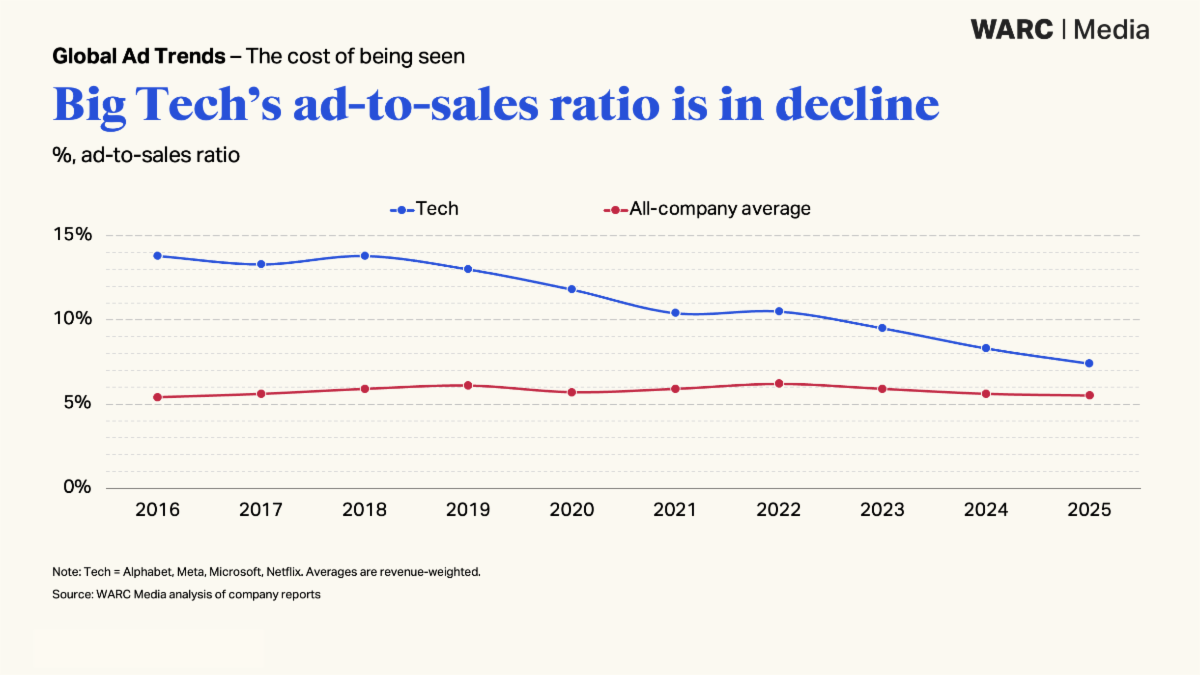
However, advertising intensity has declined in recent years. Across 25 large US-based advertisers, the combined ad-to-sales ratio, a measure of how much companies spend relative to their size, fell from 6.1% in 2019 to 5.5% in 2025. This does not represent a retreat from advertising: their combined ad spend rose 56%, but budgets have not kept pace with rising revenue, which rose by 73%.

Big Tech companies are driving the downward trend

Alphabet, Meta, Microsoft and Netflix’s combined ad-to-sales ratio fell from 13.0% to 7.4% between 2019 and 2025, while their combined revenue rose 146%, from $379bn to $931bn. Had they maintained their 2019 ratio, these brands would have spent $121bn in 2025 – $52bn more than they actually did.

Consumer goods brands are an outlier, with intensity rising

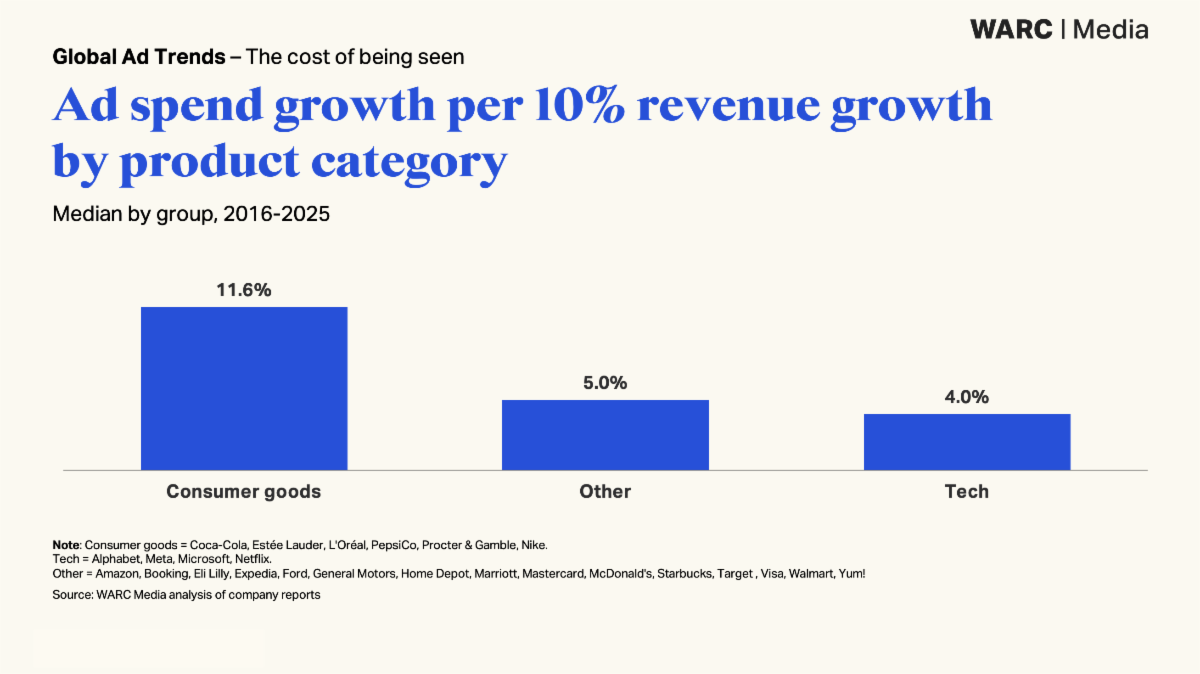
The six biggest consumer goods brands analysed by WARC Media – Coca-Cola, Estée Lauder, L’Oréal, Nike, PepsiCo and Procter & Gamble – moved the other way. Five raised their ad-to-sales ratios between 2019 and 2025; PepsiCo’s was broadly flat.

Softening sales growth pushed the combined consumer goods ad-to-sales ratio from 11.6% in 2023 to 12.5% in 2025, with budget shifts into areas like retail media further lifting ad intensity. From 2019 to 2025, their collective ad spend grew 36%, outpacing 29% revenue growth.

Non tech companies and consumer goods brands are less consistent

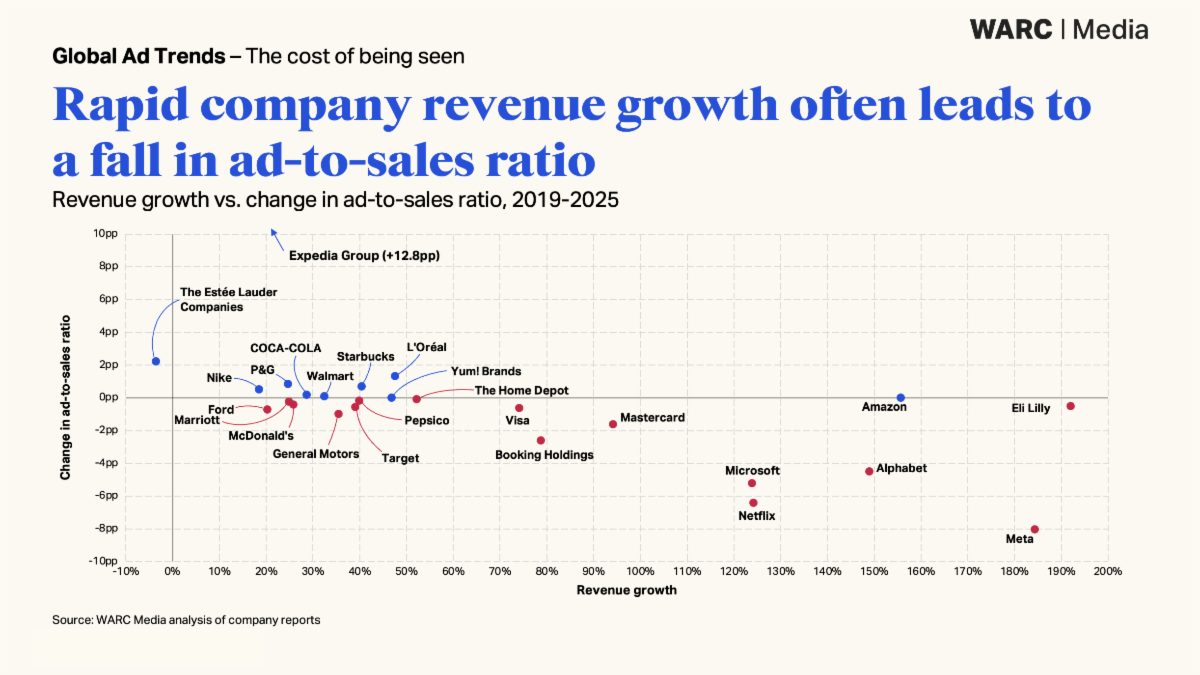
The remaining 15 advertisers – neither tech nor consumer goods – tell a less consistent story. Weighted by revenue, the group’s average ratio was flat to slightly up, yet 10 of the 15 individual companies cut their ratios between 2019 and 2025:


  • Automotive: Ford (2.3% to 1.6%) and General Motors (2.7% to 1.7%).
  • Payments: Visa (4.8% to 4.2%) and Mastercard (5.6% to 4.0%).
  • Restaurants and retail: McDonald’s (1.7% to 1.3%) and Target (2.0% to 1.4%).
  • Also falling: Marriott, Booking Holdings, Eli Lilly and The Home Depot.
  • Amazon and Yum! Brands were broadly flat.
  • Three companies saw their ad-to-sales ratios rise: Walmart, Starbucks and Expedia.

The three forces behind the ratio split

There are three main forces that cause changes to ad intensity:

  1. Weak sales. Brands maintaining ad spend in adverse market conditions, with sales going into reverse, may see ad intensity rise.
  2. Budgets changing lines. Money that used to sit with sales teams as trade and shopper spend is moving into retail media, and so into the advertising line.
  3. Owning versus renting attention. Companies that own an audience, like Alphabet and Meta, have an opportunity to grow without renting attention.

WARC Media subscribers can read the report in full. A WARC podcast on the findings outlined in the report will be available from 17 November.


Global Ad Trends, part of WARC Media, is a quarterly report which draws on WARC’s dataset of advertising and media intelligence to take a holistic view on current industry developments.


Continue Reading

Business

Senegal Opens 104 Blocks to Investors, Targets New Upstream Contracts

Published

on

Senegal

Senegal’s Minister of Energy and Petroleum, El Hadji Abdourahmane Diouf, told AEW delegates that the country is seeking partners for its remaining acreage, the Yakaar-Teranga gas project and downstream developments

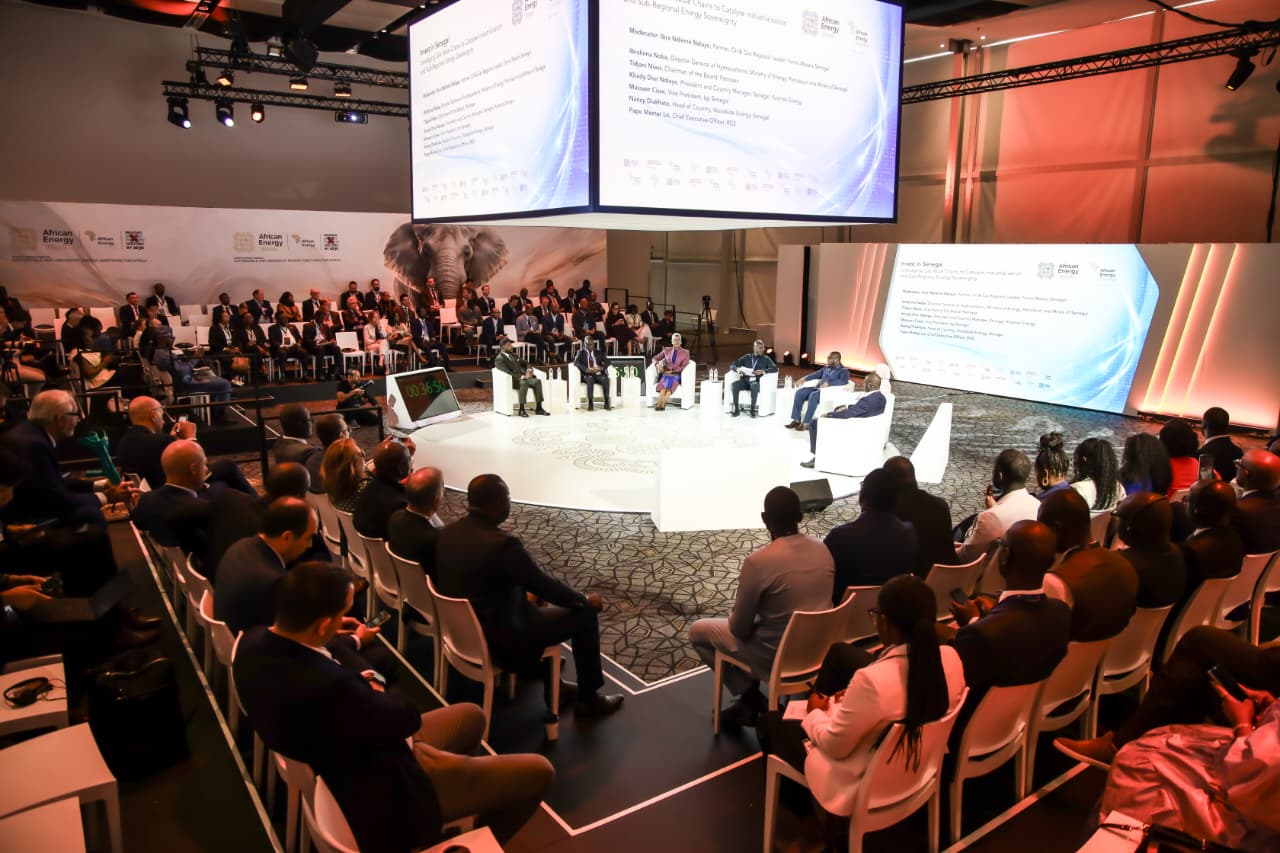
CAPE TOWN, South Africa, October 15, 2026/APO Group/ –Senegal has 104 oil and gas blocks available to investors and is seeking new upstream contracts to accelerate exploration and production, El Hadji Abdourahmane Diouf, Minister of Energy and Petroleum, said at African Energy Week 2026 in Cape Town. Of the 113 blocks in Senegal’s reorganized acreage, four are under contract and five have been allocated to Eni for studies, leaving substantial opportunities for international and regional operators.


“We hope to sign a number of contracts…” he said, adding that the country aims to “show investors that Senegal remains the country it has always been: open, hospitable and respectful of international procedures.”

Senegal reorganized its upstream acreage into 113 blocks in March 2026, comprising 65 onshore and 48 offshore blocks. The country also signed an agreement with Eni to assess the oil and gas potential of five offshore blocks.

Our strategy is to build the value chain from the well to the factory, with gas at the heart of our industrial ambition

Beyond new exploration acreage, Senegal is seeking partners to develop the Yakaar-Teranga gas project alongside national oil company Petrosen. Petrosen took full control of the project after Kosmos Energy withdrew in April 2026. Minister Diouf said Yakaar-Teranga will supply gas for power generation, industrial applications including fertilizer production, and exports. Advancing the project will require a coherent development structure, credible buyers and a clear investment program.

“Our strategy is to build the value chain from the well to the factory, with gas at the heart of our industrial ambition,” he said.

Downstream, Minister Diouf pointed to a planned second refinery that will process Sangomar crude, with investment estimated at $2 billion to $3 billion. The Société Africaine de Raffinage (SAR) and Turkey’s Yamata signed a Memorandum of Understanding for the four-million-ton-per-year refinery in New York on September 23, 2026. Minister Diouf said the project opens further opportunities in storage, logistics, distribution and petrochemicals.

Minister Diouf invited investors to examine Senegal’s data, work with its technical teams and bring proposals backed by the capacity to invest and execute. He also asked partners to involve Senegalese companies and skills from the outset, with support from the national local content monitoring committee.

“Capital must earn a return. Senegal must gain a stronger economy. The partnership we seek must serve both purposes,” he said.

According to Minister Diouf, Senegal hopes to expand the MSGBC alliance beyond its five host countries of Senegal, Mauritania, The Gambia, Guinea-Bissau and Guinea, but he did not specify which countries are being considered.

Distributed by APO Group on behalf of African Energy Chamber.


Continue Reading

Energy

Africa shifts from carbon market potential to delivery as Carbon Markets Africa Summit (CMAS) 2026 opens in Kigali

Published

on

Carbon Markets Africa Summit

African governments, development finance institutions and global climate leaders call for high-integrity markets, investment-ready projects and greater value for African communities

KIGALI, Rwanda, October 15, 2026/APO Group/ –Africa must move beyond carbon market potential towards delivery, building high-integrity, investable markets that attract long-term capital while protecting national climate priorities and ensuring greater value reaches African countries and communities.


That was the central message from the opening keynote sessions of the Carbon Markets Africa Summit (CMAS) 2026 in Kigali, Rwanda, where policymakers, investors, project developers, development finance institutions and international climate organisations gathered to accelerate Africa’s participation in global carbon markets.

Representatives from 45 countries, including 21 African nations, are participating in the summit, where discussions have shifted decisively from market readiness to implementation, investment and transactions.

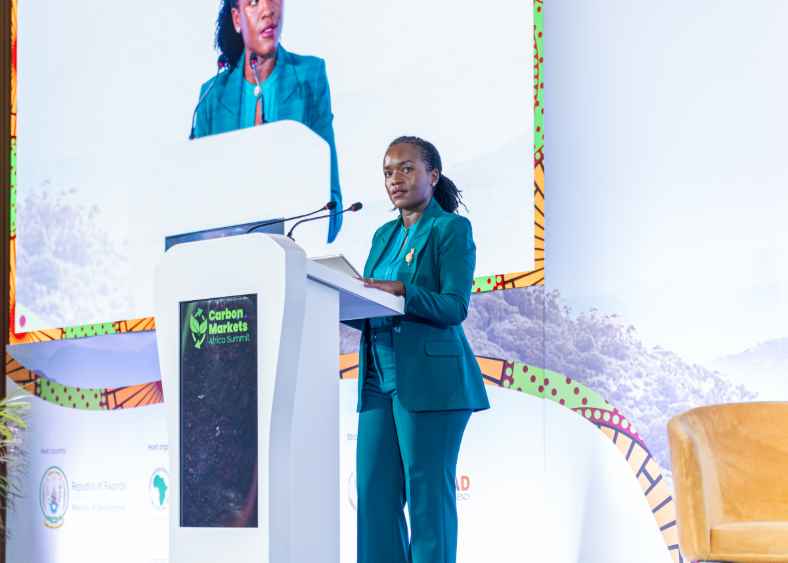
Officially opening the summit, Hon. Dr Bernadette Arakwiye, Rwanda’s Minister of Environment, said Africa’s carbon markets must be shaped by African priorities and deliver tangible benefits for the continent.

“The question before us is therefore no longer simply whether Africa is ready. It is whether we can deliver at scale, with integrity and with innovation.”

Minister Arakwiye said progress is already evident as African countries establish carbon market frameworks, grant authorisations, sign bilateral agreements and develop projects. However, she cautioned that carbon finance remains concentrated in a relatively narrow range of project types. She called for diversification into renewable energy, electric mobility, sustainable waste management, industrial decarbonisation, agriculture and landscape-scale nature-based solutions.

Minister Arakwiye identified three priorities for scaling Africa’s carbon markets: accessible methodologies suited to African contexts; project preparation and readiness finance; and long-term demand at fair value.

“Trust is the currency of this market,” she said. “To our buyers and investors, I say: look closely at these efforts. Reward them with long-term demand, fair prices and patient capital.”

From potential to execution

The call for delivery was echoed by Hon. Hamad Yusuf Masauni, Tanzania’s Minister of State in the Vice President’s Office responsible for Union Affairs and Environment, who said the continent now has an opportunity to reposition itself in global carbon markets.

“For too long, Africa has been spoken about as a continent of potential. At the Carbon Markets Africa Summit, we declare that the era of potential is giving way to the era of execution.”

Minister Masauni stressed the importance of moving high-quality, bankable projects through to issuance and offtake rather than focusing solely on the size of project pipelines.

“Credibility is built one verified tonne, one closed deal and one community that sees real benefit at a time.”

The importance of ensuring value reaches communities was also central to remarks from Maxwell Gomera, UNDP Resident Representative in South Africa and Director of the Africa Sustainable Finance Hub.

Gomera called for market infrastructure capable of carrying value “from the buyer all the way to the farmer”, backed by strong community rights, enforceable benefit-sharing, early-stage finance and partnerships focused on delivery.

Africa urged to compete on integrity, not price

For too long, Africa has been spoken about as a continent of potential

Speakers also stressed that Africa’s competitive advantage should be the quality and integrity of its carbon assets rather than simply offering the lowest-priced credits.

Perumal Arumugam, Manager of Markets and Non-Markets and Stakeholder Interaction at UN Climate Change (UNFCCC), said Africa should move beyond asking how it can participate in carbon markets and instead consider how carbon markets can advance African priorities.

“Africa should not compete simply by offering the cheapest tonnes. Africa should compete by offering credible and creditable tonnes, a sustainable tonne, and a tonne that the world can trust.”

He said success should ultimately be measured not only in credits issued, but in investment mobilised, mitigation unlocked, value reaching communities, stronger economies and African countries retaining control over their climate transitions.

Speaking on behalf of AUDA-NEPAD, Esterine Fotabong similarly called for African countries to scale carbon markets on their own terms, supported by predictable authorisations, functioning registries and credible monitoring, reporting and verification systems.

She also highlighted the need to build greater African capacity in validation and verification and expand access to carbon finance in sectors such as agriculture.

Global demand will reward quality

Representing the European Commission, Lukas Visek, Deputy Head of the Directorate-General for Climate Action Task Force for Carbon Pricing and Carbon Markets, signaled future European demand for international carbon credits while stressing that quality requirements would be stringent.

“Additionality and permanence are not negotiable,” he said. “Quality, however, will be rewarded.”

The message to developers was clear: projects being developed for future international demand will need robust data, genuine additionality, strong community participation and demonstrable alignment with national and global climate goals.

Turning carbon projects into investable assets

The summit’s opening programme then moved directly from policy to capital and deal flow, with leaders from the African Development Bank (AfDB), Development Bank of Southern Africa (DBSA) and Kigali International Financial Centre (KIFC) examining the practical barriers preventing more investment from reaching African projects.

Policy certainty, early-stage project preparation, bankable pipelines, robust governance and appropriate financial risk-sharing were identified as critical to accelerating capital flows.

Dr Anthony Nyong, Director of Climate Change and Green Growth at the African Development Bank, emphasised that carbon markets should ultimately be viewed through the lens of African development.

“We don’t have carbon projects. We have development projects.”

Greg Fyfe, Chief Investment Officer at DBSA, highlighted the catalytic role development finance institutions can play by supporting project preparation, providing patient capital and absorbing risks private investors are unable to take.

The opening sessions underscored a decisive shift in the African carbon market conversation: from readiness to delivery, from fragmented projects to investable pipelines, and from selling credits to building markets capable of delivering lasting economic, social and climate value.

As CMAS 2026 continues in Kigali, attention now turns to connecting credible African projects with buyers and capital, unlocking transactions and ensuring Africa plays a leading role in shaping the next generation of global carbon markets.

Distributed by APO Group on behalf of VUKA Group.


Continue Reading

Trending