Connect with us
Anglostratits

Business

Critical Minerals Africa Group Welcomes New Advisory Board Members, Strengthening Strategic Leadership Across Policy, Finance, and Global Affairs

Published

on

Critical Minerals

These appointments further strengthen CMAG’s mission to advance responsible mining and develop commercially viable, end-to-end supply chains across Africa

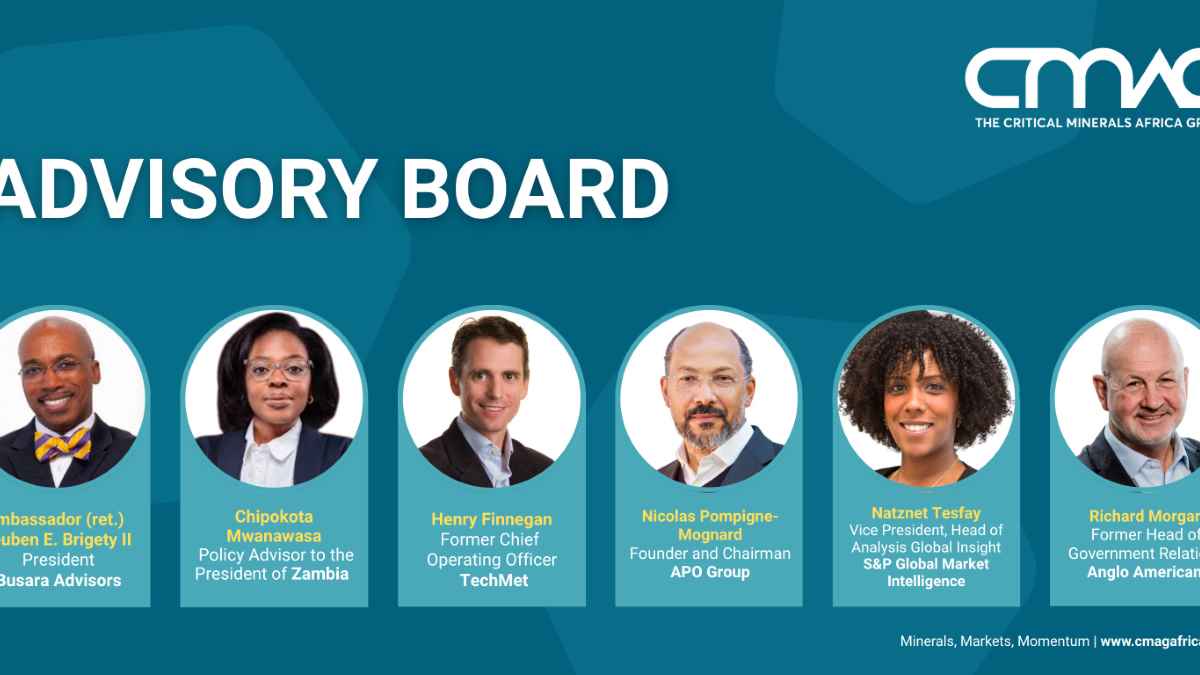
LONDON, United Kingdom, May 6, 2026/APO Group/ –The Critical Minerals Africa Group (CMAG) (https://CMAGAfrica.com/) is pleased to announce the appointment of three distinguished leaders to its Advisory Board: Ambassador (ret.) Reuben E. Brigety II, President of Busara Advisors; Chipokota Mwanawasa, Policy Advisor to the President of Zambia and Deputy Head of the Presidential Delivery Unit; and Henry Finnegan, former Chief Operating Officer of TechMet.


“Expanding CMAG’s Advisory Board with leaders of this calibre marks an important step in strengthening the depth and range of expertise guiding our work. Africa’s mineral endowment represents one of the most significant untapped industrial opportunities globally—but realising that potential requires alignment between policy, capital, and execution. By bringing together global experience across diplomacy, investment, and operations, we are better positioned to advance a more coordinated, outcomes-focused approach that supports long-term value creation on the continent.” – Veronica Bolton Smith, CEO, Critical Minerals Africa Group

These appointments further strengthen CMAG’s mission to advance responsible mining and develop commercially viable, end-to-end supply chains across Africa—focusing on practical industrial sequencing, from extraction through to processing and value addition. Central to this approach is broadening and diversifying the investor base engaging with the continent, while ensuring projects are structured to deliver tangible outcomes: scalable industries, skilled employment, and more resilient, locally anchored economic growth.

By bringing together global experience across diplomacy, investment, and operations, we are better positioned to advance a more coordinated, outcomes-focused approach

Ambassador (ret.) Reuben E. Brigety II brings decades of experience in diplomacy and African affairs, having most recently served as U.S. Ambassador to South Africa (2022–2025). He previously held senior roles including U.S. Representative to the African Union and Permanent Representative to the United Nations Economic Commission for Africa, as well as Deputy Assistant Secretary of State for African Affairs. His expertise in international relations and strategic engagement will support CMAG’s global partnerships and policy positioning.

Chipokota Mwanawasa offers a unique blend of public sector leadership, legal expertise, and private sector experience. As Policy Advisor to President Hakainde Hichilema and Deputy Head of Zambia’s Presidential Delivery Unit, she plays a key role in shaping national development priorities. With a background spanning mining, law, and entrepreneurship, she brings valuable insight into governance, investment frameworks, and inclusive economic growth.

Henry Finnegan is an experienced executive in the critical minerals investment space, having served as COO and a founding member of TechMet, a company focused on building sustainable supply chains for energy transition minerals. TechMet grew to a valuation exceeding $1.2 billion. His background in investment, operations, and international markets will support CMAG’s efforts to align capital with high-impact opportunities across the continent.

They join the inaugural members of CMAG’s Advisory Board:

  • Natznet Tesfay, Executive Director, Head of Insights and Analytics at S&P Global, who brings deep expertise in market intelligence, economic forecasting, and resource analysis.
  • Nicolas Pompigne-Mognard, Founder and Chairman of APO Group, a leading communications strategist with extensive experience in stakeholder engagement and investment promotion across Africa.
  • Richard Morgan, former Head of Government Relations at Anglo American, whose background in policy and regulatory affairs provides critical insight into government engagement and partnership building.

Together, the Advisory Board brings a powerful combination of expertise across mining, finance, policy, diplomacy, and communications. Their collective guidance will help steer CMAG’s strategic direction as it works to unlock Africa’s critical minerals potential in a way that drives sustainable industrialisation, supports education and skills development, and creates meaningful employment opportunities across the continent.

Distributed by APO Group on behalf of Critical Minerals Africa Group (CMAG).


Business

Thailand Approves $29 Billion Investment Wave as Data Center Demand Surges

Published

on

Thailand

TikTok leads new BOI approvals as Thailand moves to strengthen power readiness, clean energy access and fast-track strategic investment
BANGKOK, THAILAND – Media OutReach Newswire – 6 May 2026 – Thailand’s Board of Investment (BOI) has approved six major projects worth a combined 958 billion baht, or approximately USD 29 billion, led by a large-scale data infrastructure expansion by TikTok System (Thailand) Co., Ltd., underscoring the country’s growing role as a regional hub for data centers, cloud services and AI-driven digital infrastructure.

The approvals were made at a BOI Board meeting chaired by Mr. Ekniti Nitithanprapas, Deputy Prime Minister and Minister of Finance. The Board also approved a second batch of projects under the Thailand FastPass mechanism and discussed with energy agencies steps to strengthen electricity readiness and improve access to clean energy — two increasingly important factors in attracting large-scale digital and high-technology investment.

Mr. Narit Therdsteerasukdi, Secretary General of the BOI, said the latest approvals reflect growing investor confidence in Thailand at a time when global companies are racing to expand digital infrastructure across Asia.

“Amid continuing global volatility, investment in Thailand’s digital and advanced technology sectors continues to grow, reflecting investor confidence in the country’s potential as a regional technology hub,” Mr. Narit said. “For Thailand to capture this new investment cycle, we must be ready not only with investment incentives, but also with sufficient power, clean-energy options, skilled talent, deeper supply chains and a reliable facilitation system that allows projects to move quickly from approval to operation.”

Of the six approved projects, three are in data center and data hosting services, with a combined investment value of 913 billion baht, or approximately USD 27 billion.

The largest project is by TikTok System (Thailand) Co., Ltd., valued at 842 billion baht, or approximately USD 25 billion. The project will install additional servers and expand data storage and processing infrastructure across Bangkok, Samut Prakan and Chachoengsao Province, supporting rising demand for digital services and strengthening Thailand’s role in regional digital infrastructure.

Beyond its core infrastructure investment, TikTok has also committed to developing digital literacy and e-commerce curricula to help create new business opportunities for Thai entrepreneurs and strengthen the country’s digital workforce.

Another approved project is a 46 billion baht, or USD 1.4 billion, data center investment by Skyline Data Center and Cloud Services Co., Ltd., part of the UAE-based DAMAC Group. Located in Chachoengsao, the project will support an IT load of 200 megawatts.

A third data center project, by Bridge Data Centres IIO (Thailand) Co.,Ltd. from Singapore, was approved with an investment value of 24.6 billion baht, or USD 746 million. Located in Chonburi, the project will support an IT load of 134 megawatts.

The remaining approved projects cover renewable energy, circular economy and resource-based industries. PureCycle (Thailand) Co.,Ltd. will invest 8.18 billion baht, or USD 248 million, in recycled plastic pellet production in Rayong, using technology exclusively licensed from P&G, with Thailand serving as a key production base for the Asian market. Dan Khun Thot Wind One Co., Ltd. will invest 4.7 billion baht, or USD 143 million, in an 89-megawatt wind power generation project in Nakhon Ratchasima. ASEAN Potash Chaiyaphum Plc. will invest 31.4 billion baht, or USD 952 million, in potassium chloride production in Chaiyaphum, producing a key input for potash fertilizer.

To accelerate project implementation, the BOI Board also selected nine additional projects worth 52 billion baht, or USD 1.6 billion, for Thailand FastPass, following the first batch of 16 projects. The latest selection brings the FastPass portfolio to 25 projects, with a combined investment value of 223 billion baht, or USD 6.8 billion.

The FastPass mechanism is designed to streamline approval and permitting procedures, speed up coordination among relevant agencies — including the BOI, the Department of Industrial Works, the Industrial Estate Authority of Thailand, the Office of Natural Resources and Environmental Policy and Planning, the Customs Department and power-related agencies — and help strategic projects begin operations faster.

At the same meeting, the Board outlined steps to strengthen electricity readiness with the Ministry of Energy and the Energy Regulatory Commission, focusing on urgent power supply needs for incoming investment, particularly in the Eastern region. The Board also directed action on accelerating the issuance of Thailand’s Power Development Plan (PDP) to support future demand, new energy technologies and long-term power-system planning.

The Board also advanced plans for clean energy mechanisms, including Direct Renewable Power Purchase Agreements, or Direct PPA, which would allow private companies to buy and sell renewable electricity directly, with participation criteria and grid-service charges to be announced shortly. The Board also acknowledged the launch of Utility Green Tariff 2, or UGT2, a source-specific green tariff designed to give companies more options for procuring clean electricity.

The Board also tasked the BOI with coordinating with relevant agencies to consider regulatory improvements that would facilitate clean energy investment, including easing power-generation licensing conditions for foreign operators installing solar rooftops, and clarifying rules to support self-generation under Independent Power Supply, or IPS, arrangements.

Mr. Narit said the combination of large-scale digital investment, power readiness, clean energy access, skilled talent and faster investment facilitation is central to Thailand’s competitiveness in the next phase of global investment.

“Thailand is entering a new investment cycle in which speed, power readiness, clean energy access and skilled talent will be decisive,” he said. “The BOI is working with partner agencies to ensure that major projects can move from approval to operation as quickly as possible, while strengthening the infrastructure, workforce, supply chains and ecosystem needed for long-term growth in the digital economy.”

USD conversion based on an estimated exchange rate of 33 baht per USD.

Continue Reading

Business

RS Supports Sustainable Power Solutions Delivered by Sharps Electrical in Botswana

Published

on

Together, RS and Sharps Electrical are helping to deliver power solutions that quietly underpin exceptional guest experiences, where luxury coexists with conservation

JOHANNESBURG, South Africa, May 6, 2026/APO Group/ –RS South Africa (https://za.RS-online.com), a trading brand of RS Group plc (LSE: RS1), a global provider of product and service solutions for industrial customers, is proud to recognise the achievement of Sharps Electrical, our authorised reseller in Botswana, whose work continues to enable sustainable and reliable power solutions for some of the country’s most iconic luxury safari destinations.


Sharps Electrical (https://SharpsElectrical.co.bw) has successfully delivered electrical infrastructure for landmark projects in the Okavango Delta, including Xigera Safari Lodge, Atzaró Okavango Camp, and most recently, Elela Camp. Each of these projects represents a significant technical and environmental achievement, requiring solutions that balance operational reliability with careful preservation of one of the world’s most ecologically sensitive regions.


Working in the Okavango Delta demands more than technical capability. Projects must be executed with minimal environmental impact while meeting the exacting standards of world‑class hospitality. Sharps Electrical’s strong local presence and deep understanding of these conditions have been central to delivering power systems that are resilient, efficient, and aligned with sustainability objectives.


Reflecting on the nature of this work, José Xavier, Chief Operating Officer at Sharps Electrical, said, “Delivering projects in the Okavango Delta goes far beyond electrical infrastructure. It is fundamentally about trust, consistency, and respect for the environment. Having a reliable supply relationship is critical in such remote and sensitive locations, and RS has consistently supported us with dependable products and service that allow us to deliver to the highest standard.”

What Sharps Electrical has achieved in Botswana clearly demonstrates what is possible when strong local capability is reinforced by a dependable global supply network


As a preferred supplier, RS plays a key role in enabling this approach by providing access to high‑quality electrical products that support durable, energy‑efficient, and responsibly engineered installations. This capability allows Sharps Electrical to plan with confidence and maintain continuity across complex projects in remote locations.

“What Sharps Electrical has achieved in Botswana clearly demonstrates what is possible when strong local capability is reinforced by a dependable global supply network,” said Viv Muthan, Head of Export Sales and Operations at RS South Africa. “At RS, we create high quality experiences for our African customers by complementing the local expertise of in‑country partners with reliable, sustainably designed technologies, such as our Better World product range, backed by the RS platform.”


RS South Africa’s collaboration with Sharps Electrical reinforces a shared commitment to Make Amazing Happen for our customers. By supporting infrastructure that reduces operational risk and enables responsible energy use, the partnership helps preserve the integrity of the Okavango Delta while ensuring uninterrupted power for critical lodge operations.


Together, RS and Sharps Electrical are helping to deliver power solutions that quietly underpin exceptional guest experiences, where luxury coexists with conservation. These projects stand as a testament to what can be achieved when strong local expertise is supported by a trusted global partner with aligned values.


RS is proud to support Sharps Electrical as they continue to deliver resilient power solutions across Botswana, helping ensure that some of the country’s most iconic destinations remain reliably powered by RS for the long term.

Distributed by APO Group on behalf of RS South Africa.


Continue Reading

Business

Daqo examines moving renewable power reliably from source to load

Published

on

Daqo

Renewable projects are often located far from load centres, and the continued growth of distributed energy is changing system behaviour in ways that require earlier and more careful planning

CAPE TOWN, South Africa, May 5, 2026/APO Group/ –As reported by ESI Africa, Southern Africa is seeing major infrastructure development. Renewable energy capacity is expanding, industrial demand is rising, and electrification is reaching areas that previously had limited grid access.

However, as generation capacity grows, attention is increasingly turning to another part of the equation: how to move that power reliably from source to load.

Daqo tells ESI Africa that, for developers and EPC contractors, the distribution network is no longer simply a downstream consideration. It is becoming an increasingly important part of how projects are planned, coordinated and delivered.

Why distribution is gaining importance

Grid access, system integration and multi-party coordination are increasingly converging at the distribution level.

Renewable projects are often located far from load centres, and the continued growth of distributed energy is changing system behaviour in ways that require earlier and more careful planning.

As a result, distribution infrastructure is increasingly something projects need to design around from the outset, rather than address later in the delivery process.

A growing focus on coordination and supply

One practical consequence of this shift is greater scrutiny of how electrical equipment is sourced and coordinated.

Traditional multi-supplier models introduce multiple technical and logistical interfaces that may cause delays during installation and commissioning, particularly as project complexity increases.

With a portfolio covering medium- and low-voltage switchgear, transformers, power module systems and busbar solutions, Daqo supports a more integrated approach across the electrical distribution chain.

This can help reduce interface risk and improve alignment from design through to commissioning.

Daqo’s global footprint includes more than 10,000 customers and 32 manufacturing companies, with project engagement across Africa, the Middle East, Europe, the Americas and APAC, enabling coordinated engineering and production at scale.

Prefabricated solutions can help reduce on-site complexity and improve schedule certainty.

Prefabrication and lead time matter more than ever

On fast-track projects, delivery speed and installation efficiency are becoming increasingly decisive.


Prefabricated electrical solutions (including prefabricated substations, E-Houses and containerised medium-voltage systems) move engineering, assembly and testing into controlled factory environments.

These prefabricated solutions can help reduce on-site complexity and improve schedule certainty.

At the same time, supply timelines remain under pressure due to sustained demand growth and broader supply chain constraints.

Daqo addresses this through manufacturing lead times of four to seven weeks, integrated production across group companies, and strong vertical integration in key materials and components, all of which support delivery stability and cost control.

Performance in the field remains critical

Equipment that meets the specification on paper must also perform in the field.

Large-scale renewable integration can introduce challenges, including voltage fluctuation and reduced system inertia.

Real-world site conditions, including high temperatures, dust, corrosive industrial environments and long transport distances, place further demands on equipment durability and maintainability.

Daqo’s system-level approach incorporates intelligent monitoring, protection functions and environmental resilience into the design, helping support stable operation under variable grid conditions and compliance with IEC and project-specific standards.

Daqo looking ahead

The projects being developed across Southern Africa today will help define the region’s energy infrastructure for decades to come. Adding generation capacity is essential, but the ability to deliver, integrate and sustain electrical systems in the field will play an equally important role in determining long-term project success.

This shift in focus is already influencing how experienced developers and EPCs approach project planning, and how suppliers are expected to respond.

Enlit Africa returns to the CTICC from 19 to 21 May in 2026

Daqo will be present at Enlit Africa (Stand A5), where the team will engage with project stakeholders on distribution system design and delivery across the region. Meet us at Enlit Africa on 19-21 May 2026 at the CTICC in Cape Town, South Africa. ESI Africa, part of VUKA Group, is the Host Media Partner for the event.  More about Enlit Africa: https://apo-opa.co/4tV6HFt

Distributed by APO Group on behalf of VUKA Group.

Continue Reading

Trending