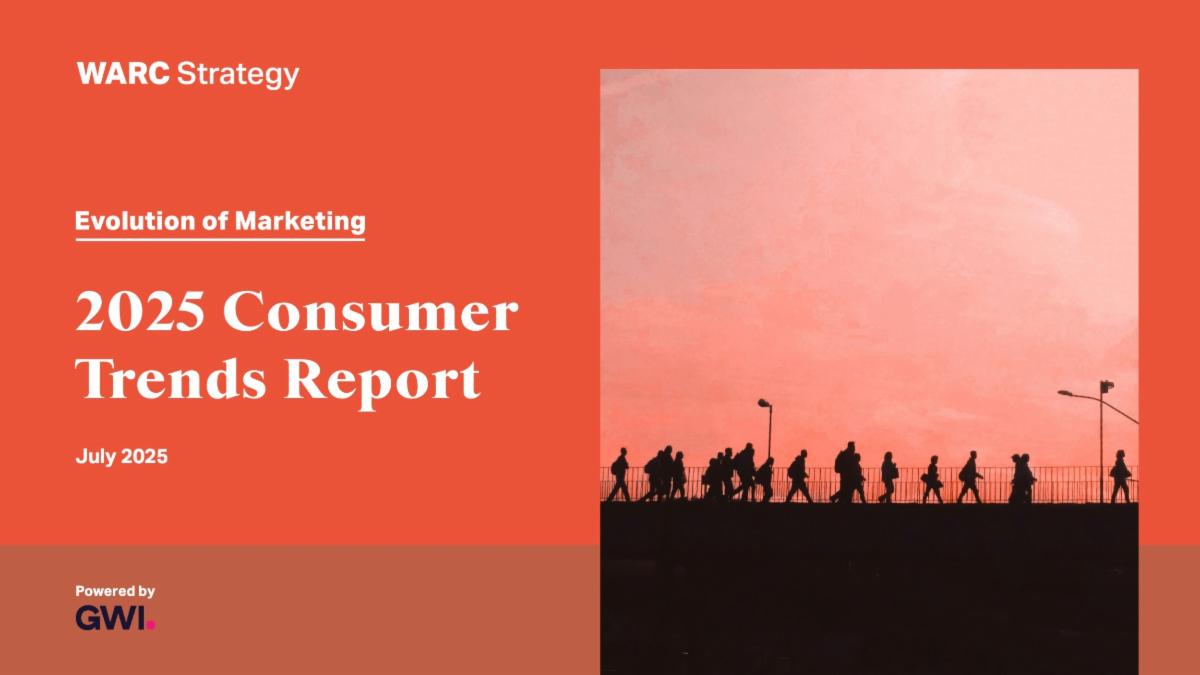
The WARC 2025 Consumer Trends report explores key issues influencing consumer purchase decisions across brands and categories
22 July 2025 – WARC has today released its 2025 Global Consumer Trends report exploring the key issues that will influence consumer purchase decisions across brands and categories over the next year.
Based on a comprehensive set of GWI surveys across 54 markets combined with WARC’s own research, case studies and analysis, the report focuses on five broad trends influencing brand selection: The widening cost-of-living gap, increasing trust in individual creators, AI assistants disrupting the purchase journey, consumers’ proactive approach to health, and the rise of alternative social activities.
Stephanie Siew, Senior Research Executive, WARC, says: “Amidst persisting economic uncertainty and the unpredictability around US trade tariffs, consumers are becoming more intentional in their spending and taking greater control over different aspects of their lives, particularly in the way they consume information, manage their wellbeing, and connect with others.
“With this report we aim to provide a wider view of the major issues confronting our industry from the perspective of consumers, with suggestions to help businesses create the most impact in the coming year.”
The consumer trends that will shape spending decisions in the year ahead, identified by WARC are:
● The widening cost-of-living gap: 55% of low-income consumers would rather pay less for a cheaper own-brand product than pay more for a brand they know
Spending power is increasingly polarised, and the widening wealth gap is causing a divergence in consumer spending habits. In the US the wealthiest 10% of households now account for almost half of consumer spending, per Moody Analytics; and UBS predicts the richest millennials will hold five times more wealth by 2030 than they do today, setting them further apart from their peers.
Tariffs are likely to accelerate this trend. Compared to higher-income households, lower-income families spend a larger portion of their income on essential goods, including more traded goods like food and apparel. Price increases in any of these areas would add substantially more strain on their budgets and reduce their purchasing power. Job losses in sectors reliant on imports are also expected to disproportionately affect lower-income families.
Within the low-income segment, 55% of consumers worldwide surveyed by GWI said they would rather pay less for a cheaper own-brand product than pay more for a brand they know. This compares to 40% in the high-income segment who said the same. The popularity of private label or own-brand products reflects consumers’ growing willingness to switch brands for better value.
Faris Yakob, Co-founder, Genius Steals, says: “Since the ‘middle class’ is bifurcating into the haves and have-nots, many companies are reshuffling to serve the top twenty percent and the top one percent within that. The lower echelons are offered value alternatives and those with money are tempted to spend it on various levels of luxury as those companies pivot to lower volume / higher margin business models.”
Marketers can respond by re-examining their target audience and adjust pricing strategies to align with changes in demand. Additionally, re-evaluate the value drivers for different segments and tailor communications and product offerings accordingly.
● The growing credibility of individual creators: Nearly half (47%) of social media users have made purchases based on influencer endorsements in the past year
Consumer attention is increasingly shifting to non-traditional information sources for news and information. Independent voices such as social media influencers and content creators, which are viewed as more authentic and transparent, are gaining traction.
Per GWI, consumers are now more likely to get their news from social media (57%) than from more traditional channels such as national TV news (52%) and news websites (49%). Consumption varies widely by generation — 71% of Gen Z have seen, read, or heard information on news from social media in the last month, compared to 62% of millennials, 48% of Gen X, and 33% of baby boomers.
As influencers build their credibility as trustworthy sources of information, their endorsements are highly valued. Nearly half (47%) of social media users have made purchases based on influencer endorsements in the past year, with trustworthiness a key factor in purchase decisions.
Sapna Chadha, VP of SEA and South Asia Frontier, Google, says: “Consumers are going to creators to discover information about brands. The difference now is that they are moving from passive discovery to really immersing themselves in an entirely new shopping experience, which encompasses video.”
Marketers can respond by leveraging individual voices, exploring partnerships with individual creators, tapping into their reach and reputation, or elevating the voices of in-house experts. Brands should also balance paid and earned media, and take a proactive approach to brand safety ensuring alignment with brand values.
● The humanisation of AI: 24% of consumers are happy to have AI agents do their shopping for them
The arrival of AI agents are expected to disrupt the way customers engage with brands. Unlike chatbots, agents can autonomously make decisions and carry out tasks on behalf of users.
OpenAI’s Operator performs tasks like filling out forms and ordering groceries, whilst Google’s Project Mariner can search flights, hotels or buy household goods.
ChatGPT remains the most popular AI tool among consumers (45% say they have used it in the past month), but others, such as Google Gemini and Microsoft Copilot, are quickly gaining ground.
Data from Salesforce shows that four in ten (39%) consumers are already comfortable with AI agents scheduling appointments, and a quarter (24%) are comfortable with AI agents doing their shopping (rising to nearly a third among Gen Z).
Debra Aho Williamson, Founder and chief analyst, Sonata Insights, says: “Soon, consumers will not even need to go to an AI platform to do what they do today. Instead, they will have an AI agent perform a task on their behalf, and the results will be delivered to them.”
Four in ten users of AI tools in the past month say that AI chatbots are efficient, provide quick responses, and just under a third (31%) appreciate that AI chatbots are available 24/7. However, data from GWI indicates that brands should not neglect the human touch with users citing emotional connection and empathy as setting human interactions apart from AI chatbots.
Marketers should respond by balancing AI and human support across touchpoints and optimise search strategies to ensure brands are visible and favourably represented in AI-generated search results.
● A proactive approach to health: 77% of consumers are concerned about the associated health risks of ultra-processed foods
Growing health consciousness and advancements in health tracking are empowering consumers to take more control over their health. There is a growing focus on preventative healthcare and healthy ageing.
More consumers are investing in vitamins, supplements, and other foods with functional benefits. Nearly a third (31%) of consumers say they have purchased vitamins or supplements in the past month, up 7pp from 24% in 2022, per GWI. Research by McKinsey revealed that millennials and Gen Z in the US were more likely than their older counterparts to have purchased a health and wellness product or service.
Growing concerns around digestive health and ultra-processed foods are driving consumers to choose which grocery items to purchase with food packaging and labels playing an important role. Over three-quarters (77%) of consumers are very or somewhat concerned about the associated health risks of ultra-processed foods.
Alberto Romano, Global Consumer & Shopper Planning Collaboration Manager, Diageo, says: “Whether it is wellness-orientated food or clothing designed for comfort and emotional wellbeing, brands have the opportunity to shape the future by carving out unique and meaningful roles and purposes that resonate deeply with consumers’ wellness lifestyles.”
Marketers can respond by spotlighting nutritional benefits, addressing and tailoring communications to the unique needs of customers, and emphasising a balanced lifestyle. Brands not traditionally linked to the health and wellbeing category (e.g., soft drinks and snacks) can tap into this sector by offering ‘better-for-you’ versions of their products or positioning some products as indulgences to be enjoyed mindfully.
● Rewriting the rules of social connection: half of Gen Z (51%) and millennials (50%) play board games at least once a month
Younger consumers are rethinking the way they spend time together. As people seek more meaningful ways to connect with each other, interest-led activities and hobbies are gaining popularity, leading to a boom in interest-based social clubs, both online (e.g., Letterboxd, Strava) and offline. The cost of going out is a major factor driving this trend forward, and it is likely to continue being a concern as tariffs increase living costs.
Data from GWI highlights the appeal of board games to younger consumers — around half of Gen Z (51%) and millennials (50%) say they play board games at least once a month. The most commonly played games are strategy, word / trivia, and party games.
For some, a greater focus on health and wellbeing has boosted their interest in fitness and exercise (38% of consumers), sports (33%), and outdoor activities such as camping and hiking (33%).
GWI data shows high consumer demand for collective, in-person experiences such as festivals and events. Over half (53%) of consumers attended a festival in the past 12 months.
Colleen Ryan, Partner, TRA, says: “Ultimately, the way people build connections has changed. We have moved from traditional systems to connecting with people whose interests are shared. For brands, this presents a challenge but also an opportunity, a middle ground on which to build connection, a space in between.”
Brands can respond by identifying new touchpoints to help boost brand visibility and mental availability, as well as creating opportunities for connection through a brand’s positioning or via experiential activations like pop-ups, workshops, and festivals.
Home Facebook













 Hospitality4 days ago
 Business4 days ago
 Energy4 days ago
 Business4 days ago
 Business4 days ago
 Energy4 days ago
 Business3 days ago
 Business4 days ago