Connect with us
Anglostratits

Tech

China Unicom and Huawei Elevate Beijing E-Town Race-Day Experiences with 5G-A GigaUplink

Published

on

China Unicom

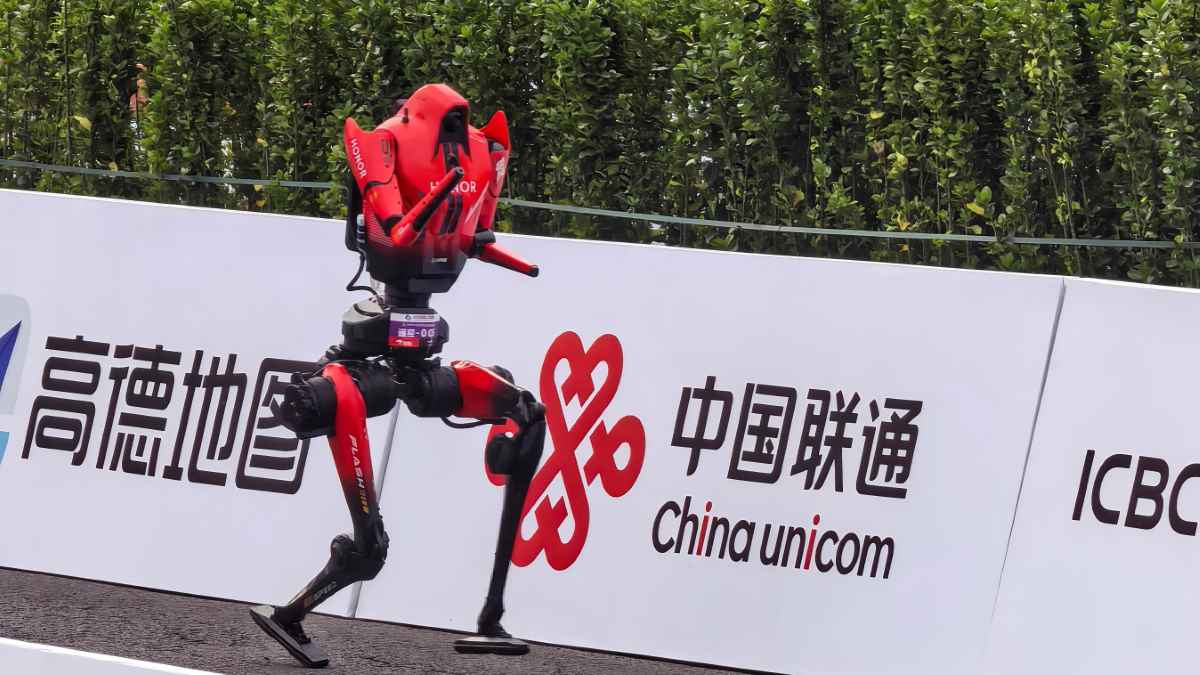
BEIJING, CHINA – Media OutReach Newswire – 20 April 2026 – China Unicom and Huawei capped off a series of successful 5G-A GigaUplink deployments by guaranteeing the premium connectivity at the Beijing E-Town Half-Marathon and Humanoid Robot Half-Marathon, where human and robot runners competed alongside through the E-Town in Daxing District. This marks the two companies’ latest landmark showcase for sports events, combining 5G-A and AI to provide fast uplink with huge capacity and low latency for event organization and media services, digital engagement, and humanoid participation.

China Unicom Delivered a Masterclass in Connected Marathon Events

Marathon events typically feature high-density crowds with an extensive demand for uploads. China Unicom and Huawei turned to 5G-A 3CC on 3.5 GHz and 2.1 GHz for the event, ensuring an uplink fulfillment at 20 Mbps surpassing 99.6%, along with a peak speed of field-tested 677 Mbps. This impressive uplink performance provided consistent and reliable support for 4K/8K broadcasting and real-time collection and editing while also enabling fans to share and stream smoothly.

Such unrivalled experience is underpinned not only by high-quality networks but also flexible operations. China Unicom and Huawei used intelligent base stations to build 5G-A intelligent, elastic channels for the event. This facilitated differentiated scheduling for livestreaming, voice and video calling, and short videos to ensure smooth experiences for fans even at heavy-traffic moments.

5G-A GigaUplink Takes Embodied AI to New Heights

In a global first, the E-Town half-marathon features a pioneering format that sees human and robot runners compete simultaneously. The humanoid robots were divided into an autonomous navigation group and a remote-control group, running on the same course and evaluated using mixed timing methods. Each humanoid robot requires approximately 10 Mbps uplink for video uploads, environment sensing, gait control, and autonomous navigation. Dedicated uplink slices were reserved to ensure a positioning accuracy of up to sub-decimeter level and an average end-to-end latency of less than 30 ms throughout the racing course, which provided strong support for the video uploads, obstacle avoidance, cornering, and sprinting of humanoid robots. While offering technical upgrades to sports events, this promoted the adoption of humanoid robots on a large scale.

Qin Yang, Deputy General Manager of China Unicom in Beijing spoke proudly of the excellent connections his company provided for the 2025 World Humanoid Robot Games as a global strategic partner and the 2026 Beijing E-Town Half-Marathon event as the exclusive official communications sponsor. “5G-A and AI are essential digital infrastructure, enabling us to bring embodied AI to sports. Given the new dynamics of AI development, we will double down on our priorities over connectivity, computing power, services, and security to sharpen our competitive edges as a preferred telecom partner for intelligent sports and a core enabler for intelligent industry transformation. Moving forward, we will accelerate our innovation-driven push to strengthen our digital infrastructure and drive the high-quality growth of embodied AI in China and beyond.”

Samuel Chen, Vice President of Huawei’s Wireless Network Business Marketing, said this humanoid robot half-marathon offers a good example of deepening integration between mobile technology and embodied intelligence. “Beyond redefining connectivity for sports, it has shown us what intelligent production and life will look like in future. We are always dedicated to building excellent 5G-A networks together with operators based on user-centered innovation to ensure GigaUplink, low latency, and high reliability for differentiated mobile AI services. This will enable us to continuously drive the high-quality growth of the digital economy.”
 

Tech

Huawei Highlights Continuous Innovation, Securing Competitive Edge Through Technological Breakthroughs

Published

on

Competitive Edge

SHENZHEN, CHINA – Media OutReach Newswire – 3 October 2026 – Huawei hosted an international media roundtable today featuring Richard Yu, Executive Director, Chairman of the Investment Review Board, and Chairman of the Board of Directors of the Consumer BG. Yu shared comprehensive insights into Huawei’s consumer business and HarmonyOS ecosystem.

Richard Yu joined Huawei in 1993, working on early developments like the first-generation program-controlled switch and participating in the establishment of Huawei’s wireless communications business, which started with GSM. Over the past decade, Yu has led Huawei’s consumer business with the vision to deliver a seamless AI life experience to all consumers across five key scenarios: HIMA-powered Smart Travel, HarmonyOS Office, Smart Home, Fitness & Health, and Entertainment, which he said is also the long-term strategy for Huawei’s consumer business over the next 10 years.


 Between 2007 and 2025, Huawei invested more than CNY1.8 trillion into R&D shifting from roughly 10% of annual revenue in early years to over 20% recently. Huawei has continued to increase investment into the core technologies of the ICT domain and basic research, which has translated into robust core capabilities, extensive intellectual property, and a vast patent portfolio, and helped with achieving a series of breakthroughs in technological innovation.

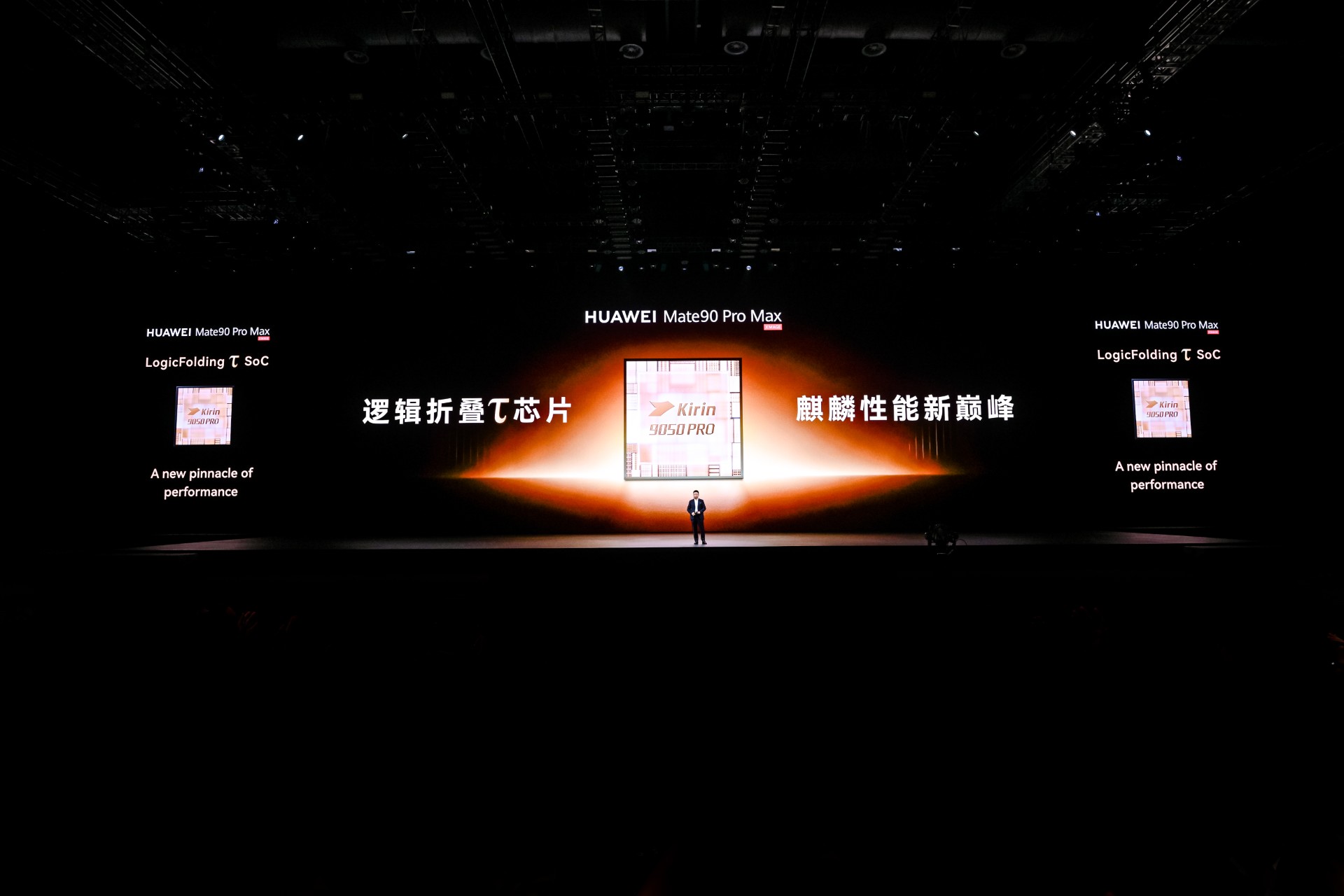
The Mate 90 series smartphones Huawei just launched come with the latest Kirin 9050 Pro chip. The overall device performance is 31% higher than the previous generation. The Balong modem, image sensor processor (ISP), mobile security processor (MSP), Lingxi CPU, Maleoon GPU, and the NPU that adopts Huawei’s Da Vinci architecture for AI processing are all designed by Huawei. They offer higher energy efficiency and deliver much-improved overall system-level performance.

Even though Yu admitted that Huawei has limited access to advanced semiconductor processes, Huawei recently made a new breakthrough in the semiconductor domain – the LogicFolding technology under the Tau Scaling Law. Unveiled by He Tingbo, head of Huawei’s Semiconductor Business Department this May, this technology vertically stacks the logic layers of chips and restructures the circuit layout through inter-layer high-density interconnect to shorten critical paths and reduce latency. This technology was adopted on Kirin 9050 Pro chip, which shows very strong AI processing power. The Mate 90 series powered by this chip can run a 30B MoE on-device AI model.

In the AI domain, Yu talked about the Ascend compute foundation that Huawei provides, by remarking Huawei’s large models called openPangu, AI capabilities for intelligent driving, and HarmonyOS Celia, which is similar to Gemini in the Google Android ecosystem. Huawei is also using AI to improve the O&M of communications network equipment. By combining AI computing power with domestic open-source large models, Huawei’s vision is to help enterprises and industries around the world to become more productive and bringing more convenience to everyone.

In the past years, Huawei has launched a broad series of products and solutions, including smartphones, PCs, tablets, wearables, TWS audio products, Smart TVs, home routers, smart home control solutions, as well as intelligent electric vehicles together with partners. Underlying these products and solutions are Huawei’s chip hardware platform and HarmonyOS – another OS ecosystem after iOS from Apple and Android from Google that Huawei developed to support all the smart devices and smart hardware across all scenarios.

Development of HarmonyOS began in 2019. Before that, Huawei was a major contributor to the Android community as well as the entire Android ecosystem. Now, more than 90 million devices, including smartphones, PCs, and tablets, currently run on HarmonyOS 6 and HarmonyOS 7. This figure is expected to hit the 100 million mark by the end of this year. The number of apps and services in the HarmonyOS ecosystem has already exceeded 450,000. Its global registered developer count has reached 11 million, and Huawei now has over 23,000 app innovation partners. Expressing his special thanks to all partners and developers for their trust and support, Yu also pointed out that Huawei is considering gradually bringing HarmonyOS to the global market in the future.

Globalization is another topic of the conversation. Yu mentioned that Huawei had very good collaboration with many companies from the US, Europe, Japan, South Korea, and Taiwan, delivering huge business value and benefits to those partners. When it comes to the difficulties that Huawei overcame since 2019, Yu said that relying on homegrown technologies and capabilities, Huawei gradually designed its own operating system and developed basic tools and software by themselves, putting a domestic supply chain in place. In 2023, Huawei started to manufacture the chips used by smartphones domestically again. With these chips and HarmonyOS, and by relying on China’s domestic supply chain, materials, and process nodes, Huawei has basically gotten rid of the dependence on US technologies.

While Huawei’s global market share was once No. 1, nowadays it only sells several million units of smartphones outside China every year. However, Yu revealed that Huawei is trying to return to the overseas market step by step.

Taking wearables as an example, Huawei is No. 1 in terms of the market share both in China and globally. Other innovative products such as TWS earphones, are also growing fast and have reached No. 1 in many countries. While Huawei’s tablet and PC business was greatly affected after it was denied access to Windows and Intel x86 chips, the HarmonyOS-based tablets are now performing strongly. Another example would be CPE, which is a mobile router that provides connectivity to the unconnected in remote and rural areas. These products are also very well received across many regions outside China, helping more people connect to the rest of the world and live better lives.

Question: Both the Huawei XT 2 and the two most advanced models of the Mate 90 series use a LogicFolding chip. Will LogicFolding chips be used for more phones in the future? We understand that Huawei’s chip production capacity is still limited. Huawei has launched SuperPoDs, and AI infrastructure is a huge business. They are both very important in China. How do you secure a larger share of the chip supply internally?

Richard Yu: We started introducing the chip that adopts the LogicFolding technology powered by the Tau Scaling Law to the Mate XT 2 tri-fold phone. To answer your question, yes, more of our phones will definitely use these LogicFolding chips in the future.

Currently, the production capacity for advanced semiconductors in China still cannot meet the rapidly growing demand. Huawei’s Ascend chips for the AI domain also use such capacity. But we have developed a requirement plan, which also covers the chip requirements of smartphones.

The sharp price increase for memory components over the past two years has somewhat limited the smartphone sales volume. Even though the production capacity remains tight right now, generally it is sufficient to meet our market shipment needs.

We hope that production capacity will ramp up in China’s semiconductor industry so that we can manufacture more advanced products for consumers in the Chinese market as well as the overseas market in the future.


Continue Reading

Tech

Cracking the Interoperability Code of African Continental Free Trade Area (AfCFTA)’s Digital Trade Era (By Ludovic Thanay)

Published

on

The potential is huge: UNCTAD estimates that tackling non-tariff barriers could generate about $20 billion a year for African economies, more than five times the $3.6 billion expected from eliminating tariffs

DUBAI, United Arab Emirates, October 8, 2026/APO Group/ —By Ludovic Thanay, Senior Vice President of Sales, Webb Fontaine (WebbFontaine.com/)

Somewhere in Africa, a truck waits at a border while a declaration already in the system is retyped. The customs system behind it knows the cargo, the consignee and the duty paid. The system 50 meters away, across the line, does not know of it. What one knows about a consignment rarely follows it to the next. The real database still travels in a folder on the dashboard.


This is Africa in 2026. In February 2025, the African Union adopted eight annexes to the AfCFTA Protocol on Digital Trade, covering cross-border data transfers, digital identities, digital payments and emerging technologies. Customs cooperation already has a legal footing in the AfCFTA’s Protocol on Trade in Goods, whose annexes on customs cooperation and mutual administrative assistance and on trade facilitation bind State Parties to work together at the border. Much of this still has to be ratified and written into national law. The rules are largely drafted. The wires are not.

The gap sits between the rulebook and the wire. Protocols are negotiated in conference rooms, but clearance happens at border posts with systems that were never designed to talk to each other. Closing this gap is the real test of the digital trade era.

It’s easy to blame technology, but interoperability fails more for lack of legal frameworks than technical tools: agreements to recognise and accept each other’s data, mutual recognition of Authorised Economic Operator status, and data protection adequacy. Rules of origin show how wide the gap between agreement and application can be. In February 2026 the AU Assembly adopted the last outstanding rules, for automotive products, clothing and textiles, completing the AfCFTA’s origin rules on paper. A rule helps a trader only once it sits in national tariff schedules, customs systems and certificate checks, and across much of the continent that work is still under way. Technology follows the legal mandate; once it exists, tech determines if the rulebook delivers cleared containers or just communiqués.

Each country has its own procedures, data standards and systems, built at different times to different specifications. The company I represent built several, giving me direct insight into the issue: a system optimised for one administration’s revenue and compliance needs rarely works for its neighbour. Traders crossing several borders pay the price in duplicate declarations and delays.

The potential is huge: UNCTAD estimates that tackling non-tariff barriers could generate about $20 billion a year for African economies, more than five times the $3.6 billion expected from eliminating tariffs.

Why single windows stop at the border

Many countries have built national single windows, achieving real domestic gains. But without an outbound layer to pass declaration data to the next customs administration, the process breaks down at the border, reverting to manual checks.

A second limit receives less attention. A Single Window is not a customs window. Much of the delay sits with agencies that are outside Customs: standards bodies, food and drug regulators, phytosanitary inspection, and port health. And this is significant. The World Customs Organization (WCO) Time Release Study shows where delays occur; every interoperability programme should start and end with a TRS.

The bilateral trap

It would be wrong to suggest Africa has not solved cross-border data exchange. It has, bilaterally, and repeatedly. The ECOWAS SIGMAT transit system was operating in nine member states by May 2025, when the Benin-Nigeria interconnection launched at Sèmè-Kraké. On 11 September 2026, the same two administrations went further. Their Customs Declaration Exchange System pilot, linking Benin’s Customs Webb with Nigeria’s B’Odogwu, lets officers in the destination country see a declaration lodged in the departure country, along with manifests, transit data and risk alerts. Each country keeps its own duty calculation, risk assessment and release. That is federation in practice, on the Abidjan-Lagos corridor that Nigerian Customs says carries about 70 per cent of West Africa’s transit trade. The East African Community’s Single Customs Territory shares declaration data and cargo tracking along the Northern and Central Corridors. COMESA’s transit guarantee moves goods under a single bond across multiple states. These are working systems, built by African institutions.

The problem is scale. Sèmè-Kraké took years of work to connect one pair of administrations. Fifty-four signatories generate 1,431 possible bilateral links, each separately negotiated, mapped and maintained, and re-tested whenever either side upgrades. Continental success requires one shared data definition, implemented once per country; one integration each, not one per pair.

It’s easy to blame technology, but interoperability fails more for lack of legal frameworks than technical tools

A common language, and what technology can do for it

The WCO Data Model provides the vocabulary, code lists and message structures almost every African administration aims for. The difficulty is that national implementations diverge. Fields are added for local requirements, legacy structures go undocumented, and the knowledge is often lost. Mapping national systems to the Data Model is laborious and must be redone with every upgrade.

This is where machine learning helps: discovering candidate mappings between undocumented legacy systems and the Data Model, inferring field meanings, and keeping those mappings current as systems change. Today, this work is manual and slow, and the highest cost in interoperability programmes.

But AI should not rewrite declarations in flight. Declarations are legally binding and must be transformed in ways that are deterministic, versioned, logged and auditable. Use machine learning to build and maintain mappings, but let published, deterministic mappings execute them. Anything else asks a revenue authority to accept an unauditable component inside its assessment chain. The same discipline applies to exceptions, because mismatched records and disputed classifications are where the operational burdens lie.

Federation, and who owns it

Africa should not centralise its Customs data. Federation is the right architecture. Each country keeps its systems and data, connects through agreed standards and secure interfaces, and shares only what’s needed for each transaction. The reasons are legal as well as political. Customs data is fiscal data, subject to statutory secrecy and regulations in most jurisdictions.

Federation, however, is an architecture, not a governance model, and this is where the debate is thinnest. Someone needs the mandate to define “only what is necessary.” The AfCFTA Secretariat, with the WCO and the Regional Economic Communities (RECs), is the obvious home for a continental exchange standard and the dispute mechanism behind it.

Until empowered, every implementation is a bilateral negotiation with added technical complexity. Security must also be addressed as each new interconnection widens the attack surface of critical revenue infrastructure.

What to do next

The cautionary example is TradeLens. Backed by Maersk and IBM, blockchain-enabled and presented as an open, neutral industry platform, it closed in 2023. The technology worked, but participation never reached critical mass. Interoperability offers little value to the first mover: country A gains nothing until B, C and D connect. So, four priorities require an owner, a date and a measure:

1. Designate the standard. The AfCFTA Secretariat, WCO and RECs should publish a single continental profile of the WCO Data Model as the mandatory exchange format, with a conformance test. Until one profile is named, every country and vendor builds to a different target.

2. Build the legal gateway. A model bilateral data-exchange agreement and framework for mutual recognition of AEO status would remove the largest source of delay in these projects, which is legal rather than technical.

3. Fund and measure two corridors. Baseline two live corridors with a Time Release Study, connect them to the continental profile, and publish the results. A target such as data reused across the border in 60 per cent of consignments, and release time down by a third, is what attracts financing from the AfCFTA Adjustment Fund and the development banks. Pair it with PAPSS, so settlement matches the speed of the paperwork.

4. Bring the traders in, including the smallest. Broadband, power and current hardware at border posts are the prerequisites and must be costed as multi-year infrastructure. Much intra-African trade is informal, often by women small traders. Without simplified regimes and a low-value threshold, interoperability  will serve large shippers and formalise nobody.

The technology exists. Most standards are set, and the working examples are African. What’s missing is a named owner for the standard, cross-border legal instruments and proper funding for two corridors. That’s the code to crack. It is a governance problem in a technical disguise, and why Africa’s goods still move faster than their data.

​

Distributed by APO Group on behalf of Webb Fontaine.


Continue Reading

Tech

OPPO Find X10 Series to Launch Globally on October 21 with Next-Generation True-to-Life Imaging

Published

on

OPPO

SHENZHEN, CHINA – Media OutReach Newswire – 8 October 2026 – OPPO today announced that its latest flagship smartphones, OPPO Find X10 Series, will make their global debut on October 21 in Mallorca, Spain. Built to be a “Hasselblad True-to-Life Camera”, the new series combines industry-leading camera hardware with the next-generation LUMO True Image Engine, marking a new chapter in OPPO’s pursuit of true-to-life imaging.


“Find X Series reflects our relentless pursuit of exceptional mobile imaging,” said Pete Lau, SVP and Chief Product Officer at OPPO. “Together with Hasselblad, we are taking another significant step forward with Find X10 Series, bringing true-to-life detail, color and tone to everyday photography. Simply open the camera and capture the moment as you see it, with no extra settings required.”

Find X10 Series carries forward the Find X Series’ minimalist design language with premium materials and thoughtfully crafted details. Its all-new Borderless Design features One-Piece Sculpted Glass that flows seamlessly into the camera module, softening the visual impact of the camera bump for a clean, cohesive look.

Find X10 Pro Max in Luna White draws design inspiration from classic cameras. Its LUMO Camera Island features a matte silver metallic finish and houses the new-generation True Color Camera and dual-flash system, complemented by knurled detailing and Hasselblad’s signature matte orange accent ring. Across the back, smooth matte glass meets a subtle fabric-inspired pattern in a distinctive two-tone finish.

Find X10 will be available in Glacier Blue, Glow Coral and Mist Grey, while Find X10 Pro Max will come in Titanium Grey and Luna White.

The series pairs this refined design with a major leap in imaging hardware. Find X10 features a category-first Dual 200MP Camera System co-developed with Hasselblad. Find X10 Pro Max goes even further with the industry’s first Triple 200MP Camera System, bringing 200MP sensors to the ultra-wide, main and telephoto cameras for the first time on a smartphone.

Making the most of its camera hardware is OPPO’s next-generation computational photography solution, LUMO True Image Engine. It combines OPPO’s imaging expertise with the natural tone rendering of Master Mode, supported by precise color information captured by the True Color Camera. LUMO True Image Engine delivers authentic detail, accurate color and natural tone. From nuanced skin tones and fine textures to the natural contrast of a scene, images stay true to the moment as you remember it.

Find X10 Series also brings a major upgrade to videography. On Find X10 Pro Max, all three rear cameras support 4K 120fps and 8K 30fps video recording, while Find X10 brings the same capabilities to its two 200MP cameras. Find X10 Series also introduces Open Gate Capture, using the sensor’s full imaging area to capture more of the scene and give creators greater freedom to crop and reframe the same footage for landscape, portrait and other formats in post-production.

Powering Find X10 Series are flagship MediaTek chipsets. Find X10 runs on MediaTek Dimensity 9600M, while Find X10 Pro Max is among the first smartphones to feature the 2nm MediaTek Dimensity 9600 Pro, delivering a major leap in both performance and power efficiency.

Both models feature an 8,000mAh OPPO Silicon-Carbon Battery¹, delivering up to two days of typical use on a single charge. Designed for long-term durability, the battery is also engineered to retain over 80% of its original capacity after five years of typical use.²

Find X10 Series also features the latest ColorOS 17, bringing a fresh look and smarter everyday experiences. Its new Living Flow Design combines refined visuals with fluid interactions, while AI Mind Pilot with Agent Mode connects agentic AI with files and photos on the phone, helping users complete complex tasks with a single prompt.

OPPO will reveal full specifications, pricing and availability, alongside more of the series’ latest innovations, at the global launch in Mallorca on October 21.

¹ Battery capacity may vary by market. Find X10 and Find X10 Pro Max feature a 7,150mAh battery in selected markets.
² Data from OPPO Lab. Actual battery health may vary depending on settings, usage and environmental conditions.


Continue Reading

Trending