● Landmark study proving that brand building works in delivering growth in dynamic Asian markets
● Campaigns that have a 50% brand investment proven to boost performance now – not just in the future
● Brands that invest time into cultural connection are twice as effective
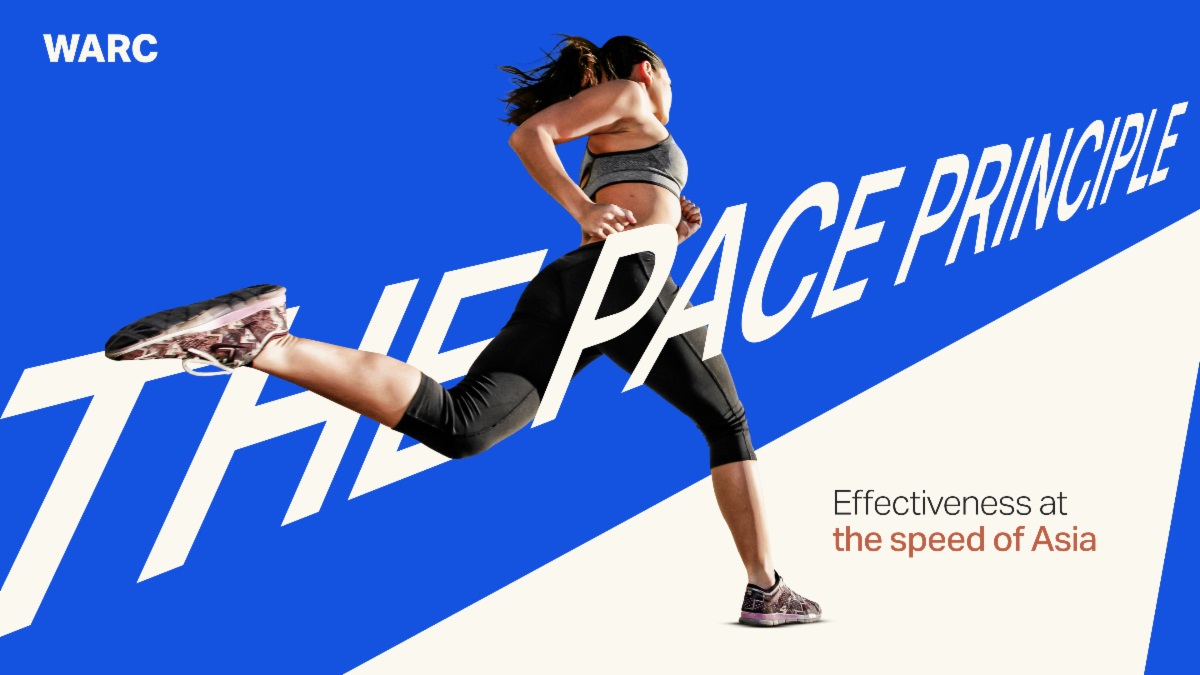
WARC releases new research in The Pace Principle
4 April 2025 – WARC, the global authority of marketing effectiveness, has today released The Pace Principle, a landmark Asian evidence-led and mythbusting guide for marketers providing evidence of what works in Asia.
Until now, most evidence underpinning core advertising effectiveness principles has come from Western markets. This ground-breaking research is built on consistent data from across Southeast Asia, Greater China, and India, to address common misconceptions that hinder businesses from maximising returns – specifically the perceived barrier that “Asia moves too fast for long-term brand building to work” due to the speed of changing market dynamics and innovation.
A key insight from the research is that “speed” is a defining feature of Asian marketing, thereby the study uses the language of “pace” to make marketing science principles more applicable to the region. The race for growth operates at “twin paces”. The “Sprint” pace uses performance tactics to secure short-term wins at speed; and the “Long-distance” pace, sees investment in brand-building to sustain long-term growth.
To cut through in a competitive marketplace and amplify positive customer associations, brands need to operate at both levels of pace equally.
Rica Facundo, Managing Editor, WARC APAC, says: “In a highly pressurised, fast-changing and competitive atmosphere, a “sprint” mindset that focuses on short-term wins is understandable, but growth is hard after maxing “easy” wins. To win, brands need to be able to operate at both levels of pace by layering in brand-led advertising to supercharge performance and unlock more value. This enables brands to not only run faster, but further.”
“Helping prove what works in Asia, The Pace Principle is packed with robust evidence and actionable insights, which we hope will be used as a model for the future of advertising in Asia and help marketers build stronger brands in our thriving region.”
Addressing legacy assumptions and challenges
To boost sustainable performance and unlock enduring value, marketers should address the following legacy assumptions and challenges:
· Speed vs effectiveness: brands are conflating the need for operational agility with a short-term approach to marketing, assuming that long-term brand investment will be undermined by market changes.
· Short-termism: In dynamic markets where change feels constant, trying to sell in the prospect of long-term results is a challenge in organisations prioritising short-term wins due to the focus on quarterly and annual performance.
· Brand payback: marketers need to get away from the perception that the payback of investing in brand-building takes years to show.
Andreas Krasser, CEO, DDB Group Hong Kong, said: “Brand building has an image problem in Asia. It’s seen as slow, outdated, and out of sync with the region’s relentless pace. Many still associate it with big-budget TV spots, high spend with low tangible returns, and a distraction from performance goals. Even when the brief says “brand,” the KPIs scream performance.”
Key strategies for effective brand building in Asia outlined in The Pace Principle are:
Long-term brand building supercharges performance. The optimum split between brand and performance investment in Asia is 50:50
Advertising in Asia needs to operate at the two levels of pace – sprint (performance) and long-distance (brand-building) – to drive the biggest instant and long-term impact.
By allocating investment towards both brand-building and performance, brands can take advantage of a multiplier effect. It’s not “brand + performance”, but “brand x performance”
Brand investment is a growth multiplier in the Asian century that drives performance now and in the future. It provides a strategic platform that cuts through in a competitive marketplace, amplifying positive customer associations and scaling-up future demand.
The evidence from this study shows that campaigns with a 50:50 split between brand and performance investment deliver the strongest effect on both short- and long-term business metrics; and even delivers stronger instant impact than a split that over indexes on just performance.
Measure campaigns for the long game: the effects of shorter campaigns are four times stronger when measured for a month after the campaign finished
Campaign measurement should prioritize measuring for growth. Using short-term ROI as the primary measurement mindset overlooks the future effects of brand-building activities, such as strengthening brand memory and increasing demand for the brand.
For shorter campaigns (1-4 weeks of duration), the effects observed were, on average, four times stronger across all key business metrics, when measurement continued for a month or more after the campaign finished.
Win with cultural advantage: demonstrating a shared perspective and value with audiences is nearly twice as effective
Cultural connection is an under looked key driver of emotional engagement that drives positive business effects. Research shows that brands with high cultural resonance grow 25% more than their competitors, and 92% of respondents in McCann Worldgroup’s Truth about Global Brands study believe that Asia’s culture is its greatest source of wealth.
However, the pressure for speed and budget constraints can leave little time for brands to undertake the critical work of understanding the cultural context of its consumers.
The Pace Principle research shows that campaigns that demonstrate a shared perspective and values with audiences are nearly twice as effective compared to those that make minimal attempts at localisation.
Brands should dedicate time and resources to thoroughly understand the cultural nuances of their target audience to maximise effectiveness by going beyond outdated stereotypes and always investigating how audiences are redefining their identities in new and dynamic ways.
Shilpa Sinha, Chief Strategy Officer, McCann Worldgroup, APAC, says: “When culture is an unequivocal cornerstone of Asia’s consumer landscape, a ‘culture-first’ marketing approach cannot afford to remain a catchphrase. It needs to become a creed for any brand aiming to win in this thriving region.”
Accelerate with multichannel momentum. Effective campaigns in Asia use on average 6.5 channels to deliver large business effects
In a fragmented media ecosystem, highly effective campaigns leverage the momentum of using multiple channels to maximise the payback of all advertising.
Evidence from the study shows that effective campaigns use on average 6.5 channels to deliver large business effects, by utilising a smart combination of media to build multiple smaller exposures and positive brand associations across various touchpoints. Key to driving cross-media effects is understanding the most optimal media combinations to leverage the multiplier effect.
Questioning long-held channel assumptions and the “mobile first” depiction of Asian consumers will help marketers make more strategic decisions with the media mix.
And despite the popularity of using influencers in Asia, the study indicates that the most effective campaigns do not lead with influencers (8%) or celebrities (5%). However, when pairing influencers with other channels such as free-to-air Commercial TV, the content reaches far beyond the fan base and the digital environment, thereby becomes 1.5x more effective in driving results.
A sample of The Pace Principle is available here. WARC members can read the full report which includes practical insights, exemplary case studies and charts to help CMOs and marketers of every level apply these ideas to their own work. Accompanying podcasts will be available from 10th and 17th of April.
Methodology of the research
The research for the report is based on in-depth analysis of 150 advertising case studies in the WARC database sourced from across Southeast Asia, Greater China, and India, as well as an accompanying questionnaire submitted by participating agencies: BBDO India, BBH Singapore, BLK J Havas, DDB Group Hong Kong, DDB Mudra Group, Forsman & Bodenfors Singapore, Initiative, MBCS, McCann Worldgroup APAC, GroupM, Ogilvy, TBWA\Asia, TBWA\India, The Womb, UM, VML.
The Pace Principle is a companion report to the recent US report The Multiplier Effect, and builds on some of its key arguments and frameworks which have been tested to also apply to Asia.
















 Hospitality4 days ago
 Business4 days ago
 Energy4 days ago
 Business4 days ago
 Business4 days ago
 Energy4 days ago
 Business3 days ago
 Business4 days ago