Business
Africa Health Excon: Positioning Africa as the continental hub for health innovation and trade
Published
4 years agoon
Merck is actively bringing technical and process expertise with various key African countries and customers to build local manufacturing capabilities
CAIRO, Egypt, June 6, 2022/APO Group/ —
The Merck (MerckGroup.com) Africa Bureau aims to accelerate the business transformation of the company operations in Africa to ensure sustainable business and create long-term value. Merck has unveiled plans to expand its footprint in Africa through a four-tiered program of awareness, diagnosis, training of healthcare professionals, and treatment access. Merck announced the brand-new Thyroid awareness program: ThyroAfrica to spread disease awareness. Africa Cancer Care program will be launched to enhance colorectal cancer diagnosis across Africa. Merck continues its work in the fight against Malaria and the neglected tropical disease (NTD) schistosomiasis. Merck is actively bringing technical and process expertise with various key African countries and customers to build local manufacturing capabilities.
Merck, a leading science and technology company, announced today its further commitment to Africa, by strategically expanding its access and awareness programs and strengthening the health systems and patients in low- and middle-income countries across the continent. The announcement came today during the Africa Health ExCon from 5th to 7th of June 2022 in Cairo, Egypt.
In this three-day event, stakeholders across Africa are meeting to learn from the worldwide leaders and experts in healthcare, as well as to share and exchange knowledge and experiences with more than 20,000 participants from more than 55 countries. The key objectives of Africa Health ExCon are refocusing on Africa’s investment potential, ensuring equitable access of health technology, the thriving of the health and pharma businesses, and incubating health innovation and trade in Africa.
”Our aspiration is to be one of the leading healthcare partners in sub-Saharan Africa and to work with NGOs and governments to build and strengthen sustainable health systems within it,” said Dr. Karim Bendhaou, Head of Merck Africa Bureau. “The Merck Africa Bureau aims to accelerate the business transformation of our operations in Africa to ensure sustainable business and create long-term value while seeking to balance environmental, social, and governance aspects. Through the four pillars of Private Public Partnership model, we work hand in hand with our stakeholders through various programs to fight counterfeit medicines, to invest in the technology transfer, to support supply chain sustainability and localization, and to decrease fragmentation of the market.’’
During the ExCon, Merck has unveiled plans to expand its footprint in Africa through a four-tiered program of awareness, diagnosis, training of healthcare professionals and treatment access. The company announced their brand-new Thyroid awareness program and upcoming launch of the Africa Cancer Care program in addition to enhancing ongoing initiatives.
Thyroid disease awareness is relatively very low in Africa. The ThyroAfrica program’s objective is to establish a collaborative partnership with the endocrinology & thyroid disease societies in Africa. This aims to increase disease awareness via communication channels for mass reach of around 7 million people and to offer the proper link for TSH (thyroid-stimulating hormone) test.
Merck has unveiled plans to expand its footprint in Africa through a four-tiered program of awareness, diagnosis, training of healthcare professionals, and treatment access
Africa Cancer Care program will be launched by the end of June to enhance colorectal cancer diagnosis across Africa by creating hubs of RAS testing in African countries such as Kenya and Nigeria. The RAS (RAT Sarcoma) test is a gene mutation analysis in colorectal cancer. As a predictive biomarker for the disease, it helps to guide treatment and determine outcomes. This would help to counteract the rising demand for specialist care especially with the existing healthcare facilities that require the scaling of resources. This has led to the rise in medical tourism across the continent, as individuals seek specialised care elsewhere. This is in addition to enhancing access to medication and providing HCP capacity-building programs through high quality trainings to oncologists, pathologists, nurses to support diagnosis and treatment of metastatic colorectal cancer in Africa.
“We will remain fully committed to increase access to innovative medicines across Africa and on ground awareness campaigns in a favour of underserved populations in low- and middle-income countries in Africa through our investments and our innovations in science & technology, together with our external partners,” said Ramsey Morad, Regional Vice-President, Head Middle East, Africa, Turkey & Russia/CIS at Merck Healthcare. “Beyond developing novel treatments, we must address the gaps in awareness, accessibility, affordability and availability of treatment.’’
After having signed a Memorandum of Understanding, Merck and the African Federation for Fertility Societies (AFFS) have been jointly working on an agenda to further develop educational training programs for healthcare professionals, aimed at improving access to high-quality infertility care for patients in Africa. By combining their forces, AFFS has sought support from Merck in order to develop a regional patient awareness campaign to be launched later this year. Additionally, they are hosting a multi-national advisory board to gain insights on educational gaps for healthcare professionals in AFFS member societies in African countries.
Professor Gamal Serour, President of African Federation of Fertility Societies stated that “AFFS welcomes and appreciates collaboration with Merck for the implementation of high-quality care across Africa”.
Merck also continues its work in the fight towards the elimination of the neglected tropical disease (NTD) schistosomiasis towards its elimination as a public health burden. In partnership with the World Health Organization (WHO), we provide up to 250 million tablets of praziquantel per year to treat mainly school-aged children in sub-Saharan Africa (SSA). Since 2007, Merck has donated over 1.5 billion tablets and enabled the treatment of more than 600 million school-aged children in 47 countries in SSA. To support the elimination of schistosomiasis, Merck have adopted an integrated approach which, beyond medicines, includes health education as well as water, sanitation and hygiene (WASH) initiatives. We also conduct research for new drugs and diagnostics and develop, together with a consortium of partners, a potential new paediatric treatment option for children as of 6 years of age and below.
Since 2015, Merck has also been very active in the fight against malaria through a holistic approach to prevent, control, and eliminate the disease. Examples include our M5717 drug development program as well as the creation of the Pan African Vivax and Ovale Network (PAVON) in over 10 countries, which has led to important policy changes regarding malaria in Botswana.
During the ExCon, Merck aims to strengthen our existing cooperation with the Pharma industry and Medicine & Quality Regulators across the continent in addition to highlighting strategic projects in Africa carried out by Merck’s Life Science business sector. These efforts bring our expertise in touch with various key African countries and research institutes to enable distributed manufacturing of much-needed vaccines, biological drugs, and therapies in African countries. “Our goal at Merck is to support capacity-building of biologics manufacturing and development in Africa,” said Youssef Gaabouri, Head of Sales Middle East & Africa at Merck Life Science BioProcessing. Furthermore, Merck provides expertise to Regulatory Agencies and shares knowledge regarding the use of quality products for audit purposes. In line with the Merck’s commitment to sustainable access to health solutions in low- and middle-income countries, we implement and enhance health access programs through our shared value initiatives, global health partnerships, and access to medicine strategy.
Distributed by APO Group on behalf of Merck.
You may like
-
Huawei Unveils the Industry’s First NPO Optical Engine with Built-in Light Source, Hi-ONE, Leading the Way in High-Speed Optical Interconnect Technology Innovation
-
Created to explore: Canon EOS R8 Mark II inspires full-frame confidence and stability in a travel-ready size
-
Load shedding has eased: South Africa now faces its next industrial energy test
-
Afreximbank extends US$10-million facility to Azania Bank to support Small and Medium-sized Enterprises (SMEs) in Tanzania
-
Hong Kong’s First Five-Year Plan sets out long-term vision for development
-
International Trade Centre (ITC) and DHL renew partnership to help small businesses trade
Events
Advancing the Agentic World, Building a Solid Silicon Foundation
Published
28 minutes agoon
September 18, 2026
Key takeaways:
- Strategic focus: The rapid approach of an intelligent world is driving up demand for computing power. Huawei is focused on developing AI infrastructure, and is actively driving innovation in systems and architecture centered around SuperPoDs and SuperClusters. These efforts are aimed at building a solid silicon foundation for the intelligent world.
- Technological breakthroughs: Huawei unveiled the Atlas 960E SuperPoD, the first in the industry to use NPO. The company also launched an upgraded TaiShan 950 SuperPoD, as well as the OceanStor M900 (a memory context storage system). Interconnected with UnifiedBus, Huawei’s agentic SuperCluster can scale up to one million NPUs.
- Open ecosystems: Huawei is actively building out open computing ecosystems. To date, the Kunpeng ecosystem has attracted 4.16 million developers from around the world. CANN has moved to sustained, community-driven open-source development. Ascend now spans over 90 leading third-party open-source projects and is officially supported as a PyTorch accelerator backend.
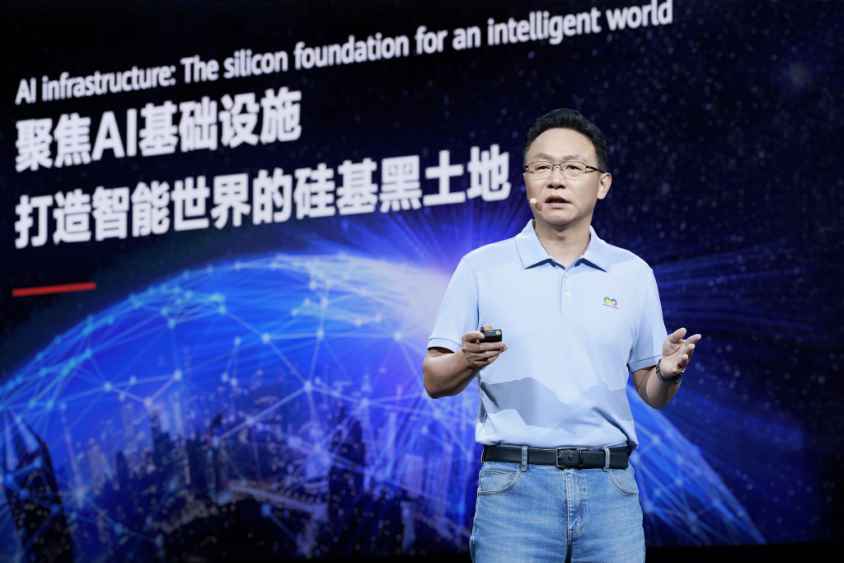
SHANGHAI, CHINA – Media OutReach Newswire – 17 September 2026 – HUAWEI CONNECT 2026 kicked off today in Shanghai. The first keynote of the date was by David Wang, the Deputy Chairman of the Board and Rotating Chairman at Huawei. In his speech (Advancing the Agentic World, Building a Solid Silicon Foundation), Wang highlighted the work the company is doing alongside industry stakeholders to build powerful AI infrastructure, lay a solid computing foundation, and address the challenges and opportunities in the intelligent world to come.
AI is sweeping the world faster than any previous technological revolution. Today, foundation model parameters are rapidly approaching 10 trillion, and are projected to exceed 100 trillion by 2030. AI agents can now work on the same task continuously, for hours on end. By 2030, they will be able to handle tasks that span months.
In China alone, the average number of inference tokens consumed every day has surged to around 500 trillion, and is expected to reach quintillions (1018) by 2030.
On-device AI is also advancing rapidly. On-device models for smartphones have expanded from three billion parameters in 2024 to 30 billion today, and will push toward hundreds of billions in the near future.
These trends will set a much higher bar for the scale, performance, and reliability of underlying technical systems. Only by building powerful AI infrastructure can the industry lay a solid foundation for the future intelligent world.
An intelligent world is approaching – and faster than ever. To lead the charge into this new world, Huawei is laser-focused on building out AI infrastructure – the silicon foundation for the future to come.
In particular, Huawei’s AI strategy is centered on computing power, with a focus on monetizing hardware. The company is also sharpening its competitive edge through systems and architectural innovation. Centering these efforts on SuperPoDs and SuperClusters, the company aims to build a solid computing foundation and offer a new option for the world.
Huawei is a major contributor to open computing ecosystems, and will continue to support native training for mainstream foundation models on its systems, as well as supporting a vast range of models and applications.
For customers, Huawei provides flexible on-premises and cloud compute solutions for its customers to accelerate intelligent transformation across industries.
With diverse forms of compute, including solutions for micro-, low-tier, mid-range, and massive computing power – Huawei is driving the expansion of on-device and in-vehicle AI, making intelligence truly ubiquitous.
Additionally, Huawei is dedicated to building next-generation communications networks to bring readily available compute and intelligence to every person, home, and organization.
SuperPoDs gain broad consensus, with adoption growing in industries, academia, and research institutes
To date, over 1,000 Atlas 900 A3 SuperPoDs have been deployed, and Atlas 950 SuperPoD is seeing large-scale commercial use. While adoption continues to grow, SuperPoDs have gained broad acceptance across industry, academia, and research institutions as a key direction for AI infrastructure. Currently, a SuperPoD is explicitly defined as a computing system in which multiple computing nodes are tightly coupled through high-speed interconnect protocols, featuring unified memory addressing across physical nodes — functioning like a single logical computer.
SuperPoDs are the go-to choice for AI infrastructure buildout. Right now, 100k-NPU computing clusters have become the baseline for training SOTA models. However, traditional server architectures result in intra-cluster communications that account for over 40% of total training time, severely constraining Model FLOPs Utilization (MFU). Simulation results from Huawei’s Markov Lab show that a 100k-NPU cluster built with 4k-NPU SuperPoDs can deliver a 2.75x increase in MFU compared to a 100k-NPU cluster composed of 8-NPU servers.
11-chip UnifiedBus-powered portfolio for SuperPoDs and SuperClusters; the Atlas 960E SuperPoD –the industry’s first to use NPO
The Ascend series of chips is the most critical component in Huawei’s 11-chip UnifiedBus-powered portfolio for SuperPoDs and SuperClusters. Development on Ascend 960 has exceeded the company’s expectations, with performance doubling as planned. Ascend 960DT will be available in Q1 2027, three quarters ahead of the company’s original roadmap. And the Ascend 960PR will be ready in Q3 2027, one quarter ahead of schedule.
“We’re evolving our Ascend chip series on a one-generation-a-year cycle,” said Wang in his keynote. “In 2028 and 2029, we will roll out the Ascend 970 and 980 chips, respectively. Thanks to the Tau (τ) Scaling Law, not only will their compute specifications continue to double, but you can also expect to see huge improvements across the board in terms of memory bandwidth, memory capacity, interconnect bandwidth, and more.”
In addition to Ascend chips, Huawei has also developed a complete portfolio of chips for AI infrastructure, based on UnifiedBus, delivering key capabilities that cover computing, interconnect, storage, and management.
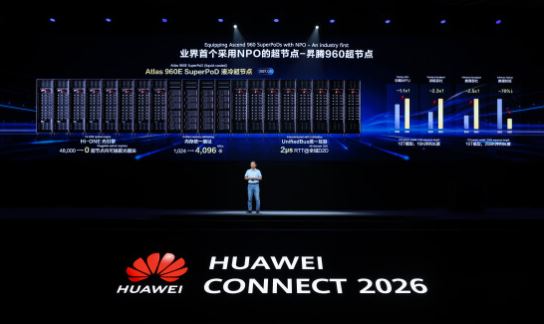
“SuperPoDs are designed to coordinate multiple NPUs through interconnect,” continued Wang. “We have developed a next-generation optical interconnect product based on near-packaged optics (NPO): the High-density Optical-interconnect-Node Engine (Hi-ONE).” Built on Huawei’s proprietary technologies, Hi-ONE has a multi-physics design for balancing optical, mechanical, electrical, electromagnetic, and thermal performance, realizing a transmission capacity of 7.2 Tbit/s per single engine.
“This is the industry’s first NPO product ready for mass production, delivering the largest transmission capacity. It is also the industry’s first NPO product with a built-in light source.”
This product combines high bandwidth and high reliability with low latency and low power consumption. This, coupled with UnifiedBus, will make it far easier to scale up SuperPoD interconnect systems.
Recently, Huawei submitted an implementation agreement (IA) on NPO to the Optical Internetworking Forum (OIF), a standards organization. The response from numerous industry partners has been widely positive. Huawei will continue its efforts to further refine the NPO industry ecosystem.
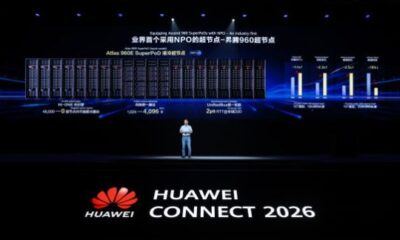
Using Ascend 960 chips and Hi-ONE, Huawei has developed the industry’s first NPO-based SuperPoDs: the Atlas 960E SuperPoDs. A single Atlas 960E SuperPoD can scale up to 4,096 NPUs, delivering 8 EFLOPS of FP8 compute performance, with up to 1 petabyte of HBM capacity. With 5,500 Hi-ONE units, this SuperPoD doesn’t need the 48,000 800G optical modules that would traditionally be required to connect all the NPUs. This cuts power consumption by over 550 kilowatts, while doubling the system’s fault-free operating time, achieving 99.8% system availability.
Combining the upgraded TaiShan 950 SuperPoD and context memory storage to power an ultrascale cluster with 1 million NPUs
As SOTA models scale to 10 trillion parameters, training and inference can no longer rely on a single AI server or AI SuperPoD – they require a more complex computing system. This system includes AI SuperPoDs, general-purpose SuperPoDs, and an interconnect system that features peer-to-peer interconnect and zero protocol conversion. For inference, including a petabyte-scale KV cache cluster is also a must.
To meet these demands, Huawei has fully upgraded its TaiShan 950 SuperPoD. Powered by UnifiedBus all-optical networking, this new SuperPoD supports up to 4,096 nodes with a unified memory pool of up to 256 TB. This setup significantly improves agent performance. For sandbox-intensive workloads, startup speeds for 100,000 sandboxes are 30 times faster than traditional servers, and sandbox density can be improved by an additional 25%. For vector search across 10 billion x 1,000-dimensional vectors, this SuperPoD delivers twice the search efficiency of traditional servers.
Huawei has also launched OceanStor M900 – a UnifiedBus-powered context memory storage cluster that delivers multi-tier KV caching for agent-heavy and longer-context workloads. Designed for agentic inference, this cluster supports one-hop direct access and provides a petabyte-scale KV cache for the L3.5 layer. OceanStor M900 also uses hybrid media and an optimized retention algorithm, extending SSD read/write lifespan by 16-fold. This ensures a higher KV cache hit rate alongside long-term stability and reliability from the ground up.
Combining its strengths in computing and communications, Huawei has built a brand-new agentic SuperCluster to accelerate training and inference for 10-trillion-parameter models. This SuperCluster uses UnifiedBus to consolidate multiple interconnect protocols into a single unified protocol, significantly reducing protocol conversion overhead. This delivers peer-to-peer interconnect between subsystems like Ascend SuperPoDs, Kunpeng SuperPoDs, and KV cache clusters. The SuperCluster also comes with a multi-tier, high-bandwidth, and large-capacity storage system that enables direct single-hop access for all KV cache tiers.
With a two-tier, four-plane Clos architecture, the SuperCluster can interconnect up to 512,000 NPUs. When combined with a multi-rail topology, this cluster can support up to one million NPUs.
One of Huawei’s core strategies: Going open source and open system to build out computing ecosystems
The Kunpeng ecosystem is driving digital and intelligent innovation across a wide range of industries. To date, the Kunpeng ecosystem has attracted over 4.16 million developers and more than 7,200 ecosystem partners from around the globe. The community currently supports over 560 open-source projects worldwide. openEuler has seen more than 20 million installations, securing the largest share in China’s server OS market.
The Ascend ecosystem has reached a new inflection point. The Compute Architecture for Neural Networks (CANN) is the foundation of the Ascend ecosystem. Today, CANN has moved to sustained, community-driven open-source development, which has brought the platform from usable to user-friendly.
External CANN developers now comprise 61% of all CANN developers, outnumbering internal developers for the first time. With over 5,200 monthly active developers, the CANN community has become the most vibrant open-source community in China. What’s more, over 40 models have been natively pre-trained on Ascend and CANN, making it the only proven domestic stack capable of model pre-training.
Ascend now supports over 90 leading third-party open-source projects, including PyTorch, Triton, vLLM, and veRL. With strong support from the Linux Foundation, Ascend is the first official Chinese compute platform on PyTorch’s website. This gives developers around the world ready access to new innovations in the Ascend ecosystem.
Diverse forms of compute for ubiquitous on-device and in-vehicle AI
AI is expanding faster into all kinds of devices. To deliver an unparalleled AI experience across all scenarios, Huawei will continue to strengthen capabilities in four key areas:
First, Huawei will combine Kirin and Ascend chips to drive self-reliance and autonomy in on-device compute.
Second, Huawei will bring together Pangu models and third-party models to make on-device intelligence better and easier to use.
Third, HarmonyOS, as an Agent OS for ubiquitous intelligence, will be completely redefined from the ground up – spanning system architecture, how it operates, and interaction logic – to enable human-agent collaboration.
Fourth, Huawei will keep cultivating a diverse AI ecosystem, which is the foundation for its system agent Celia to thrive.
Huawei plans to build four on-device computing platforms: for AI phones, AI PCs, vehicles, and homes. Through cross-device and device-cloud compute synergy, Huawei will be able to provide distributed swarm intelligence, delivering integrated and continuous intelligent services across personal mobile, office, vehicle, and home spaces, ultimately bringing intelligence to every person and every space.
Building next-generation communications that prioritize readily available compute, because without networks, all compute is siloed
Next-generation communications networks are crucial for fully unleashing the value of AI compute. We are driving the upgrade to networks that, in addition to connecting people, will prioritize delivering readily available compute. These networks will be underpinned by 5G-A/6G, 10-gigabit optical networks, and multi-tier, low-latency bearer networks, delivering intelligent connectivity across data centers, the edge, and devices.
Concluding his keynote, Wang expressed that AI “may well be the final technological revolution in human history,” noting that its impact is deeper and broader, and coming faster than anyone could have ever imagined. “No single company,” he said, “can build an intelligent world alone.”
He stressed Huawei’s ongoing commitments moving forward:
Huawei will remain committed to building a solid silicon foundation to make computing power readily accessible to all.
The company will continue to open source its software, helping developers unleash their full potential.
It will continue to embrace a wide range of models and applications, unlocking value in every form.
“And we will continue to work together to drive shared success, growing together with our customers and partners around the world,” Wang concluded. “Let’s work together to build a fully connected, intelligent world.”
Themed Advancing the Agentic World, HUAWEI CONNECT 2026 will delve into AI across three dimensions: strategy, technology, and ecosystems. You can expect an in-depth look at our latest strategic initiatives, and we’ll also be unveiling our all-new digital and intelligent infrastructure products, scenario-specific solutions for industries, and development tools. The event will run from September 17 to 19 at the Shanghai World Expo Exhibition & Convention Center and Shanghai Expo Center. For more information, please visit HUAWEI CONNECT 2026 online at www.huawei.com/en/events/huaweiconnect
FAQs:
Q1: What is a SuperPoD, and why is it becoming increasingly important?
A SuperPoD is a computing system in which multiple computing nodes are tightly coupled through high-speed interconnect, enabling them to share unified memory and function like a single computer. As foundation model training and inference continue to scale up, SuperPoDs can reduce communications overhead in large-scale clusters and improve Model FLOPs Utilization (MFU). They have gained broad consensus across industry, academia, and research institutes in AI infrastructure, and are the go-to choice for AI infrastructure buildout.
Q2: What makes the Atlas 960E SuperPoDs special?
The Atlas 960E SuperPoD is the industry’s first NPO-based SuperPoD. A single Atlas 960E SuperPoD can scale up to 4,096 NPUs, delivering 8 EFLOPS of FP8 compute performance, with up to 1 petabyte of HBM capacity. With 5,500 Hi-ONE units, this SuperPoD doesn’t need the 48,000 800G optical modules that would traditionally be required to connect all the NPUs. This cuts power consumption by over 550 kilowatts, while doubling the system’s fault-free operating time, achieving 99.8% system availability. Atlas 960E SuperPoDs can provide efficient and reliable computing power for large-scale AI training and inference.
Q3: What is NPO, and what role does Hi-ONE play in a SuperPoD?
NPO stands for Near-Packaged Optics, an optical interconnect technology designed for high-speed connectivity. Hi-ONE, developed by Huawei, is the industry’s first NPO product ready for mass production. It delivers the largest transmission capacity at 7.2 Tbit/s and is currently the industry’s only NPO product with a built-in light source. Hi-ONE, coupled with UnifiedBus, will make it far easier to scale up SuperPoD interconnect systems.

Events
Huawei Unveils the Industry’s First NPO Optical Engine with Built-in Light Source, Hi-ONE, Leading the Way in High-Speed Optical Interconnect Technology Innovation
Published
34 minutes agoon
September 18, 2026
Summary:
- At HUAWEI CONNECT 2026, Huawei unveiled the industry’s first NPO optical engine with Built-in Light Source, Hi-ONE, offering a total capacity of 7.2 TB/s and enabling Huawei to be the first to mass produce such an optical engine.
- Hi-ONE has been applied to the Ascend 960 SuperPoD, built on the “UnifiedBus plus Hi-ONE” architecture. This has reduced the number of 800G optical modules within the SuperPoD by 48,000, significantly lowered system power consumption, and enhanced reliability.
- In May 2026, the standard proposal for “12.8 TB/s NPO Module”, jointly submitted by the China Academy of Information and Communications Technology (CAICT), Huawei, and other companies, was officially initiated by the OIF, receiving support from more than 40 global industry chain vendors.
SHANGHAI, CHINA – Media OutReach Newswire – 17 September 2026 – At HUAWEI CONNECT 2026, Huawei unveiled the industry’s first NPO optical engine with Built-in Light Source, Hi-ONE, offering a total capacity of 7.2 TB/s and enabling Huawei to be the first to mass produce such an optical engine. The Ascend 960 SuperPoD, built on the “UnifiedBus plus Hi-ONE” architecture, has already adopted the Hi-ONE optical engine powered by NPO. Hi-ONE is the industry’s first-ever optical engine to adopt a built-in light source architecture, achieving high-density, high-speed optical interconnect while significantly reducing power consumption and latency for signal transmission. The launch of Hi-ONE marks the beginning of NPO technology’s transition from industry consensus to large-scale commercial use, injecting new momentum into the AI computing industry.
NPO technology path: Balancing innovation and ecosystem continuity
NPO technology realizes close interaction between optical and electrical signals but maintains the independence of the optical engine, thus maximizing the continuity of customer usage habits and industry ecosystems. By following this technology path, Huawei has developed the innovative Hi-ONE optical engine, which currently stands as the NPO product with the highest transmission capacity in the industry and the first NPO product to adopt a built-in light source architecture. Rooted in self-developed technologies, Huawei has achieved breakthroughs in key areas such as bandwidth, reliability, power consumption, and latency.
High bandwidth and high reliability: Hi-ONE is the first optical engine to integrate 36 channels of optical transceivers, significantly reducing the number of discrete components and lowering failure rates at the very source. Hi-ONE integrates key technologies, including compound optical chips, silicon photonic chips, and optoelectronic RF chips. Through a balanced design of optical, mechanical, electrical, magnetic, and thermal elements, Hi-ONE supports a transmission capacity of 7.2 TB/s on a single optical engine, and makes built-in light sources a reality in the NPO engine. As a result, overall reliability is improved by 10 times, ensuring the stable operation of long-duration training tasks.
Low power consumption and low latency: With the adoption of a linear direct-drive architecture, Hi-ONE eliminates the need for high-power oDSP chips, cutting power consumption by approximately 66% and latency by about 90%. This both lowers energy costs and boosts communications efficiency.
Standards and ecosystems drive industry consensus
Alongside product innovation, Huawei has also made progress in NPO standards and industry ecosystem development. In May 2026, the standard proposal for “12.8 TB/s NPO Module”, jointly submitted by the China Academy of Information and Communications Technology (CAICT), Huawei, and other companies, was officially initiated by the OIF, with support from more than 40 industry chain vendors worldwide.
From technological breakthroughs to product application, and from international standards to industry ecosystem development, Huawei is driving NPO from industry consensus to large-scale commercial use. It is achieving this through a combination of strong technological innovation and open collaboration with global industry partners, with the ultimate goal of shaping a new AI computing industry landscape.
FAQs:
Q1: What is NPO?
A: NPO, short for Near-Packaged Optics, is an optical interconnect technology that keeps optical engines close to switching chips, shortening the transmission distance between optical and electrical signals while maintaining the independence of optical engines.
Q2: What is the OIF?
A: The OIF, or Optical Internetworking Forum, plays a key role as a core standards developer and interoperability promoter in the optical communications industry. It has huge influence, particularly in the fields of high-speed optical modules and data center interconnect.
The issuer is solely responsible for the content of this announcement.
Events
Chaoyang International Light Festival’s Consumption Season Lights Up Again: Over 100 Cultural and Tourism Events Ignite Beijing
Published
41 minutes agoon
September 18, 2026
BEIJING, CHINA – Media OutReach Newswire – 17 September 2026 – The 2026 Beijing Chaoyang International Light Festival’s Consumption Season will run from September 11 to October 11, with a limited-edition light-and-shadow installation officially unveiled on September 24. Under the permanent theme “Amazing Chaoyang” and the annual theme “Amazing You” this year’s event builds on three consecutive successful editions with further upgrades.
With the Liangma River Cultural and Economic Belt and the Olympic Central Area as its “two core areas,” the Consumption Season of this year’s Light Festival links the Dawangjing Business District, Chaowai UIC Block, Sanlitun Commercial Area, CBD Business District, and Gaobeidian, among other areas, showcasing Chaoyang District’s new landscape of nighttime consumption.
The Liangma River Cultural and Economic Belt will create its first “processional” night-tour experience, while Chaoyang Park will be transformed into an immersive theatre, allowing residents and visitors to enjoy a new scene at every step and experience drama around every corner. Chinese and international artists will gather once again, classic installations will be renewed and upgraded, and brand-new light-and-shadow works and multiple outdoor premieres will be unveiled, injecting a constant stream of artistic vitality and boundless anticipation into the city’s nightscape.
Alongside the exciting launch of the Light Consumption Season, Chaoyang District will present over 100 cultural, commercial, tourism, sports, and exhibition experiences in quick succession: The 2026 China Open will kick off with passion; the Liangma River International Arts Festival will bloom with aesthetic vitality along the riverbanks; the Olympic Park International Carbohydrate Festival and the Beihu Light and Shadow Life Festival will light up the city’s nighttime economy; the Juicy Taco Fest and the Weibo IN Cross-Dimensional Gravity Field anniversary series will create a distinctive trendy play experience; pop-up events featuring Mao Buyi and Zhou Shen will ignite excitement; the Liangma River will host the “Chi Forest: Your Perfect Drink-Mixing Partner” parade; and the south gate of Chaoyang Park will feature exhibitions of Tesla Cybertruck and other vehicle models, as well as the Optimus robot.
During the Light Consumption Season, commercial districts and over 10,000 brand merchants across Chaoyang District will join forces, integrating Golden Week traffic, top-tier event IPs, and trendy consumption scenarios to create a citywide consumption wave and continuously support Beijing’s development as an international consumption centre.
This autumn, do not miss Chaoyang’s nightscape. As the lights come on, the riverbanks surge with life, and the neighbourhoods come alive together, a more open, more international, more vibrant nightlife awaits you.
Trending
-
Energy4 days agoAfrican Energy Week Remains a Forum for Investment, Dialogue and Continental Growth
-
Energy4 days agoNaledi Mining Services Chief Executive Officer (CEO) Joins African Mining Week (AMW) 2026 Amid Technical, Operational Expansion
-
Business3 days agoAPO Group Launches New Brand as Africa’s Only Strategic Communications Consultancy with Owned Distribution
-
Business4 days agoMiners Association of Nigeria (MAN) and Nigerian Association of Chambers of Commerce, Industry, Mines and Agriculture (NACCIMA) Sign Strategic Partnership
-
Business4 days agoAngola’s Angolan National Agency for Petroleum, Gas and Biofuels (ANPG) Signs New Deepwater Deals at Angola Oil & Gas (AOG) 2026
-
Tech3 days agoTrusted voices, peer validation, and relatable customer situations drive commercial and brand success in B2B campaigns
-
Events3 days agoHyperscalers Convergence Africa 2026 sets action agenda for Africa’s Digital Infrastructure Buildout
-
Energy3 days agoOne Month to Go: African Energy Week (AEW) 2026 Gears Up for Five Days of Deals, Dialogue and Energy Leadership