Connect with us
Anglostratits

Business

PhotonPay Raises $40M Series C to Scale Its Stablecoin-Centric Financial OS

Published

on

Financial OS

Led by Blockchain Capital, the funding will accelerate the expansion of PhotonPay’s stablecoin-centric Financial OS, connecting stablecoin liquidity with global fiat networks to unlock digital assets for everyday corporate operations and cross-border settlement.
HONG KONG SAR – Media OutReach Newswire – 29 October 2026 – PhotonPay today announced the closing of a $40 million Series C funding round led by Blockchain Capital, with participation from new investor SBI Group and follow-on investments from existing investors IDG Capital, GL Ventures, and Lightspeed Faction. Blacksheep Technology acted as exclusive financial advisor to PhotonPay on the transaction.


The new capital will support the expansion of PhotonPay’s stablecoin-centric Financial Operating System (Financial OS), with investment focused on enhancing multi-asset wallet capabilities, expanding global card issuing, strengthening local clearing infrastructure in key markets, and developing an agent-ready financial execution layer.

As of August 2026, PhotonPay’s annualized transaction volume reached US$65 billion. The company has secured 34 payment and financial licenses and regulatory authorizations across the Americas, Europe and Asia, and serves over 200,000 business customers across more than 200 countries and territories.

As stablecoins move beyond crypto-native use cases into corporate treasury, settlement and commercial spending, PhotonPay sees the next phase of global finance not as a choice between stablecoins and fiat currencies, but as the convergence of both. Its Financial OS connects on-chain liquidity with the banking, clearing and card networks businesses rely on for everyday operations.

“Moving money across borders in seconds means little if it still takes days to put that capital to work,” said Lewison Chen, Founder and CEO of PhotonPay. “Stablecoins are accelerating global money movement, while local clearing and global card issuing connect that liquidity to local settlement and everyday business spending. Our Financial OS brings these capabilities together, making the underlying infrastructure far less visible to businesses, even as it becomes more essential than ever.”

“At the same time, business software is becoming increasingly autonomous,” Chen added. “AI is shifting financial workflows from people manually operating fragmented tools toward systems that understand business intent and coordinate execution across assets, accounts and financial rails. That creates the foundation for agentic commerce. Stablecoins change how money moves. AI changes how it gets put to work. But commerce is still what money is for.”

Moving Money Across Assets and Markets

PhotonPay’s Financial OS brings together multi-asset wallets, global money movement, foreign exchange, local clearing, and global card issuing through an integrated API-first architecture. This unified system gives businesses access to the financial capabilities they need to manage and deploy funds across markets.

Stablecoins sit at the core of this architecture. PhotonPay’s multi-asset wallet connects stablecoin liquidity with fiat balances, integrating asset conversion, foreign exchange, and local clearing into a single connected workflow. This enables businesses to move funds across supported on-chain and traditional financial networks, turning digital asset liquidity into purchasing power for local payments and everyday corporate spending.

Supporting this dual-rail infrastructure is PhotonPay’s established global financial network. Businesses can open local collection accounts in 17 key markets and receive funds in more than 60 currencies. On the payout side, the network supports over 100 payment routes across local clearing systems, bank transfers, and digital wallets, including payouts to 74 major local e-wallets. Approximately 97% of payout transactions reach recipients within hours or on the same day, with 68% arriving in real time.

Global card issuing extends these capabilities into programmable business spending. Through PhotonPay’s APIs, businesses and platforms can issue virtual and physical cards, configure granular spending controls, and embed card payments directly into their software and automated workflows. Over the past 12 months, PhotonPay issued 4.4 million cards, up 275% YoY.

Beyond its first-party payment solutions, PhotonPay makes its infrastructure available through embedded finance, enabling technology platforms to natively integrate global accounts, payments, and card issuing into their own products. The company now serves more than 100 enterprise and platform partners, extending the reach of its Financial OS into industry-specific workflows.

From Financial Intent to Agentic Commerce

As AI agents assume active operational roles, financial infrastructure must evolve beyond API access to enable programmable, policy-governed execution. It requires systems capable of translating high-level instructions into coordinated financial actions, with deterministic controls governing how those actions are executed.

In May 2026, PhotonPay and Mastercard completed a live agentic payment demonstration using a tokenized PhotonPay card, validating AI-initiated transactions across existing global card networks.

Building on this milestone, PhotonPay is developing standardized financial interfaces designed for developers and AI agents. With planned support for the Model Context Protocol (MCP), PhotonPay aims to make account information, balances, card functions, and payments accessible as composable financial primitives, allowing AI agents to securely retrieve context and initiate financial workflows within defined authorization boundaries.

To govern this agent-ready layer, PhotonPay is developing a policy-based execution framework designed to enforce programmable authorization rules, spending limits, and transaction-level controls. The framework is intended to enable AI agents to coordinate financial tasks across supported accounts and assets, while ensuring that execution remains subject to explicit, enforceable policies set by businesses.

PhotonPay is also advancing its AI-assisted risk review capabilities, designed to identify complex cases for human assessment. Together, these initiatives reflect a foundational principle of autonomous finance: AI may interpret intent and coordinate tasks, but financial execution must remain governed by verifiable authorization, deterministic controls, and auditable records.

“Connecting financial networks is only the beginning. The real breakthrough is abstracting that complexity behind a unified, programmable financial layer, so businesses and AI agents can move from intent to execution within clearly defined boundaries,” said Chen.

Simple on the Surface, Deep by Design

The promise of a Financial OS is simplicity: enabling businesses to manage assets, route money, and execute payments through a unified financial operating layer. Yet delivering that simplicity requires deep financial infrastructure beneath the surface.

While stablecoins accelerate borderless value transfer, turning that liquidity into local settlement, supplier payments, and corporate spending still depends on established banking relationships, domestic clearing rails, foreign exchange infrastructure, and global card networks. Each market brings its own regulatory and operational requirements.

For PhotonPay, building a Financial OS means abstracting these fragmented global networks into a programmable, interconnected financial system. The objective is not to eliminate financial complexity, but to manage it within the underlying infrastructure, so businesses can operate without having to navigate these systems themselves.

“AI can simplify how businesses interact with financial services, but it cannot replace the infrastructure required to deliver them,” said JP Pi, Chief Compliance Officer at PhotonPay. “Establishing local financial capabilities takes years of investment, institutional partnerships, and regulatory engagement. Software or AI models alone cannot replicate that depth. The simplicity businesses experience is the result of that heavy lifting, not a substitute for it.”

PhotonPay has engineered a financial foundation spanning both stablecoin and fiat rails, connecting multi-asset conversion with local clearing networks. Institutional partnerships with J.P. Morgan, Standard Chartered, and DBS, alongside connections to domestic payment systems such as Brazil’s Pix and Mexico’s SPEI, form the backbone of this network.

The new capital will enable PhotonPay to strengthen its local clearing and compliance infrastructure in existing markets while expanding into new jurisdictions, scaling the reach of its Financial OS across corporate spending, embedded finance, and agentic commerce.

“Businesses want one provider that can handle their payments across currencies and markets, whether they’re using bank transfers, stablecoins or cards. Lewison and his team have spent a decade building the banking relationships, licenses and local payment infrastructure to deliver that. We believe PhotonPay’s ability to bring these capabilities together gives it a strong advantage as businesses adopt stablecoins for everyday payments.” – BCAP,Yuanhan Li,Partner

“As stablecoins become increasingly integrated into global payment systems, bridging digital assets with traditional financial infrastructure will be essential to unlocking their real-world potential. PhotonPay’s established global payment network and its vision for a stablecoin-centric Financial OS align closely with SBI Group’s strategy to advance digital financial infrastructure and expand the practical adoption of digital assets. We look forward to supporting PhotonPay’s continued growth and exploring opportunities for strategic collaboration across the SBI Group ecosystem.” – Eiichiro So, CEO & Managing Director of SBI Ven Capital



Business

What Does It Take to Keep Business Technology Working? Canon Highlights Its Connected Business to Business (B2B) Service Ecosystem Across Central and North Africa

Published

on

Business

Under its Integrated Printing & Services Group (IPSG), Canon connects local service reach, trained capability, manufacturer assurance and digital support around business customers

DUBAI, United Arab Emirates, November 19, 2026/APO Group/ —Canon Central and North Africa (https://en.Canon-CNA.com), through its B2B Integrated Printing & Services Group, IPSG, is strengthening the connected service ecosystem supporting business technology across the region. The approach brings together authorized partners, trained technical capability, manufacturer-backed warranty, connected service tools and a structured route to specialist support.


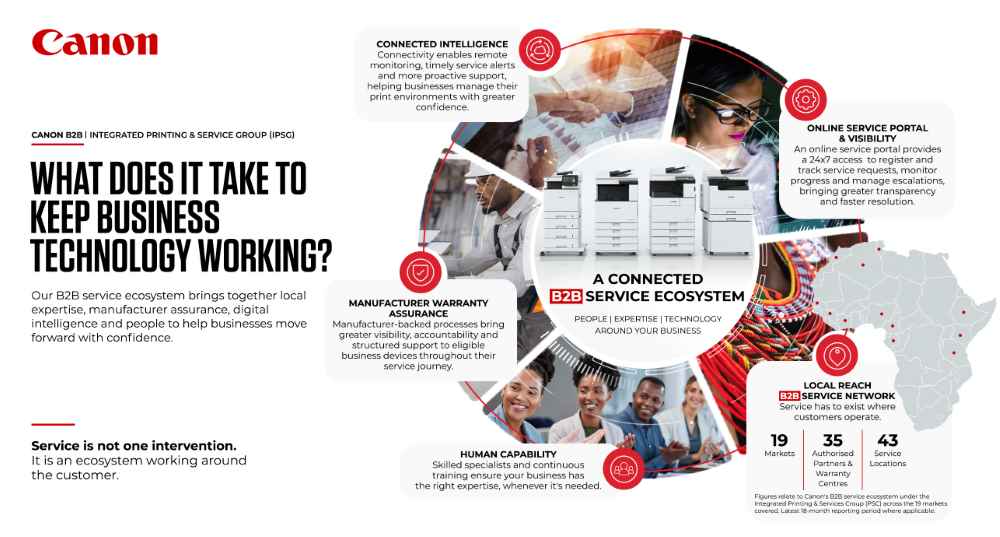
The Canon B2B service network spans 19 markets, supported by 35 authorized service partners and warranty centers, across 43 service locations. This local footprint is backed by Canon service specialists and a partner-enablement approach that provides access to technical training, product knowledge, service information, escalation support and genuine Canon spare parts and consumables.

For business customers, the value of technology extends beyond installation. Effective service depends on accessible local expertise, clear support processes and the ability to bring in manufacturer specialists when required. Canon’s B2B service approach therefore connects local delivery with manufacturer expertise rather than treating service as a separate post-sale activity.

Human capability is central to that model. Canon supports authorized service partners through ongoing technical training, product updates, service documentation and access to specialist knowledge. This helps local teams keep pace with evolving business technology and respond to customers with informed technical support.

B2B customers do not experience a technology investment only on the day it is installed

Visible escalation adds structure when a technical issue requires additional expertise. Canon’s digital service-escalation process enables authorised partner teams to document cases, share relevant technical information and follow a traceable route to specialist support. The emphasis is on transparency and continuity of information, without implying guaranteed resolution times.

Connected intelligence is another part of the ecosystem. For eligible connected devices, Canon eMaintenance supports remote monitoring and provides service teams with information that can help inform diagnostics and support decisions. This creates a foundation for a more proactive service approach while keeping trained engineers and on-site expertise central to the customer experience.

Manufacturer-backed assurance reinforces the support available beyond the initial purchase. Canon’s structured warranty programme links eligible devices to defined registration and support processes, authorized service partners and manufacturer expertise. Applicable connected devices may also qualify for complimentary extended warranty provisions, subject to published programme terms and eligibility requirements.

“B2B customers do not experience a technology investment only on the day it is installed. They experience it every day they depend on it,” said Tushar Vashnavi, Business Unit Director, B2B at Canon Central & North Africa.

“That is why service has to work as a connected ecosystem — local partners, trained technical teams, manufacturer expertise, clear escalation routes and connected tools working together. Our focus is to make that support more structured and visible, so partners can serve customers with greater confidence across the region.”

Through IPSG, Canon Central and North Africa will continue to develop its B2B service ecosystem around local capability, manufacturer-backed assurance, genuine parts and consumables, connected tools and transparent support processes — supporting business technology throughout its operational life.

Distributed by APO Group on behalf of Canon Central and North Africa (CCNA).


Continue Reading

Business

TVS Motor Company Strengthens Its Presence in Mauritius as Part of Its Africa Expansion Strategy

Published

on

TVS Motor Company

TVSM has been in Africa for over 26 years and has over 5 million customers across Africa

PORT LOUIS, Mauritius, November 18, 2026/APO Group/ –TVS Motor Company (TVSM) (www.TVSMotor.com), part of TVS VENU, and a reputed global manufacturer of two and three-wheelers, has announced a new distribution partnership with Le Warehouse in Mauritius and 361 as its reseller. This announcement also marked the introduction of two new models – TVS Ronin and TVS NTORQ XP. The event was attended by Osman Mahomed, Minister of Land Transport, Mauritius; Pradeep Chaurasiya, Head of Africa Business, TVS Motor Company; and senior representatives from Le Warehouse and 361.


For more than 10 years, TVSM has established a strong presence in the Mauritian market by contributing to the mobility landscape and earning the confidence of local customers. This new partnership builds on that foundation while bringing renewed ambition to the brand’s development on the island. By combining TVS Motor’s manufacturing expertise with Le Warehouse’s local market knowledge and 361’s retail presence, the partnership aims to strengthen the brand’s connection with Mauritian customers. This will further support the brand’s market growth as customers’ mobility needs continue to evolve.

Announcing this new partnership and the launch, Peyman Kargar, President – International Business, TVS Motor Company said, “The launch highlights the importance of the African market in our international business ambition and development as well as TVS Motor’s commitment to strengthen its presence in Mauritius. With the introduction of the TVS Ronin and TVS NTORQ XP, we are expanding our portfolio to offer Mauritian customers greater choice across distinct riding segments.”

Speaking at the launch, Pradeep Chaurasiya, Head of Africa Business, TVS Motor Company, said, “Mauritius has been an important market for TVS Motor Company for over a decade, and we are pleased to build on this longstanding association with a renewed focus on strengthening our presence in the country. Our partnership with Le Warehouse and 361 brings together TVS Motor’s global manufacturing expertise and a strong local understanding of customer needs. We look forward to working closely with our partners to deepen our engagement with customers and contribute to the evolving mobility landscape in Mauritius.”

As the world’s third-largest two-wheeler manufacturer, we bring extensive international experience, proven manufacturing capabilities and deep industry expertise to the Mauritian market. Its established presence across markets with diverse mobility needs provides a strong foundation for strengthening its footprint in the region.

Our partnership with Le Warehouse and 361 brings together TVS Motor’s global manufacturing expertise and a strong local understanding of customer needs

Amit Kantilal Shah, CEO, Le Warehouse, said, “TVS Motor Company brings together the strength of an established international manufacturer and a strong focus on innovation, performance and value, which aligns well with our own philosophy. Through 361, we have built strong relationships with Mauritian households by making recognised international brands accessible and supporting customers throughout their ownership journey. Extending this experience into mobility marks an important strategic diversification for Le Warehouse and an opportunity to play a greater role in the everyday lives of our customers. With TVSM already having an established presence and an existing community of owners in Mauritius, our focus is to build on this legacy. We will leverage 361’s retail network, digital channels and customer relationships to expand the brand’s reach, improve product accessibility and offer customers a wider choice of mobility solutions that meet their everyday needs.”

Product Specifications:

TVS RONIN:

  • Engine: 225.9 cc, single-cylinder, 4-stroke, 4-valve, oil-cooled engine
  • Maximum Power: 20.4 PS @ 7,750 rpm
  • Maximum Torque: 19.93 Nm @ 3,750 rpm
  • Transmission: 5-speed gearbox
  • Front Suspension: 41 mm upside-down (USD) forks
  • Rear Suspension: 7-step adjustable mono-shock
  • Brakes: 300 mm front disc and 240 mm rear disc
  • ABS: Dual-channel ABS with multiple modes
  • Fuel Tank Capacity: 14 litres


TVS NTORQ XP:

  • Engine: 124.79 cc, single-cylinder, 3-valve engine
  • Maximum Power: 9.4 PS @ 7,500 rpm
  • Maximum Torque: 10.5 Nm @ 5,500 rpm
  • Transmission: CVT automatic
  • Front Suspension: Telescopic suspension
  • Rear Suspension: Gas-filled hydraulic shock absorber
  • Brakes: 220 mm front disc and 130 mm rear drum
  • Fuel Tank Capacity: 5 litres
  • Technology: SmartXonnect connectivity 

The launch comes against the backdrop of Mauritius’s continuing conversation around road congestion and the changing demands of work, family life and personal travel. Two-wheelers offer an additional mobility choice for customers looking for practical and convenient alternatives for their daily commute. With the introduction of the new models, TVSM aims to cater to a wider range of customer preferences, from everyday commuting to personal mobility and leisure riding.

For Le Warehouse and 361, the focus will be on translating TVS Motor’s manufacturing expertise into a dependable local ownership experience. This will be supported through greater product accessibility, customer engagement and after-sales support. The partnership will build on TVS Motor’s existing legacy in Mauritius and strengthening its retail and distribution network. Together, the companies aim to establish TVSM as an increasingly relevant choice in the country’s evolving mobility landscape.

Distributed by APO Group on behalf of TVS Motor.


Continue Reading

Business

Afreximbank launches Creative Africa Nexus (CANEX) capacity-building programme to strengthen Africa’s creative industries

Published

on

The programme comprises four specialised ‘Practice to Trade’ learning pathways covering music, film, fashion and gastronomy

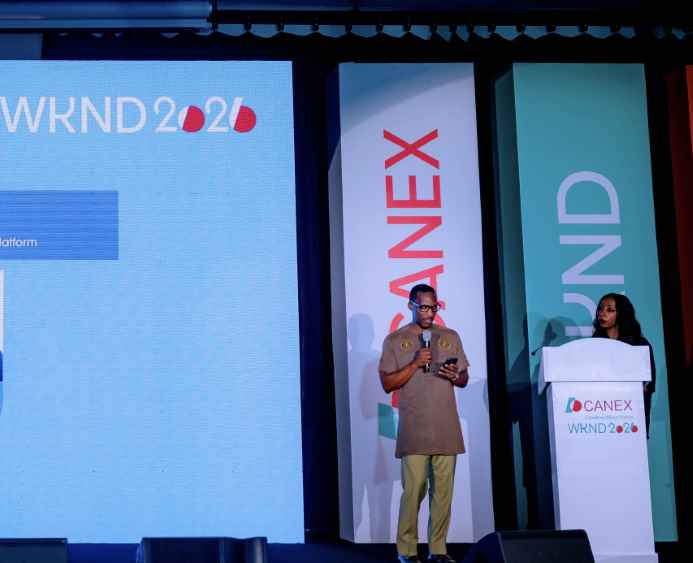
LAGOS, Nigeria, November 18, 2026/APO Group/ –African Export-Import Bank (Afreximbank) (www.Afreximbank.com), through its Afreximbank Academy (AFRACAD), launched the CANEX Capacity-Building Programme at CANEX WKND 2026 in Lagos, Nigeria, to equip African creative professionals and entrepreneurs with the skills and knowledge needed to transform their talent into commercially viable businesses.


Developed through a collaboration between Afreximbank Academy (AFRACAD) and the Bank’s Creative Africa Nexus (CANEX) programme, the initiative seeks to strengthen the technical, entrepreneurial and business management capabilities of creatives across Africa and its diaspora. It will also support participants in protecting their intellectual property, commercialising their work and accessing regional and international markets.

Speaking at the launch in Lagos, Mr. Stephen T. Kauma, Group Managing Director  Human Resources, Afreximbank, highlighted the importance of investing in people alongside financing creative enterprises.

“Africa’s creative industries possess extraordinary talent and potential, but talent alone cannot build globally competitive businesses. Through this programme, we are investing in the people behind Africa’s creative economy, providing them with the knowledge, skills and commercial capabilities needed to protect their work, access markets and build sustainable enterprises. This is central to our ambition of ensuring that Africa captures greater economic value from its creativity,” said Mr. Kauma.

Creative talent is abundant across Africa, but building a successful business requires more than artistic ability

The programme comprises four specialised ‘Practice to Trade’ learning pathways covering music, film, fashion and gastronomy. These focus on industry-specific production skills alongside entrepreneurship, branding, marketing, distribution, commercialisation and business management.

Mahlet Afework Gebremichael, award-winning Ethiopian designer and founder of Mafi Mafi / Mafi Fashion Academy and Lab, welcomed the initiative, emphasising the importance of practical business education for African creatives.

“Creative talent is abundant across Africa, but building a successful business requires more than artistic ability. Creatives must understand how to develop their brands, protect their intellectual property, price their products and reach new markets. Initiatives like this provide an important bridge between creativity and entrepreneurship, empowering African creatives to build businesses that are competitive, sustainable and capable of reaching global audiences,” said Gebremichael.

The training will be delivered free of charge through the AFRACAD digital learning platform, enabling emerging and established creatives, entrepreneurs and creative SMEs across Global Africa to access structured learning opportunities.

Since its launch in October 2022, AFRACAD has reached more than 60,000 participants through its broader training initiatives and expanded access to over 100,000 e-learning courses.

Creative professionals can enroll through https://MyLearning.AFRACAD.com.

Distributed by APO Group on behalf of Afreximbank.


Continue Reading

Trending