Connect with us
Anglostratits

Tech

OPPO Unveils ColorOS 17 Globally: Silky Smooth. Flow with AI

Published

on

OPPO

SHENZHEN, CHINA – Media OutReach Newswire – 13 October 2026 – OPPO today unveiled ColorOS 17, the latest generation of its mobile operating system, delivering a new level of smoothness alongside more intelligent, system-level AI capabilities. Debuting on the upcoming Find X10 Series and rolling out progressively to more OPPO devices, ColorOS 17 will bring these new experiences to users worldwide.


Flow Everywhere

From Parallel Animation in ColorOS 15 to Seamless Animation in ColorOS 16, smoothness has long been a defining quality of ColorOS. With ColorOS 17, OPPO takes this further, introducing the all-new Living Flow Design to make every interaction feel even more natural, continuous and responsive.

Living Flow Design is built around three core ideas: Luminous Effect, Fluid Motion and Flexible Feedback. Luminous Effect introduces softer, more translucent visuals, creating a refined sense of depth and hierarchy, while subtle lighting naturally guides attention and responds to touch. Fluid Motion enables interface elements to move, merge and transform seamlessly from one state to the next, with this sense of continuity carried throughout the system. Flexible Feedback brings the same sense of responsiveness to touch. Buttons, toolbars and other interactive elements visibly compress, stretch and rebound in response to taps, giving each interaction a more immediate and tactile feel rather than a mechanical response. Together, these elements create a more fluid and cohesive experience across the system, making everything from app transitions and Fluid Cloud to everyday interactions feel more immediate and intuitive.

To make this experience consistent across the system, ColorOS 17 introduces a Unified Rendering Architecture built on the refreshed Luminous Rendering Engine. By bringing previously separate rendering processes into a unified pipeline, the new architecture not only enables richer visual effects and more continuous transitions, but also reduces redundant rendering operations for greater efficiency. In key scenarios, it cuts rendering loads by up to 30% and RAM usage for rendering by up to 25% compared with the previous generation, helping interactions remain smooth even under heavy load.

Beyond visual rendering, ColorOS 17 also improves system-level responsiveness with the upgraded Laminar Flow Engine, an intelligent resource scheduling system built to handle increasingly complex mobile workloads. Built on OPPO’s Adaptive Scheduling Architecture, it coordinates foreground and background workloads as part of a unified flow, delivering consistently smooth performance across both everyday use and demanding scenarios.

With the Laminar Flow Engine, app launch stability improves by 55%, while Gallery thumbnails load up to 50% faster on first launch compared with ColorOS 16. During multitasking, ColorOS 17 can also keep over 25% more apps running in the background, helping users switch between apps more smoothly. 1

And smoothness is not only about how a phone performs today, but how well that experience holds up over time. In tests simulating six years of use, ColorOS 17 retains over 90% of its initial smoothness, even with storage at 90% capacity. 1

OPPO AI, Flow with Your Mind

ColorOS 17 expands OPPO AI with system-level agentic capabilities designed not only to answer questions, but also to help users complete complex tasks.

With ColorOS 17, AI Mind Pilot introduces a new Agent Mode that can work directly with photos and files stored on the device, search across multiple sources, use the appropriate tools and coordinate multiple steps to complete tasks based on the user’s request. It can find and organize scattered files, rename them based on their content and date, and use the information within them to create new outputs such as travel itineraries or webpages. It can also find photos from a specific trip, sort them into albums, and even turn a selected photo into a vlog cover or adapt it for different creative needs.

ColorOS 17 also introduces AI Photo Agent, making photo editing more intuitive while staying true to the natural look and authentic character of the original scene. With Style Match, users can simply provide a reference image, and AI Photo Agent can understand its color palette, tone and overall mood before applying a similar look to their own photo. Users can also describe the edits they want in natural language, or let AI Photo Agent analyze the image and recommend suitable adjustments based on the scene and subject.

AI Mind Space, OPPO’s personal information hub, receives a major upgrade in ColorOS 17. Users can now save documents and video links, with AI recognizing their content and turning it into structured, searchable personal memories. As saved information grows, the new Memory Collections automatically organize related memories into useful collections and summaries. For travel, it can combine remembered content with destination maps to create personalized trip plans based on the places, ideas and information users have saved.

The new AI Mind Suggest brings useful information and services to users at just the right moment. From a morning brief and timely travel reminders to flight and train cards that surface key journey information, AI Mind Suggest proactively helps users stay on top of what matters throughout the day. It can also recommend music when headphones are connected, making useful services available when they are most relevant.

Meanwhile, OSee brings OPPO’s visual AI capabilities together into one integrated experience. With a single press of the camera shutter, OSee can intelligently understand objects and scenes in view and connect users to services such as object recognition, knowledge lookup, nutrition analysis, high-definition scanning and translation. Instead of choosing between multiple separate tools, users can go directly from what they see to the service they need.

Security, Always On

ColorOS continues to place user privacy and data protection at the core of its AI experiences. OPPO’s Private Computing Cloud protects data used for cloud-based AI processing with end-to-end encryption and processes it within a secure environment designed to prevent access by third parties, including OPPO. ColorOS 17 further strengthens data transmission security with new post-quantum security capabilities in PCC. When data is transmitted between the device and the cloud, a dual-encryption mechanism helps protect information against emerging threats posed by quantum computing.

A new Transparency Report in ColorOS 17 gives users greater visibility into how their data is processed. The report provides information including which AI services have been used, when they were accessed and what operations were performed. Users can view the report directly on their device and export it whenever needed.

Proactive protection is also strengthened with the new AI Call Guard. Powered by on-device AI detection, AI Call Guard monitors calls in real time for emerging fraud risks such as synthetic voices and AI face swaps, alerting users when suspicious activity is detected to help protect both their communications and personal information.

Availability

ColorOS 17 will debut on the upcoming OPPO Find X10 Series, with additional OPPO devices receiving the update progressively.

For detailed rollout information, please refer to the official ColorOS website.

[1] Data from OPPO Lab.

2 AI Photo Agent will roll out gradually across multiple countries, with availability in Europe to follow at a later date. Monthly usage limits apply and vary by country or region. This feature supports static images only.

3 Long-doc Capture and Link Capture are not available in Europe.

4 Certain features, like MakeMyTrip Train Card, flight information reminders and Spotify music recommendations are only available in certain countries and regions.

5 Available in Indonesia, India and Thailand.



Business

Liquid C2 partners with KnowBe4 to bring workforce risk management to African businesses

Published

on

KnowBe4

KnowBe4 is an addition to Liquid C2’s Secure360 portfolio with ongoing security awareness, phishing simulations, and risk management capabilities

JOHANNESBURG, South Africa, October 13, 2026/APO Group/ –Liquid C2, a business of Cassava Technologies, a global technology leader, today announced a new reseller partnership agreement with KnowBe4, a global leader in digital workforce security, securing both humans and AI agents. Through this partnership, Liquid C2 will bring KnowBe4’s training and risk management solutions to enterprise customers across Africa.


“At Liquid C2, we understand that employees are the first and best line of defence from cybersecurity attacks for any organisation. They are the foundation of a digitally resilient organisation. Employees need the skills and awareness to spot threats early, and by working with KnowBe4, we are strengthening the human side of our cybersecurity services. Cybersecurity is no longer just a compliance exercise, it is a business continuity imperative. Our partnership will ensure our customers have access to global cybersecurity training and an experience customised for staff at all levels of client organisations” said Vinay Hiralall, Chief Commercial Officer at Liquid C2.

We look forward to working with Liquid C2 to deliver KnowBe4’s platform to even more organisations across Africa

KnowBe4 is an addition to Liquid C2’s Secure360 portfolio with ongoing security awareness, phishing simulations, and risk management capabilities. Secure360’s unified framework covers governance, protection, detection and response, while the partnership adds capabilities that help organisations address employee-related security risks.

Additionally, the KnowBe4 platform includes attack simulation and training, email and collaboration security, and agent security powered by its Artificial Intelligence Defence Agents (AIDA). KnowBe4 maintains a robust partner programme that helps organisations worldwide strengthen their      workforce security capabilities.

“We look forward to working with Liquid C2 to deliver KnowBe4’s platform to even more organisations across Africa,” said Kurt Mills, SVP of global channel at KnowBe4. “By integrating KnowBe4’s high-quality, world-class platform with our existing security services, we can now deliver comprehensive protection that combines technological safeguards with digital workforce security. This partnership represents our commitment to providing customers with the most effective methods to build a security-conscious culture and significantly reduce their human and agentic AI-related security risks.”

This offering will be available to small, mid-sized, and large enterprises across Africa, with tailored benefits for regulated sectors like finance, telecoms, and government, where strong cyber security measures are critical to protecting people, systems, and data. Customers will have access to local billing, regional support, onboarding, and compliance assistance specific to their industry needs.

KnowBe4 will be bundled with other Liquid C2 services, including managed cybersecurity which is also available as part of Liquid C2’s Governance, Risk and Compliance offering. This gives organisations greater flexibility to integrate the solution into their existing cybersecurity environments.

Distributed by APO Group on behalf of Liquid Intelligent Technologies.


Continue Reading

Tech

OPPO Partners with Manus to Bring Agentic AI Experiences to Smartphones

Published

on

OPPO

SHENZHEN, CHINA – Media OutReach Newswire – 13 October 2026 – Global smart device brand OPPO today announced a collaboration with Manus, a leading AI agent platform, to bring next-generation agentic AI experiences to smartphones. By integrating Manus’ agentic capabilities to OPPO AI Mind Pilot, the collaboration will help users turn complex, multi-step tasks into ready-to-use results—advancing OPPO’s vision for Personalized Proactive Intelligence, where AI understands users and proactively helps them get things done.


“Agentic AI marks an important shift from answering questions to helping users get things done.” said Kai Tang, President of Software Engineering at OPPO. “Together with Manus, we are bringing more proactive and capable experiences to AI Mind Pilot, enabling AI to better understand users’ intentions, take actions and complete tasks. Our goal is to make personal AI a natural part of everyday life and work.”

“Smartphones are central to people’s daily lives and support many of the tasks they handle every day, making them a natural platform for personal AI agents,” said Tao Zhang, Co-Founder & CPO of Manus. “By bringing together Manus’ agentic capabilities and OPPO’s system-level integration, we can make advanced AI agents more accessible and help users complete multi-step tasks through simple, natural interactions.”

Manus Capabilities Debut in AI Mind Pilot’s New Agent Mode

The collaboration will debut through the integration of Manus’ agentic capabilities into AI Mind Pilot’s new Agent Mode on the upcoming OPPO Find X10 Series with ColorOS 17.

Designed to move beyond simple question-and-answer interactions, AI Mind Pilot can understand a user’s end goal, break it down into multiple steps, identify relevant information, select the appropriate tools, and deliver a finished result, including by working directly with files and photos stored on the device.

For example, a user planning a trip could simply ask AI Mind Pilot to organize their travel plans. It can find flight tickets, hotel bookings, restaurant reservations, and attraction tickets scattered across different apps on the smartphone, organize them, and combine them with relevant online information to create a personalized, day-by-day itinerary—without requiring users to manually gather and upload the information.

The same capabilities can support everyday creative and professional tasks. Users can ask AI Mind Pilot to find and organize photos from a trip, locate specific images, or bring together existing files and online information to create a presentation, proposal, portfolio, or other ready-to-use content, all with just one single prompt.

Powerful Agentic AI Built Around User Control and Privacy

As AI moves from providing information to working with personal context and completing tasks, privacy, security, and user control become increasingly important. AI Mind Pilot is designed with these priorities at its core.

ColorOS 17 uses on-device models to understand and organize relevant information locally. For local tasks such as finding, organizing, or renaming files and photos, the original content remains on the device and is not shared with Manus. When a task requires external processing, AI Mind Pilot will ask for the user’s explicit confirmation before relevant content is uploaded or shared.

Users remain in control of what information is accessed, which actions are taken and whether external processing is allowed. Through on-device processing and transparent authorization, OPPO and Manus aim to make agentic AI more capable while maintaining a clear fucus on users’ choice and control.

Launching on OPPO Find X10 Series

The Manus-powered capabilities in AI Mind Pilot will debut on the OPPO Find X10 Series with ColorOS 17. Further details on availability, supported markets, and user benefits will be announced at launch.


Continue Reading

Tech

Huawei Highlights Continuous Innovation, Securing Competitive Edge Through Technological Breakthroughs

Published

on

Competitive Edge

SHENZHEN, CHINA – Media OutReach Newswire – 3 October 2026 – Huawei hosted an international media roundtable today featuring Richard Yu, Executive Director, Chairman of the Investment Review Board, and Chairman of the Board of Directors of the Consumer BG. Yu shared comprehensive insights into Huawei’s consumer business and HarmonyOS ecosystem.

Richard Yu joined Huawei in 1993, working on early developments like the first-generation program-controlled switch and participating in the establishment of Huawei’s wireless communications business, which started with GSM. Over the past decade, Yu has led Huawei’s consumer business with the vision to deliver a seamless AI life experience to all consumers across five key scenarios: HIMA-powered Smart Travel, HarmonyOS Office, Smart Home, Fitness & Health, and Entertainment, which he said is also the long-term strategy for Huawei’s consumer business over the next 10 years.


 Between 2007 and 2025, Huawei invested more than CNY1.8 trillion into R&D shifting from roughly 10% of annual revenue in early years to over 20% recently. Huawei has continued to increase investment into the core technologies of the ICT domain and basic research, which has translated into robust core capabilities, extensive intellectual property, and a vast patent portfolio, and helped with achieving a series of breakthroughs in technological innovation.

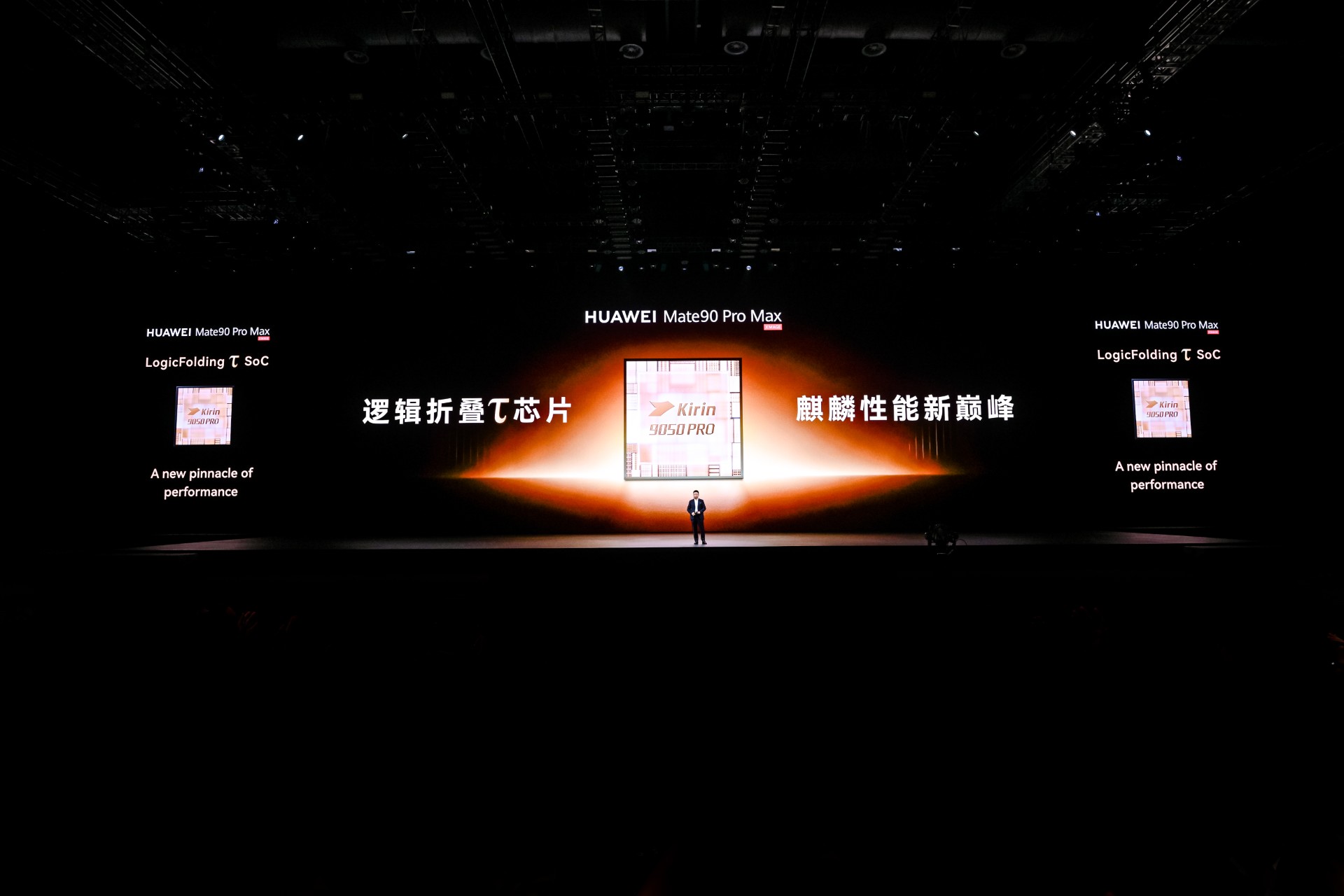
The Mate 90 series smartphones Huawei just launched come with the latest Kirin 9050 Pro chip. The overall device performance is 31% higher than the previous generation. The Balong modem, image sensor processor (ISP), mobile security processor (MSP), Lingxi CPU, Maleoon GPU, and the NPU that adopts Huawei’s Da Vinci architecture for AI processing are all designed by Huawei. They offer higher energy efficiency and deliver much-improved overall system-level performance.

Even though Yu admitted that Huawei has limited access to advanced semiconductor processes, Huawei recently made a new breakthrough in the semiconductor domain – the LogicFolding technology under the Tau Scaling Law. Unveiled by He Tingbo, head of Huawei’s Semiconductor Business Department this May, this technology vertically stacks the logic layers of chips and restructures the circuit layout through inter-layer high-density interconnect to shorten critical paths and reduce latency. This technology was adopted on Kirin 9050 Pro chip, which shows very strong AI processing power. The Mate 90 series powered by this chip can run a 30B MoE on-device AI model.

In the AI domain, Yu talked about the Ascend compute foundation that Huawei provides, by remarking Huawei’s large models called openPangu, AI capabilities for intelligent driving, and HarmonyOS Celia, which is similar to Gemini in the Google Android ecosystem. Huawei is also using AI to improve the O&M of communications network equipment. By combining AI computing power with domestic open-source large models, Huawei’s vision is to help enterprises and industries around the world to become more productive and bringing more convenience to everyone.

In the past years, Huawei has launched a broad series of products and solutions, including smartphones, PCs, tablets, wearables, TWS audio products, Smart TVs, home routers, smart home control solutions, as well as intelligent electric vehicles together with partners. Underlying these products and solutions are Huawei’s chip hardware platform and HarmonyOS – another OS ecosystem after iOS from Apple and Android from Google that Huawei developed to support all the smart devices and smart hardware across all scenarios.

Development of HarmonyOS began in 2019. Before that, Huawei was a major contributor to the Android community as well as the entire Android ecosystem. Now, more than 90 million devices, including smartphones, PCs, and tablets, currently run on HarmonyOS 6 and HarmonyOS 7. This figure is expected to hit the 100 million mark by the end of this year. The number of apps and services in the HarmonyOS ecosystem has already exceeded 450,000. Its global registered developer count has reached 11 million, and Huawei now has over 23,000 app innovation partners. Expressing his special thanks to all partners and developers for their trust and support, Yu also pointed out that Huawei is considering gradually bringing HarmonyOS to the global market in the future.

Globalization is another topic of the conversation. Yu mentioned that Huawei had very good collaboration with many companies from the US, Europe, Japan, South Korea, and Taiwan, delivering huge business value and benefits to those partners. When it comes to the difficulties that Huawei overcame since 2019, Yu said that relying on homegrown technologies and capabilities, Huawei gradually designed its own operating system and developed basic tools and software by themselves, putting a domestic supply chain in place. In 2023, Huawei started to manufacture the chips used by smartphones domestically again. With these chips and HarmonyOS, and by relying on China’s domestic supply chain, materials, and process nodes, Huawei has basically gotten rid of the dependence on US technologies.

While Huawei’s global market share was once No. 1, nowadays it only sells several million units of smartphones outside China every year. However, Yu revealed that Huawei is trying to return to the overseas market step by step.

Taking wearables as an example, Huawei is No. 1 in terms of the market share both in China and globally. Other innovative products such as TWS earphones, are also growing fast and have reached No. 1 in many countries. While Huawei’s tablet and PC business was greatly affected after it was denied access to Windows and Intel x86 chips, the HarmonyOS-based tablets are now performing strongly. Another example would be CPE, which is a mobile router that provides connectivity to the unconnected in remote and rural areas. These products are also very well received across many regions outside China, helping more people connect to the rest of the world and live better lives.

Question: Both the Huawei XT 2 and the two most advanced models of the Mate 90 series use a LogicFolding chip. Will LogicFolding chips be used for more phones in the future? We understand that Huawei’s chip production capacity is still limited. Huawei has launched SuperPoDs, and AI infrastructure is a huge business. They are both very important in China. How do you secure a larger share of the chip supply internally?

Richard Yu: We started introducing the chip that adopts the LogicFolding technology powered by the Tau Scaling Law to the Mate XT 2 tri-fold phone. To answer your question, yes, more of our phones will definitely use these LogicFolding chips in the future.

Currently, the production capacity for advanced semiconductors in China still cannot meet the rapidly growing demand. Huawei’s Ascend chips for the AI domain also use such capacity. But we have developed a requirement plan, which also covers the chip requirements of smartphones.

The sharp price increase for memory components over the past two years has somewhat limited the smartphone sales volume. Even though the production capacity remains tight right now, generally it is sufficient to meet our market shipment needs.

We hope that production capacity will ramp up in China’s semiconductor industry so that we can manufacture more advanced products for consumers in the Chinese market as well as the overseas market in the future.


Continue Reading

Trending