

Business
New outlook shows Gulf Crisis still threatens $94bn of incremental ad investment worldwide over next 18 months
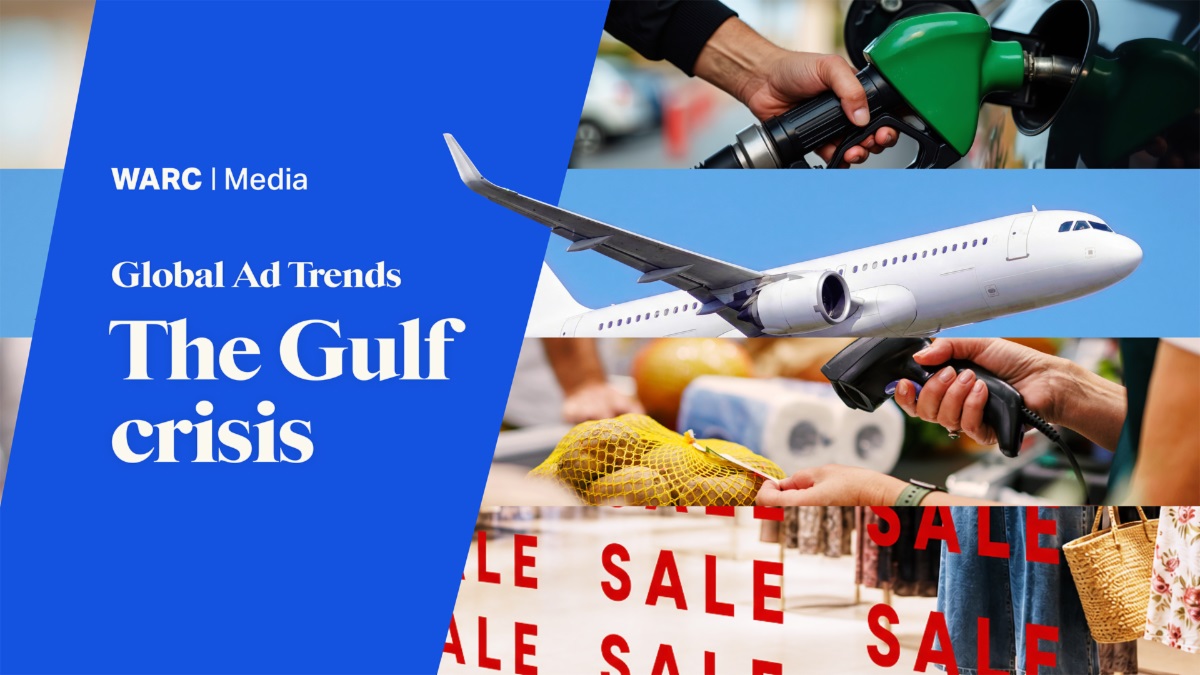
- Global ad growth uprated to +11.5% this year – to $1.39trn – but ongoing volatility could remove as much as 3.2 percentage points (pp) – or $39.6bn – from growth in 2026
- Automotive, food, and travel & transport sectors among most susceptible to high oil prices and a prolonged disruption to shipping in Strait of Hormuz
- There is an uneven impact on brand- and performance-led media spend, with TV suffering sharp falls as social and search remain largely unaffected
- Ad market growth is expected to ease to 8.2% next year – to a total of $1.50trn – but a prolonged Gulf crisis could remove a further $54.1bn from growth prospects in 2027
WARC Media Global Ad Spend Forecast Q2 2026 update: Implications of the Gulf energy crisis
11 June 2026 – A new study from WARC, the experts in marketing effectiveness, has found that a prolonged conflict in the Gulf region could threaten $39.6bn of global advertising growth this year, and $93.7bn over the next 18 months.
James McDonald, Director of Data, Intelligence & Forecasting, WARC, and author of the research, says: “As the Gulf Crisis stretches into its fourth month, global markets are now in damage limitation mode as the blockade of the Strait of Hormuz acts like a tax on consumers, lifting prices and squeezing real spending power.
“If the conflict drags on – or further intensifies – these risks shift toward stagflation, with sectors such as travel, automotive, and food acutely exposed to higher production costs and weaker demand. The net effect is a grueling squeeze on margins that could put as much as $94bn of anticipated ad market growth at risk over the coming 18 months.”

WARC Media’s latest global projections are based on data aggregated from 100 markets worldwide and leverage a proprietary neural network which projects advertising investment trends based on over two million data points. The projections account for three scenarios of increasing severity to model the potential impacts of the ongoing Gulf Crisis.
The fallout from the conflict is being felt differently across regions
WARC’s baseline scenario is for 11.5% ad market growth in 2026, but if the Crisis were to become more severe, the growth rate could fall to +8.3%
Southeast Asia (+6.9%) and Latin America (+12.8%) are on course for healthy growth this year, but are most exposed to an increase in severity
The Gulf ad market could fall into recession (-0.2%) this year, as would the French ad market (-1.0%), in the most severe scenario
The US (+9.5%) is well insulated and benefits from the World Cup and Midterms; even in a severe scenario the ad market would lose just $10bn in growthThe baseline projection is for global ad market growth of 11.5% to $1.39trn this year, an upgrade from the 10.6% rise predicted in March owing to a strong first half for online platforms. The supply-side pressures caused by the Gulf Crisis, however, are expected to be felt by consumers and brands alike from the second half of the year.
Data shows that Southeast Asia will be among the hardest hit by the conflict, due to vulnerabilities in energy imports and trade flows. WARC’s baseline projects +6.9% ad spend growth for the region to $24.8bn in 2026; a moderate scenario, however, pulls that to +6.3%, and a severe scenario delivers +3.6% – a 3.3pp swing from best to worst outcome.
China’s exposure is also distinct: imported energy and shipping costs compress industrial margins and export competitiveness. A baseline ad spend growth forecast of +7.9% (to $223.1bn) for 2026 falls to +5.3% in the severe scenario (-2.6pp), equivalent to $5.3bn in lost growth for the Chinese ad market should the situation deteriorate.
While the US isn’t immune to pressures from the situation in the Gulf, its relative insulation shows a clear contrast to the pressures war in the Middle East is placing on other markets. Even under the severe scenario, US ad spend growth is +7.2% in 2026, down 2.3pp from a baseline of +9.5% (to $452.6bn) and equivalent to a shortfall of $9.8bn.
Conversely, the Latin American ad market is on the precipice. Led by Brazil and Mexico, Latin America posts the strongest baseline ad spend growth of any region in the forecast: +12.8% to $27.8bn in 2026. The severe scenario clips that to just +3.4%; a 9.4pp downgrade and the largest single swing in the data.
The markets in the Gulf Cooperation Council (GCC) – namely Saudi Arabia, United Arab Emirates, Kuwait, Oman, Qatar, and Bahrain – are already seeing weakened demand, particularly from global advertisers. Under the severe scenario, GCC ad spend tips into outright contraction at -0.2% in 2026, a swing of -11.9pp against the baseline expectation of +11.7% to $5.7bn.
Ad spend across the Eurozone, where major economies are already stagnating, is set to rise 5.6% to $109.0bn this year. This could, however, ease to just 1.8% growth if the severe scenario is realized. The UK (+6.3%), Germany (+6.7%) and France (+2.7%) are all expected to see ad market growth this year, but the severe scenario removes 3.1 percentage points on average, pushing France into recession should the worst case materialise.
Travel, automotive and food sectors among most susceptible to a prolonged disruption
Travel & Transport ad spend already forecast to decline (-3.5%) this year
Automotive ad spend is largely flat in Western Europe, though is still expected to be up globally (+6.7%) in 2026
Growth in the food sector remains steady this year (+10.3%), but the impacts of present supply chain disruption are expected to be felt more in 2027
Travel is the worst-hit major category and the only one already thought to be contracting at the global level, with ad spend forecast to be down -3.5% to $34.4bn in 2026. Airlines active in the Middle East are already reviewing budget allocations. The sector is expected to record a projected recovery of +13.0% in 2027, however.
The double squeeze of rising inputs on the manufacturer side and consumer credit sensitivity suppressing demand is clearly visible in the automotive sector. Germany – one of the world’s largest car manufacturers – is forecast to see automotive ad spend grow by just +1.9% in the 2026. If the Gulf Crisis were to become more severe, this would fall to a 4.2% contraction this year, a 6.0pp swing from a baseline that was already fragile.
While the food market looks steady – ad spend is projected to grow 10.3% to $99.8bn this year – the sector can be heavily impacted by a complex supply chain: fertiliser, grain, fuel, and packaging costs are rising before consumers feel it.
The full impacts on the food sector are expected to land in H2 2026 and into 2027, when the severe forecast scenario trails the baseline by 1.2pp, wider than the 2026 gap. Europe’s major markets are impacted significantly: UK food ad spend grows +4.9% in the baseline and contracts -0.2% in the severe scenario: a 5.0pp swing that tips the category negative.

There is an uneven impact on brand- and performance-led media spend
Linear TV’s decline likely to accelerate as the situation worsens, with advertisers favouring short-term, performance channels over brand-building
Social media growth remains strong, but cost pressures on small and medium-sized companies leave social platforms somewhat exposed
Paid search – including generative AI – remains stable in all scenarios
In the baseline scenario, the linear TV ad market is forecast to fall 2.7% in 2026, and by the same margin again in 2027. TV’s total share of global ad investment – 12.7% in the baseline across linear and video on-demand combined – slips to 12.5% in the severe scenario. While the 2026 FIFA World Cup provides a cyclical boost in the baseline that partially offsets the decline. However, a severe scenario erodes that buffer.
The headline numbers are robust for social media: 20.0% growth in the baseline forecast this year, falling back to 17.9% in the severe scenario (a 2.1pp gap). The severe scenario therefore costs social platforms $7.8bn, just 11% of incremental ad revenue this year. However, underneath these numbers may lie some vulnerability. Social’s advertiser base is heavily concentrated in SMEs. If smaller businesses are suffering because household spend is declining, then marketing budgets may be at risk. Paid search – including generative AI – provides the most stable picture. In the severe scenario, it still grows +11.0% in 2026 – only 3.3pp below a baseline of +14.3%.
Even under the most disruptive conditions modelled, search, social and retail media will retain two-thirds of global ad spend. The channels absorbing the losses are those already under pressure. Linear TV falls 7.3% this year in the severe scenario (compared to a 3.7% fall in the baseline forecast); publishing contracts 8.5% (compared to a 0.8% baseline dip), and cinema drops 4.0% in the most severe case, versus a baseline forecast of 6.3% growth this year.
Cinema, alongside publishing, is the least resilient channel in the dataset. Cinema advertising is tied directly to leisure discretionary spending and theatrical attendance, both of which weaken sharply when consumer confidence falls and energy-linked transport costs rise.

WARC Media subscribers can read the full report available from Monday 15 June. A WARC podcast on the findings outlined in the report will be available from 18 June.







Business
Century Group Joins African Energy Week (AEW) 2026 as Floating Production Storage and Offloading (FPSO) Partner, Showcasing Regional Offshore Expansion

Business
ES-KO Secures Five-Year Catering & Facilities Management Contract Renewal with TotalEnergies EP Congo

Business
Ascott expands in Nairobi with new Citadines signing, reinforcing the city’s position as a regional hub

-

 Energy5 days ago
United States (US)-Africa Energy & Investment Forum at African Energy Week (AEW) 2026 to Advance Commercial Partnerships and Unlock Capital
-

 Tech5 days ago
HUAWEI Mate XT 2 | ULTIMATE DESIGN Debuts as the First Smartphone to Feature LogicFolding Tau (τ) Chip and Reach Mass Commercialization
-

 Energy5 days ago
Democratic Republic of Congo (DRC) Critical Minerals & Industrialisation Forum’s Digital Webinar Series Kicks Off on 23 September
-

 Business5 days ago
Conlog expands smart utility offering with new water metering capability
-

 Business5 days ago
Venezuela Hydrocarbons Minister Opens Hydrocarbon Value Chain to Private Investment
-
 Business5 days ago
Inaugural Tanzania Investment Forum to bring opportunities to the global capital market
-

 Energy5 days ago
UR Energy’s Abel Manumbu Brings Regional Power Focus to African Mining Week (AMW) 2026
-

 Business4 days ago
Canon Central & North Africa Secures Gold at the Brandon Hall Group Human Capital Management (HCM) Excellence Awards for Second Consecutive Year