Connect with us
Anglostratits

Tech

HUAWEI Mate XT 2 | ULTIMATE DESIGN Debuts as the First Smartphone to Feature LogicFolding Tau (τ) Chip and Reach Mass Commercialization

Published

on

HUAWEI

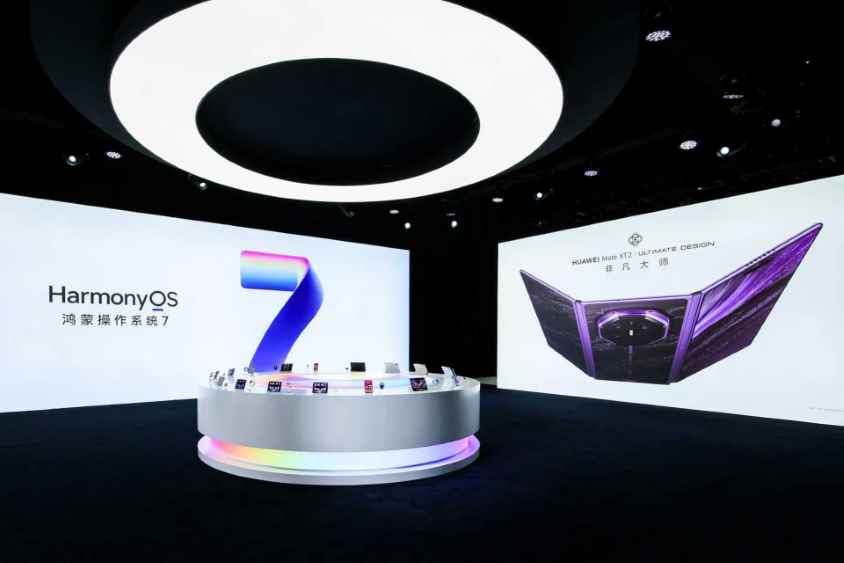
GUANGZHOU, CHINA – Media OutReach Newswire – 7 September 2026 – On September 7, Huawei officially unveiled the latest addition to its tri-fold lineup, the HUAWEI Mate XT 2 | ULTIMATE DESIGN. As the first smartphone to feature the LogicFolding Tau (τ) Chip, HUAWEI Mate XT 2 | ULTIMATE DESIGN marks the chip’s official entry into mass commercialization.

The phone debuts with a wing-like tri-fold design, continuously pushing the boundaries of ultimate aesthetics, craftsmanship, and innovation. It is the first device powered by the Kirin 9050 Pro chip and introduces several industry-first features and experiences, including the Xuanwu Ultra-Durable Tri-Fold Architecture, Smart Shield Privacy Screen, True-to-Color Camera 3.0, and the HarmonyOS 7 large-screen experience. As the pioneer of tri-fold phones, this new generation once again redefines the extraordinary.


The new HUAWEI Mate XT 2 | ULTIMATE DESIGN features a wing-like tri-fold design that opens from both sides, offering a more intuitive unfolding experience. The design philosophy draws on Chinese aesthetics, with a cloud pattern on the back panel created using Brocade Cloud craftsmanship. It is available in three colors: Purple, White, and Black. The camera ring inherits the iconic Star Diamond Glow design, crafted from Yttrium Crystal and fired at 1,800°C. Combining gemstone design and cutting techniques, it undergoes eight steps of fine polishing to form 33 star diamond facets, delivering a dazzling gemstone-like luster.

The device features the Xuanwu Ultra-Durable Tri-Fold Architecture, which re-engineers the hinge and screen technology for layered protection from the inside out. It is the first tri-fold phone to support IP58/59 dust and water resistance. The cover screen, made of Xuanwu Kunlun Glass, resists daily scratches and impacts with ease. It also features anti-glare technology, ensuring clear visibility even under direct sunlight. The main screen uses a multi-layer composite ultra-tough structure, including a large UTG glass layer, aerospace-grade ultra-thin high-strength steel, and a carbon fiber support layer, providing robust impact resistance. The Advanced Precision Hinge System 2.0 employs a 5 curved arm structure and a synchronized linkage mechanism for even force distribution and reliable pressure resistance.

Ultimate Performance: Kirin Chipset, a Leap in Power

The HUAWEI Mate XT 2 | ULTIMATE DESIGN is the first to feature the Kirin 9050 Pro chip, delivering a dual leap in performance and energy efficiency. Through deep collaboration between hardware, software, chips, and cloud, overall device performance is improved by 42% compared to the previous generation. The LinxiCore CPU, combined with the Ultra-smooth HUAWEI Ark Engine, enables faster loading of large files and superior performance when running multiple apps or multitasking. The Maleoon GPU features doubled computing units and cache, significantly enhancing rendering performance. In gaming scenarios, it supports 50 MRPS hardware-level real-time ray tracing, delivering a more immersive and realistic experience. The HUAWEI Da Vinci Architecture NPU brings a leap in on-device AI computing power, supporting large models of various sizes. For the first time in the industry, it natively supports the Pangu 30B-A2B MoE LLM, enabling smart experiences such as on-device AI album management with Celia.

The innovative heat dissipation architecture distributes heat sources across three frames, working with ultra-large vapor chambers and highly thermally conductive graphene materials to efficiently conduct heat across axes. Intelligent collaboration of multiple communication systems and 32 distributed antennas ensures faster 5A connectivity. It supports Tiantong satellite communication and Beidou satellite messaging, ensuring connectivity anywhere in the world. The Mobile Security Processor, combined with an independent security chip, enables post-quantum cryptography algorithm detection and has passed EAL5+ CCRC security certification, providing dual protection for personal data and assets.

Ultimate Technology: A Masterpiece of Innovation for Peace of Mind

The industry’s first foldable Smart Shield Privacy Screen is now available, marking the first time hardware-level privacy protection is achieved on a foldable device. It features an independent dual-pixel design, ensuring consistent screen resolution before and after activating Privacy mode, maintaining a clear front-facing view. With intelligent sensing capabilities, it provides smart reminders when entering airports or train stations. It also supports elegant activation of Privacy mode through methods such as double-tapping the cover screen or the Smart controls button.

The HUAWEI Mate XT 2 | ULTIMATE DESIGN is equipped with ECG analysis software and has obtained the NMPA Class II Medical Device Registration Certificate. Users can initiate an ECG measurement by holding the unfolded large screen with both hands. Celia intelligently interprets and analyzes the report, providing thoughtful care.

Ultimate Photography: True-to-Color Camera 3.0, Capturing Every Moment

The HUAWEI Mate XT 2 | ULTIMATE DESIGN undergoes a comprehensive upgrade from optical hardware to computing power. It is the first to feature the True-to-Color Camera 3.0, which effectively filters out infrared light interference, improving color reproduction by 95% compared to the previous generation. It also features an ultra-HDR main camera, ultra-wide aperture periscope telephoto camera, and Ultra-wide angle camera, delivering true-to-life colors, realistic portraits, and clear night shots, with excellent performance at both close and long distances. Video recording supports an ultra-high dynamic range of 18 EV, ensuring outstanding image quality in every frame.

XMAGE SmartCapture has been upgraded to intelligently recognize people, scenery, and food scenes, and supports AIGC real-time previews for clear composition and lighting recommendations. Its unique tri-fold form enables Desk-calendar mode shooting, making it easy to capture warm moments, whether for selfies or group photos.

Ultimate Experience: A Superior Large-Screen Experience

HUAWEI Mate XT 2 | ULTIMATE DESIGN is powered by the new HarmonyOS 7, redefining the large-screen interaction experience. The Live-Multitask capability supports three windows displayed in parallel, with adjustable window sizes and independent volume control. This large-screen experience covers core scenarios such as financial management, social entertainment, smart office, shopping comparison, and travel guides. Furthermore, it has been deeply adapted to leading industry apps, continuously driving innovation in the tri-fold large-screen ecosystem.

HUAWEI Mate XT 2 | ULTIMATE DESIGN starts at RMB 19,999 and will be available for purchase along with a stylus set, with official sales beginning at 10:08 on September 12th.


Tech

Huawei Pioneers a New Computing Architecture for the AI Era: Making One Million Processors Work as One Computer

Published

on

Huawei

SHANGHAI, CHINA – Media OutReach Newswire – 30 September 2026 – During HUAWEI CONNECT on September 17, 2026, Eric Xu (Huawei’s Rotating Chairman) and Dr. Liao Heng (Chief Scientist of HiSilicon) had a Q&A session with journalists of media outlets to discuss Huawei’s Peerium Computing Architecture for the AI era as well as UnifiedBus (UB).

At last year’s HUAWEI CONNECT, Eric Xu gave a keynote speech and released Ascend chips and their roadmap (including the 950, 960, 970, and SuperPoDs and SuperClusters). He also announced the open release of the UnifiedBus protocol.


At this year’s HUAWEI CONNECT, Huawei announced the Ascend 950 and the Atlas 950 SuperPoD. While the industry is talking about SuperPoDs or supernodes, the ways of making these products differ hugely. The key of SuperPoDs is about allowing several thousand or even tens of thousands of processors to work as one computer.

Today, Huawei announced a SuperPoD based on the Ascend 950 chip. The SuperPoD is powered by a new computing architecture that Huawei has pioneered. This architecture now can make one million processors work as one computer. This architecture is called Peerium, and it can achieve strong scaling to the million-processor level through nested parallelism, unified memory addressing, and peer-to-peer interconnect. It extends the parallelism paradigm of Turing with the introduction of Nested BSP (Nested Bulk Synchronous Parallel).

This architecture also extends the von Neumann single-machine architecture and overruns the master-slave design paradigm that has prevailed for decades. Given that the available technologies in the industry could not support this architecture, Huawei invented a key interconnect technology – UnifiedBus. Ultimately, one million processors can truly work as one larger computer.

UnifiedBus is a high-speed bus that uses an open protocol to scale without a limit to connect CPUs, NPUs, memory, SSDs, interface cards, and switches. With UnifiedBus, peer-to-peer interconnect is achieved across compute, storage, and networking. This fundamentally overruns the traditional master-slave architecture.

The Atlas 950 SuperPoD is a product built upon the Peerium Computing Architecture. A SuperCluster with 256,000 computing cards is currently being deployed and tested.

Q: Dr. Liao, your paper mentioned a SuperPoD that’s made up of 256,000 cards. Is that the upper limit of your technology? Can you tell us more about market demand for your products?

Liao Heng: 256,000 or roughly 200k, this number is not an arbitrary number.

First of all, the purpose of these large clusters is for training. It has a hardware infrastructure that can support the training of foundation models, which today are already in the 5T parameter range.

Over the next two years, there will be roughly 6 or 7 frontier AI labs in China, and all will aim at training foundation language models of sizes ranging from 10 to 40 trillion parameters. These numbers kind of match up to the memory capacity and the size of the SuperPoD. So you need such a scale of infrastructure to train these models.

The second thing is that in China, most data centers have a national plan on this power grid. So 200,000 is a relatively conservative number, given the design of the power delivery system in a single autonomous zone and single data center campus.

As I said, everybody must be quite familiar with the AI model race that’s happening across the globe. And in China, there are at least 3 or 4 tier-1 players that are already well recognized and have achieved tier-1 status.

Q: What are your plans to encourage Chinese model providers to use Ascend chips for training?

Eric Xu: For the Ascend 950, we first launched the 950PR to the market. It’s primarily used for AI inference, and currently the total volume of supply available in the market is not very big. The SuperPoDs based upon the Ascend 950DT are mainly used for AI training. Right now, they are under testing, and their large-scale supply will start at the end of this year or early next year. We are having extensive dialogues and discussions with AI model providers. The testing result of using the Ascend 950DT for training is pretty good. I believe that starting from next year, a lot of AI model training will be based upon SuperPoDs that use the Ascend 950DT. I think at the end of the day, it’s not about how hard we are going to push model providers, but about how much supply capacity we will have. We can only supply based on how much that’s produced. And we hope the value chain will expand its capacity faster to increase supply.

Q: What is Huawei’s take on recent calls by leading AI model providers in the US to slow down AI development?

Eric Xu: We need to look at the level and cadence of AI development in China and the US. AI models in China are largely open-source models and their progress is relatively transparent. If we look at the mainstream model providers in the US, they have more computing power, so maybe only they themselves know where they are in terms of the level of sophistication of their models. The market feeling about AI risks might be weaker in China than in the US. Model providers in China need to speed up their pace to reach a level where they could also feel the risks from AI development. And then, maybe they will feel the same as the leading US model providers. But I always believe that we need to strike a balance between driving AI development and managing AI risks. At the very least, the bottom line is we need to ensure AI for good, not AI for evil.

Q: Does Huawei have plans to bring the Atlas 950 SuperPoD to other markets outside China? If yes, which markets are you going to target? Can you share with us data about your market share in China? What is your take on China’s push for chip self-sufficiency?

Eric Xu: Since we don’t have enough capacity to even satisfy the demand in China, we don’t have plans to expand to the international market in a fully-fledged way. But indeed, there are several countries that have very strong demand. We are doing some testing, and we are providing some supply to those countries, but the volume is quite limited.

Right now, it’s pretty hard to collect data about the market share of NVIDIA in China. But based on the data we have collected, Ascend has surpassed NVIDIA.

China’s push for chip self-sufficiency is an inevitable path forward. China is a country of 1.4 billion people and it’s an industrial powerhouse, so the way people work and live is closely tied to chips. Chinese people have a keen sense of urgency, and will not accept a future in which others decide whether or not we can have access to certain products. Even though our chips may be less advanced, at least their supply is assured, so that you don’t have to worry about chip supply day in and day out. I think that’s certainly the path forward. For the Chinese government, for the domestic industry, and for Huawei, the path forward is undoubtedly to push for full self-sufficiency in terms of chips and the entire semiconductor value chain. We also believe this will become a reality sooner or later.

To read the full Q&A session: https://www.apmultimedianewsroom.com/multimedia-newsroom/huawei-pioneers-a-new-computing-architecture-for-the-ai-era-making-one-million-processors-work-as-one-computer-2 


Continue Reading

Business

Mukuru launches everyday transactional account in South Africa

Published

on

Mukuru

Higher limits, faster EFTs, better prices: everyday banking for the burgeoning emerging economy

This launch is a key milestone in our remittance-led neobank strategy

JOHANNESBURG, South Africa, September 30, 2026/APO Group/ –Mukuru (www.Mukuru.com), the Pan-African fintech trusted by more than 17 million customers, today launched the Mukuru Account & Card in South Africa. The product is offered in partnership with Bank Zero, the licensed sponsor bank, and is enabled by Paymentology and Mastercard.


The new proposition builds on Mukuru’s established remittance and card foundation, giving customers access to a broader range of everyday financial services through a single account, integrated with the rest of the Mukuru offering in South Africa. For existing Mukuru customers, it means being able to receive their salaries, make local payments, shop and send money across borders without having to rely on multiple financial services providers.

More power, better value

With the new Mukuru Account & Card, customers can:

  • send EFTs and real-time payments to any bank in South Africa for the first time through their Mukuru Account
  • receive salaries and other incoming EFT payments faster
  • spend up to R150 000 a month
  • make everyday purchases in-store and online and withdraw cash at reduced ATM fees
  • access credit facilities
  • get exclusive discounts when sending money across Africa.

The account launches with an existing customer base. Around 500 000 Mukuru customers hold a Mukuru prepaid card today, and migration to the new Account, for more functionality and lower fees, is already gathering momentum.

“This launch is a key milestone in our remittance-led neobank strategy,” said Andy Jury, Mukuru CEO. “For 22 years, we’ve been synonymous with cross-border money transfers, and millions of our customers have trusted us with the money that matters most to them, the money they send to family. Over time we have introduced a range of complementary products and services and now, together with Bank Zero, we can give them their everyday banking too: getting paid, paying rent, shopping and sending money across borders, all from one account.”

A bridge between cash and everyday banking

Mukuru has built its business on understanding how customers across Africa earn, move and use their money. In South Africa, that includes people who support family members in another province or country and who move between cash and digital payments every day.

The new Account & Card build on Mukuru’s established and proprietary distribution network (with 320 000 physical locations offering Mukuru services or cash-in/cash-out points) and digital channels, enabling customers to move between cash and digital financial services in ways that suit their individual needs.

“At Mukuru, we always talk about meeting our customers where they are,” said Juan Seco, Chief Growth Officer at Mukuru. “Just because someone transacts in cash should not mean they have access to fewer financial services. The strength of the Account & Card is that it bridges that gap and can grow with the customer, leveraging the reach of our physical and digital networks.”

The Mukuru Account & Card is now available at Mukuru branches, participating partner locations and customer service offices, and through roaming customer field ambassadors across South Africa. Customers can also sign up via the Mukuru app and on WhatsApp. To find the nearest location, visit https://apo-opa.co/4xWCDdJ .

The South African launch follows the recent launch of the Mukuru Wallet & Card in Botswana. It further expands Mukuru’s regulated footprint across the region, which includes e-money licences in Botswana, Zambia and Malawi, as well as a deposit-taking microfinance licence in Zimbabwe.

Distributed by APO Group on behalf of Mukuru.


Continue Reading

Events

Africa Tech Festival 2026 puts the conversations shaping Africa’s digital economy in focus

Published

on

digital economy

Africa Tech Festival returns to the Cape Town International Convention Centre from 16 to 19 November 2026, bringing together government, technology companies, telecoms operators, infrastructure providers, enterprise leaders, startups and investors from across the continent and beyond

CAPE TOWN, South Africa, September 29, 2026/APO Group/ –With a little over two months to go, anticipation is building for the 29th edition of Africa Tech Festival (https://AfricaTechFestival.com), the continent’s longest running and most influential technology event. As the countdown continues, the programme is taking shape around some of the most pressing questions facing Africa’s digital economy, from AI and the infrastructure needed to support it, to cybersecurity, connectivity and the changing investment environment for African technology businesses.


Africa Tech Festival returns to the Cape Town International Convention Centre from 16 to 19 November 2026, bringing together government, technology companies, telecoms operators, infrastructure providers, enterprise leaders, startups and investors from across the continent and beyond.

“The questions facing Africa’s digital economy are becoming more interlinked, more complex and more urgent. It’s no longer simply about whether businesses will adopt AI, move to the cloud or invest in new infrastructure, but about how those decisions are made, who benefits from them and what needs to be in place for them to deliver sustainable growth,” said David Monaghan, VP, Africa Tech Festival. “This year’s programme is designed to provide a platform for those conversations and give stakeholders a clearer view of the decisions, partnerships and investment priorities that will shape the next phase of Africa’s digital development.”

The questions facing Africa’s digital economy are becoming more interlinked, more complex and more urgent

Artificial intelligence runs through much of the 2026 programme. A panel titled Beyond Adoption: What Will Make Africa an AI Producer, Not Just a Consumer? will examine what is required to build globally competitive AI capabilities in Africa. Sessions will explore the emergence of agentic AI in enterprise decision-making and how companies should prioritise investment across AI, cloud, data platforms and core systems as they modernise for growth.

That focus on capability extends to the infrastructure underpinning it. AI growth is inseparable from questions about data centres, cloud infrastructure and local compute capacity. The Next Wave of AI Infrastructure Growth panel will consider where new capacity should be built, the role of hyperscaler partnerships and the need for localised compute to meet data sovereignty requirements. Dedicated discussions will examine which African markets are attracting investment interest, how power availability and hyperscaler presence are shaping that interest, and how sovereignty, performance and cost are reshaping cloud architecture decisions.

Africa’s next phase of digital growth also depends on extending reliable connectivity while keeping digital businesses and services secure. The Telecoms & Connectivity programme will examine fibre investment, 4G and 5G deployment and the growing role of satellite technology in reaching underserved communities.

All of these conversations point to a maturing digital economy, where competitiveness depends as much on enabling environments as on ambition, and where practical groundwork, compute, capital, skills and partnerships will determine who benefits from Africa’s growth. This is what makes Africa Tech Festival such a highly anticipated fixture on the calendar: it is where these decisions are debated, tested and made, bringing together the people setting policy, developing infrastructure and allocating capital across the sector.

With just months to go, the excitement is building for three days of conversation, connection and insight into where Africa’s digital future is heading. Registration for Africa Tech Festival 2026 is now open.

Distributed by APO Group on behalf of Africa Tech Festival.


Continue Reading

Trending