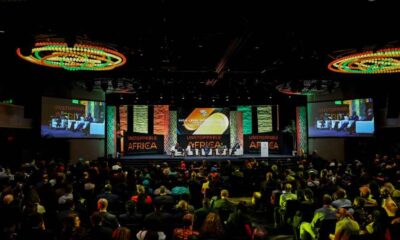
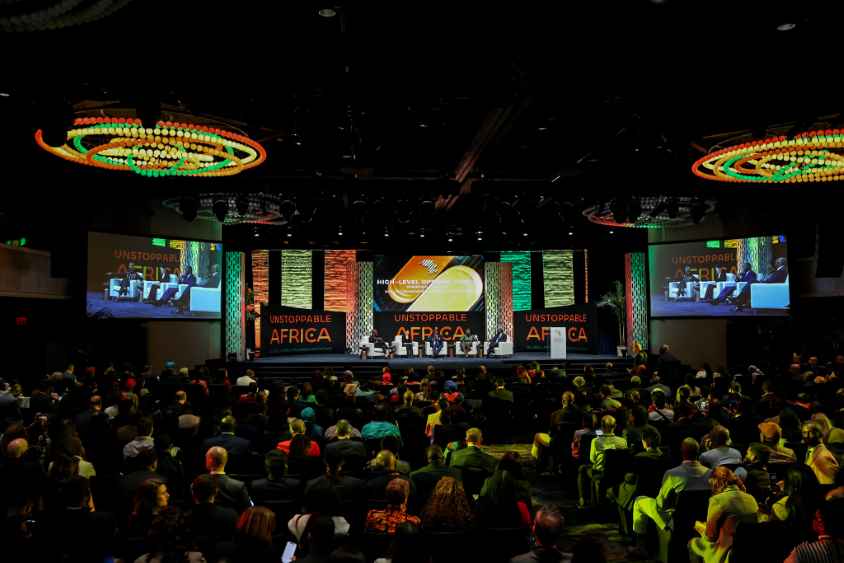
NEW YORK, United States of America, September 21, 2026/APO Group/ –Africa is pushing for a bigger role in shaping the global economy, as business leaders, heads of state, investors, policymakers, and global partners converged in New York yesterday to articulate the continent’s ambition in global trade, investment, and value creation. Held alongside the 81st session of the United Nations General Assembly,
Unstoppable Africa 2026 put Africa’s business agenda at the center of the global conversation.
The fifth edition of the Global Africa Business Initiative’s (GABI) flagship convening drew senior leaders from across business, government, and global institutions to the Marriott Marquis in Times Square, including UN Secretary-General H.E. António Guterres; H.E. Mahmoud Ali Youssouf, Chairperson of the African Union Commission; and Massad Boulos, Senior Advisor to the President of the United States on Arab and African Affairs.
The UN Secretary-General called for action to give Africa a greater role on the global stage, including a permanent presence on the United Nations Security Council: “Africa needs a permanent presence on the United Nations Security Council, where it can contribute to dialogue and action for the whole globe.” He stressed that Africa’s growing influence in global markets must translate into a stronger voice in international affairs. Guterres also urged reforms to better reflect the needs of developing countries, particularly in Africa, and for the continent’s natural resources, including critical minerals, to generate more local value and decent jobs rather than simply being exported.
With critical minerals, trade, energy, and investment dominating the first day, Unstoppable Africa reflected a wider shift in Africa’s economic story: from supplying the global economy to building more of the businesses, industries, and value chains that can capture the opportunity.
H.E. Mahmoud Ali Youssouf, Chairperson of the African Union Commission, said Africa’s 1.5 billion people and growing market create a significant opportunity, but the continent must accelerate the development of African value chains and remove barriers to trade to drive industrial transformation. He identified affordable energy, better infrastructure, access to finance, skills, technology, and clear standards as critical requirements for Africa to turn its market potential into faster economic growth.
Africa needs a permanent presence on the United Nations Security Council, where it can contribute to dialogue and action for the whole globe
The private sector took center stage, as African and global business leaders articulated what it will take to turn Africa’s resources, markets, and talent into productive economic capacity. The Leaders Panel brought together Samaila Zubairu, President and CEO of the Africa Finance Corporation; Aliko Dangote, Founder and Chairman of the Dangote Group; Mandy DeFilippo, CEO of Americas, Europe, Middle East and Africa at Standard Chartered; Nonkululeko Nyembezi, Chairperson of Standard Bank Group; Nolitha Fakude, Chairperson of Anglo American South Africa; and Tidjane Thiam, General Partner at Allied Critical Minerals Fund.
Leaders stressed the need to move beyond exporting raw materials, including critical minerals and crude oil, by developing local processing, manufacturing, and value chains that create jobs and retain more economic value on the continent.
One of the highlights announced yesterday was that the US$300 million Nigeria Distributed Renewable Energy (DRE) Fund has reached its first close, securing its initial capital commitments and moving into operation. Co-managed by the Nigeria Sovereign Investment Authority (NSIA) and Africa50, the fund will provide equity financing to local clean-energy developers, supporting decentralized solutions including solar mini-grids, solar home systems, commercial and industrial power solutions, and energy storage. Aligned with Mission 300, which aims to connect 300 million Africans to electricity by 2030, the fund is designed to mobilize private investment and expand reliable energy access for Nigerian homes and businesses.
Energy was another major focus. Anna Bjerde, Managing Director of Operations at the World Bank Group, and Damilola Ogunbiyi, CEO and Special Representative of the UN Secretary-General for Sustainable Energy for All, joined discussions on how innovative finance could unlock investment in Africa’s power infrastructure and accelerate access to reliable energy.
Healthcare also featured within the wider economic conversation. Roche reaffirmed its commitment to advancing breast cancer care through its Africa Breast Cancer Ambition (ABCA), which aims to help 80% of women diagnosed with breast cancer in Africa survive for at least five years by 2030.
Unstoppable Africa 2026 continues today, September 21st, with further sessions focused on digital transformation, investment, creative industries, sport, and Africa’s role in the global economy.
Everyone is invited to watch the event live on Unstoppable Africa YouTube channel at https://apo-opa.co/4xoGXlz









 Business5 days ago
 Business5 days ago
 Business5 days ago
 Business5 days ago
 Business5 days ago
 Business5 days ago
 Business4 days ago