Managing consumption and carbon footprint driving trends toward regulation, standardization, and the search for generator alternatives
DUBAI, United Arab Emirates, November 21, 2022/APO Group/ —
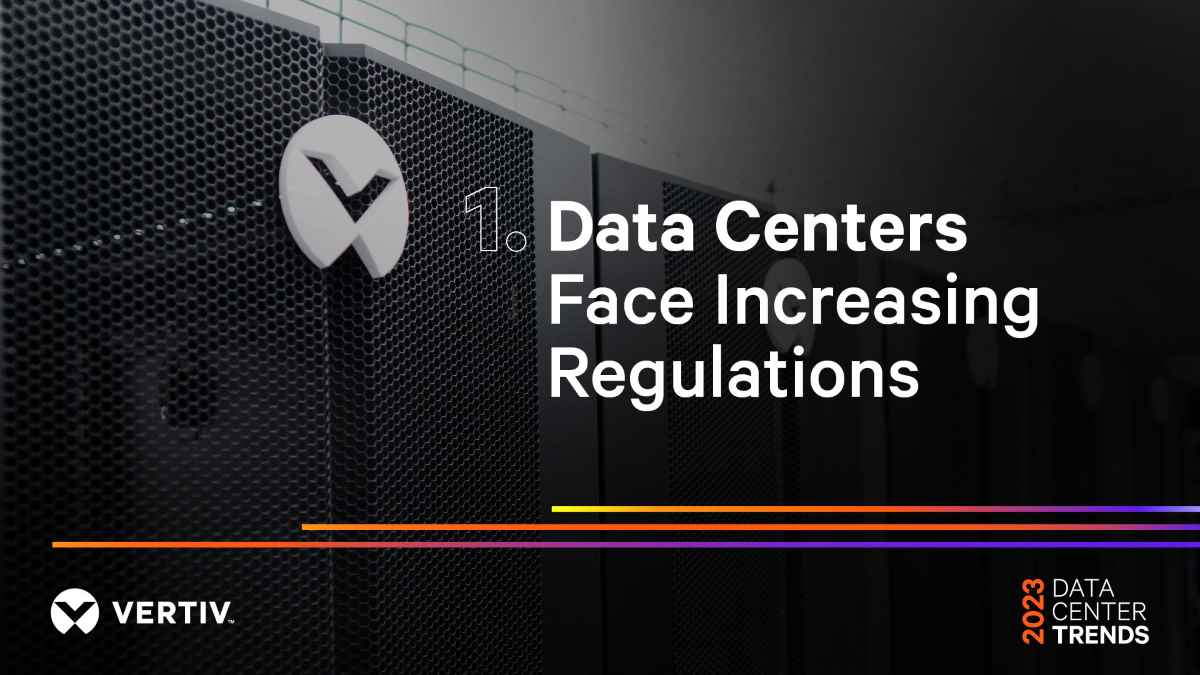
Data centers will experience increased regulation and third-party oversight in 2023 as the world continues to grapple with the industry’s rising energy and water consumption against the backdrop of ongoing climate change. The intensified focus on the overall environmental and community impact of the data center is one of five industry trends for 2023 identified by the global data center experts at Vertiv (NYSE: VRT) (http://bit.ly/3ElZ8ix), a global provider of critical digital infrastructure and continuity solutions.

“The data center industry is growing rapidly as more and more applications require compute and storage, driving a corresponding rapid increase in energy and water use in data center facilities. The industry has understood that pursuing energy and water efficiency aggressively is key for future success and survival,” said Giordano Albertazzi, Vertiv Chief Operating Officer and president, Americas. “Increased regulation is inevitable and will lead to important innovations across our industry. The process may not always be easy or linear, but it can be navigated with the help of expert data center partners and innovative solutions that can anticipate the changes while meeting the always increasing requirements of the data center applications.”
The advances in chip design and manufacturing that limited server power consumption through the first decade and a half of the 2000s reached their limits in recent years, and a spike in the amount of energy servers use has followed. In a recent report, Silicon heatwave: the looming change in data center climates (http://bit.ly/3EoKkQe), the Uptime Institute cited data from the Standard Performance Evaluation Corporation (SPEC) that showed server power consumption increasing by 266% since 2017. This surge is among various technical and market forces driving the focus on environmental awareness and sustainability in several of the 2023 trends identified by Vertiv’s experts. Those trends are:
Data centers face increasing regulation
Mounting pressures to meet consumer demand for energy and water are forcing governments at all levels to take a harder look at data centers and their outsized consumption of those resources. Data centers are estimated to be responsible for up to 3% of global electricity consumption (http://bit.ly/3tOikjS) today and projected to touch 4% by 2030. The average hyperscale facility consumes 20-50MW annually – theoretically enough electricity to power up to 37,000 homes (https://bit.ly/3tOikjS). Vertiv’s experts expect this to prompt increasing governmental scrutiny in 2023.
It’s happening in some places already. Dublin, Ireland, and Singapore have taken steps to control data center energy use, and data center water consumption – especially in areas prone to drought – is likely to trigger similar scrutiny (http://bit.ly/3OpCoT7). According to the U.S. Department of Energy, the water usage effectiveness (WUE) (http://bit.ly/3VbkyWn) of an average data center using evaporative cooling systems is 1.8L per kWh. That type of data center can consume 3-5 million gallons of water per day (https://bit.ly/3OpCoT7) – similar to the capacity used by a city of 30,000-50,000 people. The industry will continue to take steps to self-monitor and moderate – including an increasing preference for environmentally-friendly thermal designs – but 2023 will see increases in regulatory oversight.

Hyperscalers and others shop off the rack
According to a recent Omdia survey, 99% of enterprise data center operators say prefabricated, modular data center designs will be a part of their future data center strategy. That’s more than a trend; it’s the new normal. In 2023, Vertiv’s experts anticipate a continuing shift in the same direction among hyperscalers as they seek the speed and efficiencies standardization delivers.
This is a newer concept for the world’s leading cloud providers, and they’re turning to colocation providers (http://bit.ly/3V0Pg4Y) – who have been standardizing for years – to make it happen. Specifically, those cloud providers are outsourcing their new builds to colos to leverage their in-market expertise, proven repeatability, and speed of deployment. In short order, standardization – ranging from modular components, such as power and cooling modules and skids, to full-fledged prefabricated facilities – will become the default approach not just for the enterprise, but also hyperscale and the edge of the network.
The industry has understood that pursuing energy and water efficiency aggressively is key for future success and survival
Diesel generators see real competition
The diesel generator has long been an imperfect but inescapable piece of the data center ecosystem. It represents stored energy that largely goes unused while still requiring maintenance or fuel replacement after periods of inactivity. Then, when pressed into service, generators produce carbon emissions operators are desperately trying to avoid. Already, some organizations are relying on batteries for longer load support – up to five minutes in some cases – and even designing their data centers with minimal generator capacity.
These are transitional steps to minimize the role of the generator as the industry searches for other options – including new battery technologies – for extended backup power. In 2023, Vertiv’s experts anticipate a preferred alternative will emerge – specifically hydrogen fuel cells. These fuel cells will function much like a generator at first, providing momentary load support, and eventually hold promise for sustained or even continuous operation.
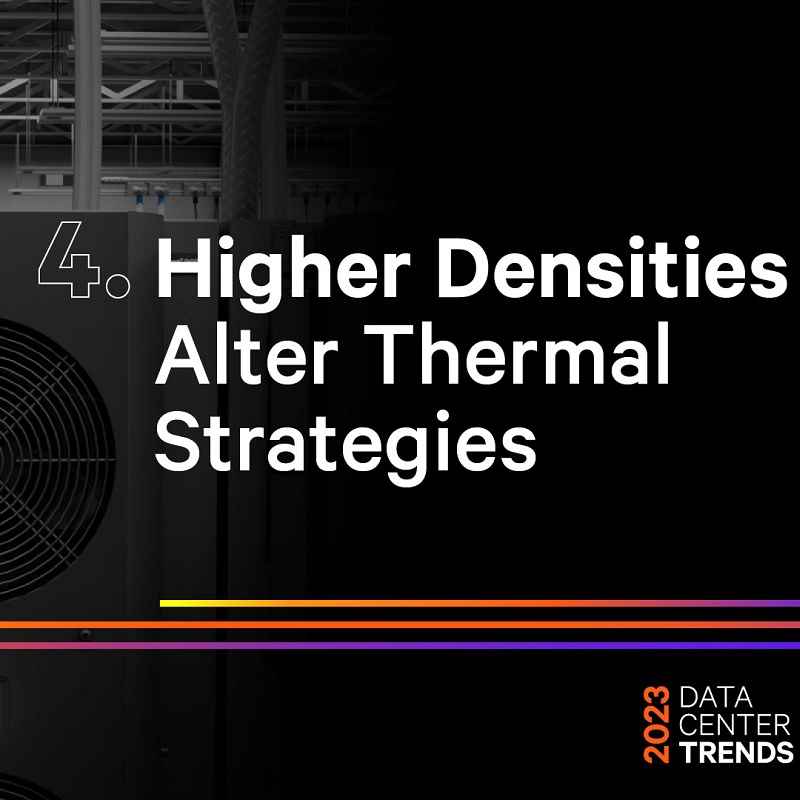
Higher densities alter thermal strategies
After years of relatively static rack densities, data center operators are increasingly requesting higher-density racks. According to the Uptime Institute’s 2022 Global Data Center Survey (http://bit.ly/3EQaoVU), more than a third of data center operators say their rack densities have rapidly increased in the past three years. This is especially true among larger enterprise and hyperscale data centers, where nearly half of those operating facilities at 10MW and above reported racks above 20kW and 20% claimed racks higher than 40kW.
This is consistent with the maturity of liquid-cooled server technologies and increasing acceptance and adoption of such technologies. The aforementioned increases in server power consumption are happening as the need to add capacity quickly is growing, challenging operators from all sides. This leaves them little choice but to explore the boundaries of existing facilities by adding computing in tight spaces, increasing rack densities, and creating thermal profiles that require liquid cooling. While liquid cooling is not a new technology, the early wave of successful, efficient, problem-free deployments in high-density environments has provided proof of concept that will boost adoption in the coming year. The addition of direct-to-chip cooling to new OCP and Open19 standards will only accelerate this trend.

5G meets the metaverse at the edge
Omdia, in its 2022 Mobile Subscription and Revenue Forecast (http://bit.ly/3XkHogc), projects nearly half of all mobile subscriptions – more than 5.8 billion – to be 5G by 2027, pushing computing closer and closer to the user. The metaverse is an application in search of an ultra-dense, low-latency computing network. In 2023, we’ll see these two activities intersect, with metaverse implementations leveraging 5G networks to enable the ultra-low latency features the application demands. Ultimately, this will require higher powered computing in those 5G edge locations, and we’ll see that happening soon – with early forays in 2023 followed by more widespread deployments in the years after. As the edge of the network becomes more sophisticated, so will the infrastructure needed to support it. This will include technologies such as artificial intelligence and virtual reality planning and management systems and increased adoption of lithium-ion UPS systems at the edge – an ongoing trend that saw share increase from 2% of sales in August 2021 to 8% in August 2022, according to IDC.
“In recent years, sustainability has been the greatest focus area for the data center industry, and that aligns with the 2023 emphasis on increased regulation from governments, as well as interest in alternative energy sources,” said Karsten Winther, Vertiv president for Europe, Middle East and Africa (EMEA). “As we move forward, data center owners and operators will need to choose an infrastructure solutions partner that is able to advise them on the best practices and technologies to help them meet their ‘net zero’ goals. With greater innovation and industry transformation, particularly in 5G and the metaverse, 2023 will be an exciting year for our customers and industry.”
For more information on 2023 industry trends and Vertiv solutions for data center and communication networks, visit Vertiv.com.
Aurionpro’s upgraded iCashpro platform for DTB delivers a unified digital experience across payments, trade, virtual accounts, and real-time reporting, enhancing straight-through processing, visibility, and control for both the bank and its corporate customers
MUMBAI, India, April 30, 2026/APO Group/ –Aurionpro Solutions Limited (www.AurionPro.com) (BSE: 532668 | NSE: AURIONPRO), a global leader in banking technology, announced the expansion and upgrade of its transaction banking engagement with Diamond Trust Bank (DTB), to modernize and enhance the bank’s corporate transaction banking capabilities across multiple countries.
This multi-country transaction banking upgrade covering Kenya, Uganda, and Tanzania aligns with DTB’s intent to enhance customer experience, streamline operations, and support growing transaction volumes as it expands its regional corporate banking footprint. DTB continues to focus on building a more agile, ‘digital-first’ banking experience, particularly around payments for its corporate customers across Africa, and is now well positioned to scale these capabilities. As part of its broader transformation agenda, the bank has been steadily investing in platforms that enhance scale, reliability, and service consistency across markets.
Through this partnership, we are proud to lead the next era of transformation in transaction banking, helping DTB enhance operational agility
Aurionpro’s upgraded iCashpro platform for DTB delivers a unified digital experience across payments, trade, virtual accounts, and real-time reporting, enhancing straight-through processing, visibility, and control for both the bank and its corporate customers. By enabling DTB to standardize and scale its transaction banking operations across countries, the platform ensures consistent service levels, stronger control, and improved efficiency. It also supports enhanced user experience, advanced security, and the flexibility to introduce new features as DTB expands its regional transaction banking footprint.
Murali Natarajan (https://apo-opa.co/48trPdk), Managing Director & CEO, DTB Kenya commented: “We are delighted to strengthen and broaden our partnership with Aurionpro Solutions as part of DTB’s ongoing digital transformation journey across multiple markets. Our focus on innovation, operational excellence, and customer-centricity continues to guide our technology investments. This upgrade strengthens our transaction banking capabilities, enabling us to deliver greater value to our customers through robust digital channels and seamlessly integrated experiences.”
Ashish Rai, Group CEO, Aurionpro Solutions, commented: “We are pleased to deepen our multi-country engagement with Diamond Trust Bank and support the next phase of its transaction banking modernization. As DTB continues to scale across markets, platform resilience and consistency become paramount. Through this partnership, we are proud to lead the next era of transformation in transaction banking, helping DTB enhance operational agility, deliver superior experiences to corporate customers, and create long-term value across geographies.”
He added, “Aurionpro’s iCashpro lays a strong digital foundation for transaction & wholesale banks across the globe to grow their corporate and SME client portfolio today, while creating a clear roadmap for next- generation capabilities in AI-driven insights, advanced automation and API-led connectivity for businesses in Kenya and across Africa.”
Distributed by APO Group on behalf of Aurionpro Solutions Ltd.
Minerals Council CEO to share insights on policy, infrastructure and investment trends shaping South Africa’s mining industry
CAPE TOWN, South Africa, April 30, 2026/APO Group/ –The upcoming African Mining Week (AMW) conference will feature Mzila Mthenjane, CEO of the Minerals Council of South Africa, as a speaker. Scheduled for October 14 – 16, 2026 in Cape Town, the event will bring together global investors, policymakers and industry leaders, with Mthenjane’s participation highlighting the council’s commitment to engaging international stakeholders and promoting investment across South Africa’s mining sector.
His participation comes at a critical moment as the Minerals Council works closely with government on finalizing the Mineral Resources Development Bill 2025, a policy framework aimed at strengthening the country’s mining investment climate and the sector’s contribution to GDP. According to the council, the revised legislation will support new investment across the value chain as South Africa seeks to mobilize R2 trillion over the next five years to unlock its critical minerals potential.
The policy reforms come amid shifting production trends in the sector. In 2025, South Africa recorded declines in gold and platinum group metals output of 1.9% and 4.1%, respectively. The new regulatory framework is expected to strengthen public-private partnerships and stimulate investment, enabling South Africa to increase production and capitalize on strong global commodity prices. Increased private sector investments is crucial with South Africa seeking targeting to unlock an estimated R40 trillion in untapped iron ore potential as well as maintain its position as the world’s leading producer of chrome and manganese.
At AMW 2026, Mthenjane is expected to outline these trends, providing insights into how the council is contributing to addressing challenges disrupting the sector. Infrastructure and energy costs remain key concerns for industry players. To support the energy-intensive sector, South Africa approved a 35% reduction in electricity tariffs for major ferrochrome producers, helping stabilize an industry that has faced significant cost pressures after electricity prices surged by roughly 900% since 2008.
Logistics constraints are also a priority area for reform. South Africa’s economy is losing an estimated R1 billion per day due to inefficiencies across rail and port infrastructure. As a result, the government is considering measures supported by the Minerals Council to increase private sector participation in logistics. Planned reforms include rail modernization initiatives targeting 250 million tons of freight capacity by 2029, alongside port upgrades and private operator participation aimed at strengthening mineral exports and improving supply chain efficiency.
Beyond infrastructure and policy reforms, the Minerals Council is advocating for stronger exploration investment to support long-term industry growth.
At AMW, Mthenjane is expected to highlight these developments and outline the steps required to reinforce South Africa’s position in the global minerals supply chain. His insights will offer investors and stakeholders a timely perspective on opportunities within the country’s mining sector.
Distributed by APO Group on behalf of Energy Capital & Power.
Seychelles energy minister will speak at AEW 2026, positioning her to highlight reforms, renewable projects and investment opportunities as the island nation advances its transition toward a diversified energy system
CAPE TOWN, South Africa, April 29, 2026/APO Group/ –Marie-May Jérémie, Minister of Environment, Climate, Energy and Natural Resources for Seychelles will participate as a speaker at this year’s African Energy Week (AEW) 2026, taking place from October 12–16 in Cape Town. Her participation underscores the country’s growing role in shaping Africa’s small-island energy transition agenda.
Minister Jérémie’s presence at AEW 2026 comes at a critical time as Seychelles accelerates efforts to reduce its heavy reliance on imported fossil fuels. The event provides a platform to attract investment, strengthen policy alignment and showcase bankable projects, positioning the country as a viable destination for private-sector participation in island energy systems.
Seychelles is demonstrating how policy reform and innovation can unlock investment in constrained environments
In May last year, international finance institution the World Bank approved the Renewable Energy Acceleration Program, a seven-year initiative aimed at modernizing the grid and increasing renewable energy penetration to 15% by 2030. The program focuses on unlocking private capital while strengthening transmission infrastructure to accommodate variable renewable energy sources.
Project development is gaining traction in the country, particularly in innovative technologies suited to Seychelles’ land constraints. The 5.8 MW Seysun Lagoon floating solar PV project, developed by independent renewable power producer Qair, is under construction and expected online in 2026.
Alongside renewables, Seychelles continues to pursue upstream opportunities to diversify its economy. The government approved new exploration entrants in 2025 and extended exiting petroleum agreements, while securing an infrastructure partnership with China. Multilateral estimates suggest over $800 million in investment will be required over the next 25 years.
Regulatory reform is central to this transition, with Seychelles introducing an independent power producer framework to open the market to private developers. Standardized power purchase agreements, grid access reforms and strengthened public-private partnership structures are being implemented to improve transparency, reduce risk and accelerate project bankability across solar, storage and emerging wind opportunities.
“Minister Jérémie’s participation highlights the strategic importance of island nations in Africa’s broader energy transition,” says NJ Ayuk, Executive Chairman, African Energy Chamber. “Seychelles is demonstrating how policy reform and innovation can unlock investment in constrained environments. Her insights will be critical to advancing dialogue on resilient, low-carbon energy systems across the continent.”
Distributed by APO Group on behalf of African Energy Chamber.
We use cookies on our website to give you the most relevant experience by remembering your preferences and repeat visits. By clicking “Accept”, you consent to the use of ALL the cookies.
This website uses cookies to improve your experience while you navigate through the website. Out of these, the cookies that are categorized as necessary are stored on your browser as they are essential for the working of basic functionalities of the website. We also use third-party cookies that help us analyze and understand how you use this website. These cookies will be stored in your browser only with your consent. You also have the option to opt-out of these cookies. But opting out of some of these cookies may affect your browsing experience.
Necessary cookies are absolutely essential for the website to function properly. These cookies ensure basic functionalities and security features of the website, anonymously.
Cookie
Duration
Description
cookielawinfo-checkbox-analytics
11 months
This cookie is set by GDPR Cookie Consent plugin. The cookie is used to store the user consent for the cookies in the category "Analytics".
cookielawinfo-checkbox-functional
11 months
The cookie is set by GDPR cookie consent to record the user consent for the cookies in the category "Functional".
cookielawinfo-checkbox-necessary
11 months
This cookie is set by GDPR Cookie Consent plugin. The cookies is used to store the user consent for the cookies in the category "Necessary".
cookielawinfo-checkbox-others
11 months
This cookie is set by GDPR Cookie Consent plugin. The cookie is used to store the user consent for the cookies in the category "Other.
cookielawinfo-checkbox-performance
11 months
This cookie is set by GDPR Cookie Consent plugin. The cookie is used to store the user consent for the cookies in the category "Performance".
viewed_cookie_policy
11 months
The cookie is set by the GDPR Cookie Consent plugin and is used to store whether or not user has consented to the use of cookies. It does not store any personal data.
Functional cookies help to perform certain functionalities like sharing the content of the website on social media platforms, collect feedbacks, and other third-party features.
Performance cookies are used to understand and analyze the key performance indexes of the website which helps in delivering a better user experience for the visitors.
Analytical cookies are used to understand how visitors interact with the website. These cookies help provide information on metrics the number of visitors, bounce rate, traffic source, etc.
Advertisement cookies are used to provide visitors with relevant ads and marketing campaigns. These cookies track visitors across websites and collect information to provide customized ads.