Africa urgently needs a more extensive and robust aviation network, given the region’s relative lack of alternative long-distance transportation infrastructure
The African aviation market has been underserved for a long time. Before 2020, only 9% of Africa’s air traffic was between African countries, the rest being intercontinental. And today, globally, the region accounts for less than 2% of total air traffic despite being home to around 17% of the world’s population.
Africa urgently needs a more extensive and robust aviation network, given the region’s relative lack of alternative long-distance transportation infrastructure. Indeed, unlike the United States and Europe, where there is an extensive road and rail network, in Africa, these vital modes of intracontinental transport remain underdeveloped.
“African countries have experienced unprecedented economic growth in the past years, with a fast-growing population, but the airline industry has not enjoyed the same positive trend. African airlines have been marginalised, and this is evidenced by the sharp drop of their market share in the past years. In the intra-African regional market, there is need for airlines to deploy the appropriate right-sized aircraft. As the air transport sector resumes the growth trajectory post-COVID, growth will be enhanced by implementing the Single African Air Transport Market (SAATM) and the African Continental Free Trade Agreement (AfCFTA). A shift of strategies and focus on the regional operations to feed, and de-feed major hubs is important for African carriers to harness the growth opportunity and enhance competitiveness.” Mr Abderahmane Berthé – AFRAA Secretary General, speaking at the associations’ Annual General Assembly in Dakar Senegal.
While infrastructure is being developed, aircraft manufacturers are also responding to the call. Embraer, in particular, has long seen the potential for its planes in Africa and has thus extensively marketed its aircraft to African airlines.
Rolls-Royce proudly supplies the Brazil-based aircraft manufacturer with AE3007 engines for its 50-seater ERJ family of aircraft. Since the engine achieved FAA/EASA certification in 1995 for Embraer, Rolls-Royce has delivered more than 3,200 engines worldwide, with more than 65 million flight hours. The AE3007 also reliably and efficiently powers the Cessna Citation X passenger aircraft. In the Defence sector, the AE3007 powers the Northrop Grumman RQ-4A Global Hawk & Triton; in fact, the AE engine family was initially developed for defence applications. Still, the constant development of the common core has given us a range of highly robust and versatile engines.
In Africa, Rolls-Royce powers more than 100 regional aircraft in operation. These range from premium full-serviced regional airlines, government-owned flagship airlines, charter operations, and mining companies to operators serving humanitarian missions for the United Nations and the World Food Program.
The majority of these aircraft, however, are Embraer’s ERJ 145/140/135 and Legacy twin-turbofan regional jets. The Long Range version of the ERJ140 can carry a full load of passengers over a distance of more than 3,000 kilometres. This range can intra-connect Eastern, Central, Western, Southern and Northern African sub-regions.
As this connectivity increases and barriers to trade and travel are lowered, we expect demand for this aircraft type to grow.
During the pandemic, with many aircraft grounded, Rolls-Royce took the opportunity to complete an extensive maintenance program on their AE3007 engines in the region, upgrading to the latest standards without charge. This allowed operators to comply with an Airworthiness Directive (necessary for all grounded aircraft) before operations restarted, giving them an all-important head start.
Meanwhile, in September 2021, Rolls-Royce penned an important extension of its TotalCare maintenance service agreement with South African airline Airlink.
Rolls-Royce has submitted a proposal to Embraer to power the new 70-90 seater rear-mounted turboprop that the airframer plans to launch in early 2023
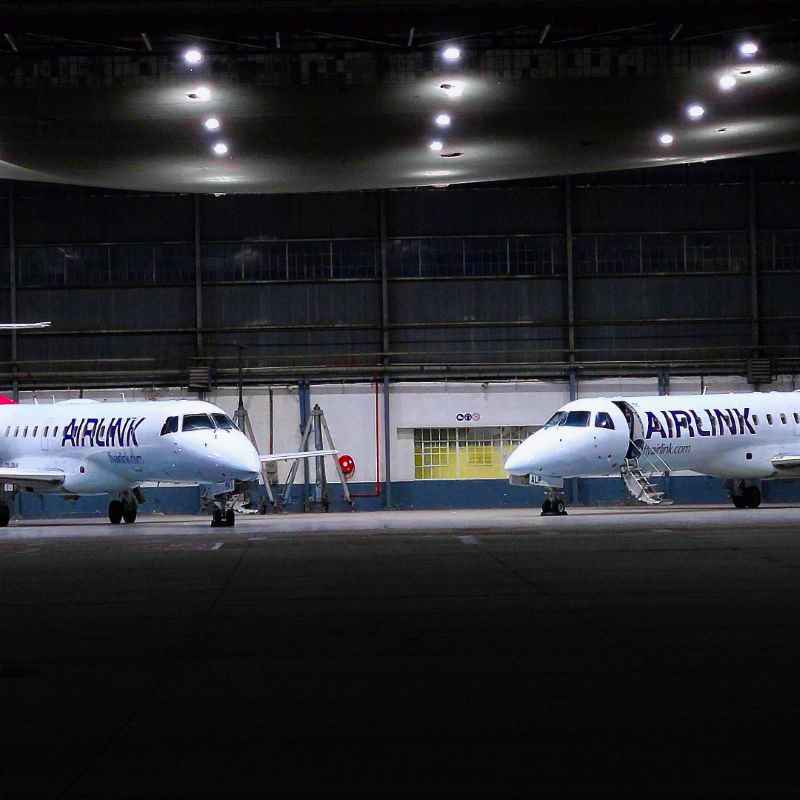
“I’m very proud to say that we have had a long-standing relationship with Rolls-Royce since 2001. These engines power up our 28-aircraft Embraer ERJ fleet. Rolls-Royce has never dropped the ball, and Airlink has extreme reliability on these engines. Kudos to Rolls-Royce, who has been awarded our supplier of the year and on an unbelievable and excellent relationship.” Rodger Foster, Chief Executive Officer, Managing Director Airlink
The key to TotalCare is that Rolls-Royce takes back time-on-wing and shop visit cost risks, providing airlines with peace of mind that their maintenance schedules will run at a fixed cost per engine flying hour.
The service is underpinned by predictive maintenance, i.e. fixing problems before they occur. It relies on extensive gathering and analysis of performance data, which helps engineers to diagnose potential future faults and act on them to avoid downtime.
Indeed, this has been central to Airlink’s impressive on-time performance, consistently above 97% throughout its use of TotalCare.
Moving forwards, if Africa is to build a more extensive regional flying network, maintenance infrastructure will be essential to ensure it runs smoothly. Indeed, Rolls-Royce has observed the need to diversify services to keep as many aircraft flying in the region as possible.
A relentless focus on efficiency and the pathway to zero-emissions
Deploying the right aircraft on suitable routes is also crucial to running the network as environmentally and sustainably as possible.
According to research by Embraer, some 14% of all domestic African flights are operated on widebody aircraft. In addition, the company observes that almost all (99%) of these flights flown with widebodies fly on sectors under 4,500 kilometres – in other words, the scope for narrowbody aircraft seating 120-150 passengers to increase operational efficiency is sizeable.
In the longer term, the regional aviation industry has a huge opportunity to be a flagbearer for net zero flying.
And here, as one example in Norway, Embraer and Rolls-Royce, in collaboration with Widerøe, are deep into a study on a conceptual zero-emission regional aircraft. The 12-month project, set to conclude in February 2023, aims to accelerate the knowledge of the technologies necessary for the net zero transition, progress which could pave the way for clean fuels and electrification to be the significant enablers of a new era of regional aviation. The study examines a variety of potential solutions, including all-electric, hydrogen fuel cell or hydrogen-fuelled gas turbine-powered aircraft.
Meanwhile, Rolls-Royce has submitted a proposal to Embraer to power the new 70-90 seater rear-mounted turboprop that the airframer plans to launch in early 2023. A key reason why Embraer has chosen to switch the design to rear-mounted engines is that it enables easier accommodation of a hydrogen system which could be integrated in the future. With its ongoing R&D into hydrogen-propelled aircraft, Rolls-Royce will be well-placed to fulfil this need.
In addition, the company is set to prove that all its aero engines will be able to run on 100% Sustainable Aviation Fuel by the end of 2023. Any sustainable fuel that meets the D1655 jet fuel standard and requirements is now approved for use in AE3007 engines. Currently, seven different blend varieties can be used, some being certified to blend up to 50% with conventional jet fuel, dramatically reducing carbon footprints.
In keeping its fingers on the pulse, Rolls-Royce is ideally positioned to steer Africa’s growing regional aviation sector in a sustainable direction over the coming years.
Distributed by APO Group on behalf of Rolls-Royce.
Aurionpro’s upgraded iCashpro platform for DTB delivers a unified digital experience across payments, trade, virtual accounts, and real-time reporting, enhancing straight-through processing, visibility, and control for both the bank and its corporate customers
MUMBAI, India, April 30, 2026/APO Group/ –Aurionpro Solutions Limited (www.AurionPro.com) (BSE: 532668 | NSE: AURIONPRO), a global leader in banking technology, announced the expansion and upgrade of its transaction banking engagement with Diamond Trust Bank (DTB), to modernize and enhance the bank’s corporate transaction banking capabilities across multiple countries.
This multi-country transaction banking upgrade covering Kenya, Uganda, and Tanzania aligns with DTB’s intent to enhance customer experience, streamline operations, and support growing transaction volumes as it expands its regional corporate banking footprint. DTB continues to focus on building a more agile, ‘digital-first’ banking experience, particularly around payments for its corporate customers across Africa, and is now well positioned to scale these capabilities. As part of its broader transformation agenda, the bank has been steadily investing in platforms that enhance scale, reliability, and service consistency across markets.
Through this partnership, we are proud to lead the next era of transformation in transaction banking, helping DTB enhance operational agility
Aurionpro’s upgraded iCashpro platform for DTB delivers a unified digital experience across payments, trade, virtual accounts, and real-time reporting, enhancing straight-through processing, visibility, and control for both the bank and its corporate customers. By enabling DTB to standardize and scale its transaction banking operations across countries, the platform ensures consistent service levels, stronger control, and improved efficiency. It also supports enhanced user experience, advanced security, and the flexibility to introduce new features as DTB expands its regional transaction banking footprint.
Murali Natarajan (https://apo-opa.co/48trPdk), Managing Director & CEO, DTB Kenya commented: “We are delighted to strengthen and broaden our partnership with Aurionpro Solutions as part of DTB’s ongoing digital transformation journey across multiple markets. Our focus on innovation, operational excellence, and customer-centricity continues to guide our technology investments. This upgrade strengthens our transaction banking capabilities, enabling us to deliver greater value to our customers through robust digital channels and seamlessly integrated experiences.”
Ashish Rai, Group CEO, Aurionpro Solutions, commented: “We are pleased to deepen our multi-country engagement with Diamond Trust Bank and support the next phase of its transaction banking modernization. As DTB continues to scale across markets, platform resilience and consistency become paramount. Through this partnership, we are proud to lead the next era of transformation in transaction banking, helping DTB enhance operational agility, deliver superior experiences to corporate customers, and create long-term value across geographies.”
He added, “Aurionpro’s iCashpro lays a strong digital foundation for transaction & wholesale banks across the globe to grow their corporate and SME client portfolio today, while creating a clear roadmap for next- generation capabilities in AI-driven insights, advanced automation and API-led connectivity for businesses in Kenya and across Africa.”
Distributed by APO Group on behalf of Aurionpro Solutions Ltd.
Minerals Council CEO to share insights on policy, infrastructure and investment trends shaping South Africa’s mining industry
CAPE TOWN, South Africa, April 30, 2026/APO Group/ –The upcoming African Mining Week (AMW) conference will feature Mzila Mthenjane, CEO of the Minerals Council of South Africa, as a speaker. Scheduled for October 14 – 16, 2026 in Cape Town, the event will bring together global investors, policymakers and industry leaders, with Mthenjane’s participation highlighting the council’s commitment to engaging international stakeholders and promoting investment across South Africa’s mining sector.
His participation comes at a critical moment as the Minerals Council works closely with government on finalizing the Mineral Resources Development Bill 2025, a policy framework aimed at strengthening the country’s mining investment climate and the sector’s contribution to GDP. According to the council, the revised legislation will support new investment across the value chain as South Africa seeks to mobilize R2 trillion over the next five years to unlock its critical minerals potential.
The policy reforms come amid shifting production trends in the sector. In 2025, South Africa recorded declines in gold and platinum group metals output of 1.9% and 4.1%, respectively. The new regulatory framework is expected to strengthen public-private partnerships and stimulate investment, enabling South Africa to increase production and capitalize on strong global commodity prices. Increased private sector investments is crucial with South Africa seeking targeting to unlock an estimated R40 trillion in untapped iron ore potential as well as maintain its position as the world’s leading producer of chrome and manganese.
At AMW 2026, Mthenjane is expected to outline these trends, providing insights into how the council is contributing to addressing challenges disrupting the sector. Infrastructure and energy costs remain key concerns for industry players. To support the energy-intensive sector, South Africa approved a 35% reduction in electricity tariffs for major ferrochrome producers, helping stabilize an industry that has faced significant cost pressures after electricity prices surged by roughly 900% since 2008.
Logistics constraints are also a priority area for reform. South Africa’s economy is losing an estimated R1 billion per day due to inefficiencies across rail and port infrastructure. As a result, the government is considering measures supported by the Minerals Council to increase private sector participation in logistics. Planned reforms include rail modernization initiatives targeting 250 million tons of freight capacity by 2029, alongside port upgrades and private operator participation aimed at strengthening mineral exports and improving supply chain efficiency.
Beyond infrastructure and policy reforms, the Minerals Council is advocating for stronger exploration investment to support long-term industry growth.
At AMW, Mthenjane is expected to highlight these developments and outline the steps required to reinforce South Africa’s position in the global minerals supply chain. His insights will offer investors and stakeholders a timely perspective on opportunities within the country’s mining sector.
Distributed by APO Group on behalf of Energy Capital & Power.
Seychelles energy minister will speak at AEW 2026, positioning her to highlight reforms, renewable projects and investment opportunities as the island nation advances its transition toward a diversified energy system
CAPE TOWN, South Africa, April 29, 2026/APO Group/ –Marie-May Jérémie, Minister of Environment, Climate, Energy and Natural Resources for Seychelles will participate as a speaker at this year’s African Energy Week (AEW) 2026, taking place from October 12–16 in Cape Town. Her participation underscores the country’s growing role in shaping Africa’s small-island energy transition agenda.
Minister Jérémie’s presence at AEW 2026 comes at a critical time as Seychelles accelerates efforts to reduce its heavy reliance on imported fossil fuels. The event provides a platform to attract investment, strengthen policy alignment and showcase bankable projects, positioning the country as a viable destination for private-sector participation in island energy systems.
Seychelles is demonstrating how policy reform and innovation can unlock investment in constrained environments
In May last year, international finance institution the World Bank approved the Renewable Energy Acceleration Program, a seven-year initiative aimed at modernizing the grid and increasing renewable energy penetration to 15% by 2030. The program focuses on unlocking private capital while strengthening transmission infrastructure to accommodate variable renewable energy sources.
Project development is gaining traction in the country, particularly in innovative technologies suited to Seychelles’ land constraints. The 5.8 MW Seysun Lagoon floating solar PV project, developed by independent renewable power producer Qair, is under construction and expected online in 2026.
Alongside renewables, Seychelles continues to pursue upstream opportunities to diversify its economy. The government approved new exploration entrants in 2025 and extended exiting petroleum agreements, while securing an infrastructure partnership with China. Multilateral estimates suggest over $800 million in investment will be required over the next 25 years.
Regulatory reform is central to this transition, with Seychelles introducing an independent power producer framework to open the market to private developers. Standardized power purchase agreements, grid access reforms and strengthened public-private partnership structures are being implemented to improve transparency, reduce risk and accelerate project bankability across solar, storage and emerging wind opportunities.
“Minister Jérémie’s participation highlights the strategic importance of island nations in Africa’s broader energy transition,” says NJ Ayuk, Executive Chairman, African Energy Chamber. “Seychelles is demonstrating how policy reform and innovation can unlock investment in constrained environments. Her insights will be critical to advancing dialogue on resilient, low-carbon energy systems across the continent.”
Distributed by APO Group on behalf of African Energy Chamber.
We use cookies on our website to give you the most relevant experience by remembering your preferences and repeat visits. By clicking “Accept”, you consent to the use of ALL the cookies.
This website uses cookies to improve your experience while you navigate through the website. Out of these, the cookies that are categorized as necessary are stored on your browser as they are essential for the working of basic functionalities of the website. We also use third-party cookies that help us analyze and understand how you use this website. These cookies will be stored in your browser only with your consent. You also have the option to opt-out of these cookies. But opting out of some of these cookies may affect your browsing experience.
Necessary cookies are absolutely essential for the website to function properly. These cookies ensure basic functionalities and security features of the website, anonymously.
Cookie
Duration
Description
cookielawinfo-checkbox-analytics
11 months
This cookie is set by GDPR Cookie Consent plugin. The cookie is used to store the user consent for the cookies in the category "Analytics".
cookielawinfo-checkbox-functional
11 months
The cookie is set by GDPR cookie consent to record the user consent for the cookies in the category "Functional".
cookielawinfo-checkbox-necessary
11 months
This cookie is set by GDPR Cookie Consent plugin. The cookies is used to store the user consent for the cookies in the category "Necessary".
cookielawinfo-checkbox-others
11 months
This cookie is set by GDPR Cookie Consent plugin. The cookie is used to store the user consent for the cookies in the category "Other.
cookielawinfo-checkbox-performance
11 months
This cookie is set by GDPR Cookie Consent plugin. The cookie is used to store the user consent for the cookies in the category "Performance".
viewed_cookie_policy
11 months
The cookie is set by the GDPR Cookie Consent plugin and is used to store whether or not user has consented to the use of cookies. It does not store any personal data.
Functional cookies help to perform certain functionalities like sharing the content of the website on social media platforms, collect feedbacks, and other third-party features.
Performance cookies are used to understand and analyze the key performance indexes of the website which helps in delivering a better user experience for the visitors.
Analytical cookies are used to understand how visitors interact with the website. These cookies help provide information on metrics the number of visitors, bounce rate, traffic source, etc.
Advertisement cookies are used to provide visitors with relevant ads and marketing campaigns. These cookies track visitors across websites and collect information to provide customized ads.