Connect with us
Anglostratits

Business

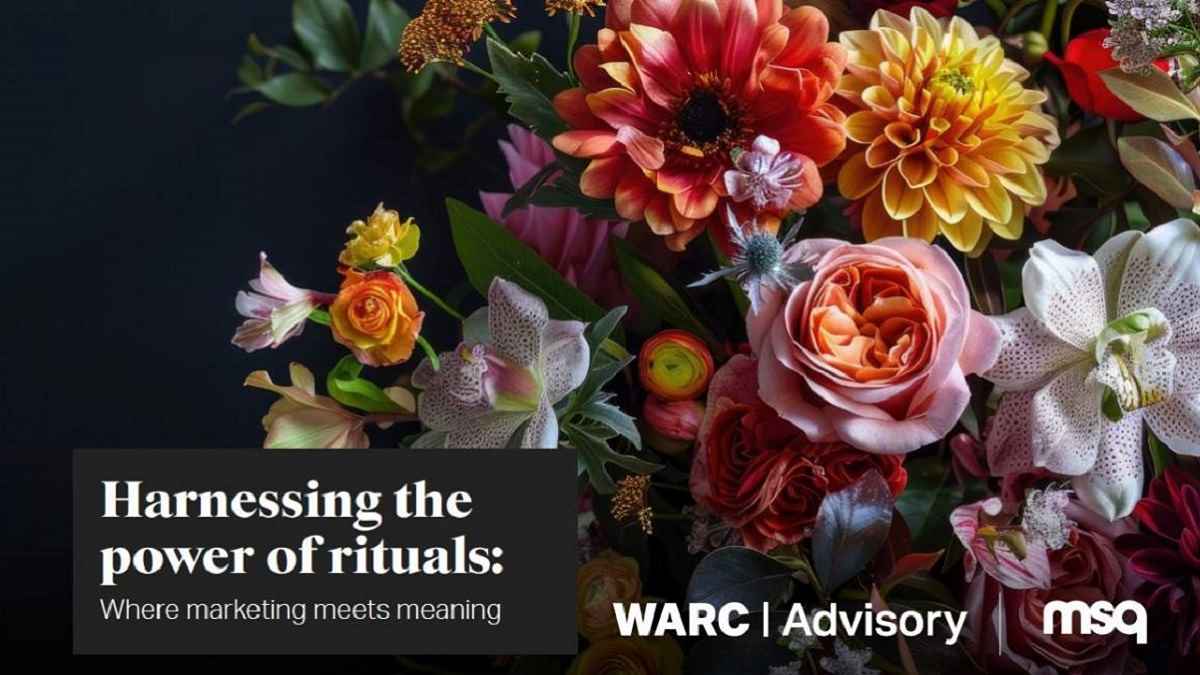
Rituals unlock access to consumers’ deep emotional behaviours to support meaningful brand-building

Published

on

WARC Advisory

Breakthrough research by WARC Advisory and MSQ presented in new whitepaper: ‘Harnessing the power of rituals: Where marketing meets meaning’

72% of consumers incorporate brands into their rituals at least some of the time, and 39% feel more positively toward brands that become a part of ritual

Rituals are driven by personal meaning even when providing practical benefit: 44% of rituals are centred around daily routine, 25% around self care. For 33% rituals provide structure, escape (32%) and control (31%)

17 September 2024 – WARC Advisory and creative, technology and media group, MSQ have released a whitepaper today, Harnessing the power of rituals: Where marketing meets meaning.

This breakthrough research examines the role of rituals in consumers’ lives, how people participate in them and why, and explores the potential opportunities that brands can unlock: 72% of consumers surveyed incorporate brands into their rituals at least some of the time, 70% are very, or somewhat, open to adopting new rituals, and 39% feel more positively toward brands that become a part of rituals, the report finds.

As brands battle to connect more meaningfully with consumers, the report outlines how rituals – defined as a succession of behaviours designed to induce an emotional transformation – can enrich understanding of consumer behaviours, unlocking access to more meaningful brand building. This allows brands to unleash deeper connections and generate longer relationships. The whitepaper outlines marketing opportunities through engaging in rituals.

The analysis combines a WARC Advisory survey of 4000 consumers across Germany, France, UK and the US, and in-depth expert interviews with marketers, culture experts, behavioural scientists and neuroscientists including: Dr. Marcus Collins, Professor at the Ross School of Business, University of Michigan, Author of For the Culture; and Sian Davies Global Founder, The Behavioural Architects.

In addition, through utilising its Texture tool to analyse over 688,000 social media data sources and 200 million search data points, Freemavens (an MSQ agency) has unearthed eight ritual types that show a range of individualised and collective behaviours within three specific categories – Personal Care, Alcoholic Beverages, Finances – outlined within the report: Security, Maintenance, Celebration, Identity, Commencement, Connection, Enhancement and Calming.

Kate Howe, Executive Director, MSQ, said: “This whitepaper reveals that rituals offer more than just a glimpse into consumer behaviour—they provide a roadmap to creating long-lasting brand relationships. By understanding the emotional transformations that rituals are designed to induce, brands can align their strategies to resonate more deeply with consumers’ emotional needs.”

Imaad Ahmed, Head of Advisory, EMEA & Americas, WARC, commented: “Our research found that seventy two percent of consumers incorporate a specific brand into their rituals for reasons of familiarity, better experiences and convenience. Brands who actively observe customer behaviour, facilitate enhanced ritual experiences when customers allow, and participate in those rituals as much or as little as the customer chooses, tend to win. Brands grow in emotional value to consumers if they become part of their rituals. By growing a brand’s emotional value, marketing meets meaning.”

The whitepaper provides a set of guiding principles on rituals to help marketers identify and understand their role in consumers lives:

Principle 1. Rituals are driven by personal meaning even when providing practical benefit

One in four people surveyed say that, “creating the rules or beliefs for living my life” best describes the impact of their rituals, and nearly the same number agree that “rituals give my life purpose and meaning.” Rituals are most often connected to mindfulness and self-care, the report finds.

Principle 2. Rituals offer support for the individual in an atomised society

Rituals are often thought of as something that individuals do to connect to others and create a sense of community, whether through religion, culture, sports, or other shared experiences. While those rituals are just as important today, the data showed how often rituals are used to support the individual. 56% of rituals centre around personal care, or deepening connections with others. Beyond being concentrated in our daily routines, these rituals are focused on nurturing self and relationships. The research finds that rituals are most often carried out inside the home, and twice as often individually, than with friends or family. Also 50% of consumers surveyed involve others in their rituals at least some of the time.

3. Rituals provide structure and control in a volatile environment

One of the core functions of rituals is to provide a stabilising mechanism to counteract the forces which may create an individual’s sense of losing control. Of those surveyed, structure (33%), escape (32%) and control (31%) were the top three benefits of rituals.

4. Rituals create meaning in a world obsessed with efficiency

In a technology-driven culture that is hyper-focused on efficiency, people’s lives are more efficient than ever, resulting in a struggle to achieve a balance with mental and physical health, and overall happiness. In marketing, efficiency is by no means a bad thing. However, meaning and emotion in marketing messages and customer experience can often be lost in the quest for endless automation and efficiency. Rituals can enhance experiences and help to create rules and beliefs in people’s lives, the analysis finds.

Alongside presenting key insights, the whitepaper explores key macro forces and trends that are shaping rituals: Declining faith in institutions, influence of social media on ritual discovery and sharing, shifting priorities in the post-pandemic economy, and new rituals forming across generational divides.

While marketing campaigns built entirely around rituals are rare, the report provides case studies of brands that have optimised ritual behaviour to solve a business challenge, from KFC to The Guardian. The study also offers actionable insights for brands wanting to tap into the power of rituals.

Experts interviewed for this report:

Dr. Marcus Collins, Professor at the Ross School of Business, University of Michigan, Author of For the Culture
Sian Davies, Global Founder, The Behavioural Architects
Leila Fataar, Founder, CEO & CSO, Platform13
Samori Gambrah, Global Brand Director, Captain Morgan, Diageo
Matthew Graham, Chief Marketing Officer, Global Food & Nutrition, Mars
Ellesha Kirby, Global Executive in Consumer Health and Beauty and previously Global Head, Skin Health & Beauty and Design at Kenvue
Samrat Saran, Head of Client Solutions, Neuro-Insight US & Europe
John Starkey, President Family Care North America, Kimberly-Clark
Eli Velez, Managing Director, Partner Agencies & Superette, DoorDash
Jelina Wan, General Manager, Mars Taiwan & Hong Kong
Natalie Wills, VP of Brand Marketing, Booking.com



Energy

SBM Offshore Confirmed as Silver Sponsor for African Energy Week (AEW) 2026 Amid Africa FPSO Expansion Push

Published

on

African Energy Chamber

SBM Offshore will participate as Silver Sponsor at African Energy Week 2026, where they are set to showcase FPSO expansion in Angola, Namibia and Guyana amid strong financials and a deepwater innovation strategy

CAPE TOWN, South Africa, June 9, 2026/APO Group/ –Multinational oil and gas services company SBM Offshore will participate at this year’s African Energy Week (AEW) 2026 Conference and Exhibition as a Silver Sponsor, reinforcing the company’s long-term commitment to Africa’s expanding deepwater oil and gas industry. Their participation comes as SBM Offshore accelerates brownfield optimization projects in Angola while aggressively positioning itself for new frontier developments in Namibia’s Orange Basin.


SBM Offshore’s return to AEW, which takes place from October 12–16 in Cape Town, is expected to draw significant industry attention as operators, financiers and EPC contractors evaluate the next wave of floating production infrastructure across the Atlantic Basin. With more than 20 years of experience in Africa and over $31 billion in contract backlog globally, the company remains one of the world’s most influential FPSO suppliers.

The Sponsorship follows several major milestones announced during 2025 and 2026. On May 26, the American Bureau of Shipping approved SBM Offshore’s seawater intake riser technology developed alongside Shell. The system pumps cold seawater from depths of 700m to FPSO topsides, reducing onboard cooling energy demand and improving emissions performance for future African and South American projects.

The company’s financial position strengthened considerably following the $2.32 billion sale of FPSO One Guyana to ExxonMobil in February 2026. The transaction helped drive a 216% year-on-year increase in Q1 2026 directional revenue to $3.5 billion while reducing SBM Offshore’s net debt from $5.7 billion to $3.2 billion by March 21, 2026.

SBM Offshore continues to demonstrate the technical expertise, operational scale and long-term investment approach needed to advance Africa’s next generation of energy projects

In March 2026, ExxonMobil awarded SBM Offshore front-end engineering and design contracts for the Longtail development in Guyana. The proposed FPSO is expected to feature the world’s highest gas-handling capacity ever deployed on a floating production vessel, processing 1.2 billion cubic feet of gas and 250,000 barrels of condensate daily.

Across Africa, SBM Offshore continues expanding its offshore footprint. In Angola, the company signed multi-year extensions in December 2025 with Esso Exploration Angola for FPSO Mondo and FPSO Saxi Batuque in Block 15, extending operations through 2032. Brownfield upgrades and life-extension works commenced in early 2026 to support declining reservoir pressure management and maintain environmental compliance standards.

The company also finalized a share purchase agreement with Equatorial Guinea’s national oil company GEPetrol in December 2025, restructuring regional asset ownership and supporting localized operational transitions. The FPSO Aseng formally exited SBM Offshore’s lease-and-operate fleet during the same period as management responsibilities shifted toward Equatoguinean entities.

Namibia retains a central focus of SBM Offshore’s African growth strategy. The company is actively competing for TotalEnergies’ Venus FPSO contract in the Orange Basin, one of Africa’s largest recent offshore discoveries with estimated resources of roughly 2 billion barrels. SBM Offshore has expanded its Cape Town commercial engineering workforce while positioning its standardized technologies for upcoming South Atlantic developments.

“SBM Offshore’s participation at this year’s event reflects the growing momentum behind Africa’s deepwater industry and the critical role FPSO technology will play in unlocking new production. From Angola’s mature offshore hubs to Namibia’s frontier discoveries, SBM Offshore continues to demonstrate the technical expertise, operational scale and long-term investment approach needed to advance Africa’s next generation of energy projects,” says NJ Ayuk, Executive Chairman, African Energy Chamber.

Looking ahead, SBM Offshore aims to combine frontier expansion with lower-emission offshore production systems. Through partnerships with SLB and Cognite, the company is integrating industrial AI platforms to its global fleet while scaling standardized hull construction to accelerate project delivery timelines across Africa and Latin America.

Distributed by APO Group on behalf of African Energy Chamber.

Continue Reading

Business

Minister Kgosientsho Ramokgopa Joins African Energy Week (AEW) 2026 as South Africa Opens R400B Grid Expansion to Private Investment

Published

on

Kgosientsho Ramokgopa

South Africa has moved from rolling blackouts to a year of stable supply, and Minister Kgosientsho Ramokgopa now turns to the grid expansion and market reforms needed to keep the lights on and draw private capital

CAPE TOWN, South Africa, June 9, 2026/APO Group/ –Kgosientsho Ramokgopa, Minister of Electricity and Energy of the Republic of South Africa, has been confirmed as a featured speaker at African Energy Week (AEW) 2026, where he is expected to outline the next phase of the country’s power-sector recovery and the investment drive needed to expand the electricity grid.


Taking place October 12-16, AEW 2026 represents the largest energy gathering on the African continent, offering a strategic platform for dealmaking and partnerships. Minister Ramokgopa’s participation reflects the country’s ambitions to strengthen investment flows across the power and energy markets, supporting long-term generation resilience and improved transmission networks.

South Africa has moved from one of the worst phases of its electricity crisis to its most stable supply in years. The country recently passed a full year without load-shedding, and the grid is at its strongest in half a decade, with roughly 4,400 MW more generation on hand than a year earlier. The return of Kusile Power Station to its full output of about 4,800 MW helped anchor the turnaround.

South Africa’s recovery shows what disciplined execution can achieve, and opening the grid to private capital is the logical next step

With supply stabilized, Ramokgopa has reframed the current market challenge as being less about generation and more to do with transmission, offtakers and bottlenecks, pointing to more than 130 GW of generation projects that have yet to secure firm offtake agreements. That bottleneck sits at the center of the country’s largest infrastructure push. The Transmission Development Plan calls for 14,000 km of new power lines and 105 substations by 2030, at a cost of roughly R400 billion, to unlock an additional 22.5 GW of capacity.

Because neither Eskom nor the state can fund that build alone, the government has opened transmission to private investment for the first time through the Independent Transmission Projects (ITP) program. In December 2025, Ramokgopa named seven prequalified bidders for the first phase, all of them international-led consortia. The phase covers 1,164 km of high-voltage lines across seven corridors, with a combined value of about $1 billion. A request for proposals is expected in the second half of 2026.

“South Africa’s recovery shows what disciplined execution can achieve, and opening the grid to private capital is the logical next step,” says NJ Ayuk, Executive Chairman of the African Energy Chamber. “The real opportunity now is in transmission, and the investors who help build that network will open up generation that will change South Africa’s future for the better.”

Private appetite is already evident on the generation side. The latest round of the Renewable Energy Independent Power Producer Procurement Program drew 10.2 GW of bids against the 5 GW on offer. In the 2025/26 financial year, eight new independent power projects came online with a combined 800 MW, and another 1,610 MW is under construction.

Minister Ramokgopa is also expected to address the Integrated Resource Plan 2025, the government’s blueprint guiding new generation capacity, and the rollout of a competitive wholesale electricity market intended to open the sector beyond Eskom.

As AEW 2026 prepares to convene policymakers, investors and operators at the Cape Town International Convention Center this October, Minister Ramokgopa’s participation is the host nation’s signal that its power sector is open for investment.

Distributed by APO Group on behalf of African Energy Chamber.

Continue Reading

Energy

Carbon Markets Africa Summit (CMAS) 2026 programme launched as Africa’s carbon markets move from readiness to delivery

Published

on

CMAS

Positioned as a pan-African marketplace, CMAS connects policy, project pipelines, capital and buyers in a structured environment focused on enabling real deal flow

CAPE TOWN, South Africa, June 9, 2026/APO Group/ –Africa is emerging as an exciting destination to develop carbon market projects with improved policy certainty and more and more projects becoming investment-ready. As global carbon markets transition from rule-setting to real transactions, with Article 6 mechanisms moving into implementation and compliance-driven demand such as CORSIA accelerating, attention is shifting towards where credible supply, policy certainty and investment-ready projects can be delivered at scale.


Against this backdrop, the Carbon Markets Africa Summit (CMAS) that is organised by VUKA Group has released its official 2026 programme, outlining how Africa’s carbon markets can move beyond frameworks into execution, investment and transactions. The summit will take place from 13–15 October 2026 in Kigali, Rwanda, hosted by the Ministry of Environment of Rwanda, with UNDP and the African Development Bank (AfDB) as host organisations, the Development Bank of Southern Africa (DBSA) as host partner, and AUDA-NEPAD as the strategic institutional partner.

Positioned as a pan-African marketplace, CMAS connects policy, project pipelines, capital and buyers in a structured environment focused on enabling real deal flow.

This year’s programme reflects a changing market dynamic, one where integrity, quality and transaction readiness are becoming decisive.

Carbon markets are entering a more selective and operational phase. The question is no longer whether Africa has a role to play, but whether the continent can bring forward credible projects, enabling frameworks and market infrastructure to transact at scale,” said Emmanuelle Nicholls, Project Lead. “CMAS 2026 is designed as a response to that moment – connecting the actors, pipelines and capital needed to move from ambition to execution.”

Africa’s carbon markets must be built on integrity, equity, and continental coordination so that carbon finance delivers real value

Within this evolving context, the summit places strong emphasis on the foundations required to scale markets responsibly. As Estherine Fotabong, Director at AUDA-NEPAD, notes, “Africa’s carbon markets must be built on integrity, equity, and continental coordination so that carbon finance delivers real value for communities, ecosystems, and sustainable development across the continent.”

A programme built for execution

The CMAS 2026 programme spans the full carbon market value chain from policy and Article 6 implementation to project development, finance and transactions. Key highlights include the keynote opening session on delivering projects, capital and transactions at scale, a high-level dialogue on trust and market readiness, ministerial and technical roundtables, and sessions focused on buyer demand, investor priorities and deal structuring.


A central feature is a curated pipeline of African carbon projects across nature-based solutions, regenerative agriculture, carbon removals, waste-to-value and blue carbon, presented through project showcases, case studies and investment-ready deal rooms.

The programme also includes solution labs and technical workshops addressing critical bottlenecks—including Article 6 and CORSIA implementation, early-stage finance, MRV systems and project bankability, alongside live demonstrations of digital carbon infrastructure, ensuring focus on practical market development and delivery.

CMAS 2026 is hosted in Rwanda, a country advancing carbon market frameworks under Article 6, and takes place at a pivotal moment as global markets increasingly prioritise integrity, quality and real delivery at scale.

Distributed by APO Group on behalf of VUKA Group.

Continue Reading

Trending