Connect with us
Anglostratits

Business

Quality buying, the rise of curation, AI-powered brand safety and the growth of programmatic out-of-home are set to define programmatic advertising over the next year

Published

on

programmatic

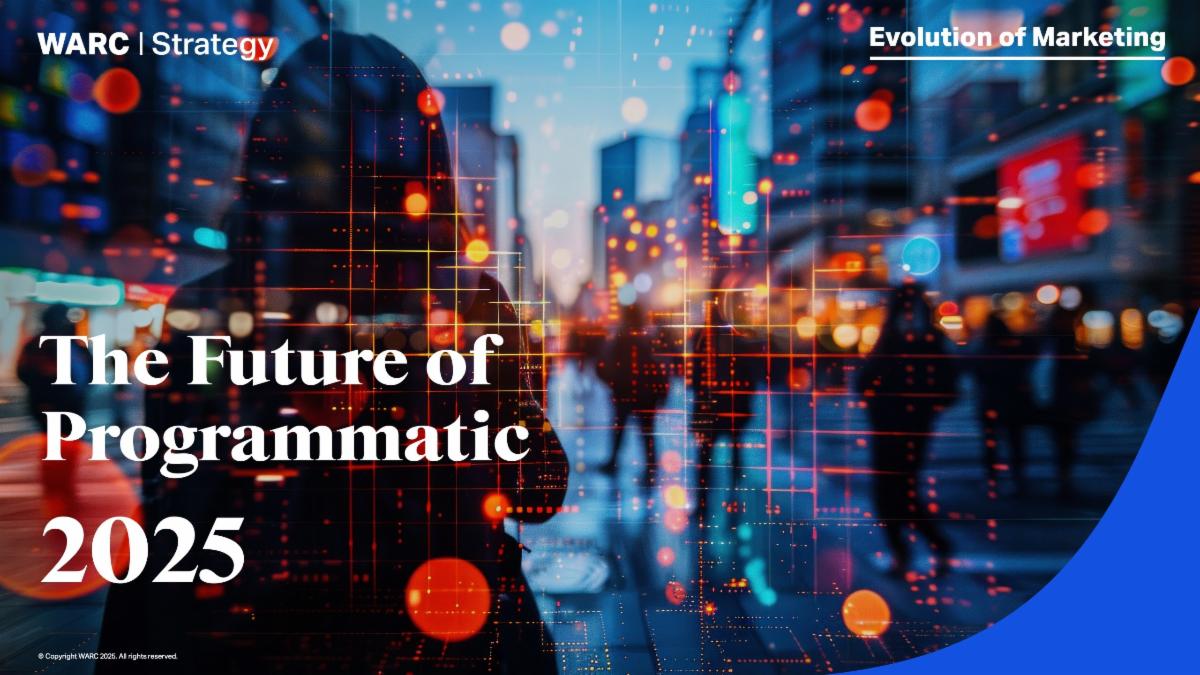
The Future of Programmatic 2025: new research by WARC explores major trends in programmatic advertising

10 July 2025 – WARC’s The Future of Programmatic 2025 report, released today, highlights emerging trends in programmatic.

Based on insights from both WARC and external research, it provides an overview of the programmatic marketplace, a deep-dive into three specific trends – the rise of sell-side curation, AI-powered brand safety, and the growth of programmatic out-of-home advertising – and includes practical guidance for marketers evolving their programmatic and ad tech capabilities.

Paul Stringer, Managing Editor, Research and Insights, WARC, says: “The past few years have been challenging for open web programmatic advertising due to issues over transparency, targeting and measurement. There is a growing sense that it must reinvent itself or risk losing even more ground.

“Fortunately, programmatic advertising is showing promising signs of progress as advertisers put more emphasis on quality inventory, embrace privacy-friendly approaches and cookie-less channels like CTV, retail media and DOOH, and adopt advanced AI tools that enhance brand safety measurement — signaling a potential renaissance for open web programmatic advertising.”

Key trends outlined in WARC’s Future of Programmatic 2025 report are:

Marketplace overview: The shift to quality

Spending on the programmatic open internet has stagnated, with almost all of the growth accrued by the major walled garden platforms.

To cope with signal loss, advertisers are responding by adopting a range of cookie-free strategies, with first-party data and contextual advertising proving particularly popular. Research by Comscore shows nearly half (48%) of marketers expect to primarily rely on cookie-free targeting tactics by the end of 2025.

Following years of inaction, advertisers are now looking for more transparency and control over programmatic buying, and putting more emphasis on quality and brand-safe inventory. Spend efficiency on programmatic campaigns has increased 14% since 2023, according to the ANA’s Q1 2025 transparency benchmark report.

Phil Acton, UK Country Manager, Adform, commented: “Walled gardens have built their empires on scale, not transparency or quality. The open web’s strength lies in accountability and collaboration, delivering better results for advertisers, more revenue for publishers, and richer experiences for consumers.”

According to research by the IAB, key programmatic growth areas this year include retail media, CTV and DOOH. WARC forecasts indicate both CTV and retail media will lead ad spend growth to 2026, ahead of channels including social media, online audio and search.

The rise of sell-side curation

Programmatic curation (the process of packaging advertising inventory based on criteria like audience interests, behaviours and contextual relevance) is moving to mainstream adoption and could eventually become the primary means of transacting on open web inventory.

According to a 2024 study by Exchangewire, 41% of marketers across Europe see curated deals as an opportunity to drive higher ROI; and programmatic consultancy, Jounce Media, reports that multi-publisher curated deals now represent nearly three-quarters of all bid requests in programmatic advertising. The open auction, meanwhile, is in structural decline.

Joe Root, CEO and co-founder, Permutive, said: “Curation effectively harnesses first party data from publishers alongside all addressable audience signals. When advertisers operate this way, you see huge uplifts in reach, and more importantly, significant improvements in outcomes.”

However, curated deals can mean higher costs for both advertisers and publishers. Advertisers do not always get clear visibility into where their ads run, what data was used, and who the supply partners were, while publishers also lack insight into how their inventory is being packaged and where it is being sold.

Brand safety’s AI-powered evolution

Marketers increasingly see brand safety as a top priority, according to IAB Europe, and evidence from the ANA’s 2025 Programmatic Benchmark shows advertisers are buying more quality, brand-safe inventory. Along with these behavioural shifts, brand safety tools are evolving.

New AI-powered tools are capable of analysing content and context with far more precision and granularity than traditional tools, like keyword and category blocking, which have failed to protect brands from showing up in unsafe environments while unfairly penalising publishers.

There is hope these new tools will help shift brand safety strategies from being reactive to proactive, while increasing trust, accountability and transparency across the entire programmatic ecosystem.

Laura Quigley, Senior Vice President APAC Sales, Integral Ad Science, comments: “AI is revolutionising digital advertising by enhancing brand safety and performance. Innovative AI technologies can analyse vast datasets to identify harmful content and predict trends, allowing marketers to strategically place ads that align with their brand image and risk tolerance.”

The growth of programmatic out-of-home

Programmatic digital out-of-home (prDOOH) represents an evolution in outdoor advertising, combining out-of-home (OOH) media’s traditional reach capabilities with the precision and addressability of programmatic buying.

While OOH ad spend has remained largely static since 2013, global digital out-of-home (DOOH) spend is growing at a healthy pace – up 15.0% in 2024 and forecast to rise 14.9% this year, reaching $17.6bn, per WARC Media.

Half of all digital out-of-home (DOOH) campaigns are now purchased either fully or partly programmatically, which offers more flexibility and precision than traditional OOH, allowing brands to target audiences with more relevant and timely ads. Research consistently shows that outdoor is more effective when combined with other channels.

The ability to adjust creative in real-time, is a major benefit of prDOOH. Adoption of dynamic creative optimisation (DCO) is on the rise. This enables brands to adjust creative based on data triggers, such as time of the day, footfall, weather, and even product availability – to deliver more relevant and effective advertising. But scale remains an issue given the finite amount of prDOOH inventory available.

Helen Miall, Chief Marketing Officer, VIOOH, says: “prDOOH’s lower barriers to entry and data-driven capabilities are enabling advertisers to increasingly use real-time messaging within dynamic creatives. This ensures highly contextual and relevant campaigns, confirming the 37% more attention that OOH delivers to digital ads within multi-channel campaigns.”

WARC subscribers can read The Future of Programmatic 2025 in full. A WARC podcast on the report will be available later in the month.

The report is part of WARC Strategy’s Evolution of Marketing, a content programme of in-depth forward-looking reports focusing on the future of the marketing discipline by drawing on the latest evidence, emerging trends, technologies, media, social influences and other drivers of change.

Home  Facebook

Business

Aurionpro expands its multi-country transaction banking engagement with Diamond Trust Bank (DTB)

Published

on

Aurionpro

Aurionpro’s upgraded iCashpro platform for DTB delivers a unified digital experience across payments, trade, virtual accounts, and real-time reporting, enhancing straight-through processing, visibility, and control for both the bank and its corporate customers

MUMBAI, India, April 30, 2026/APO Group/ –Aurionpro Solutions Limited (www.AurionPro.com) (BSE: 532668 | NSE: AURIONPRO)a global leader in banking technology, announced the expansion and upgrade of its transaction banking engagement with Diamond Trust Bank (DTB), to modernize and enhance the bank’s corporate transaction banking capabilities across multiple countries.

Download Document: https://apo-opa.co/4edHUaC

This multi-country transaction banking upgrade covering Kenya, Uganda, and Tanzania aligns with DTB’s intent to enhance customer experience, streamline operations, and support growing transaction volumes as it expands its regional corporate banking footprint. DTB continues to focus on building a more agile, ‘digital-first’ banking experience, particularly around payments for its corporate customers across Africa, and is now well positioned to scale these capabilities. As part of its broader transformation agenda, the bank has been steadily investing in platforms that enhance scale, reliability, and service consistency across markets.

Through this partnership, we are proud to lead the next era of transformation in transaction banking, helping DTB enhance operational agility

Aurionpro’s upgraded iCashpro platform for DTB delivers a unified digital experience across payments, trade, virtual accounts, and real-time reporting, enhancing straight-through processing, visibility, and control for both the bank and its corporate customers. By enabling DTB to standardize and scale its transaction banking operations across countries, the platform ensures consistent service levels, stronger control, and improved efficiency. It also supports enhanced user experience, advanced security, and the flexibility to introduce new features as DTB expands its regional transaction banking footprint.

Murali Natarajan (https://apo-opa.co/48trPdk), Managing Director & CEO, DTB Kenya   commented: “We are delighted to strengthen and broaden our partnership with Aurionpro Solutions as part of DTB’s ongoing digital transformation journey across multiple markets. Our focus on innovation, operational excellence, and customer-centricity continues to guide our technology investments. This upgrade strengthens our transaction banking capabilities, enabling us to deliver greater value to our customers through robust digital channels and seamlessly integrated experiences.”

Ashish Rai, Group CEO, Aurionpro Solutions, commented: “We are pleased to deepen our multi-country engagement with Diamond Trust Bank and support the next phase of its transaction banking modernization. As DTB continues to scale across markets, platform resilience and consistency become paramount. Through this partnership, we are proud to lead the next era of transformation in transaction banking, helping DTB enhance operational agility, deliver superior experiences to corporate customers, and create long-term value across geographies.”

He added, “Aurionpro’s iCashpro lays a strong digital foundation for transaction & wholesale banks across the globe to grow their corporate and SME client portfolio today, while creating a clear roadmap for next- generation capabilities in AI-driven insights, advanced automation and API-led connectivity for businesses in Kenya and across Africa.”

Distributed by APO Group on behalf of Aurionpro Solutions Ltd.


Continue Reading

Business

Minerals Council Chief Executive Officer (CEO) Joins African Mining Week (AMW) as South Africa Improves Sectorial Investment Climate

Published

on

Energy Capital

Minerals Council CEO to share insights on policy, infrastructure and investment trends shaping South Africa’s mining industry

CAPE TOWN, South Africa, April 30, 2026/APO Group/ –The upcoming African Mining Week (AMW) conference will feature Mzila Mthenjane, CEO of the Minerals Council of South Africa, as a speaker. Scheduled for October 14 – 16, 2026 in Cape Town, the event will bring together global investors, policymakers and industry leaders, with Mthenjane’s participation highlighting the council’s commitment to engaging international stakeholders and promoting investment across South Africa’s mining sector.

His participation comes at a critical moment as the Minerals Council works closely with government on finalizing the Mineral Resources Development Bill 2025, a policy framework aimed at strengthening the country’s mining investment climate and the sector’s contribution to GDP. According to the council, the revised legislation will support new investment across the value chain as South Africa seeks to mobilize R2 trillion over the next five years to unlock its critical minerals potential.

The policy reforms come amid shifting production trends in the sector. In 2025, South Africa recorded declines in gold and platinum group metals output of 1.9% and 4.1%, respectively. The new regulatory framework is expected to strengthen public-private partnerships and stimulate investment, enabling South Africa to increase production and capitalize on strong global commodity prices. Increased private sector investments is crucial with South Africa seeking targeting to unlock an estimated R40 trillion in untapped iron ore potential as well as maintain its position as the world’s leading producer of chrome and manganese.

At AMW 2026, Mthenjane is expected to outline these trends, providing insights into how the council is contributing to addressing challenges disrupting the sector. Infrastructure and energy costs remain key concerns for industry players. To support the energy-intensive sector, South Africa approved a 35% reduction in electricity tariffs for major ferrochrome producers, helping stabilize an industry that has faced significant cost pressures after electricity prices surged by roughly 900% since 2008.

Logistics constraints are also a priority area for reform. South Africa’s economy is losing an estimated R1 billion per day due to inefficiencies across rail and port infrastructure. As a result, the government is considering measures supported by the Minerals Council to increase private sector participation in logistics. Planned reforms include rail modernization initiatives targeting 250 million tons of freight capacity by 2029, alongside port upgrades and private operator participation aimed at strengthening mineral exports and improving supply chain efficiency.

Beyond infrastructure and policy reforms, the Minerals Council is advocating for stronger exploration investment to support long-term industry growth.

At AMW, Mthenjane is expected to highlight these developments and outline the steps required to reinforce South Africa’s position in the global minerals supply chain. His insights will offer investors and stakeholders a timely perspective on opportunities within the country’s mining sector.

Distributed by APO Group on behalf of Energy Capital & Power.

Continue Reading

Energy

Seychelles Targets Energy Investment Push as Minister Jérémie Joins African Energy Week (AEW) 2026 as a Speaker

Published

on

African Energy Chamber

Seychelles energy minister will speak at AEW 2026, positioning her to highlight reforms, renewable projects and investment opportunities as the island nation advances its transition toward a diversified energy system

CAPE TOWN, South Africa, April 29, 2026/APO Group/ –Marie-May Jérémie, Minister of Environment, Climate, Energy and Natural Resources for Seychelles will participate as a speaker at this year’s African Energy Week (AEW) 2026, taking place from October 12–16 in Cape Town. Her participation underscores the country’s growing role in shaping Africa’s small-island energy transition agenda.

Minister Jérémie’s presence at AEW 2026 comes at a critical time as Seychelles accelerates efforts to reduce its heavy reliance on imported fossil fuels. The event provides a platform to attract investment, strengthen policy alignment and showcase bankable projects, positioning the country as a viable destination for private-sector participation in island energy systems.

Seychelles is demonstrating how policy reform and innovation can unlock investment in constrained environments

In May last year, international finance institution the World Bank approved the Renewable Energy Acceleration Program, a seven-year initiative aimed at modernizing the grid and increasing renewable energy penetration to 15% by 2030. The program focuses on unlocking private capital while strengthening transmission infrastructure to accommodate variable renewable energy sources.

Project development is gaining traction in the country, particularly in innovative technologies suited to Seychelles’ land constraints. The 5.8 MW Seysun Lagoon floating solar PV project, developed by independent renewable power producer Qair, is under construction and expected online in 2026.

Alongside renewables, Seychelles continues to pursue upstream opportunities to diversify its economy. The government approved new exploration entrants in 2025 and extended exiting petroleum agreements, while securing an infrastructure partnership with China. Multilateral estimates suggest over $800 million in investment will be required over the next 25 years.

Regulatory reform is central to this transition, with Seychelles introducing an independent power producer framework to open the market to private developers. Standardized power purchase agreements, grid access reforms and strengthened public-private partnership structures are being implemented to improve transparency, reduce risk and accelerate project bankability across solar, storage and emerging wind opportunities.

“Minister Jérémie’s participation highlights the strategic importance of island nations in Africa’s broader energy transition,” says NJ Ayuk, Executive Chairman, African Energy Chamber. “Seychelles is demonstrating how policy reform and innovation can unlock investment in constrained environments. Her insights will be critical to advancing dialogue on resilient, low-carbon energy systems across the continent.”

Distributed by APO Group on behalf of African Energy Chamber.

Continue Reading

Trending