Connect with us
Anglostratits

Business

Organisation of the Petroleum Exporting Countries (OPEC) Achieves Consensus on Production Levels
Published

on

OPEC

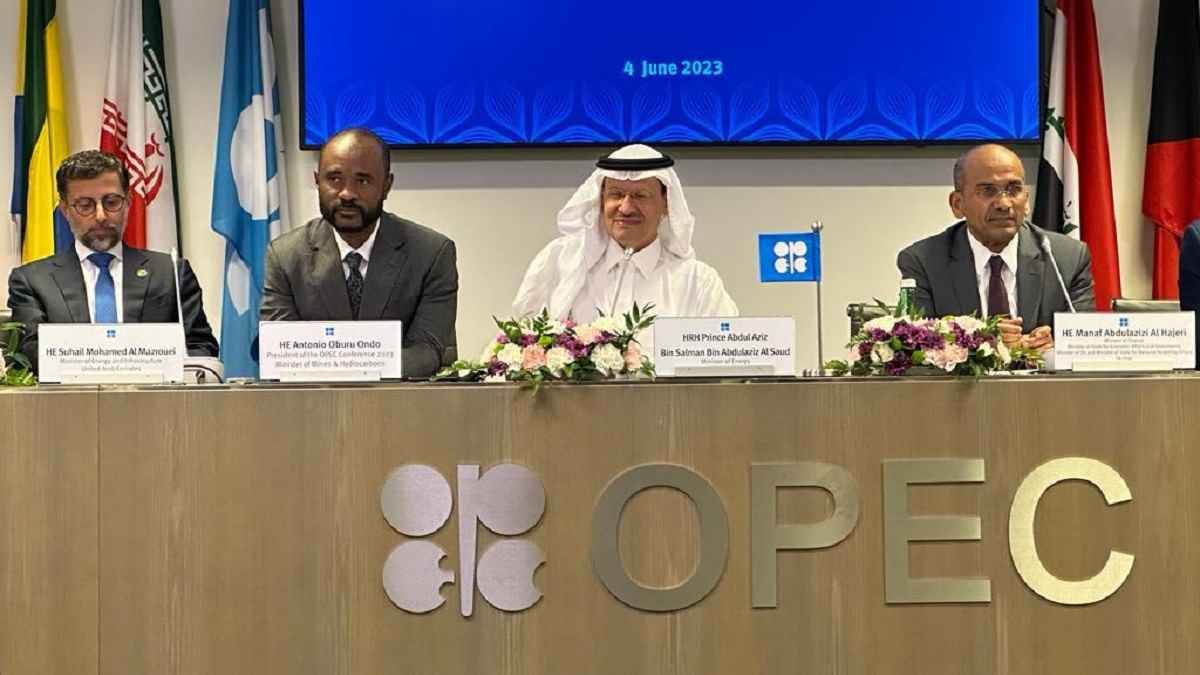
During the 35th OPEC and non-OPEC Ministerial Meeting, members reached a consensus on production levels, under the leadership of OPEC President, H.E. Antonio Oburu Ondo, Equatorial Guinea’s Minister of Mines and Hydrocarbons

JOHANNESBURG, South Africa, June 5, 2023/APO Group/ — 

In an endeavor that emulates OPEC’s dedication to fostering market stability, the recent convening of the OPEC and non-OPEC Ministerial Meeting in Vienna on June 4, 2023, witnessed unanimous agreement among participants regarding pivotal resolutions, thereby engendering favorable momentum within the energy market and guaranteeing stability for stakeholders encompassing consumers and producers alike.

During the meeting, chaired by OPEC President H.E. Antonio Oburu Ondo, Equatorial Guinea’s Minister of Mines and Hydrocarbons, participating countries reaffirmed their dedication to the Framework of the Declaration of Cooperation (DoC) and the Charter of Cooperation, which have been instrumental in fostering collaboration between OPEC and non-OPEC nations. The commitment to the Doc and Charter of Cooperation demonstrates OPEC’s efforts to address market challenges and maintain stability within the global oil market.

One of the key agreements reached during the meeting was the adjustment of the overall crude oil production levels for OPEC and non-OPEC Participating Countries. Starting from January 1, 2024, until December 31, 2024, the production level will be set at 40.46 million barrels per day (mb/d).

The meeting also emphasized the importance of agreement with the DoC, with crude oil production monitored based on information from secondary sources, following the established methodology for OPEC Member Countries. Adhering to full conformity with the agreed production levels was reiterated as crucial, ensuring market stability and balanced supply and demand dynamics.

The consensus reached during the 35th OPEC and non-OPEC Ministerial Meeting reflects a concerted effort to stabilize the market and promote sustainable growth

Saudi Arabia played a significant role in the discussions and decisions made during the meeting. The Saudi Oil Minister, Prince Abdulaziz bin Salman, engaged with African delegates and held talks with the United Arab Emirates (UAE) to address production quotas, suggesting cuts in production quotas from some African countries. While some tensions arose, it is important to note that the ultimate aim of Saudi Arabia, and indeed the entire organization, is to strike a balance that benefits both consumers and producers.

The current market volatility has been a concern for all stakeholders, as it adversely affects both consumers and producers. Recognizing this, OPEC has taken a cautious and proactive approach, focusing on stabilizing crude oil prices. The recent decisions made during the meeting, in conjunction with the extended mandate of the Joint Ministerial Monitoring Committee (JMMC), demonstrate OPEC’s commitment to closely monitoring global oil market conditions and ensuring adherence to the agreed production levels.

Looking ahead, the 36th OPEC and non-OPEC Ministerial Meeting is scheduled to take place on November 26, 2023, in Vienna. The continuity of these meetings, along with the authority granted to the JMMC to convene additional gatherings if needed, underscores OPEC’s responsiveness to market developments.

As the energy market navigates evolving dynamics, the consensus reached during the 35th OPEC and non-OPEC Ministerial Meeting reflects a concerted effort to stabilize the market and promote sustainable growth. With the Equatorial Guinea Minister of Mines and Hydrocarbons, H.E. Antonio Oburu Ondo, assuming the Presidency, OPEC is poised to continue its crucial role in providing long-term guidance and ensuring a stable oil market for the benefit of consumers and producers alike.

“The consensus reached among participants reflects a positive step towards market stability and the commitment of all involved to balance supply and demand. It is crucial to maintain a stable market as volatility can have detrimental effects on both consumers and producers. Additionally, we acknowledge and support the statements made by Saudi Arabia, highlighting the importance of stability and cooperation in the oil market,” states, OPEC President H.E. Antonio Oburu Ondo, Equatorial Guinea’s Minister of Mines and Hydrocarbons.

The African Energy Chamber endorsed the decision of the OPEC Ministers.

Distributed by APO Group on behalf of African Energy Chamber.

Business

Rockwell Automation Announces Collaboration with Mimosa Mine and Mine Elect on Cybersecurity and Modernization Initiative in Zimbabwe

Published

on

Rockwell Automation

Project supports mine’s digital migration journey to strengthen operational resilience

HARARE, Zimbabwe, September 1, 2026/APO Group/ –Rockwell Automation (www.RockwellAutomation.com), the world’s largest company dedicated to industrial automation and digital transformation, today announced a new collaboration with Mimosa Mine and Mine Elect to support the mine’s ongoing modernization program in Zimbabwe.


Mimosa Mine, a platinum‑group metals (PGM) and base metals operation located in the Midlands Province of Zimbabwe, is undertaking a multi‑year digital migration initiative aimed at modernizing its operations and improving the resilience of its industrial infrastructure. As part of this journey, the mine recently upgraded its operational technology (OT) network and sought support for secure connectivity, cybersecurity (https://apo-opa.co/3UxzrqS) risk management and long‑term digital sustainability.

Through the project, Mimosa Mine is expected to benefit from improved visibility across its operational networks, stronger safeguards for critical systems and a more resilient digital foundation to support reliable and efficient mining operations over time. The scope of work focused on strengthening network architecture, improving security segmentation and establishing more secure mechanisms for system access, data transfer, monitoring and recovery.

This collaboration brought together global industrial expertise and local knowledge to support a mining operation that is actively investing in its digital future

“This project reflects a growing focus across the mining sector on operational resilience and cyber risk management as digital technologies become more deeply embedded in day‑to‑day operations,” said Rodrick Naidoo, country director for English‑speaking Africa at Rockwell Automation. “By working closely with Mimosa Mine and our local partner, we were able to align technology, governance and skills to support the mine’s broader modernization objectives while addressing the realities of an operational mining environment.”

A key element of the collaboration is Rockwell Automation’s long‑standing partnership with Mine Elect, a Zimbabwe‑based Rockwell Automation specialty distributor with deep experience supporting the mining and industrial sectors locally. Mine Elect provided local engineering, implementation and onsite support, helping to connect global capabilities with in‑country execution.

“We embarked on this digital transformation journey more than three years ago with the upgrade of key OT infrastructure, which included the migration of Mimosa’s legacy OT networks to Ethernet/IP,” said Dr. Blessing Mahomva, managing director of Mine Elect (https://apo-opa.co/4xstXfB). “Our role during this critical phase was to ensure the project was delivered in a way that was practical, sustainable and aligned with Mimosa’s operational priorities. This collaboration brought together global industrial expertise and local knowledge to support a mining operation that is actively investing in its digital future.”

Delivering industrial digital and cybersecurity initiatives in mining environments (https://apo-opa.co/4yj6KwF) presents unique challenges. Mining operations combine legacy systems, harsh physical conditions, safety critical processes and limited downtime windows, all which place constraints on how modern technologies can be deployed. In addition, the growing convergence of operational technology and information systems increases exposure to cyber risk, requiring careful design, sequencing and validation to avoid operational disruption.

“This project supports our broader digital migration journey by strengthening the resilience and security of our operational systems,” said Lloyd Shamu, head of technical services at Mimosa Mining Company (https://apo-opa.co/4zQv3n5). “Having partners who understand mining operations, the local context and the importance of secure, reliable infrastructure has been critical as we continue to modernize the way we operate.”

Distributed by APO Group on behalf of Rockwell Automation.


Continue Reading

Business

South Africa’s Government-Business Partnership Opens New Mining Investment Opportunities Ahead of African Mining Week (AMW) 2026

Published

on

Etu Energias

African Mining Week 2026 will connect key decision-makers across South Africa’s mining sector with global investors to forge new and strengthen existing public-private investment partnerships

CAPE TOWN, South Africa, September 1, 2026/APO Group/ —South Africa is stepping up efforts to attract investment into its mining sector, with President Cyril Ramaphosa launching Phase 3 of the Government-Business Partnership, a public-private initiative designed to accelerate economic growth, investment and job creation. Mining has been identified as a key pillar of the new phase, alongside energy, transport and logistics, tourism, infrastructure and agriculture.


The initiative targets GDP growth of more than 3% and the creation of one million additional jobs by 2030, with the mining sector positioned to play a central role in achieving those objectives.


Within mining, Phase 3 targets R50 billion in capital expenditure by February 2028 and the rollout of South Africa’s national mining cadastre system by March 2027. The digital platform is expected to streamline mining-rights applications and help address administrative and project-implementation bottlenecks, supporting efforts to attract new investment and improve the sector’s contribution to economic growth.


Mining currently contributes approximately 6% of South Africa’s GDP and supports around 470,000 direct jobs, with each mining job supporting an estimated five to 10 dependents. The urgency of accelerating investment was underscored by President Ramaphosa, who said the country’s current growth rate remains insufficient to meaningfully expand employment, with 8.5 million people unemployed and roughly 300,000 new job-seekers entering the labor force each year.


Phase 3 forms part of a broader national ambition to mobilize R2 trillion over the next five years to unlock South Africa’s critical minerals potential. The country holds approximately 80% of the world’s platinum group metals and ranks as the world’s largest producer of chrome and manganese, creating significant opportunities for investors across exploration, mining, processing and related infrastructure. South Africa is also seeking to unlock an estimated R40 trillion in iron ore potential, further expanding the pipeline of opportunities for international and domestic capital.


Against this backdrop, African Mining Week (AMW) 2026 – the Most Influential Mining Conference in Africa – will bring together global investors, financiers, mining companies and government decision-makers in Cape Town from October 14–16. The event comes at a critical juncture as South Africa seeks to translate its vast mineral endowment into new investment, production, infrastructure and jobs while improving the regulatory environment needed to support long-term project development.


AMW 2026 will feature senior figures from across South Africa’s mining and investment ecosystem, including Deputy Minister of Planning, Monitoring and Evaluation Seiso Joel Mohai, Rand Refinery CEO Dean Subramanian, Transnet Freight Rail CEO Russell Baatjies, Gold Fields Executive Vice President: South Africa Benford Mokoatle, Minerals Council of South Africa CEO Mzila Mthenjane, Standard Bank Managing Principal and Coverage Head for Resources & Energy Shirley Webber, and Executive Head for Energy, Infrastructure and Mining, Business and Commercial Banking Deerosh Maharaj, among other industry leaders.


Through high-level discussions, project showcases and networking sessions, AMW 2026 will examine South Africa’s evolving regulatory environment, expanding project pipeline and investment opportunities across the mining value chain. The conference will provide a platform for investors and industry stakeholders to explore how public-private partnerships, domestic capital and international investment can accelerate the next phase of South Africa’s mining growth.


Distributed by APO Group on behalf of Energy Capital & Power.


Continue Reading

Energy

Halliburton Repositions for Venezuela’s Upstream Revival at Venezuela Energy Week 2027

Published

on

Etu Energias

Halliburton will join Venezuela Energy Week as a Platinum Sponsor as international operators accelerate efforts to restore production, reactivate drilling capacity and rebuild the oilfield services ecosystem

CARACAS, Venezuela, August 27, 2026/APO Group/ –Halliburton has joined Venezuela Energy Week 2027 as a Platinum Sponsor, bringing one of the world’s leading oilfield services companies into a market where international operators are moving to restore production and expand upstream activity. Taking place February 22–25 in Caracas, Venezuela Energy Week comes as a new investment cycle is creating fresh demand for drilling, well services, reservoir evaluation and production technologies.


Halliburton has already begun repositioning its Venezuelan operations for the changing market. In April, Chairman, President and CEO Jeff Miller said the company was discussing commercial terms with customers and had visited its Venezuelan facilities, which he said were in better condition than expected. In July, Venezuela’s Supreme Court ordered the restart of Halliburton’s operations and the return of previously seized assets, removing a significant legal obstacle to the company’s reactivation. Halliburton has since posted new positions in Venezuela, including roles in Maturín covering logging and perforating maintenance and supply-chain procurement, as well as a technical sales position in Zulia.

The timing reflects growing demand for oilfield services as Venezuela moves to reactivate mature fields, expand drilling and bring new investment into production. Halliburton’s capabilities span the full well lifecycle, including drilling, formation evaluation, well construction, completion and production, with services such as well intervention, cementing and stimulation increasingly important as operators work to restore aging wells and infrastructure. As new investment moves from agreements into field activity, Halliburton is positioned to provide the technical expertise and equipment required to translate Venezuela’s resource potential into additional production.

The investment environment is also changing. Venezuela’s January 2026 reform of the Organic Hydrocarbons Law opened new avenues for private participation in primary hydrocarbons activities, including operating and production contracts under which private companies can assume technical, operational and financial management. Subsequent regulations issued in July established the framework for royalties and the integrated hydrocarbons tax, while oil companies have been working to migrate existing agreements into the new regime.

This evolving framework is creating an increasingly important role for international oilfield service companies capable of supplying technology, equipment and technical expertise at scale. Halliburton’s renewed engagement comes as Venezuela moves from regulatory reform and investment agreements toward the practical work of drilling wells, restoring production and expanding field capacity.

At Venezuela Energy Week 2027, Halliburton will bring its renewed Venezuelan presence into discussions on the practical requirements of production growth, from drilling and well construction to completion and intervention. Its Platinum Sponsorship will place the company at the center of conversations around how Venezuela can rebuild oilfield capacity and translate new investment into additional barrels.

Distributed by APO Group on behalf of Energy Capital & Power.


Continue Reading

Trending