Connect with us
Anglostratits

Tech

Huawei to Announce the Open Source Project of A2A-T Software, Boosting the application of agent communication standards

Published

on

Huawei

BARCELONA, SPAIN – Media OutReach Newswire – 1 March 2026 – On the eve of the 2026 Mobile World Congress (MWC 2026), Huawei announced that it will officially launch the open source project for the A2A-T (Agent-to-Agent for Telecom) protocol supporting software during the event. This initiative aims to accelerate the global adoption and practice of telecom-grade agent-communication standards through open collaboration, and to jointly build an open, collaborative, and prosperous Agentic Internet era.

With the rapid development of artificial intelligence, highly Autonomous Networks are becoming a crucial direction for the communications industry, and the importance of industry collaboration is increasingly prominent. To this end, the A2A-T protocol, including the IG1453 beta version and the enhanced prompt meta-model IG1453A, was jointly released by global telecommunications industry partners at the TM Forum Accelerate Week on February 6, 2026. It aims to provide a unified interaction framework for multi-agent collaboration, addressing challenges faced by operators in automated production, such as collaboration efficiency, reliability, and security.

As a standardized agent interaction protocol, A2A-T marks a new stage in agent interaction, unlocking three major industry breakthroughs: a revolutionary improvement in integration efficiency, reducing the system integration cycle from “months” to “days”. Breaking the boundaries of task collaboration to support complex cross-domain, cross-vendor workflows; and accelerating industry ecosystem convergence by lowering interconnection barriers through unified standards, fostering a sustainable collaborative ecosystem.

While standards chart the course for the industry, open source is the optimal path to achieve widespread interoperability and rapid innovation. In line with the evolutionary consensus of the Autonomous Network industry, Huawei is going to open source the core supporting software for the A2A-T protocol, to practically propel this standard from industry consensus to global deployment.

This open source project will encompass key components for implementing the A2A-T protocol, including:
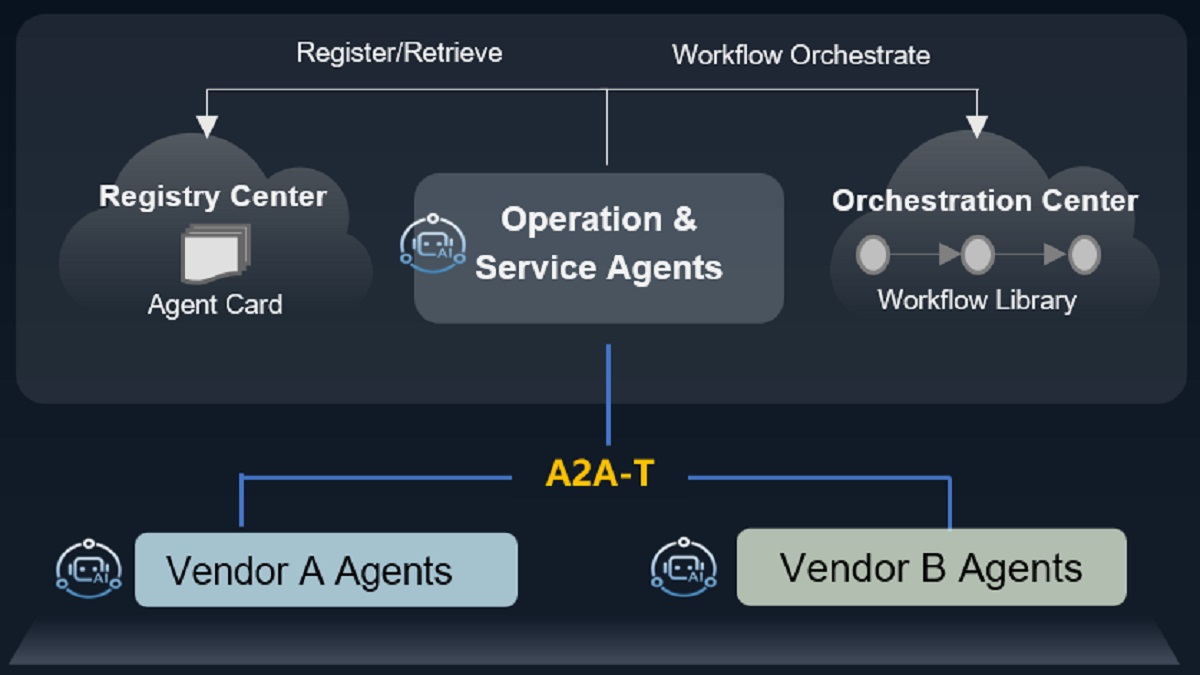
A2A-T Protocol SDK: Provides integration tools for standardized interaction between agents.
Registry Center: Enables authentication, addressing, and skill management for multiple agents.
Orchestration Center: Supports low-code/no-code visual workflow orchestration, with pre-built high-value solution packages.
More detailed information will be officially announced during MWC 2026 at the Global Autonomous Network Industry Summit​ (14:30~16:00, March 2, 2026, Sofitel Barcelona Skipper Hotel). We cordially invite global industry partners to attend the launch event on-site or follow the project’s progress through online channels, working together to promote the prosperity of the Agentic Internet.

Business

KoçSistem Leads Türkiye’s Information Technology (IT) System Integrator for the Eighth Consecutive Year as KoçDigital Wins Top Artificial Intelligence (AI) Award

Published

on

KoçSistem

KoçSistem ranked first in ICT 500’s main system integrator category for an eighth consecutive year, while KoçSistem and KoçDigital recorded 10 category wins as KoçSistem expands its MENA operations through Dubai and Riyadh

ISTANBUL, Türkiye, August 9, 2026/APO Group/ –KoçSistem (www.KocSistem.com.tr), a Türkiye-based technology company, ranked first in the main Information Technology Systems Integrator and Business Partner category of the 27th ICT 500, the country’s most comprehensive ICT (information and communication technology) sector research.


The company announced that the eighth consecutive category lead, as well as 10 combined category wins for KoçSistem and KoçDigital, support its MENA growth through offices in Dubai and Riyadh.

“Securing this leadership for an eighth consecutive year in ICT 500 is a strong reference for our leadership position in Türkiye,” said Mehmet Ali Akarca, General Manager of KoçSistem. “It also supports our objective of growing in international markets. We are pleased to take the technology expertise and operational capabilities we developed over many years in Türkiye to the MENA region.”

Ten category wins across two companies

KoçSistem’s eight first-place results covered the main system integrator category and areas including consulting, cloud, hosting management, cybersecurity, managed services and data backup and storage hardware.

With over 80 years of experience, we aim to create long-term value for the region’s digital ecosystem

KoçDigital added two first-place results in data warehousing and business intelligence software, and artificial intelligence under the “Contribution to Türkiye’s Economy” category.

ICT 500 ranks Türkiyes largest ICT companies

ICT 500 is BThaber’s annual ranking of Türkiye’s 500 largest ICT companies by revenue, with additional tables covering operating categories. The latest edition assessed 2025 data and marked the study’s 27th year.

The research reported that the combined 2025 revenue of the 500 ranked companies reached TRY 1.6 trillion, up 40 per cent from 2024.

MENA growth through Dubai and Riyadh

KoçSistem opened offices in Dubai and Riyadh in 2024 and continues to develop its MENA business in AI, cloud, cybersecurity, data analytics and managed services.

The offices extend a regional initiative outlined at GITEX Dubai 2024, when KoçSistem described Dubai as a base for developing customer and partner relationships across the Gulf and wider MENA markets.

“With over 80 years of experience, we aim to create long-term value for the region’s digital ecosystem,” Akarca concluded.

Distributed by APO Group on behalf of KoçSistem.


Continue Reading

Events

Data Centre Summit Connects Africa’s Digital Growth with the Power Systems Needed to Sustain it

Published

on

Data Centre Summit

The programme will examine why data centres are emerging as a new industrial powerhouse and what coordinated action is required from operators, hyperscalers, utilities, independent power producers and investors to capture Africa’s share of global demand

JOHANNESBURG, South Africa, August 13, 2026/APO Group/ –The Data Centre Summit returns for its second edition on 29 October 2026, co-located with the C&I Energy + Storage Summit at The Maslow Hotel in Johannesburg.


Following its debut alongside Enlit Africa in Cape Town, the Summit responds to a clear industry need: a platform that connects the growth of artificial intelligence and digital infrastructure with the power, cooling, financing and sustainability challenges shaping data centre development across Africa.

The programme will examine why data centres are emerging as a new industrial powerhouse and what coordinated action is required from operators, hyperscalers, utilities, independent power producers and investors to capture Africa’s share of global demand.

Cooling will be a central focus, with sessions exploring the shift from air to liquid cooling as rack densities increase. Discussions will consider deployment at scale, high-performance infrastructure, water availability, waste-heat reuse and the pressure that freshwater scarcity places on cooling decisions.

A South Africa country spotlight will assess the wheeling landscape, grid congestion, regulatory developments and investor sentiment influencing near-term project delivery. The programme will also explore the operational realities of maintaining 24/7 power supply through renewable blending, co-location and evolving generation technologies.

A dedicated case study will unpack how Cape Town, the first African city to launch a formal data strategy, is balancing spatial planning, resource constraints and public transparency against the rapid site approvals demanded by hyperscale growth. This will be paired with a cross-sector conversation on how surging digital workloads are drawing municipal grid capacity and independent power producers into closer alignment, and what coordinated, energy-led siting means for the next wave of facilities coming online across the continent.

Parallel masterclasses will focus on implementation, practical data centre design for African conditions and the barriers limiting clean energy investment. These sessions will address project bankability, power availability, execution risk, grid instability, contractor capacity and blended-finance solutions, giving delegates concrete tools to move projects from concept to bankable reality.

Co-location with the C&I Energy + Storage Summit, created by VUKA Group, places data centre operators in direct conversation with the customers, energy providers, financiers and technical partners responsible for powering Africa’s digital backbone.

For more information and to download the Data Centres Summit Johannesburg programme, visit https://apo-opa.co/3TXHxJ5  

Distributed by APO Group on behalf of VUKA Group.

Continue Reading

Business

Taara and Liquid use light-beam technology to expand data center capacity to large enterprises in Lagos, Nigeria

Published

on

Taara

Over the last two years, Liquid has deployed nearly a dozen Taara links across Lagos to quickly serve high-speed connectivity to large local enterprises and improve network resilience across key commercial areas for local internet service providers, banks, hotels, and a utility company

SUNNYVALE, United States of America, August 5, 2026/APO Group/ –Taara, a graduate of X, Google’s Moonshot Factory and a leader in high-speed, high-capacity wireless optical communication, today announced its continued collaboration with Liquid Intelligent Technologies (https://Liquid.Tech), a business of Cassava Technologies, a global technology company.

Taara has helped Liquid to quickly distribute high-capacity bandwidth from its points of presence at Africa Data Centres and other leading data centers in Nigeria to large enterprises within and beyond the reach of fiber, where traditional deployments can be costly, time-consuming, or operationally challenging, especially in areas where network outages caused by fiber cuts can take days to restore.

Over the last two years, Liquid has deployed nearly a dozen Taara links across Lagos to quickly serve high-speed connectivity to large local enterprises and improve network resilience across key commercial areas for local internet service providers, banks, hotels, and a utility company.

Nigeria is one of the largest economies in Africa, with some analysts reporting that the country’s economy is growing faster (https://apo-opa.co/4fX49AN) in 2026 than it has done in the previous five years. Lagos is the country’s largest and fastest-growing commercial hub, but expanding network infrastructure in dense urban environments can be challenging.

Wireless optical communication gives operators another tool to extend capacity, reach customers faster, and build more resilient networks without compromising performance

To meet growing enterprise demand, operators increasingly rely on a mix of technologies to extend coverage and increase redundancy. Liquid is using Taara’s technology to ensure improved proliferation of connectivity across the most difficult terrains in the country.

By using highly focused beams of light to transmit data through the air, Taara enables operators to establish links within days rather than weeks, helping accelerate customer deployments while complementing existing fiber infrastructure. Liquid is now exploring opportunities to expand the use of wireless optical communication into regions across Nigeria, including Abuja, Ibadan, and Kano.

“For Liquid, deployment speed has been one of the most significant advantages. Traditional fiber deployments aren’t always a possibility, especially across difficult terrains. Taara links can often be installed and activated within hours, allowing Liquid to ensure it is remaining true to its mission to create a digitally connected future that leaves no African behind,” said Eugene Uka, Acting Chief Executive Officer at Liquid Intelligent Technologies Nigeria.

“As demand for connectivity continues to grow, operators need more flexibility in how they expand and reinforce their networks,” said Bhavesh Mistry, Regional Lead for Taara in Africa. “Fiber remains an essential part of modern communications infrastructure, and will for some time, but there are many situations where deploying fiber quickly or cost-effectively can be difficult. Wireless optical communication gives operators another tool to extend capacity, reach customers faster, and build more resilient networks without compromising performance.”

Taara Lightbridge occupies a unique position between fiber and traditional radio-frequency solutions, delivering up to 20 Gbps of capacity across distances of up to 20 kilometers using narrow, invisible beams of light. The platform enables operators to rapidly deploy high-capacity links without trenching, spectrum licensing, or extensive civil works, helping bridge connectivity gaps that might otherwise remain unserved. Taara Lightbridge is currently deployed in more than 20 countries with operators including T-Mobile, Airtel, Digicel, Liquid, and SoftBank, helping extend and reinforce network capacity across urban, rural, remote, and hard-to-reach environments.

Read more in the case study (https://apo-opa.co/4fGlpLK). For more information about Taara, visit https://apo-opa.co/4gbnzmO.

Distributed by APO Group on behalf of Liquid Intelligent Technologies.


Continue Reading

Trending