Connect with us
Anglostratits

Energy

Geoex MCG Named Official Geosciences Partner of Venezuela Energy Week 2026 in Landmark Subsurface Collaboration
Published

on

Etu Energias

Geoex MCG, a global subsurface geoscience and data solutions provider, has been appointed Official Geosciences Partner for Venezuela Energy Week, bringing technical depth and geological credibility to discussions surrounding one of Latin America’s most significant hydrocarbon resource bases

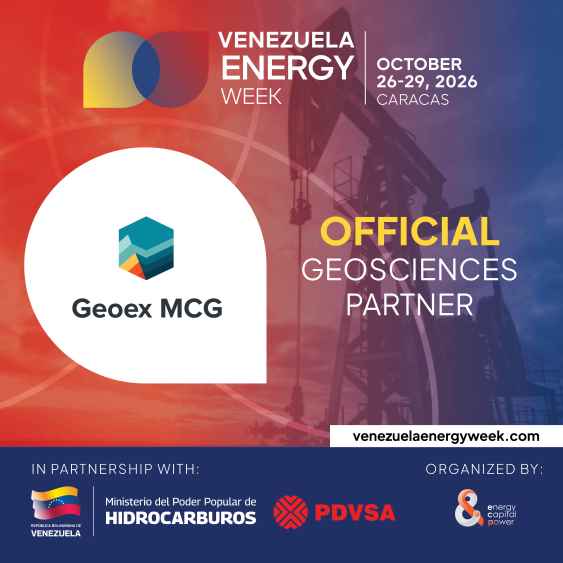
CARACAS, Venezuela, June 15, 2026/APO Group/ –Venezuela Energy Week 2026 has appointed Geoex MCG as its Official Geosciences Partner, in a move designed to strengthen the technical foundation of discussions around the country’s vast hydrocarbon basins as upstream activity and international engagement continue to evolve.

Geoex MCG holds a unique position in Venezuela’s upstream sector as the sole provider of offshore seismic data and the only company operating under a multi-client agreement with the Ministry of Hydrocarbons. Its newly reprocessed offshore datasets are currently available for licensing, with plans underway for new data acquisition from 2026 onward to further support exploration and development activities.

The partnership brings a leading subsurface geoscience and geophysical solutions provider into the core of the event’s technical program at a time when Venezuela is seeking to reframe its upstream narrative around data quality, geological certainty and investable resource definition.
“This partnership underscores the growing role of subsurface science in shaping investment decisions and operational strategy across Venezuela’s upstream sector,” said James Chester, CEO of Energy Capital & Power. “It brings greater geological and geophysical rigor at a pivotal moment for the industry, helping bridge the gap between resource potential and subsurface certainty.”

This partnership underscores the growing role of subsurface science in shaping investment decisions and operational strategy across Venezuela’s upstream sector


Geoex MCG’s participation is expected to enhance technical discussions on Venezuela’s basin evolution, seismic imaging quality, prospectivity assessment and development of offshore fields. With their newly reprocessed data, exploration in the underexplored frontier areas of the offshore can now be evaluated, as well as improved imaging of existing fields, namely Perla, Rio Caribe/Mejillones/Patao/Dragon and Loran/Cocuina.


“Venezuela represents a highly significant subsurface province, where geological potential is well established but increasingly dependent on modern, high-quality data to unlock value,” said Robert Sorley, President, Geoex MCG LLC. “Supported by our exclusive multi-client agreement with the Ministry of Hydrocarbons, a growing portfolio of datasets reprocessed in partnership with DUG Technology, and plans for new acquisition, our focus is to enable international explorers to evaluate offshore opportunities with confidence. We are pleased to support Venezuela Energy Week 2026 by strengthening the technical dialogue and bringing greater subsurface clarity to investment and development discussions.”


Geoex MCG specializes in the design and delivery of geoscientific surveys, subsurface data acquisition, seismic reprocessing and project management services, supporting exploration and development activities across oil and gas, CCUS, natural hydrogen and other energy sectors. Through its asset-light business model, the company works with selected contractors to deliver tailored subsurface solutions aligned with clients’ technical and commercial objectives.


As Venezuela seeks to attract renewed international investment, Venezuela Energy Week is positioning itself as a leading technical and commercial platform where geology, data and capital converge, supporting dialogue on investment frameworks, upstream development and the long-term future of one of the world’s largest hydrocarbon resource bases.

Distributed by APO Group on behalf of Energy Capital & Power.

Energy

Senegal Rewrites the Rules of its Hydrocarbon Boom as Minister Birame Soulèye Diop Heads to African Energy Week 2026 in October

Published

on

African Energy Chamber

At AEW 2026, Senegal’s Energy Minister Birame Soulèye Diop is expected to outline Senegal’s integrated hydrocarbons, gas and power strategy at AEW

CAPE TOWN, South Africa, April 13, 2026/APO Group/ –Senegal is reinforcing the policy architecture behind its new hydrocarbons era, with the Ministry of Energy, Petroleum and Mines launching reforms to the legal framework for local content in the extractive sector in March 2026. The reforms are aimed at improving national value retention while maintaining momentum on upstream and infrastructure development.


The move comes as Dakar works to translate first oil and first gas into broader industrial growth, stronger domestic participation and long-term energy security. Against this backdrop, Birame Soulèye Diop, Senegal’s Minister of Energy, Petroleum and Mines, will speak at African Energy Week (AEW) 2026 – taking place in Cape Town from October 12-16 – where he is expected to present Senegal’s roadmap for balancing investor engagement, gas monetization and sovereign energy development.

Minister Diop represents the kind of pragmatic African leadership that is turning resource potential into real economic transformation

In January 2026, 3.8 million barrels of crude oil were exported from the Sangomar field, while the Greater Tortue Ahmeyim (GTA) project is expected to nearly double its LNG cargoes in 2026 as the FLNG ramp‑up continues. Beyond current production, Senegal is also pushing to expand its resource pipeline. Petrosen has announced plans for a $100 million onshore exploration program in 2026, while the government has also signaled a stronger strategic focus on Yakaar-Teranga, with Senegalese investors encouraged to take a greater role in developing the 25 trillion cubic feet gas resource to prioritize domestic needs while keeping export optionality on the table.

Dakar is now focused on the next phase: using domestic gas resources to lower electricity costs, improve fuel security and support industrial competitiveness. A key pillar of this strategy is the 250 MW Gandon power plant, expected to be supplied through new gas infrastructure linked to the GTA system, alongside the broader Cap des Biches and northern gas corridor buildout. At the same time, Dakar is continuing to strengthen the regulatory foundations of its power transition. In March 2026, the Ministry of Energy, Petroleum and Mines validated Senegal’s first national standards for solar photovoltaic equipment, a move designed to improve quality, safety and performance as the country scales renewable energy deployment in parallel with oil and gas infrastructure.

At AEW 2026, Minister Diop is expected to provide strategic insight into how Senegal is navigating the transition from discovery and commissioning to full-scale execution. His participation is set to reinforce Senegal as one of the few frontier African producers pursuing an integrated model that combines hydrocarbons, gas-to-power and renewables under a single national development agenda.

“Minister Diop represents the kind of pragmatic African leadership that is turning resource potential into real economic transformation. Senegal is showing how first oil and first gas can become the basis for industrial growth, stronger regional integration and long-term energy security and his insights will bring great value to AEW 2026,” said NJ Ayuk, Executive Chairman, African Energy Chamber.

Distributed by APO Group on behalf of African Energy Chamber.


Continue Reading

Business

bp Bets Big on Namibia’s Deepwater Frontier with New Offshore Blocks

Published

on

bp

The supermajor’s entry into three offshore blocks signals rising confidence in Namibia’s deepwater potential and Africa’s expanding upstream opportunity

JOHANNESBURG, South Africa, April 13, 2026/APO Group/ –The African Energy Chamber (AEC) (www.EnergyChamber.org) has welcomed bp’s acquisition of a 60% operating interest in three offshore exploration blocks in Namibia, describing the move as a strong endorsement of Africa’s frontier basins and the continent’s growing role in global energy supply.

The transaction, which gives bp operatorship of blocks PEL97, PEL99 and PEL100 in Namibia’s Walvis Basin, marks a significant expansion of the UK supermajor’s African upstream footprint. The assets were acquired from Eco Atlantic Oil & Gas, with bp stepping into a position that places it closer to Namibia’s rapidly evolving deepwater exploration corridor adjacent to the Orange Basin.


The deal reinforces the shift in Africa’s exploration narrative – from perceived frontier risk toward increasingly competitive global opportunity, underpinned by geological potential, improving partnerships and rising investor confidence.

“Credit must be given to bp for recognizing the scale of opportunity in Namibia, and equally to Gil Holzman and Eco Atlantic for pioneering early exploration efforts that helped position these blocks on the global radar,” says NJ Ayuk, Executive Chairman of the AEC. “This is what African energy development should look like – international majors and African-focused companies working together to unlock value, build knowledge and accelerate development.”

Credit must be given to bp for recognizing the scale of opportunity in Namibia

Namibia has rapidly emerged as one of the world’s most closely watched frontier exploration provinces, following a wave of offshore discoveries in the Orange Basin by operators including Shell, TotalEnergies and Galp. These discoveries have repositioned the country as a potential multi-billion-barrel deepwater oil province and triggered a surge of international interest.

The Walvis Basin, where bp has now established operatorship, remains less explored but is increasingly seen as a geological extension of the same broader petroleum system. Early indicators point to comparable reservoir characteristics, positioning it as a potential next frontier for exploration-led investment. While appraisal and development timelines remain long-cycle, Namibia is expected to see first production from offshore discoveries by the end of the decade, assuming continued exploration success and infrastructure alignment.

bp’s move reflects a broader rebalancing in global upstream portfolios, as international oil companies prioritize high-impact exploration opportunities capable of delivering long-term reserves growth.

Africa is increasingly benefiting from this shift. As mature basins face declining output and rising costs, frontier regions such as Namibia are emerging as strategic alternatives offering scale, geological upside and relatively open acreage.

Under the agreement, Eco Atlantic will retain a minority stake alongside Namibia’s national oil company NAMCOR, ensuring continued local participation in the development of the blocks. This model is critical to ensuring that exploration success translates into domestic value creation, local capability development and long-term production capacity.

While Namibia remains in the exploration phase, the pace of activity points to a rapidly evolving basin trajectory. bp’s entry adds technical expertise and financial capacity that could accelerate appraisal drilling and future development planning.

The deal also reflects a broader validation of Africa’s upstream sector as a central pillar of future global energy security, particularly as supply diversification becomes a strategic priority for international markets. bp’s investment, alongside the groundwork laid by Eco Atlantic under Gil Holzman’s leadership, underscores a collaboration model that positions Namibia not just as a frontier play, but as an emerging cornerstone of Africa’s deepwater future.

Distributed by APO Group on behalf of African Energy Chamber.


Continue Reading

Energy

Mozambique’s Liquefied Natural Gas (LNG) Restart, Gas-to-Power Push Shape African Energy Week (AEW) 2026 Investment Discussion

Published

on

African Energy Chamber

With large-scale LNG projects back in motion and gas-to-power and renewable investment growing, Mozambique enters a defining period for its energy sector

CAPE TOWN, South Africa, August 20, 2026/APO Group/ –Mozambique’s gas sector is entering its most active phase in a decade. Large-scale LNG projects are back in the development pipeline, domestic gas-to-power infrastructure is expanding and the government is pursuing renewable energy targets alongside its upstream ambitions.


A dedicated session at African Energy Week (AEW) 2026, titled “Invest in Mozambique: Unleashing Africa’s Premier Gas and Upstream Exploration Frontier,” will explore how these developments are reshaping the country’s energy and investment landscape.

The session comes at a pivotal moment for the country’s gas sector. In January 2026, TotalEnergies announced the full restart of the Mozambique LNG project after a nearly five-year suspension. More than 4,000 workers are now mobilized, $4 billion in contracts have been awarded to Mozambican companies and first LNG is targeted for 2029. The project represents a total investment of roughly $20 billion and will produce 12.9 mtpa from the Area 1 concession in the Rovuma Basin.

This is now about delivery, and AEW 2026 is where the industry will take stock of what that means for the country and the continent

Additional LNG projects are advancing across the country. Eni reached a final investment decision in October 2025 on the $6 billion to $7 billion Coral North floating LNG project, which will add 3.6 mtpa from 2028 alongside the already operational Coral South. ExxonMobil’s $24 billion Rovuma LNG project has passed a front-end engineering milestone and is moving toward a final investment decision. Together, the three developments could bring Mozambique’s combined LNG capacity above 25 mtpa by the early 2030s.

The gas-to-power dimension is equally important for closing the country’s electrification gap. Empresa Nacional de Hidrocarbonetos is working to strengthen domestic pipeline and logistics infrastructure so that Rovuma Basin gas can serve Mozambique as well as its international customers. The government has made clear that it expects the gas sector to contribute to the country’s industrialization, not only through export revenues but through job creation, the development of local suppliers and expanded energy access for Mozambican households and businesses.

Mozambique also holds significant renewable energy potential, adding another layer to the conversation happening at AEW 2026. Hydropower already accounts for roughly 70% of the country’s electricity generation – anchored by the 2,075 MW Cahora Bassa plant – and the government’s Just Energy Transition Strategy targets an additional 2 to 4 GW of hydropower and 2 GW of solar by 2030. Utility-scale solar tenders are advancing, and off-grid solutions are central to the target of universal electrification by the end of the decade.

“For years we talked about Mozambique’s gas potential in the future tense. With Mozambique LNG restarted, Coral North going forward and Rovuma LNG moving toward a final investment decision, the conversation has changed,” says NJ Ayuk, Executive Chairman of the African Energy Chamber. “This is now about delivery, and AEW 2026 is where the industry will take stock of what that means for the country and the continent.”

This dedicated Mozambique investment session will take place as part of AEW 2026 in Cape Town from October 12-16.


Distributed by APO Group on behalf of African Energy Chamber.


Continue Reading

Trending