Connect with us
Anglostratits

Business

Gabon and South Africa deepen mining ties through new geoscience collaboration agreement

Published

on

mining

The agreement reflects Gabon’s broader strategy to diversify its economy and unlock the full commercial potential of its mining industry

LIBREVILLE, Gabon, February 11, 2026/APO Group/ –Gabon has taken a significant step toward strengthening its mining sector by signing a new collaboration agreement between the Ministry of Mines and Geological Resources of Gabon (www.Mines.Gouv.ga) and South Africa’s Council for Geoscience. The partnership is designed to enhance geological research, build technical capacity, and accelerate the sustainable development of Gabon’s mineral resources.

The agreement reflects Gabon’s broader strategy to diversify its economy and unlock the full commercial potential of its mining industry. While the country is widely known for its oil production, it also possesses significant untapped deposits of iron ore, manganese, gold, and other strategic minerals. By collaborating with one of Africa’s leading geoscience institutions, Gabon aims to modernize its geological knowledge base and strengthen the institutional foundations of its mining sector.

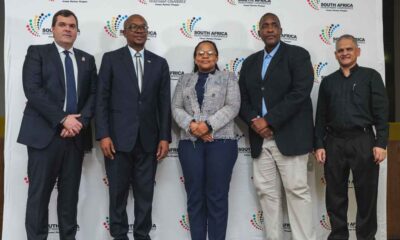
At the core of the agreement is a commitment to conduct comprehensive geological assessments across Gabon to identify new potential. The Council for Geoscience will work alongside Gabonese experts to review existing geological data, carry out new surveys where necessary, and develop updated resource maps. These efforts are expected to provide a clearer picture of Gabon’s mineral endowment and help the government design more effective strategies for resource commercialization. The agreement was signed in Cape Town by Mr Alain Manzanza, Director General of Geology in the Ministry of Mines of Gabon and Mr Mosa Mabuza, CEO of the Council of geoscience South Africa under the watchful eyes of HE Sosthene Nguema Nguema, minister of Mines and Geological Resources of Gabon and HE Rod Rembendambya Gabon’s ambassador to South Africa.

Another key pillar of the partnership is capacity building. The agreement includes provisions for training programs, technical exchanges, and joint research initiatives aimed at developing the skills of Gabonese mining professionals. Through workshops, internships, and collaborative projects, Gabonese geologists and engineers will gain exposure to advanced exploration techniques and international best practices in mineral resource management.

This is as a timely initiative in line with the directives of our head of State, President Brice Clotaire Oligui Nguema

Minister Nguema Nguema emphasized that the partnership is not limited to technical cooperation. It is also intended to strengthen economic ties between Gabon and South Africa by encouraging South African mining companies to explore investment opportunities in Gabon. By improving geological transparency and regulatory capacity, the agreement is expected to make Gabon a more attractive destination for foreign investment in the mining sector.

Environmental and technological standards form another important dimension of the collaboration. Both parties have committed to sharing knowledge on modern mining technologies and evolving environmental regulations. This includes promoting responsible mining practices, improving environmental monitoring, and integrating sustainability considerations into project planning. Such measures are increasingly important as global investors place greater emphasis on environmental, social, and governance (ESG) standards.

The agreement also aligns with regional efforts to promote intra-African cooperation in the extractive industries. By leveraging South Africa’s long-standing experience in mining and geoscience, Gabon is positioning itself to benefit from African expertise while contributing to the continent’s collective development. The partnership demonstrates how African countries can collaborate to build stronger institutions and more competitive resource sectors.

According to Minister Nguema Nguema, “this is as a timely initiative in line with the directives of our head of State, President Brice Clotaire Oligui Nguema who has pledged to increase the contribution of the mining sector to the national economy. Ultimately, we will have to work in collaboration with advanced mining economies like south Africa to achieve this.”

Global demand for minerals is rising, driven in part by the energy transition and the growing need for materials used in renewable technologies and infrastructure. With improved geological data and stronger technical capacity, Gabon is better placed to participate in these emerging markets and capture greater value from its natural resources.

In the coming months, joint working groups from both institutions are expected to outline a detailed implementation roadmap. Early priorities will likely include data integration, training schedules, and the identification of priority regions for geological surveys. As the partnership moves from agreement to action, it has the potential to play a transformative role in shaping the future of Gabon’s mining industry.

By combining expertise, technology, and institutional support, the Gabon – South Africa collaboration marks an important milestone in Gabon’s efforts to build a modern, transparent, and sustainable mining sector.

Distributed by APO Group on behalf of Ministry of Mines and Geological Resources of Gabon.

Business

African Energy Chamber (AEC) Condemns Dawes Island Ruling as Judicial Overreach Threatening Nigeria’s Marginal Field Reform

Published

on

African Energy Chamber

The Federal High Court ruling reversing the revocation of the Dawes Island license risks undermining Nigeria’s “drill or drop” policy, impacting investor confidence and the sanctity of petroleum contracts

JOHANNESBURG, South Africa, February 11, 2026/APO Group/ –A Federal High Court in Nigeria has delivered a judgement against the Ministry of Petroleum Resources in favor of Eurafric Energy Limited, reversing the 2020 revocation of the Dawes Island marginal field license, which post revocation has been held and developed by Petralon 54 Limited since 2022.  The ruling effectively challenges the regulator’s 2020 decision not to renew Eurafric’s license that had expired without commercial production after 17 years. An appeal has since been initiated by Petralon 54 Limited, with a stay of execution pending determination by higher courts. For Nigeria’s upstream sector – which is already navigating production recovery and reform implementation under the Petroleum Industry Act (PIA) – the implications extend far beyond a single asset.


As the voice of the African energy sector, the African Energy Chamber (AEC) strongly condemns the ruling carried down against the Ministry of Petroleum Resources and Petralon, recognizing it as not only an affront to Nigerian companies that are trying to develop marginal fields but also as a clear example of judicial overreach. The Chamber stands firmly with the Ministry and Petralon, calling for the issue to be resolved to pave the way for Petralon to continue increasing production, monetizing the asset and supporting Nigeria’s long-term industry goals.

An Example of Judicial Overreach

The AEC is deeply concerned by the legal reasoning underpinning the judgment. A central issue is the apparent application of provisions of the PIA – enacted on August 16, 2021 – to events that occurred prior to its passage. The Dawes Island license expired in April 2019, and the regulator formally declined renewal in April 2020 – both actions taken under the legal regime in force at the time. Applying the PIA retrospectively risks undermining the principle of legal certainty that underpins long-term upstream investment. Investors commit capital on the basis of clear statutory frameworks, fiscal terms and regulatory authority.

The ruling also raises operational concerns, particularly in its treatment of approximately 62,000 barrels produced during a well test as evidence of commercial production. In established upstream practice, well testing is a technical evaluation of reservoir performance – not the commencement of sustained commercial production, which requires regulatory confirmation through a technical allowable. Additionally, reliance on an unsigned farm-out agreement to establish enforceable legal interest departs from established contract law principles, under which unsigned documents do not create binding obligations. Taken together, the ruling risks setting a precedent where lower courts intervene in technically complex petroleum matters in a manner inconsistent with regulatory practice and fiscal governance.

If Nigerian independents are placed in a precarious position by inconsistent judicial decisions, it will deter both local and international investment

Petralon’s Commitment to Marginal Production

Following the designation of the asset under Petroleum Prospecting License 259 (PPL 259), Petralon moved swiftly to execute its obligations. The licence terms compel a one-well commitment, yet and the company deployed approximately $60 million to drill two new wells and put in place support facilities to commence production within a 12-month period. More than 150,000 barrels have been produced and evacuated to the Bonny Terminal, Nigeria’s largest export terminal, and royalty payments have already commenced being remitted to the state.

The commencement of the second well was witnessed by Heineken Lokpobiri, Minister of State for Petroleum Resources (Oil) in November 2025, signaling alignment between operator and government. The company has since committed to doubling production at the asset, reaffirming its dedication to Nigeria’s oil growth. These results stand in stark contrast to the field’s previous history of non-production. Petralon’s activities demonstrate the effectiveness of Nigeria’s “drill or drop” policy and the broader Project One Million Barrels initiative – reforms designed to ensure that marginal fields contribute meaningfully to national output. At a time when Nigeria is actively courting new upstream capital, visible execution, compliance and royalty generation should be reinforced – not destabilized.

“Petralon is a Nigerian independent that has followed every rule, complied with every regulation and worked hand-in-hand with government to increase production. They drilled. They invested. They paid royalties. They delivered results. To come at this time and derail that progress is unjust and sends the wrong signal to the market,” states NJ Ayuk, Executive Chairman, AEC.

A History of Development

Petralon is not a speculative entrant into Nigeria’s upstream sector. Incorporated in 2014, the company has steadily built a diversified portfolio of operated and non-operated assets. Between 2021 and 2022, Petralon raised $60 million in capital, strengthening its balance sheet and positioning itself for upstream growth. Today, the company holds one operated field and two non-operated deepwater assets.

Through its indirect 6.06% shareholding in Prime Oil & Gas, Petralon has exposure to OML 127 and OML 130. OML 127 contains the Agbami field, while OML 130 includes the Akpo, Egina and Preowei fields – some of Nigeria’s most significant deepwater producing assets. This production base underscores that Petralon is not merely a marginal field operator but a credible Nigerian upstream participant with deepwater exposure, capital discipline and operational alignment with regulatory frameworks.

“This is not just about one field. It is about supporting Nigerian companies that are investing in Nigeria, creating jobs, increasing production and strengthening our energy security. If Nigerian independents are placed in a precarious position by inconsistent judicial decisions, it will deter both local and international investment,” Ayuk added.

Distributed by APO Group on behalf of African Energy Chamber.

Continue Reading

Business

APO Group’s Rania El Rafie Appointed Chair of Public Sector & Thought Leadership Awards Judging Committee for the Middle East & North Africa Stevie® Awards

Published

on

Rania El Rafie

The appointment reflects APO Group’s leadership in shaping communications excellence across Africa and the Middle East

JOHANNESBURG, South Africa, February 11, 2026/APO Group/ –APO Group (www.APO-opa.com), the leading multi-award-winning, pan-African communications consultancy and press release distribution service, has announced the appointment of Rania El Rafie, Vice President of  Public Relations & Strategic Communications, as Chair of the Public Sector & Thought Leadership Awards Judging Committee for the Middle East & North Africa Stevie® Awards.


The Middle East & North Africa Stevie® Awards (https://apo-opa.co/4rNgXy4) are among the world’s most respected business awards, recognising innovation, leadership, and impact across sectors within the MENA region.

Chairing a Stevie® Awards judging committee is a professional honour – for myself and for APO Group

As Chair, Rania personally selected a judging committee comprising senior leaders with deep expertise across corporate communications, government relations, commercial strategy, and multinational operations. Together, the panel brings a combination of regional insight and global perspective, shaped by hands-on experience navigating complex environments and culturally nuanced markets. The judging committee comprises:

  • Mai Youssef, Corporate Communications & Marketing Services Director at Canon Middle East & Central and North Africa
  • Sean Muir, Director of Public Relations for the GITEX Portfolio at Dubai World Trade Centre
  • Laila Bastati, Chief Commercial Officer at APO Group
  • Mohamed Elwagih, Group Corporate Communications Manager at Mantrac Group

Commenting on her appointment, El Rafie said: “Chairing a Stevie® Awards judging committee is a professional honour – for myself and for APO Group. Effective communication programmes must navigate trust, accountability, and measurable impact. In assembling this committee, it was important to bring together leaders who understand the complexity of operating across diverse markets and stakeholder groups, while upholding the highest international standards for submissions. I look forward to working with them to identify the region’s success stories.”

With more than 22 years’ experience across multiple markets and sectors, Cairo-based El Rafie has led high-impact, award-winning communications programmes for clients such as Emirates, Canon, Nestlé, TikTok, Marriott, Afreximbank, GITEX, MSD, and Western Union. In 2024, she became APO Group’s first internally appointed Vice President. In 2025, she was named Most Innovative Woman of the Year at the Stevie® Awards and recognised among Africa’s Top 50 Outstanding Women in Communications.

El Rafie’s appointment speaks to her standing as one of the region’s most respected communications leaders, and to APO Group’s depth of experience advising high-profile clients across multiple countries and sectors.

Distributed by APO Group on behalf of APO Group.

Continue Reading

Business

Vantage Capital exits investment in Seaton Estates

Published

on

Vantage

After a 4-year investment period, Vantage has been fully exited through a combination of sale proceeds and a senior debt refinance by FedGroup

JOHANNESBURG, South Africa, February 11, 2026/APO Group/ –Vantage Capital (www.VantageCapital.co.za), Africa’s largest mezzanine debt fund manager, announced that it has fully exited its investment in Seaton Estates (“Seaton”), a residential coastal development located on the North Coast of Kwa-Zulu Natal, South Africa. The promoter of Seaton is Collins Residential, the residential arm of a diversified group with interests in the real estate, hospitality, and agricultural sectors, both in South Africa and internationally.

The Seaton development sits on prime property with direct access to a kilometre stretch of beach frontage. The development comprises 1,150 opportunities made up of 600 single residential stands and 22 planned urban developments, offering a further 550 sectional title opportunities. The development is designed to be an eco-conscious coastal estate characterized by wild grasslands, ocean views and rehabilitated indigenous forests. Facilities include a country club with multi-disciplinary sports, an equestrian centre with arena’s and stabling, direct beach access and 26km of walking, running and bridle trails through rehabilitated natural forest and grasslands. Later stages of the development will include commercial mixed-use nodes offering retail, education, and office facilities. The development is near the popular leisure towns of Salt Rock and Ballito.

Vantage Capital’s mezzanine funding played an important role in supporting the delivery of key infrastructure during the early phases of the Seaton Estates development

Vantage first invested in Seaton in January 2022 by arranging R360 million of mezzanine funding for development of initial phases of common use infrastructure and bulk services (primarily for single residential units). After a 4-year investment period, Vantage has been fully exited through a combination of sale proceeds and a senior debt refinance by FedGroup.

Werksmans acted as legal counsel for Vantage.

Roshal Ramdenee, Partner at Vantage Capital, said “This investment demonstrates how structured mezzanine capital can unlock large-scale infrastructure development in complex residential projects. Our funding enabled the timely delivery of critical bulk infrastructure, which in turn supported strong sales momentum and value creation across the estate. We are pleased to have partnered with Collins Residential on a high-quality coastal development and to have achieved an outcome that reflects both the strength of the underlying asset and disciplined execution over the investment period”

Luc Albinski, Executive Chairman at Vantage Capital, added “Seaton Estates marked the first investment of our Fund IV program and set the tone for what we aim to achieve. From the outset, we partnered with an exceptionally entrepreneurial KZN-based group known for executing large and complex developments. Despite the disruptions of the KZN riots, extreme weather events, and unavoidable approval delays, the partnership remained resilient. Collaborating with such a professional and committed team has been a genuine pleasure.”

Jon De Bufanos, Financial Director at Collins Residential added “Vantage Capital’s mezzanine funding played an important role in supporting the delivery of key infrastructure during the early phases of the Seaton Estates development. The funding structure gave us flexibility during a challenging period, while allowing the project to continue progressing in a measured and disciplined way. We appreciated Vantage’s practical, collaborative approach throughout the investment period and their contribution to the development of Seaton.”

Distributed by APO Group on behalf of Vantage Capital Group.

Continue Reading

Trending