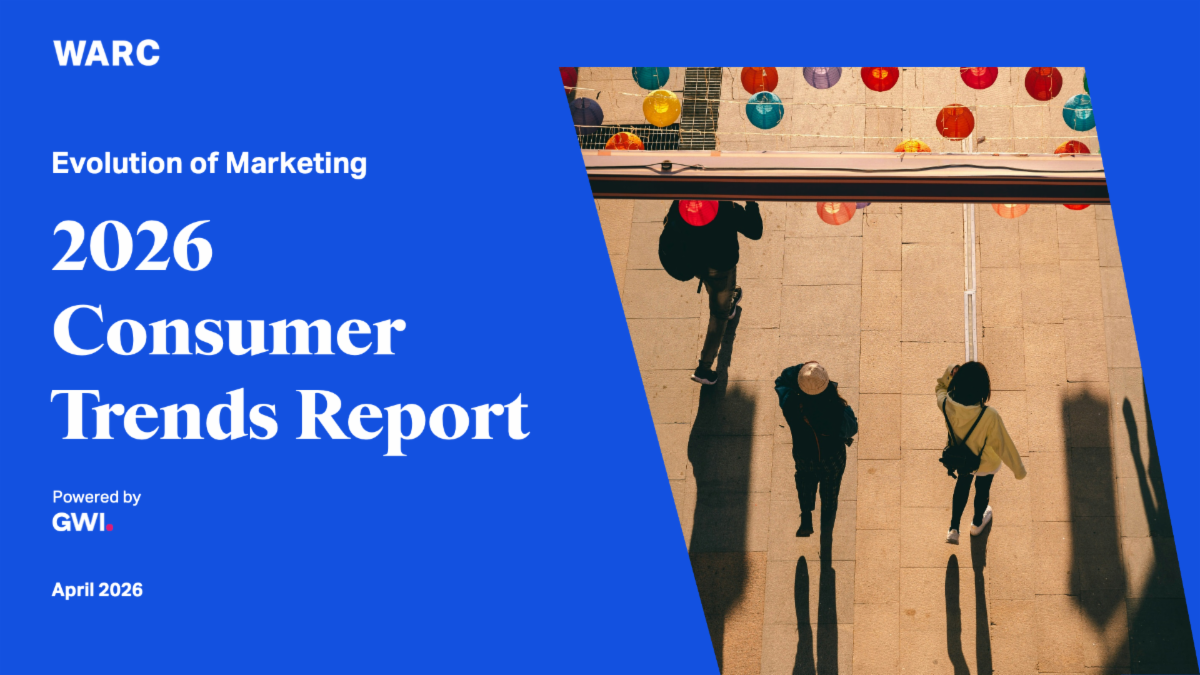
The WARC 2026 Consumer Trends report explores key issues influencing consumer purchase decisions across brands and categories
23 April 2026 – WARC has today released its 2026 Global Consumer Trends report exploring the key issues that will influence consumer purchase decisions across brands and categories over the next year.
Based on a comprehensive set of GWI surveys combined with WARC’s own research, case studies and analysis, the report focuses on five trends influencing brand selection, each examined through the lens of WARC’s proprietary GEISTE framework: consumers’ pivot to comfort consumption amid prolonged uncertainty, the rise of AI companionship, escalating restrictions to youth social media access, a reassessment of ‘Made in China’ brands, and the growing demand for authenticity and transparency in AI generated content.
Stephanie Siew, Senior Research Executive, WARC, says: “Consumer sentiment in 2026 remains fragile, shaped by financial pressures, geopolitical turbulence, and a growing need for escape, with spend shifting to small comforts that bring joy. Brands that forge emotional connections will thrive, but must navigate rising scrutiny on technology, authenticity, and trust to make a meaningful impact.”
“Our annual Consumer Trends report provides a broader view of the major issues confronting our industry from the perspective of consumers, with suggestions to help businesses create the most impact in the year ahead.”
The consumer trends that will shape spending decisions in the year ahead, identified by WARC are:
Uncertainty fuels comfort consumption: Nearly half (45%) of employed consumers are concerned about their job security. One third (33%) are either saving more or cutting back on expenses due to job market conditions
Ongoing macroeconomic turbulence, geopolitical conflict, and employment anxiety have created a sense of emotional and financial fatigue among consumers. Half (50%) of consumers view financial stress as the biggest contributor to their unhappiness.
Consumers are reacting to uncertainty by being more intentional with their money, channelling spending toward purchases that bring them joy at minimal cost, such as wellness and hobbies. While there is also a desire for travel, ongoing geopolitical conflict threatens to dampen this demand as safety concerns and potential fuel price increases impact affordability and destination choices.
To tap into consumers’ desire for accessible joy, marketers are recommended to explore ways to align brand offerings with these smaller comforts that consumers are prioritising.
AI redefines companionship: 1 in 10 consumers globally report having been in a relationship with an AI chatbot. 62% of users in these relationships say they are likely to turn to an AI chatbot rather than a human friend for personal advice
Consumers are increasingly using AI tools for social fulfilment including companionship and emotional support, which is redefining interpersonal relationships: 1 in 10 consumers globally report having been in a relationship with an AI chatbot. AI companions appeal to users by reducing loneliness and removing the complexities of human interaction.
This demand for frictionless connection is driving innovation across categories, such as AI-powered toys and companion devices designed to meet the emotional and safety needs of the elderly. Consumers are also becoming more trusting of AI as their relationships deepen.
Marketers must tread carefully when leveraging AI to engage with vulnerable populations – particularly younger demographics – and address potential safety and mental health risks.
Challenges to youth social media access: 64% of consumers believe social media is harmful to children. Half (51%) would support age verification for social media
Concerns around the potential harms of social media for teens and children, such as cyber bullying and exposure to harmful content, have escalated, triggering a wave of legislation and debate around social media bans for minors.
Restrictions on younger audiences pose challenges for marketers, as platforms play a growing role in Gen Alpha’s purchasing journey, from product discovery to reviews and style inspiration. Social media restrictions may redirect media investments toward alternative channels such as private messaging apps and family-friendly streaming services.
Brands should consider creating their own channels and community spaces to enhance content control and customer relationships. With tighter restrictions on reaching younger audiences, targeting parents as key decision-makers and prioritising child safety and transparency can build trust and offer a competitive edge. Influencer marketing must adapt with robust safety measures, regulatory compliance, and audience verification to ensure responsible engagement.
Reassessment of ‘Made in China’: 36% of consumers now recognise Chinese apps and tech products as “innovative”. 1 in 4 people globally now prefer to buy their personal electronics and smart devices from China, ranking it behind only the US and Japan
Chinese companies are moving beyond traditional manufacturing roles, establishing themselves as influential global players and focusing on building highly valued, emotionally resonant brands. Consequently, the “Made in China” low price perception is changing, particularly in the tech, automotive and personal lifestyle categories, although affordability remains a key association with Chinese-made products.
Marketers should focus on building trust through quality, technological innovation, and emotional connections to drive sustainable premium pricing, and should consider investing in deep local market insights, cultural nuances, regulatory frameworks and consumer behaviour to build authentic connections.
Legacy global brands can leverage established distribution channels, which present immediate barriers to entry for emerging competitors, and may be better positioned to cope with energy shortages compared to some Asian economies.
The promise and threat of AI in content: 85% of people say knowing an artwork is made by a human makes it more meaningful. 78% of consumers believe it is very or extremely important for AI-generated content to be clearly labelledThe flood of AI-generated content in digital spaces has sparked pushback from consumers over quality and ethical concerns. In entertainment sectors such as gaming, some fans are actively opposing the use of AI, forcing several developers to rethink their releases.
At the same time, a portion of consumers see potential for AI to improve creative quality. According to Billion Dollar Boy, around four in ten consumers believe AI has improved both the quality and diversity of creator content.
Authenticity and transparency remain top priorities for consumers as many already struggle to differentiate AI-generated from human-made content. Eight in ten (78%) demand clear labelling and disclosures when AI has been used, especially in high stakes contexts such as healthcare, politics, or law. They hold similar disclosure expectations for social media.
Strategic Architect of African Convention Bureaus Rick Taylor Joins African Collaborations Group (ACG) Advisory Board to Advance Sport and Entertainment Districts Across Africa
Rick Taylor is one of Africa’s most experienced strategists in destination development and the business tourism sector
LONDON, United Kingdom, October 26, 2026/APO Group/ –African Collaborations Group (ACG) (www.ACGafrica.com), the leading strategic project origination and collaboration platform focused on the industrialisation of sport in Africa through the origination of bankable sport and entertainment district ecosystems, today announced the appointment of Rick Taylor to its Advisory Board.
Rick Taylor is one of Africa’s most experienced tourism strategists, with more than three decades of expertise in destination development and business events, also known as MICE (Meetings, Incentives, Conferences, Events and Exhibitions). As Founder and Chief Executive Officer of The Business Tourism Company, a Cape Town-based international consultancy, he has led more than 100 tourism advisory, strategy and training projects worldwide and has been the strategic architect of national destination strategies and Convention Bureau projects across Africa, including in South Africa, Namibia, Rwanda, Kenya, Tanzania, Ethiopia, Uganda, Senegal, Cameroon, Zambia, Togo and Mozambique.
Rick was the architect of Africa’s first Convention Bureau in Cape Town, which has maintained the #1 position in Africa in the International Congress and Convention Association (ICCA) city ranking for more than two decades. Since then, he has devoted his career to positioning business events as a strategic pillar of tourism, investment and socio-economic development across the continent.
The global business events sector has now surpassed pre-pandemic levels, reaching an estimated USD 1.5 trillion, yet Africa hosts only around 3% of the world’s association meetings. Rick has spent his career addressing this structural gap by helping countries build the strategies, institutions, infrastructure and international positioning required to compete for a greater share of the global business events economy.
His presence on our Advisory Board significantly strengthens ACG’s capacity to originate projects that combine these dimensions from the outset
A defining feature of Rick’s approach is what he calls “Lalibela thinking” — a 50- to 100-year perspective that sees MICE not simply as an events industry, but as long-term economic infrastructure capable of driving investment, tourism, job creation, skills development and poverty alleviation. His work has helped shape business events infrastructure, convention bureaus and national MICE strategies across Africa.
His appointment to the ACG Advisory Board reflects a core ACG conviction: that large-scale sport and entertainment districts must be conceived from the outset as integrated economic ecosystems spanning sport, entertainment, hospitality, tourism and business events. Convention Centres, conference facilities and other business events infrastructure are essential components of such districts. They can generate high-value activity on non-match and non-concert days, strengthen year-round hotel and hospitality demand, and connect the district to the wider tourism and business travel economy of its host country.
Rick therefore brings to ACG a rare combination of strategic and practical expertise: deep knowledge of African destination development; pan-continental relationships with tourism ministries, national tourism organisations and other public-sector stakeholders; hands-on experience in establishing Convention Bureaus and business events infrastructure; and a long-term perspective on the role of business events in African socio-economic development. These capabilities are directly relevant to ACG’s work in originating and structuring large-scale sport and entertainment district projects across the continent.
“Rick Taylor is one of the most respected voices in African business tourism, and his career has literally built the Convention Bureau architecture that powers business events across the continent. His appointment reflects a foundational conviction at ACG: that sport and entertainment districts are not stadiums and concert halls standing alone, but integrated ecosystems that generate value across sport, entertainment, hospitality and business events. Sport, entertainment and convention infrastructure is district infrastructure. His presence on our Advisory Board significantly strengthens ACG’s capacity to originate projects that combine these dimensions from the outset,” said Nicolas Pompigne-Mognard (www.Pompigne-Mognard.com), Founder and Executive Chairman of ACG.
The ACG Advisory Board provides strategic guidance as ACG originates and structures large-scale sport and entertainment district projects across the continent, aligning governments, development finance institutions (DFIs), investors, sport bodies and infrastructure partners to support the development of financially sustainable, mixed-use district ecosystems.
Africa’s sport economy is projected to reach $20 billion by 2035, yet the continent continues to lack the integrated district ecosystems required to support large-scale development. ACG addresses this gap by originating bankable sport and entertainment district projects, moving beyond single-venue development models towards mixed-use, revenue-generating and financially sustainable district ecosystems.
Through its collaborative model, ACG convenes governments, PPP authorities and regulators, development finance institutions, private investors, developers, designers and engineers, legal and transaction advisors, operators, sport federations and leagues, event promoters, media and broadcast partners, academic institutions and host communities, creating structured pathways from concept to feasibility, bankability and delivery.
Distributed by APO Group on behalf of African Collaborations Group (ACG).
Moody’s affirms Islamic Corporation for the Insurance of Investment and Export Credit (ICIEC)’s Aa3 Insurance Financial Strength Rating with Stable Outlook
Moody’s cited ICIEC’s strengthening standalone credit profile, including its role as a leading multilateral provider of Shariah-compliant export credit and investment insurance and reinsurance solutions
JEDDAH, Saudi Arabia, October 25, 2026/APO Group/ –The Islamic Corporation for the Insurance of Investment and Export Credit (ICIEC) (http://ICIEC.IsDB.org), a Shariah-based multilateral insurer and member of the Islamic Development Bank Group, is pleased to announce that Moody’s Ratings has affirmed the Corporation’s Aa3 Insurance Financial Strength Rating (IFSR) with a Stable Outlook, reflecting the agency’s ongoing confidence in the Corporation’s strong financial fundamentals and strategic importance as a member of the Islamic Development Bank (IsDB) Group.
This affirmation is a strong endorsement of ICIEC’s financial resilience and our ability to manage risks effectively
Moody’s cited ICIEC’s strengthening standalone credit profile, including its role as a leading multilateral provider of Shariah-compliant export credit and investment insurance and reinsurance solutions. The agency highlighted improved underwriting performance supported by enhanced risk management, strong asset quality and liquidity, and strong capital adequacy. The Corporation’s preferred creditor status among its Member Countries further reinforces its financial strength and institutional standing.
The rating also benefits from the strong institutional and shareholder support of the IsDB and sovereign shareholders, including Kingdom of Saudi Arabia.
Commenting on the rating affirmation, Dr. Khalid Khalafalla, Chief Executive Officer of ICIEC, stated: “This affirmation is a strong endorsement of ICIEC’s financial resilience and our ability to manage risks effectively in an increasingly complex global environment. It strengthens our position as a trusted multilateral partner, enabling us to expand our reach, mobilise investment and deliver meaningful development impact across our Member Countries through innovative Shariah-compliant insurance solutions.”
The Stable Outlook primarily reflects expected ongoing shareholder support, alongside expectations of continued risk management improvements and strong financial fundamentals as ICIEC expands and diversifies its operations while maintaining prudent underwriting discipline. Moody’s also identified ICIEC’s exposure to geopolitical risks and its smaller operational scale relative to peers as moderating factors.
Distributed by APO Group on behalf of Islamic Corporation for the Insurance of Investment and Export Credit (ICIEC).
About The Islamic Corporation for the Insurance of Investment and Export Credit (ICIEC):
As a member of ‘AAA’ rated Islamic Development Bank (IsDB), ICIEC commenced operations in 1994 to strengthen economic relations between OIC Member States and promote intra-OIC trade and investments by providing risk mitigation tools and financial solutions. The Corporation is the only Islamic multilateral insurer in the world. It has led from the front to deliver a comprehensive suite of solutions to companies and parties in its 51 Member States. ICIEC, for the 19th consecutive year, maintained an “Aa3” insurance financial strength credit rating from Moody’s, ranking the Corporation among the top of the Credit and Political Risk Insurance (CPRI) Industry. Additionally, S&P has reaffirmed ICIEC “AA-“ long-term Issuer Credit and Financial Strength Rating for the third year with Stable Outlook. ICIEC’s resilience is underpinned by its sound underwriting, global reinsurance network, and strong risk management policies. Cumulatively, ICIEC has insured more than USD 139 billion in trade and investment. ICIEC activities are directed to several sectors such as energy, manufacturing, infrastructure, healthcare, and agriculture.
The new partnership will support these plans by combining Invictus Investment’s expertise across the agro-food value chain with Helios’ track record of investing in and supporting market-leading businesses across Africa
We welcome Helios, one of Africa’s leading private equity investors, as our partner in the expansion of Merec
DUBAI, United Arab Emirates, October 23, 2026/APO Group/ —
Helios to acquire a significant minority stake in Merec Industries, Mozambique’s largest flour milling company
Partnership combines Invictus Investment’s sector knowledge and operational capabilities with Helios’ extensive experience across Africa to support Merec Industries’ growth in Mozambique and the wider region
Transaction expected to close by the end of 2026, subject to customary closing conditions, including regulatory approvals
Invictus Investment (ADX: INVICTUS) (https://InvictusInvestment.ae), a leading holding company specialised in agro-food commodities across the Middle East and Africa, and Helios Investment Partners (“Helios”), a leading Africa-focused private investment firm, today announced that Helios Fund V (“Helios V”) has entered into an agreement to acquire up to a 49% interest in Stratton Africa Holdings Limited, the Mauritius-incorporated holding company of Merec Industries (“Merec”), from Invictus Investment.
The transaction is expected to close by the end of 2026, subject to customary closing conditions, including regulatory approvals, after which Invictus Investment will remain the majority shareholder.
Founded in 1998, Merec is Mozambique’s largest flour milling company, processing wheat and corn into an integrated product portfolio spanning flour, pasta, biscuits and animal feed. Its mills, production facilities and silos are strategically located in each of Mozambique’s three principal port regions: Beira, Maputo and Nacala – making it the only miller with manufacturing facilities in all three. Merec also owns a grain terminal at the port of Maputo. This footprint supports a nationwide distribution network serving wholesalers, retailers, bakeries, feed producers and distributors, underlining Merec’s important role in the production and supply of essential food products across Mozambique.
Invictus Investment acquired Merec in January 2025 through the purchase of its holding company, Stratton Africa Holdings Limited, as part of its strategy to expand its agro-food business in high-potential African markets and strengthen its capabilities across the value chain. Since the acquisition, Merec’s operating performance has improved significantly, and this has prompted a more ambitious growth strategy to expand the business beyond its core operations into new food categories in Mozambique and across the wider Southern African Development Community (“SADC”) region.
The new partnership will support these plans by combining Invictus Investment’s expertise across the agro-food value chain with Helios’ track record of investing in and supporting market-leading businesses across Africa. Together, the shareholders will also work on furthering Merec’s governance framework, leadership capabilities, ESG practices and broader development impact.
Commenting on the announcement, Amir Daoud Abdellatif, CEO of Invictus Investment, said: “We welcome Helios, one of Africa’s leading private equity investors, as our partner in the expansion of Merec. With its strong focus on high-growth sectors across the continent, Helios’ regional expertise will be instrumental in accelerating Merec’s next phase of growth.Since Invictus Investment’s acquisition of Merec, its position as Mozambique’s largest flour milling company has been strengthened and consolidated, and now, our shared ambition with Helios is to build on the business’s contribution to food security and local employment in Mozambique and develop it into a regional food platform for Southern Africa.This partnership aligns perfectly with our strategic approach to acquisitions, which has always been to build strong businesses alongside high-calibre partners that support our long-term vision of building a fully integrated agro-food enterprise.”
Tope Lawani, Co-Founder and Managing Partner of Helios Investment Partners, added: “Merec has built a distinctive position in Mozambique, with a nationwide footprint, strong brands and an important role in the country’s staple foods market. The consumer non-discretionary sector is a key strategic focus for Helios, and we bring a proven track record of investing in and scaling resilient businesses that serve essential consumer needs across Africa. We see significant opportunity to build on Merec’s strengths and are pleased to partner with Invictus Investment and the management team to support the company’s next phase of growth.”
Akin Gump Strauss Hauer & Feld is acting as legal counsel to Helios, with GDA Advogados as Mozambican counsel. Freshfields is acting as legal counsel to Invictus Investment.
*Please refer to heliosinvestment.com/news and invictusinvestment.ae/investor-relations/ for more information.
Distributed by APO Group on behalf of Invictus Investment Company PLC.
We use cookies on our website to give you the most relevant experience by remembering your preferences and repeat visits. By clicking “Accept”, you consent to the use of ALL the cookies.
This website uses cookies to improve your experience while you navigate through the website. Out of these, the cookies that are categorized as necessary are stored on your browser as they are essential for the working of basic functionalities of the website. We also use third-party cookies that help us analyze and understand how you use this website. These cookies will be stored in your browser only with your consent. You also have the option to opt-out of these cookies. But opting out of some of these cookies may affect your browsing experience.
Necessary cookies are absolutely essential for the website to function properly. These cookies ensure basic functionalities and security features of the website, anonymously.
Cookie
Duration
Description
cookielawinfo-checkbox-analytics
11 months
This cookie is set by GDPR Cookie Consent plugin. The cookie is used to store the user consent for the cookies in the category "Analytics".
cookielawinfo-checkbox-functional
11 months
The cookie is set by GDPR cookie consent to record the user consent for the cookies in the category "Functional".
cookielawinfo-checkbox-necessary
11 months
This cookie is set by GDPR Cookie Consent plugin. The cookies is used to store the user consent for the cookies in the category "Necessary".
cookielawinfo-checkbox-others
11 months
This cookie is set by GDPR Cookie Consent plugin. The cookie is used to store the user consent for the cookies in the category "Other.
cookielawinfo-checkbox-performance
11 months
This cookie is set by GDPR Cookie Consent plugin. The cookie is used to store the user consent for the cookies in the category "Performance".
viewed_cookie_policy
11 months
The cookie is set by the GDPR Cookie Consent plugin and is used to store whether or not user has consented to the use of cookies. It does not store any personal data.
Functional cookies help to perform certain functionalities like sharing the content of the website on social media platforms, collect feedbacks, and other third-party features.
Performance cookies are used to understand and analyze the key performance indexes of the website which helps in delivering a better user experience for the visitors.
Analytical cookies are used to understand how visitors interact with the website. These cookies help provide information on metrics the number of visitors, bounce rate, traffic source, etc.
Advertisement cookies are used to provide visitors with relevant ads and marketing campaigns. These cookies track visitors across websites and collect information to provide customized ads.