Connect with us
Anglostratits

Business

European Union (EU) Launches Invest4Libya to Strengthen Public Finance and Drive Digital and Green Investment in Libya

Published

on

Libya

The project adopts a holistic approach to support efficient and transparent public financial management, modernize financial markets, and stimulate private sector growth

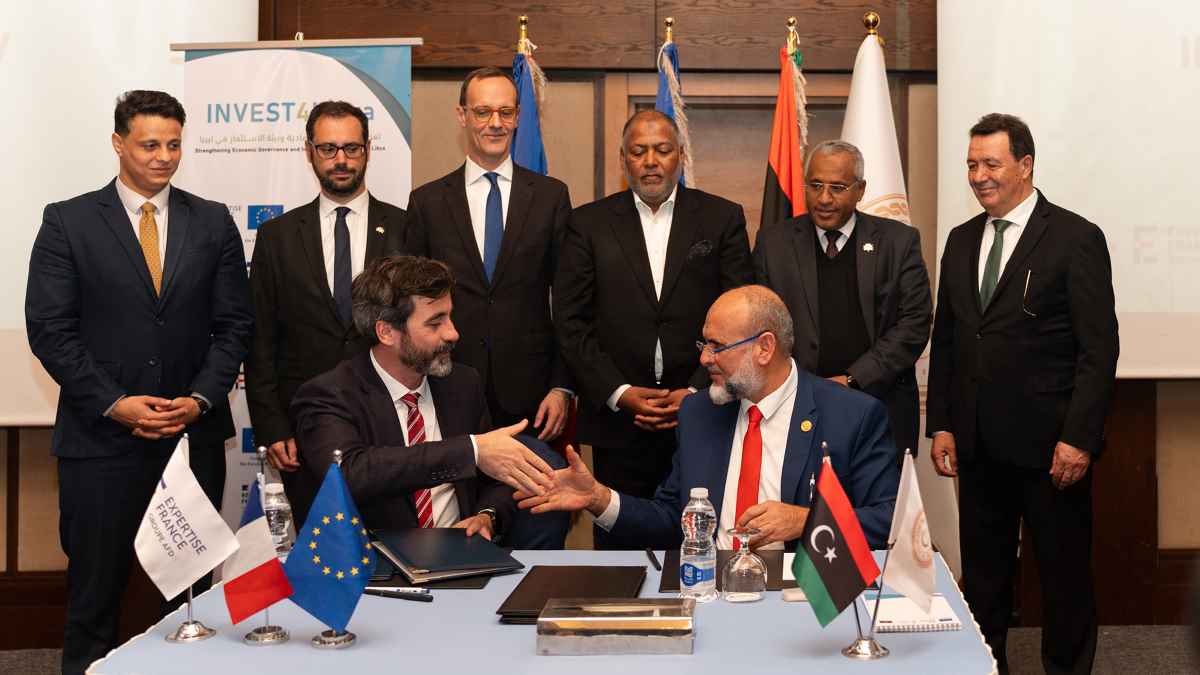
TRIPOLI, Libya, February 9, 2026/APO Group/ –The Ministry of Finance, the Delegation of the European Union to Libya, the Embassy of France in Libya, and Expertise France (www.ExpertiseFrance.fr) officially inaugurated the Invest4Libya project today. An initiative designed to strengthen Libya’s financial governance, improve its investment climate, and boost the performance and inclusiveness of the country’s MSME and entrepreneurship ecosystem.


The project adopts a holistic approach to support efficient and transparent public financial management, modernize financial markets, and stimulate private sector growth, particularly in green and digital entrepreneurship, laying the foundation for sustainable and inclusive economic recovery in Libya.

“Invest4Libya represents an important step in advancing public financial management and strengthening Libya’s economic foundations,” said H.E. Dr. Khaled Almbarouk, Minister of Finance. “By improving transparency and supporting private sector development, this initiative aligns with our national priorities. We value our partnership with the EU and look forward to the positive outcomes this collaboration will bring.”

Invest4Libya represents an important step in advancing public financial management and strengthening Libya’s economic foundations

Invest4Libya stands as a key milestone of the EU’s ongoing support for Libya’s economic and institutional development. Funded primarily by the European Union, with additional support from the French government, the project is implemented by Expertise France and structured around three strategic pillars:

  • Public Financial Management Reform: Supporting the Ministry of Finance and Audit Bureau to improve fiscal transparency, spending efficiency, and accountability.
  • Financial Sector Governance & Modernization: Strengthening regulatory frameworks to promote financial inclusion and the integration of digital and green finance into national policy, with the collaboration of the Central Bank of Libya and the Ministry of Planning.
  • Entrepreneurship & MSME Support: Developing Libya’s private sector by empowering incubators, accelerators, and MSMEs and linking them to investors, expertise, and enabling policies.

Together, these three pillars form a cohesive national effort that links high-level policy reform with on-the-ground implementation. Anchored by core partners such as the Ministry of Finance, the Central Bank of Libya, and the Audit Bureau, and implemented in close cooperation with the Ministry of Planning, the Ministry of Higher Education and Scientific Research, and the Ministry of Environment, the project also engages public and research institutions, private sector bodies, and business incubators to ensure broad institutional alignment and national impact.

“Creating a strong investment environment is essential for economic recovery and sustainable growth. Invest4Libya represents a major advance in the partnership between the European Union and Libya. By supporting reforms in public finance and financial governance and improving conditions for investment, this project reaffirms the EU’s dedication to empowering the Libyan private sector and supporting Libya’s economic development and diversification,” said H.E. Mr. Nicola Orlando, Ambassador of the European Union to Libya.

“Expertise France has been privileged to support Libya’s economic development for the past 10 years. With Invest4Libya, we are excited to form new partnerships and continue our collaboration with Libyan institutions to advance public financial management and empower the private sector. This initiative is vital to strengthening institutional capacity and supporting entrepreneurs, particularly in the green and digital sectors, who are driving innovation and helping shape a thriving Libyan economy” commented Mr. Maxime Bost, Programs Director of Expertise France in Libya.

Building on the successes of previous governance and digitalization efforts, the project bridges policy reform with actionable outcomes to ensure that improved financial oversight leads to tangible growth for startups and small businesses. By removing regulatory obstacles and empowering local incubators, this collaborative partnership serves as a vital step in modernizing the national economy and unlocking Libya’s potential for a more digital, diversified, and inclusive future.

Distributed by APO Group on behalf of Expertise France.

Business

Africa Must Rewire US$29.5 Trillion Mineral Endowment Around Industry, Infrastructure and Demand, Africa Finance Corporation Study Says

Published

on

The report argues that improving geological data availability and quality is a necessary first step to de-risk projects and unlock exploration capital

CAPE TOWN, South Africa, February 9, 2026/APO Group/ –Africa hosts an estimated US$29.5 trillion in mine-site mineral value, representing about 20% of global mineral wealth, yet captures only a fraction of the economic value embedded in this endowment, according to a new study (http://apo-opa.co/4txjr5p) released today by Africa Finance Corporation (AFC) (www.AfricaFC.org).


Of this total, US$8.6 trillion remains undeveloped, reflecting an under-explored continent where fragmented geological data, uneven coverage, and limited transparency continue to elevate risk perception and constrain investment. The report argues that improving geological data availability and quality is a necessary first step to de-risk projects and unlock exploration capital.

The study also stresses that mine-site values significantly understate Africa’s true potential by failing to capture the far larger value created when minerals are processed into steel, aluminium, fertilisers, batteries and alloys. Measured at the point of industrial use, Africa’s mineral endowment expands by an order of magnitude—revealing substantial latent value.

Launched at Mining Indaba in Cape Town, the Compendium of Africa’s Strategic Minerals reframes the sector through an African development lens, placing industrialisation, infrastructure, and long-term regional demand at the centre of mineral strategy.

“Today, AFC is proud to launch the Compendium of Africa’s Strategic Minerals an initiative to reframe the sector through an African lens and convert endowment into execution pathways for our collective prosperity,” said Samaila Zubairu, President & CEO of AFC. “The Compendium maps full value chains and links reserves and production to processing capacity, power and transport infrastructure, and regional industrial corridors—improving data transparency to de-risk exploration, lower the cost of capital, and guide smarter investment into mining and the enabling infrastructure needed for beneficiation and integrated regional value chains.”

Mineral Development Anchored on African Demand

The Compendium finds that mineral production, enabling infrastructure, and demand rarely co-locate or align at scale, and calls for stronger regional planning anchored in Africa’s long-term demand fundamentals.

The steel value chain illustrates this misalignment. Africa hosts world-class endowments of ferro-alloys such as manganese, chromium and nickel, and iron ore supply is entering a new growth cycle. Yet these supply chains remain commercially tethered to Asian steel cycles rather than Africa’s own development trajectory.

Today, AFC is proud to launch the Compendium of Africa’s Strategic Minerals an initiative to reframe the sector through an African lens and convert endowment into execution pathway

This exposure is economically costly and can be seen playing out right now. The slowdown in Asian steel demand—linked to China’s property downturn and weaker construction—has transmitted shocks into African mineral markets. In the Democratic Republic of the Congo, production quotas have been imposed on cobalt to manage oversupply and collapsing prices. In South Africa, primary steelmaking capacity has shut down amid weak domestic demand, high costs, and fragmented offtake. In Gabon, major manganese operations have periodically suspended production in response to softer alloy demand from Asia.

These outcomes are occurring even as Africa continues to expand transport networks, power systems, housing, and industrial capacity that require these materials. The constraint is not a lack of demand, but a lack of demand anchoring: the failure to align mineral production, processing capacity, and infrastructure investment around Africa’s long-term material needs.

Infrastructure Links Minerals, Processing and Demand

The Compendium places infrastructure at the centre of mineral strategy—not as a passive enabler, but as the system that links raw materials, processing capacity, and demand. Power cost and reliability, transport connectivity, and access to industrial land ultimately determine whether beneficiation is viable.

To this end, the report maps mineral deposits and producing assets alongside railways, ports, power generation hubs, and transmission networks to identify where regional value chains can realistically be developed. It calls for targeted interventions in shared rail corridors and cross-border power transmission, particularly in mineral-rich regions where coordinated infrastructure could unlock scale, reduce delivered costs, and support regional industrial platforms.

Infrastructure is also central to Africa’s competitiveness in a world of green industrialisation. Clean power, efficient logistics, and integrated corridors such as Lobito can reduce carbon intensity and improve access to markets where low-carbon and traceable supply chains are increasingly required.

African Minerals in a Fragmenting Global Economy

The Compendium situates Africa’s mineral strategy in a rapidly changing geo-economic landscape shaped by trade tensions, export controls, industrial policy, and efforts to reduce concentration risk. These shifts are elevating the strategic relevance of Africa’s mineral endowment—but only where the continent can offer reliable, value-adding alternatives.

Rather than positioning Africa as a marginal supplier of raw materials, the report argues for selective integration into strategically exposed segments of global supply chains, where diversification would materially enhance resilience—particularly for minerals with highly concentrated processing markets. These include manganese, rare earths, graphite, uranium, and critical alloying inputs for defence, aerospace, and clean-energy technologies.

Encouragingly, momentum is emerging:

  • Angola is developing one of the world’s largest and highest-grade magnet metal rare earth deposits;
  • Mozambique has become a key feedstock anchor for graphite and anode materials;
  • Battery-grade manganese sulphate projects are advancing in Southern Africa; and
  • Uranium production has resumed in Namibia and Malawi over 2024-25.

Download AFC’s Compendium of Africa’s Strategic Mineral Resources here: http://apo-opa.co/4txjr5p.

Distributed by APO Group on behalf of Africa Finance Corporation (AFC).

Continue Reading

Business

Scottish Africa Business Association Strengthens Subsea Links with Egypt at Subsea Expo

Published

on

Expo

Building on the momentum from Subsea Expo and the Minister’s visit, SABA will lead a trade delegation to Egypt in April 2026 in partnership with The EIC

ABERDEEN, Scotland, February 9, 2026/APO Group/ –The Scottish Africa Business Association (SABA) (www.AfricaScot.com) has strengthened international links and opened new opportunities for Scottish companies following a highly successful presence at Subsea Expo in Aberdeen, organised by the Global Underwater Hub.

As part of its programme at the event, SABA hosted an inward delegation from Egypt and was delighted to welcome Minister Plenipotentiary Wael Abdelraheem to Scotland for the first time. His visit, supported by the Scottish Government, formed part of ongoing efforts to deepen commercial ties between Scotland and one of North Africa’s most strategically important energy markets.

During his time in Aberdeen, Minister Abdelraheem attended the Subsea Expo evening reception and held a series of meetings with SABA member companies and other businesses from across the North-east. Discussions focused on opportunities for collaboration in subsea engineering, offshore services, inspection and maintenance, digital technologies and supply chain partnerships.

SABA’s exhibition stand attracted hundreds of visitors over the two-day event, with strong interest in opportunities across multiple African markets. Conversations covered subsea infrastructure, offshore wind, energy transition projects, exporting challenges and education & skills training, creating a significant pipeline of follow-up activity for the organisation and its members.

Seona Shand, Chief Operating Officer at the Scottish Africa Business Association, said: “Subsea Expo provided an outstanding platform to showcase Scottish capability and connect businesses with real opportunities across African markets. We were particularly pleased to welcome Minister Plenipotentiary Wael Abdelraheem to Scotland for the first time and to facilitate meaningful introductions between Egyptian stakeholders and our members.

The level of engagement at our stand exceeded expectations, with hundreds of conversations taking place and strong interest in the expertise Scotland has to offer. There is clear demand for subsea and offshore capability across Africa, and we now have a substantial programme of follow-up to help translate these connections into tangible business opportunities.”

Egypt is emerging as a major regional energy hub, with significant investment in offshore gas production in the Mediterranean, expansion of subsea infrastructure and a growing focus on energy security and export capacity. Major developments such as the Zohr gas field and associated pipeline networks have driven demand for subsea installation, inspection, repair and maintenance services, as well as specialist engineering, digital monitoring and asset integrity solutions.

Alongside its established oil and gas sector, Egypt is also investing heavily in energy transition projects, including offshore and coastal renewable energy, hydrogen and power interconnection initiatives. This is creating new opportunities for companies with experience in subsea construction, cable installation, offshore wind foundations, survey, robotics and environmental monitoring.

With its strategic location, large domestic market and strong government focus on infrastructure and energy development, Egypt offers a gateway for Scottish companies looking to expand their presence across North Africa and the Eastern Mediterranean.

Building on the momentum from Subsea Expo and the Minister’s visit, SABA will lead a trade delegation to Egypt in April 2026 in partnership with The EIC. The mission will focus on the energy sector providing Scottish companies with direct access to key government stakeholders, operators and local partners.

The programme will include market briefings, business-to-business meetings, site visits and networking opportunities designed to help participants understand the operating environment and identify concrete opportunities.

Further details about the trade mission and how to participate are available at: https://apo-opa.co/4toUqsT

Seona Shand added: “Egypt represents one of the most exciting growth markets for subsea and offshore services in the region. The conversations that took place in Aberdeen demonstrated strong mutual interest, and our April mission will give Scottish companies the opportunity to build relationships on the ground and position themselves for upcoming projects.”

Subsea Expo provided an outstanding platform to showcase Scottish capability and connect businesses with real opportunities across African markets

Subsea Expo is the world’s largest subsea exhibition and conference, bringing together global operators, contractors, technology providers and supply chain companies. SABA’s presence at the event reflects its ongoing role in helping Scottish organisations access international markets through trade missions, inward delegations, market intelligence and tailored business support.

Following the strong response at Subsea Expo, SABA will now work with participating companies to progress introductions, provide market insight and support next steps as businesses explore opportunities across Egypt and other African markets.

Distributed by APO Group on behalf of Scottish Africa Business Association (SABA).

Continue Reading

Events

China’s Langzhong Ancient City Extends a Global Invitation to Experience Authentic Festivities

Published

on

NANCHONG, CHINA – Media OutReach Newswire – 9 February 2026 – On February 4, at a briefing on cultural and tourism activities for the 2026 Spring Festival hosted by the Sichuan Provincial Department of Culture and Tourism, Nanchong City announced an extended Spring Festival holiday (from the eighth day of the twelfth lunar month to the sixteenth day of the first lunar month of the following year, that is, from January 26 to March 4 of the solar calendar), inviting visitors from around the world to Langzhong, known as the “Ancient City of the World and Birthplace of the Spring Festival”, to experience the most authentic and abundant traditions of the Chinese Lunar New Year.

The celebrations feature a wide range of programs designed to offer residents and visitors alike an immersive cultural experience. Visitors can explore the “Langzhong Stone Rubbing Exhibition for the Lunar New Year”, which showcases precious rubbings of stone inscriptions dating back 1,500 years, and trace the past through their tangible imprints. They may also encounter the “Old Man of the Spring Festival” roaming the streets in traditional costumes to bestow blessings and offer traditional New Year’s greetings.

To enrich the visitor experience, the ancient city has curated a wide array of interactive experiences, with millennium-old folk customs unfolding one after another. A vibrant intangible cultural heritage (ICH) market will present more than 40 nationally and provincially recognized ICH items. Visitors can try their hand at crafting delicate shadow puppets or cutting festive paper window decorations. They may also choose to watch a performance of the Ba Commandery Nuo Opera, a representative ICH item of Sichuan Province that blends ancient ritual practices with folk opera and carries a distinctive sense of regional mystique. Running throughout the festive period, the New Year Grand Temple Fair brings together cultural performances, themed exhibitions, and modern recreational attractions. Whether watching the large-scale cultural stage play Legend of Langyuan or experiencing water tours or low-altitude flights, visitors of all ages are sure to be thoroughly entertained.

Langzhong’s reputation as the “Ancient City of the World and Birthplace of the Spring Festival” stems from Luo Xiahong, an astronomer of the Western Han Dynasty, who compiled the groundbreaking Taichu Calendar here. Luo was the first to incorporate the 24 solar terms into the Chinese calendrical system and to designate the first day of the first lunar month as the official start of the year, thereby establishing the Spring Festival as a fixed annual celebration. For this historic contribution, he is revered as the original “Old Man of the Spring Festival”. This calendar profoundly shaped Chinese agriculture and folk life for more than two millennia, securing Langzhong’s place as one of the cradles of Spring Festival culture. Today, Langzhong Ancient City stands ready to extend its warmest welcome to every visitor from afar, offering the most authentic New Year customs and the most heartfelt warmth of its people.

Continue Reading

Trending