Connect with us

Business

Canon Showcases Enhanced End-to-End Product Lineup at International Broadcasting Convention (IBC) 2024

Published

on

Canon

Canon showcased its very latest innovations in imaging technology designed to empower broadcasters and content creators to push creative boundaries and deliver exceptional visual experiences

DUBAI, United Arab Emirates, October 2, 2024/APO Group/ — 

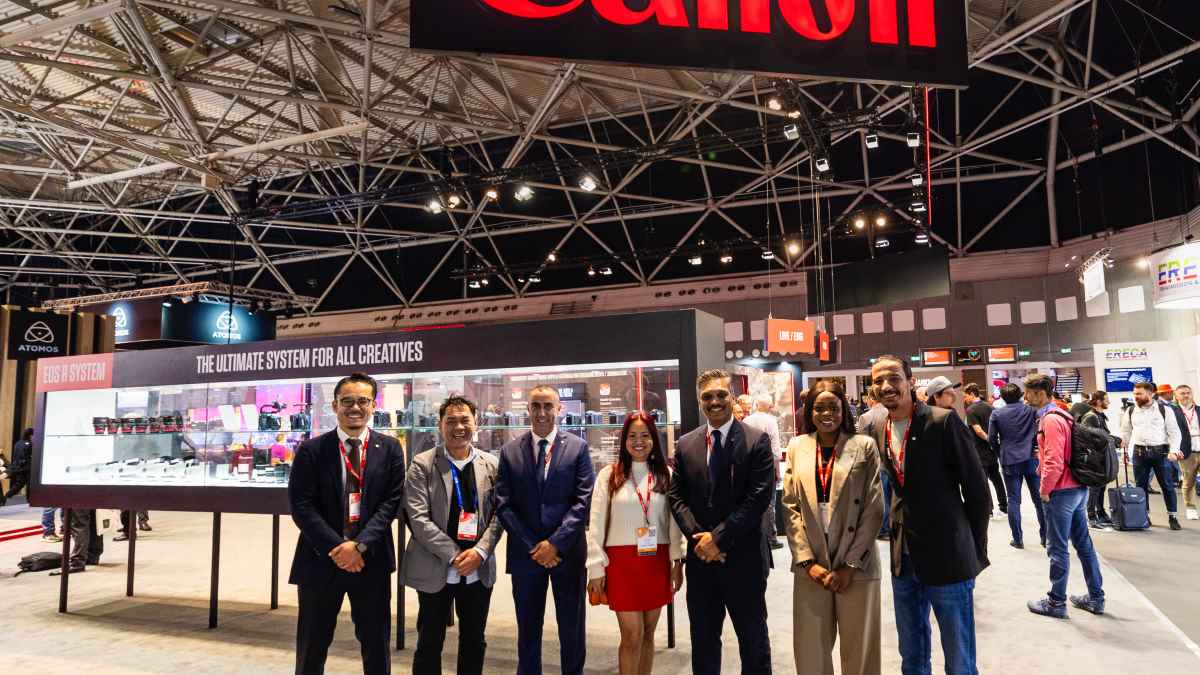
As part of our ‘Closer to Our Customers’ strategy, we showcased our latest advancements including the EOS R1, EOS R5 Mark II, EOS C400 & EOSC80 to 25 key customers from across Africa; We aimed to equip our customers with firsthand experience of the diverse products, including Canon’s Multicam Solutions (www.Canon-CNA.com), empowering them to tailor strategies, enhance workflows, and improve efficiency.

Canon Central & North Africa returned to the International Broadcasting Convention (IBC) took place at the RAI Amsterdam, 13 – 16 September 2024. At this year’s show, Canon showcased its very latest innovations in imaging technology designed to empower broadcasters and content creators to push creative boundaries and deliver exceptional visual experiences.

Following a summer of momentous launches including the Canon EOS R1, EOS R5 Mark II, and the EOS C400, and with more advancements in the pipeline, the convention offered attendees a first look at the latest products. From professional cinema and PTZ cameras to an extended VR range, the entire breadth of the Canon portfolio was showcased at IBC to explore and experience.

Rashad Ghani, B2C Business Unit Director at Canon Central & North Africa, said: Canon has had a groundbreaking year, setting a new standard for professional of all levels. As part of our ‘Closer to Our Customers’ strategy, we’re thrilled to have had the opportunity to showcase our latest advancements, including the EOS R1, EOS R5 Mark II, and EOS C400, to 25 key customers from various parts of Africa. From Kenya and Nigeria to Egypt, Morocco, Central African region and beyond, we welcomed customers representing diverse industries, including broadcast, cinema, rental houses, education, and government institutions.

Our goal was to equip our African customers with firsthand experience of our products and solutions, enabling them to tailor their strategies to meet the unique needs of the African market. By highlighting the breadth of our portfolio and the cutting-edge capabilities of our equipment, we aim to empower our customers to drive their businesses forward. Additionally, we also highlighted Canon’s Multicam Solutions, which enhance workflows by offering operational, management, and cost efficiencies, allowing users to optimize processes and improve overall efficiency.

Whether it’s virtual production, remote workflows, or other emerging trends, we remain dedicated to ensuring everyone, from individual creators to those part of large-scale productions, benefit from our advancements.

This year, we were particularly honoured to welcome the talented Nigerian cinematographer and filmmaker, Nora Awolowo, who experienced her first visit to IBC. As one of the few individuals to exclusively experience the EOS C80 prior to the event, Nora’s participation underscores our commitment to nurturing and empowering creative professionals from Africa. By providing opportunities for direct engagement with industry experts and networking with peers, we aim to foster a vibrant and innovative community within the region.”

Building on last year’s success, the stand was made up of multiple zones giving visitors the chance to get hands-on with a host of Canon products. This included a Multi-Cam zone, RF System zone, Virtual Production Workflow space and PTZ Wall. Canon’s team of experts were on hand to guide users through the experience, answer questions and showcase the full capability of the products on display. 

Empowering broadcasters to embrace the future of visual storytelling

By providing opportunities for direct engagement with industry experts and networking with peers, we aim to foster a vibrant and innovative community within the region

Canon focused on key areas where its technology is helping drive the industry forward, including the latest large format cameras and lenses built to capture breathtaking visuals with incredible detail and cinematic depth of field.

The EOS C400 launched earlier this year is the first high-end RF mount Cinema EOS camera, ushering in a groundbreaking new era. The EOS C400 enables operators to access the full suite of features typically associated with larger scale production cameras without the burden of size, weight or attaching additional modules.

The PTZ area included an extensive list of products that showcased the powerful image quality and operability of the full range of indoor and outdoor PTZ products and applications from Canon. The CR-N100, CR-N300, CR-N500 and CR-X300, controllers, as well as Canon Auto Loop and Auto Tracking, will all be exhibited for visitors.

Mirrorless cameras setting new standards for performance and creativity

Canon’s flag bearers for the EOS R System – the EOS R1 and EOS R5 Mark II – were showcased giving attendees the chance to try out features such as the new ‘Accelerated Capture’ imaging platform and new Dual Pixel Intelligent AF.

EOS R1 and EOS R5 Mark II offer video in 12-bit RAW recording internally to the memory card as well as using Cinema EOS Movie Recording formats alongside Canon Log 2 and 3 with proxy video recording that is now fully supported between two cards. This takes professional video production to new heights, delivering outstanding quality and creative flexibility no matter the scenario.

Virtual production workflows

The versatile Flex Zoom lens lineup including the CN-E20-50mm T2.4 L F / FP and CN-E14-35mm T1.7 L S / SP that are future-proofed for 8K productions as well as providing greater flexibility for 4K due to the additional detail and high resolution they provide. For VR, the new RF-S 3.9mm F3.5 STM DUAL FISHEYE lens makes it easier than ever to create 3D VR footage. The compact lens boasts a wide 144-degree field of view and large depth of field, simplifying set-up and keeping the subject in focus. Also on display were the RF 5.2mm F2.8L DUAL FISHEYE and RF-S 7.8mm F4 STM DUAL lenses, further showcasing the possibilities for immersive content creation.

Cover more from studios to stadiums with expanded range of lenses

Beyond VR, over the last few months, Canon has been expanding its lens offering. The Lens Showcase Zone demonstrates Canon’s commitment to innovation and empowering users to capture stunning footage whether that’s in the great outdoors or in studio. On display were familiar lenses alongside new releases such as the CJ27ex7.3B IASE T lens which features the widest coverage and telephoto reach currently on the market in its category, along with new hybrid products such as the RF 24-105mm F2.8L IS USM Z.

For Cine lenses, the recently unveiled CN7x17 KAS T cine servo lens were on display, showcasing an upgraded drive unit that revolutionises the future of Canon’s lens offering.

For more information about IBC, visit: https://apo-opa.co/3TSO5pk

Distributed by APO Group on behalf of Canon Central and North Africa (CCNA).

Business

From Megawatt (MW) to Gigawatt (GW): Why Africa Must Think in Grid-Scale Power to Compete in the Artificial Intelligence (AI) Economy

Published

on

As AI infrastructure drives power demand into the gigawatt range, Africa must move beyond incremental energy planning – placing grid-scale generation at the center of discussions at African Energy Week 2026’s AI and Data Center Track

CAPE TOWN, South Africa, May 11, 2026/APO Group/ –The rapid expansion of artificial intelligence is fundamentally reshaping global energy demand, with implications that extend well beyond traditional power planning. Nowhere is this more apparent than in the growing energy footprint of data centers. Facilities that once required tens of megawatts are now being developed at 100–200 MW scale, with hyperscale campuses increasingly aggregating demand into the gigawatt range.


This shift presents a structural challenge for Africa. While the continent is rich in energy resources, its planning frameworks remain largely oriented around incremental, megawatt-scale additions – often tied to localized demand or short-term capacity gaps. In the context of AI-driven infrastructure, this approach is increasingly misaligned with the scale and concentration of future demand.

Africa’s data center sector, while growing, remains at an early stage. Operational capacity currently stands at approximately 300–400 MW, with projections reaching 1.5–2.2 GW by 2030. At the same time, demand is accelerating rapidly: electricity consumption from data centers is rising at 20–25% annually and is expected to reach around 8,000 GWh in the near term. This growth mirrors a broader global surge, with data center power demand projected to approach 945 TWh by 2030, driven largely by AI workloads.

This is ultimately about aligning Africa’s energy strategy with where global demand is heading

What distinguishes AI-related demand is not only its scale, but its concentration and consistency. Unlike many traditional industrial loads, data centers require uninterrupted, high-quality power, often with built-in redundancy. This places new demands on grid design, prioritizing stability, capacity and long-term scalability over incremental expansion.

Meeting these requirements will require a departure from conventional planning models. Rather than adding capacity in small increments, there is a growing case for developing gigawatt-scale generation aligned with emerging digital infrastructure hubs. This means integrating power generation, transmission and data center development into coordinated investment strategies, particularly in markets with strong resource bases and improving regulatory environments.

It also requires a shift in how excess capacity is viewed. In many African power systems, surplus generation has historically been treated as a financial inefficiency. In the context of AI and digital infrastructure, however, maintaining a margin of available capacity can enhance grid stability, reduce outages and provide the flexibility needed to support rapid load growth, while creating a foundation for broader industrial development.

A useful benchmark can be seen in Northern Virginia, the world’s largest data center market, where installed capacity has now exceeded 4 GW and more than 1 GW of new supply was added in a single year, reflecting the rapid pace at which hyperscale infrastructure is being deployed. Driven by major cloud and AI players, demand has tightened the market significantly, with vacancy rates approaching zero and most new capacity released well in advance. The scale and speed of development highlight how quickly data center demand is expanding – and underscore the level at which infrastructure must be planned.

These dynamics are increasingly shaping the policy conversation. At African Energy Week 2026, the AI and Data Center Track will focus on the infrastructure required to support this transition, with a particular emphasis on aligning energy planning with digital economy objectives. As AI infrastructure scales, reliable and abundant power is no longer a supporting factor, but a prerequisite.

“This is ultimately about aligning Africa’s energy strategy with where global demand is heading,” says NJ Ayuk, Executive Chairman of the African Energy Chamber. “If we continue to plan in megawatts, we will struggle to compete in an economy that is already moving at the gigawatt scale. Building larger, more resilient power systems is not just about meeting demand – it is about creating the conditions for investment, innovation and long-term growth.”

Distributed by APO Group on behalf of African Energy Chamber.

Continue Reading

Business

Telecoming Strengthens Its Presence in Africa with the Launch of DCB Software South Africa

Published

on

The company advances its regional strategy with a model built on AI, monetisation and direct connectivity with local operators

JOHANNESBURG, South Africa, May 11, 2026/APO Group/ –Telecoming (www.Telecoming.com), a global technology company specialising in the monetisation of digital services, announces the launch of DCB Software South Africa (www.DCBSoftwareZA.com), its new local subsidiary. The move reinforces the company’s growth strategy in Africa, one of the most promising markets in the mobile economy.

The new entity will be led by Javier de Corral, who will lead business development, establish partnerships with telecom operators and build a local team based in Johannesburg.

The South African launch builds on Telecoming’s existing footprint in the continent, where it already operates through its Algerian subsidiary, DCB Software Dzayer, further strengthening its regional position.

We are very excited about the opportunities in South Africa and committed to investing in its digital future

DCB Software South Africa will operate as a local hub focused on AI-driven digital services, supported by a team entirely based in the country. Its scope includes the development of digital products, mobile and web services, as well as solutions in digital entertainment and marketplaces, all built on scalable, multi-device platforms designed to ensure a seamless user experience.

The subsidiary combines in-depth knowledge of the South African and Sub-Saharan markets with direct access to telecom operators, digital platforms and local payment solutions. It will deploy multiple monetisation models, including Direct Carrier Billing (DCB), to optimise conversion rates and overall performance.

The launch of DCB Software South Africa marks a key milestone in our global expansion strategy”, said Cyrille Thivat, CEO of Telecoming. “We are very excited about the opportunities in South Africa and committed to investing in its digital future. With Javier de Corral at the helm, we are confident that this new subsidiary will not only drive our local growth but also contribute to the broader digital and AI ecosystem.”

Telecoming develops technology designed to enhance user acquisition, streamline payment processes and improve the performance of digital services. Its platforms integrate monetisation, advertising and user experience, leveraging artificial intelligence to deliver secure, scalable and efficient solutions.

This expansion reinforces Telecoming’s commitment to delivering innovative digital and AI services and strengthens its position as a key player in the African market. With this launch, the company takes another step in its international expansion, enhancing its ability to support the development of Africa’s digital ecosystem through advanced technology, local expertise and strategic partnerships.

Distributed by APO Group on behalf of Telecoming.

Continue Reading

Business

Enlit Africa 2026 makes 20 May the Commercial and Industrial (C&I) delivery day across power, water and clean energy hubs

Published

on

Taking place 19–21 May 2026 at the Cape Town International Convention Centre (CTICC), Enlit Africa, created by VUKA Group, convenes utilities, municipalities, large energy users, financiers, developers and technology providers to focus on what shifts outcomes in African infrastructure

CAPE TOWN, South Africa, May 11, 2026/APO Group/ –Enlit Africa 2026 will put commercial and industrial delivery front and center on Wednesday 20 May with a dedicated line-up across the Power HubWater Hub and Renewable Energy & Storage Hub. The day is built for decision-makers who must keep operations running, secure reliable supply, manage risk and move projects from concept to implementation.


Taking place 19–21 May 2026 at the Cape Town International Convention Centre (CTICC), Enlit Africa, created by VUKA Group, convenes utilities, municipalities, large energy users, financiers, developers and technology providers to focus on what shifts outcomes in African infrastructure.

On 20 May, the programme is anchored by the keynote, “How a coordinated energy/water plan could change African resilience” (09:30–11:45), positioning water and energy as interlinked operational risks that can no longer be managed in silos. From there, the day breaks into practical tracks tailored for large users and the solution partners that support them.

In the Renewable Energy & Storage Hub, sessions focus on the realities of C&I adoption and delivery at scale, including “Project implementation for multi-megawatt C&I projects” (11:45–13:00) and “Clean energy adoption in the C&I market” (14:30–15:45), before turning to fleet electrification and operations with “Mobility: Management of electric vehicle fleets for C&I” (16:00–17:30).

In the Water Hub, the agenda targets the technologies and operating models that matter most to industrial continuity and compliance. Sessions include “Next-generation water treatment technologies” (11:45–13:00), “Advanced water treatment & smart water systems” (14:30–15:45) and “Accelerating water technology deployment for C&I operations” (16:30–17:30).

Together, the three stages create a single day of high-signal, implementation-led content for C&I leaders, utilities, municipalities and suppliers focused on operational performance, investment readiness and delivery discipline.

Distributed by APO Group on behalf of VUKA Group.

Continue Reading

Trending

Exit mobile version