Connect with us
Anglostratits

Business

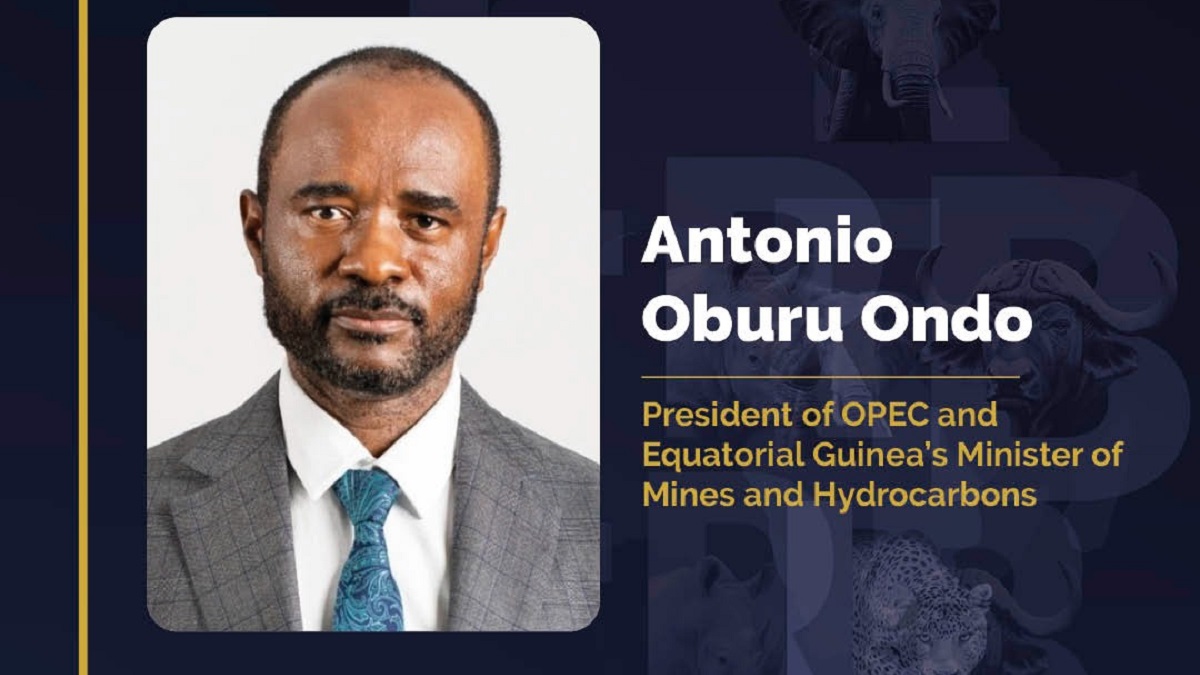
Antonio Oburu Ondo Reveals Strategies to Explore, Drill and Unlock Offshore Potential in Equatorial Guinea

Published

on

Antonio Oburu Ondo

In an exclusive interview with the African Energy Chamber, President of OPEC and Equatorial Guinea’s Minister of Mines and Hydrocarbons, Antonio Oburu Ondo, dives deep into the country’s exploration and drilling Strategies

JOHANNESBURG, South Africa, August 6, 2023/APO Group/ — 

OPEC members recently met in Vienna for the 8th OPEC International Seminar. What measures is OPEC currently taking to stabilize the market given recent price increases?

The global oil market has experienced a relatively volatile few years but OPEC remains committed to contributing towards market stability, both for producers and consumers alike. We have been closely monitoring the market and the associated global dynamics, and our recent seminar in Vienna featured in-depth discussions about production, and maintaining a balance between supply and demand. OPEC will continue to monitor the market while cooperating with our member and non-member countries to address any market imbalances.

Equatorial Guinea’s Gas Mega Hub (GMH) initiative continues to make progress with a Heads of Agreement signed with Marathon Oil Corporation for the second and third phases of the project. What does the timeline look like for the project? Can we expect any milestones to be achieved in 2024 and 2025?

Phase one of the GMH comprised the tie-back of the Alen Field to the Punta Europa Liquefied Natural Gas (LNG) terminal on Bioko Island. This phase delivered first gas in February 2021, and soon thereafter, the government, alongside its project partners, have been working towards getting phase two onstream. In March this year we signed an agreement with Marathon Oil and Noble Energy for the next two phases of the project and we expect phase two to come online as early as January 2024. This stage involves processing gas from the Alba Field while phase three will facilitate gas processing from Noble Energy’s Aseng oil and gas field. Marathon Oil is also currently evaluating two infill drilling opportunities to improve the Alba production performance.

So, we will be starting 2024 with a major milestone and are aiming to reach many more after that. We have recently also established a bilateral trade agreement with Cameroon on cross-border oil and gas development while other exploration projects continue to make progress. A similar agreement was signed with Nigeria in 2022. These endeavors open up new opportunities for the expansion of the GMH by maximizing feedstock for the terminal.

With production decreasing due to natural declines in legacy fields, what efforts are being taken by the Ministry to boost output? 

The country’s enabling environment for investment and strong record of successful offshore finds have also seen new E&P players join the market

In addition to drilling works being undertaken to improve and maintain production levels at existing fields, the Ministry is making great strides towards accelerating exploration across the country’s offshore acreage. Our recent agreement with Cameroon will see the two countries jointly develop oil and gas projects along our maritime borders, including the Yoyo and Yolanda fields, the Etinde gas field and the Camen and Diega fields.

The country’s enabling environment for investment and strong record of successful offshore finds have also seen new E&P players join the market. Earlier this year we also signed three production sharing contracts with Panoro Energy and Africa Oil Corporation. These contracts are expected to further open up the upstream market. Additionally, we have several global energy majors and independents progressing with exploration and are optimistic about these campaigns. The only way to address production declines is to explore, drilling more wells and unlocking the potential of offshore basins.

Equatorial Guinea has recently inked agreements with regional neighbors Nigeria and Cameroon to expand energy cooperation. How is the government strengthening local content within the natural gas industry and how will these agreements help bolster capacity building on a regional scale?

Local content has and will always be a top priority for Equatorial Guinea. In our oil and gas sector, local content is enforced through the National Content Regulation and Hydrocarbons Law as well as additional ministerial decrees, individual production sharing contracts and local labor laws. Through clear regulation and regular engagement with both local and international energy companies, we continue to strengthen our local content and drive capacity building and opportunity.

In addition to policy, the government carries out skills and technology transfer through initiatives and training. We have a number of training and education institutions open and constantly engage our partners about exchange programs and bilateral skills development. Our agreements with neighboring countries fall under these efforts to up-skill and re-skill the workforce. We also believe that regional cooperation will help advance opportunities for oil and gas entrepreneurs. Our partnerships with other West African countries aim to increase trade, commerce and collaboration between Equatorial Guinea and its regional counterparts. These efforts are introducing opportunities for domestic and regional market growth as well as bilateral knowledge sharing.

African Energy Week 2023 takes place under a mandate to make energy poverty history by 2030. How does Equatorial Guinea plan to leverage its resources to achieve this objective and what messages will you be driving during this year’s conference?

Equatorial Guinea, like many other African countries, believes that in order to make energy poverty history, we need to monetize and maximize all of our natural resources. Our efforts to increase investment and bolster development across the entire energy value chain has already been instrumental in alleviating energy poverty. Equatorial Guinea has a wealth of natural gas resources and we are making progress to leverage these resources for domestic power generation. The Bioko Turbogas thermal power plant provides reliable power to the population and as the GMH expands, so will opportunities for gas-to-power.

The country is also capitalizing on its renewable energy wealth, and invites investors and project developers to invest in the country’s green energy sector. We are also working with other countries in Africa to expand trade and regional connectivity.

This year, I am looking forward to participating in a number of panel discussions, investor summits and ministerial forums, and will drive the message that gas is good for Africa. Equatorial Guinea has made significant progress to monetize both domestic and regional gas but a lot more needs to be done to maximize resources and drive industrialization and economic growth. Gas, as a clean and readily available resource, is the best way for Africa to achieve energy security while facilitating a just energy transition.

Distributed by APO Group on behalf of African Energy Chamber.

Business

Aurionpro expands its multi-country transaction banking engagement with Diamond Trust Bank (DTB)

Published

on

Aurionpro

Aurionpro’s upgraded iCashpro platform for DTB delivers a unified digital experience across payments, trade, virtual accounts, and real-time reporting, enhancing straight-through processing, visibility, and control for both the bank and its corporate customers

MUMBAI, India, April 30, 2026/APO Group/ –Aurionpro Solutions Limited (www.AurionPro.com) (BSE: 532668 | NSE: AURIONPRO)a global leader in banking technology, announced the expansion and upgrade of its transaction banking engagement with Diamond Trust Bank (DTB), to modernize and enhance the bank’s corporate transaction banking capabilities across multiple countries.

Download Document: https://apo-opa.co/4edHUaC

This multi-country transaction banking upgrade covering Kenya, Uganda, and Tanzania aligns with DTB’s intent to enhance customer experience, streamline operations, and support growing transaction volumes as it expands its regional corporate banking footprint. DTB continues to focus on building a more agile, ‘digital-first’ banking experience, particularly around payments for its corporate customers across Africa, and is now well positioned to scale these capabilities. As part of its broader transformation agenda, the bank has been steadily investing in platforms that enhance scale, reliability, and service consistency across markets.

Through this partnership, we are proud to lead the next era of transformation in transaction banking, helping DTB enhance operational agility

Aurionpro’s upgraded iCashpro platform for DTB delivers a unified digital experience across payments, trade, virtual accounts, and real-time reporting, enhancing straight-through processing, visibility, and control for both the bank and its corporate customers. By enabling DTB to standardize and scale its transaction banking operations across countries, the platform ensures consistent service levels, stronger control, and improved efficiency. It also supports enhanced user experience, advanced security, and the flexibility to introduce new features as DTB expands its regional transaction banking footprint.

Murali Natarajan (https://apo-opa.co/48trPdk), Managing Director & CEO, DTB Kenya   commented: “We are delighted to strengthen and broaden our partnership with Aurionpro Solutions as part of DTB’s ongoing digital transformation journey across multiple markets. Our focus on innovation, operational excellence, and customer-centricity continues to guide our technology investments. This upgrade strengthens our transaction banking capabilities, enabling us to deliver greater value to our customers through robust digital channels and seamlessly integrated experiences.”

Ashish Rai, Group CEO, Aurionpro Solutions, commented: “We are pleased to deepen our multi-country engagement with Diamond Trust Bank and support the next phase of its transaction banking modernization. As DTB continues to scale across markets, platform resilience and consistency become paramount. Through this partnership, we are proud to lead the next era of transformation in transaction banking, helping DTB enhance operational agility, deliver superior experiences to corporate customers, and create long-term value across geographies.”

He added, “Aurionpro’s iCashpro lays a strong digital foundation for transaction & wholesale banks across the globe to grow their corporate and SME client portfolio today, while creating a clear roadmap for next- generation capabilities in AI-driven insights, advanced automation and API-led connectivity for businesses in Kenya and across Africa.”

Distributed by APO Group on behalf of Aurionpro Solutions Ltd.


Continue Reading

Business

Minerals Council Chief Executive Officer (CEO) Joins African Mining Week (AMW) as South Africa Improves Sectorial Investment Climate

Published

on

Energy Capital

Minerals Council CEO to share insights on policy, infrastructure and investment trends shaping South Africa’s mining industry

CAPE TOWN, South Africa, April 30, 2026/APO Group/ –The upcoming African Mining Week (AMW) conference will feature Mzila Mthenjane, CEO of the Minerals Council of South Africa, as a speaker. Scheduled for October 14 – 16, 2026 in Cape Town, the event will bring together global investors, policymakers and industry leaders, with Mthenjane’s participation highlighting the council’s commitment to engaging international stakeholders and promoting investment across South Africa’s mining sector.

His participation comes at a critical moment as the Minerals Council works closely with government on finalizing the Mineral Resources Development Bill 2025, a policy framework aimed at strengthening the country’s mining investment climate and the sector’s contribution to GDP. According to the council, the revised legislation will support new investment across the value chain as South Africa seeks to mobilize R2 trillion over the next five years to unlock its critical minerals potential.

The policy reforms come amid shifting production trends in the sector. In 2025, South Africa recorded declines in gold and platinum group metals output of 1.9% and 4.1%, respectively. The new regulatory framework is expected to strengthen public-private partnerships and stimulate investment, enabling South Africa to increase production and capitalize on strong global commodity prices. Increased private sector investments is crucial with South Africa seeking targeting to unlock an estimated R40 trillion in untapped iron ore potential as well as maintain its position as the world’s leading producer of chrome and manganese.

At AMW 2026, Mthenjane is expected to outline these trends, providing insights into how the council is contributing to addressing challenges disrupting the sector. Infrastructure and energy costs remain key concerns for industry players. To support the energy-intensive sector, South Africa approved a 35% reduction in electricity tariffs for major ferrochrome producers, helping stabilize an industry that has faced significant cost pressures after electricity prices surged by roughly 900% since 2008.

Logistics constraints are also a priority area for reform. South Africa’s economy is losing an estimated R1 billion per day due to inefficiencies across rail and port infrastructure. As a result, the government is considering measures supported by the Minerals Council to increase private sector participation in logistics. Planned reforms include rail modernization initiatives targeting 250 million tons of freight capacity by 2029, alongside port upgrades and private operator participation aimed at strengthening mineral exports and improving supply chain efficiency.

Beyond infrastructure and policy reforms, the Minerals Council is advocating for stronger exploration investment to support long-term industry growth.

At AMW, Mthenjane is expected to highlight these developments and outline the steps required to reinforce South Africa’s position in the global minerals supply chain. His insights will offer investors and stakeholders a timely perspective on opportunities within the country’s mining sector.

Distributed by APO Group on behalf of Energy Capital & Power.

Continue Reading

Energy

Seychelles Targets Energy Investment Push as Minister Jérémie Joins African Energy Week (AEW) 2026 as a Speaker

Published

on

African Energy Chamber

Seychelles energy minister will speak at AEW 2026, positioning her to highlight reforms, renewable projects and investment opportunities as the island nation advances its transition toward a diversified energy system

CAPE TOWN, South Africa, April 29, 2026/APO Group/ –Marie-May Jérémie, Minister of Environment, Climate, Energy and Natural Resources for Seychelles will participate as a speaker at this year’s African Energy Week (AEW) 2026, taking place from October 12–16 in Cape Town. Her participation underscores the country’s growing role in shaping Africa’s small-island energy transition agenda.

Minister Jérémie’s presence at AEW 2026 comes at a critical time as Seychelles accelerates efforts to reduce its heavy reliance on imported fossil fuels. The event provides a platform to attract investment, strengthen policy alignment and showcase bankable projects, positioning the country as a viable destination for private-sector participation in island energy systems.

Seychelles is demonstrating how policy reform and innovation can unlock investment in constrained environments

In May last year, international finance institution the World Bank approved the Renewable Energy Acceleration Program, a seven-year initiative aimed at modernizing the grid and increasing renewable energy penetration to 15% by 2030. The program focuses on unlocking private capital while strengthening transmission infrastructure to accommodate variable renewable energy sources.

Project development is gaining traction in the country, particularly in innovative technologies suited to Seychelles’ land constraints. The 5.8 MW Seysun Lagoon floating solar PV project, developed by independent renewable power producer Qair, is under construction and expected online in 2026.

Alongside renewables, Seychelles continues to pursue upstream opportunities to diversify its economy. The government approved new exploration entrants in 2025 and extended exiting petroleum agreements, while securing an infrastructure partnership with China. Multilateral estimates suggest over $800 million in investment will be required over the next 25 years.

Regulatory reform is central to this transition, with Seychelles introducing an independent power producer framework to open the market to private developers. Standardized power purchase agreements, grid access reforms and strengthened public-private partnership structures are being implemented to improve transparency, reduce risk and accelerate project bankability across solar, storage and emerging wind opportunities.

“Minister Jérémie’s participation highlights the strategic importance of island nations in Africa’s broader energy transition,” says NJ Ayuk, Executive Chairman, African Energy Chamber. “Seychelles is demonstrating how policy reform and innovation can unlock investment in constrained environments. Her insights will be critical to advancing dialogue on resilient, low-carbon energy systems across the continent.”

Distributed by APO Group on behalf of African Energy Chamber.

Continue Reading

Trending