Connect with us

Business

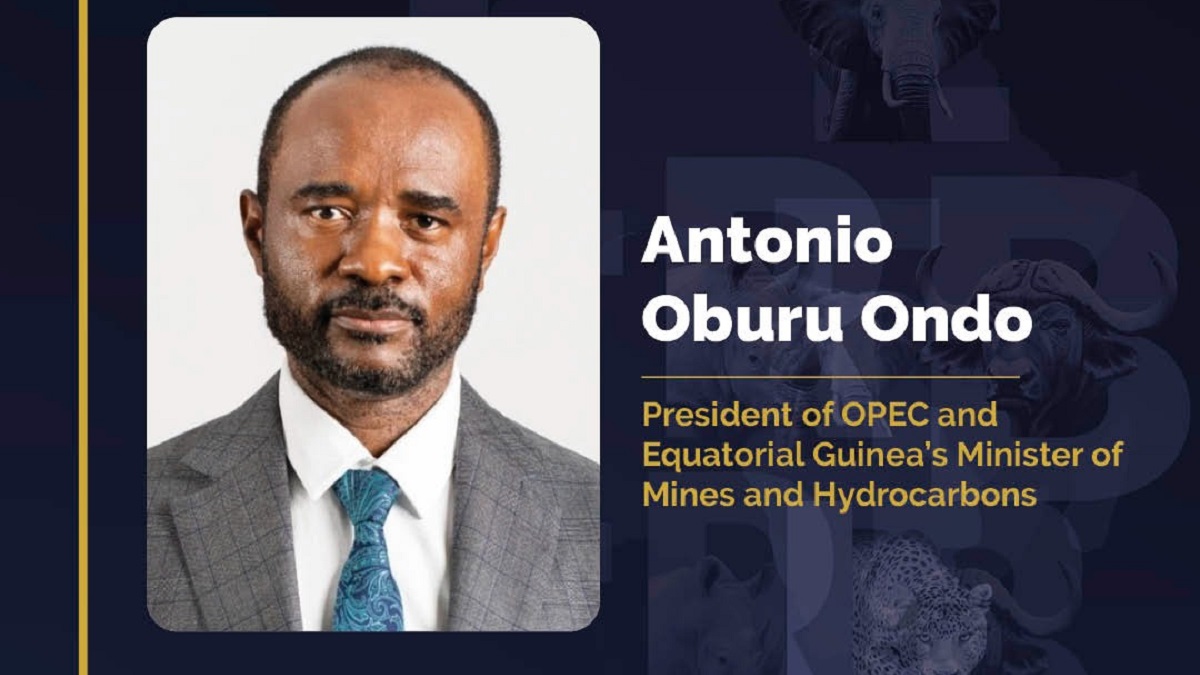
Antonio Oburu Ondo Reveals Strategies to Explore, Drill and Unlock Offshore Potential in Equatorial Guinea

Published

on

Antonio Oburu Ondo

In an exclusive interview with the African Energy Chamber, President of OPEC and Equatorial Guinea’s Minister of Mines and Hydrocarbons, Antonio Oburu Ondo, dives deep into the country’s exploration and drilling Strategies

JOHANNESBURG, South Africa, August 6, 2023/APO Group/ — 

OPEC members recently met in Vienna for the 8th OPEC International Seminar. What measures is OPEC currently taking to stabilize the market given recent price increases?

The global oil market has experienced a relatively volatile few years but OPEC remains committed to contributing towards market stability, both for producers and consumers alike. We have been closely monitoring the market and the associated global dynamics, and our recent seminar in Vienna featured in-depth discussions about production, and maintaining a balance between supply and demand. OPEC will continue to monitor the market while cooperating with our member and non-member countries to address any market imbalances.

Equatorial Guinea’s Gas Mega Hub (GMH) initiative continues to make progress with a Heads of Agreement signed with Marathon Oil Corporation for the second and third phases of the project. What does the timeline look like for the project? Can we expect any milestones to be achieved in 2024 and 2025?

Phase one of the GMH comprised the tie-back of the Alen Field to the Punta Europa Liquefied Natural Gas (LNG) terminal on Bioko Island. This phase delivered first gas in February 2021, and soon thereafter, the government, alongside its project partners, have been working towards getting phase two onstream. In March this year we signed an agreement with Marathon Oil and Noble Energy for the next two phases of the project and we expect phase two to come online as early as January 2024. This stage involves processing gas from the Alba Field while phase three will facilitate gas processing from Noble Energy’s Aseng oil and gas field. Marathon Oil is also currently evaluating two infill drilling opportunities to improve the Alba production performance.

So, we will be starting 2024 with a major milestone and are aiming to reach many more after that. We have recently also established a bilateral trade agreement with Cameroon on cross-border oil and gas development while other exploration projects continue to make progress. A similar agreement was signed with Nigeria in 2022. These endeavors open up new opportunities for the expansion of the GMH by maximizing feedstock for the terminal.

With production decreasing due to natural declines in legacy fields, what efforts are being taken by the Ministry to boost output? 

The country’s enabling environment for investment and strong record of successful offshore finds have also seen new E&P players join the market

In addition to drilling works being undertaken to improve and maintain production levels at existing fields, the Ministry is making great strides towards accelerating exploration across the country’s offshore acreage. Our recent agreement with Cameroon will see the two countries jointly develop oil and gas projects along our maritime borders, including the Yoyo and Yolanda fields, the Etinde gas field and the Camen and Diega fields.

The country’s enabling environment for investment and strong record of successful offshore finds have also seen new E&P players join the market. Earlier this year we also signed three production sharing contracts with Panoro Energy and Africa Oil Corporation. These contracts are expected to further open up the upstream market. Additionally, we have several global energy majors and independents progressing with exploration and are optimistic about these campaigns. The only way to address production declines is to explore, drilling more wells and unlocking the potential of offshore basins.

Equatorial Guinea has recently inked agreements with regional neighbors Nigeria and Cameroon to expand energy cooperation. How is the government strengthening local content within the natural gas industry and how will these agreements help bolster capacity building on a regional scale?

Local content has and will always be a top priority for Equatorial Guinea. In our oil and gas sector, local content is enforced through the National Content Regulation and Hydrocarbons Law as well as additional ministerial decrees, individual production sharing contracts and local labor laws. Through clear regulation and regular engagement with both local and international energy companies, we continue to strengthen our local content and drive capacity building and opportunity.

In addition to policy, the government carries out skills and technology transfer through initiatives and training. We have a number of training and education institutions open and constantly engage our partners about exchange programs and bilateral skills development. Our agreements with neighboring countries fall under these efforts to up-skill and re-skill the workforce. We also believe that regional cooperation will help advance opportunities for oil and gas entrepreneurs. Our partnerships with other West African countries aim to increase trade, commerce and collaboration between Equatorial Guinea and its regional counterparts. These efforts are introducing opportunities for domestic and regional market growth as well as bilateral knowledge sharing.

African Energy Week 2023 takes place under a mandate to make energy poverty history by 2030. How does Equatorial Guinea plan to leverage its resources to achieve this objective and what messages will you be driving during this year’s conference?

Equatorial Guinea, like many other African countries, believes that in order to make energy poverty history, we need to monetize and maximize all of our natural resources. Our efforts to increase investment and bolster development across the entire energy value chain has already been instrumental in alleviating energy poverty. Equatorial Guinea has a wealth of natural gas resources and we are making progress to leverage these resources for domestic power generation. The Bioko Turbogas thermal power plant provides reliable power to the population and as the GMH expands, so will opportunities for gas-to-power.

The country is also capitalizing on its renewable energy wealth, and invites investors and project developers to invest in the country’s green energy sector. We are also working with other countries in Africa to expand trade and regional connectivity.

This year, I am looking forward to participating in a number of panel discussions, investor summits and ministerial forums, and will drive the message that gas is good for Africa. Equatorial Guinea has made significant progress to monetize both domestic and regional gas but a lot more needs to be done to maximize resources and drive industrialization and economic growth. Gas, as a clean and readily available resource, is the best way for Africa to achieve energy security while facilitating a just energy transition.

Distributed by APO Group on behalf of African Energy Chamber.

Events

As global power structures shift, Invest Africa convenes The Africa Debate 2026 to redefine partnership in a changing world

Published

on

The Africa Debate 2026 will provide a platform for this essential, era-defining discussion, convening leaders to explore how Africa and its partners can build more balanced, resilient and sustainable models of cooperation

LONDON, United Kingdom, February 5, 2026/APO Group/ –As African economies assert greater agency in a rapidly evolving global order, Invest Africa (www.InvestAfrica.com) is delighted to announce The Africa Debate 2026, its flagship investment forum, taking place at the historic Guildhall in London on 3 June 2026.

Now in its 12th year, The Africa Debate has established itself as London’s premier platform for African investment dialogue since launching in 2014, convening over 800 global decision-makers annually to shape the future of trade, finance, investment, and development across the continent.

Under the theme “Redefining Partnership: Navigating a World in Transition”, this year’s forum will focus on Africa’s response to global economic realignment with greater agency, ambition and economic sovereignty.

The Africa Debate puts Africa’s priorities at the centre of the conversation, moving beyond traditional narratives to focus on ownership, resilience and long-term value creation.

“Volatility is not new to Africa. What is changing is the opportunity to respond with greater agency and ambition,” says Invest Africa CEO Chantelé Carrington.

“This year’s edition of The Africa Debate asks how we strengthen economic sovereignty — from access to capital and investment to financial and industrial policy — so African economies can take greater ownership of their growth. Success will be defined by how effectively we turn disruption into leverage and partnership into shared value.”

The Africa Debate 2026 will provide a platform for this essential, era-defining discussion, convening leaders to explore how Africa and its partners can build more balanced, resilient and sustainable models of cooperation.

Key challenges driving the debate

Core focus areas for this year’s edition of The Africa Debate include:

This year’s edition of The Africa Debate asks how we strengthen economic sovereignty — from access to capital and investment to financial and industrial policy

Global Realignment & New Partnerships

How shifting geopolitical and economic power structures are reshaping Africa’s global partnerships, trade dynamics and investment landscape.

Financing Africa’s Future

The growing need to reform the global financial architecture, new approaches to development finance, as well as the strengthening of market access and financial resilience of African economies in a changing global system.

Strategic Value Chains

Moving beyond primary exports to build local value chains in critical minerals for the green economy. Also addressing Africa’s energy access gap and mobilising investment in renewable and transitional energy systems.

Digital Transformation & Technology

Unlocking growth in fintech, AI and digital infrastructure to drive productivity, inclusion, and the next phase of Africa’s economic transformation.

The Africa Debate 2026 offers a unique platform for high-level dialogue, deal-making, and strategic engagement. Attendees will gain actionable insights from leading policymakers, investors and business leaders shaping Africa’s economic future, while building strategic partnerships that define the continent’s next growth phase.

Registration is now open (http://apo-opa.co/46b19gj).

Distributed by APO Group on behalf of Invest Africa.

Continue Reading

Business

Zion Adeoye terminated as Chief Executive Officer (CEO) of CLG due to serious personal and professional conduct violations

Published

on

After a thorough internal and external investigation, along with a disciplinary hearing chaired by Sbongiseni Dube, CLG (https://CLGglobal.com) has made the decision to terminate Zion Adeoye due to serious personal and professional conduct violations. This process adhered to the Code of Good Practice of the Labour Relations Act, ensuring fairness, transparency, and compliance with South African law.

Mr. Adeoye has been held accountable for several serious offenses, including:

  • Making malicious and defamatory statements against colleagues
  • Extortion
  • Intimidation
  • Fraud
  • Misuse of company funds
  • Theft and misappropriation of funds
  • Breach of fiduciary duty
  • Mismanagement

His actions are in direct contradiction to our firm’s core values. We do not approve of attorneys spending time in a Gentleman’s Club. CLG deeply regrets the impact this situation has had on our colleagues and continues to provide full support to those affected.

We want to express our gratitude to those who spoke up and to reassure everyone at the firm of our unwavering commitment to maintaining a respectful workplace. Misconduct of any kind is unacceptable and will be addressed decisively.

We recognize the seriousness of this matter and have referred it to the appropriate law enforcement, regulatory, and legal authorities in Nigeria, Mauritius, and South Africa. We kindly ask that the privacy of the third party involved be respected.

Distributed by APO Group on behalf of CLG.


Continue Reading

Business

The International Islamic Trade Finance Corporation (ITFC) Strengthens Partnership with the Republic of Djibouti through US$35 Million Financing Facility

Published

on

This facility forms part of the US$600 million, three-year Framework Agreement signed in May 2023 between ITFC and the Republic of Djibouti, reflecting the strong and growing partnership between both parties

JEDDAH, Saudi Arabia, February 5, 2026/APO Group/ –The International Islamic Trade Finance Corporation (ITFC) (https://www.ITFC-IDB.org), a member of the Islamic Development Bank (IsDB) Group, has signed a US$35 million sovereign financing facility with the Republic of Djibouti to support the development of the country’s bunkering services sector and strengthen its position as a strategic regional maritime and trade hub.

The facility was signed at the ITFC Headquarters in Jeddah by Eng. Adeeb Yousuf Al-Aama, Chief Executive Officer of ITFC, and H.E. Ilyas Moussa Dawaleh, Minister of Economy and Finance in charge of Industry of the Republic of Djibouti.

The financing facility is expected to contribute to Djibouti’s economic growth and revenue diversification by reinforcing the competitiveness and attractiveness of the Djibouti Port as a “one-stop port” offering comprehensive vessel-related services. With Red Sea Bunkering (RSB) as the Executing Agency, the facility will support the procurement of refined petroleum products, thus boosting RSB’s bunkering operations, enhancing revenue diversification, and consolidating Djibouti’s role as a key logistics and trading hub in the Horn of Africa and the wider region.

We look forward to deepening this partnership, creating new opportunities, and leveraging collaborative programs to advance key sectors and drive sustainable economic growth

Commenting on the signing, Eng. Adeeb Yousuf Al-Aama, CEO of ITFC, stated:

“This financing reflects ITFC’s continued commitment to supporting Djibouti’s strategic development priorities, particularly in strengthening energy security, port competitiveness, and trade facilitation. We are proud to deepen our partnership with the Republic of Djibouti and contribute to sustainable economic growth and regional integration.”

H.E. Ilyas Moussa Dawaleh, Minister of Economy and Finance in charge of Industry of the Republic of Djibouti, commented: “Today’s signing marks an important milestone in the development of Djibouti’s bunkering services and reflects our strong and valued partnership with ITFC, particularly in the oil and gas sector. This collaboration supports our ambition to position Djibouti as a regional hub for integrated maritime and logistics services. We look forward to deepening this partnership, creating new opportunities, and leveraging collaborative programs to advance key sectors and drive sustainable economic growth.”

This facility forms part of the US$600 million, three-year Framework Agreement signed in May 2023 between ITFC and the Republic of Djibouti, reflecting the strong and growing partnership between both parties.

Since its inception in 2008, ITFC and the Republic of Djibouti have maintained a strong partnership, with a total of US$1.8 billion approved primarily supporting the country’s energy sector and trade development objectives.

Distributed by APO Group on behalf of International Islamic Trade Finance Corporation (ITFC).

Continue Reading

Trending

Exit mobile version