Connect with us
Anglostratits

Business

AI accelerates advertising measurement, but advertisers still lack a complete view of ROI

Published

on

WARC

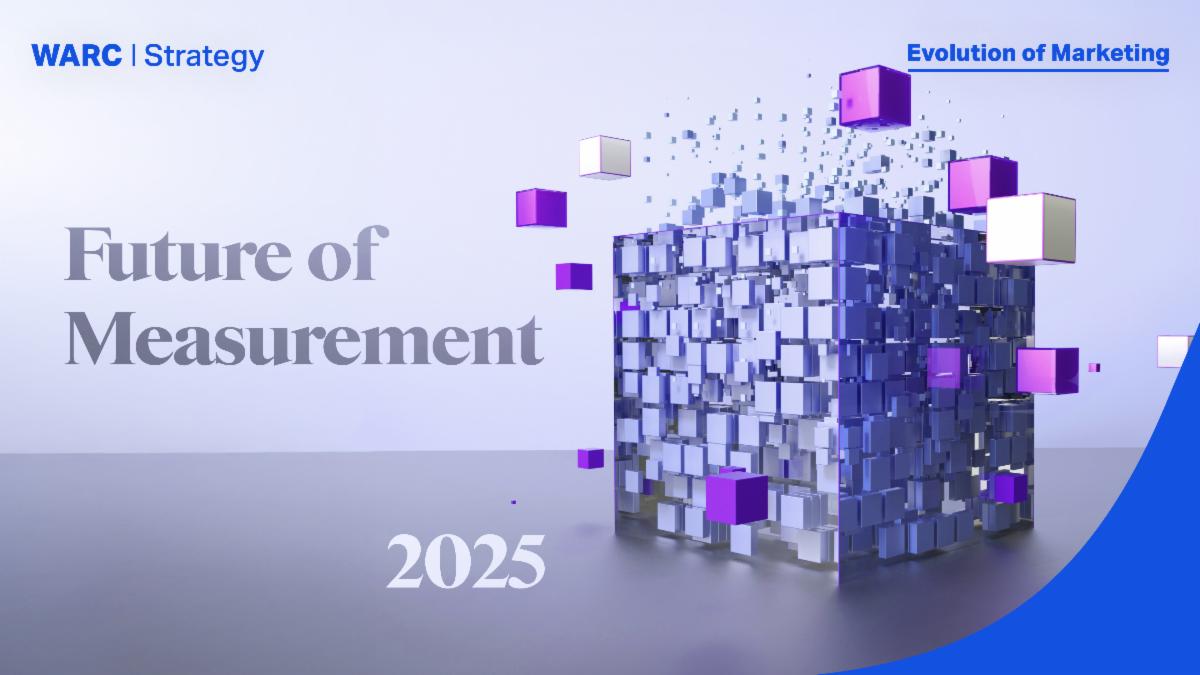
The Future of Measurement 2025, part of WARC’s Evolution of Marketing programme, highlights emerging trends in media and creative measurement

8 May 2025 – As measurement continues to evolve, WARC, the global authority on marketing effectiveness, has today released The Future of Measurement 2025, a report that explores the latest emerging trends in media and creative measurement. It focuses on three key areas: the growth of marketing experiments, the price measurement gap, and the rise of AI-powered creative testing.

Paul Stringer, Managing Editor Research and Insights, WARC, says: “Once considered the preserve of more advanced advertisers, the next 12 months in marketing measurement will be defined by a growing democratisation of tools and methods. However, while AI tools, in particular, bring new speed and scale to measurement, advertisers still lack a complete framework for understanding advertising return on investment.

“With this report we aim to provide clarity on the latest advancements in measurement techniques by sharing insights from both WARC and external research, as well as equipping marketers with takeaways to put into practice.”

Key trends set to shape the measurement landscape over the next 12 months are:

Marketers using experiments doubles, from 18% to 36%

The number of marketers using experiments to measure marketing effectiveness has risen significantly, doubling from 18% to 36%, over the past year.

Considered key for understanding advertising effectiveness, experiments enable marketers to examine causality, or the incremental effects of advertising. They also encourage the exploration of new approaches, channels and creative ideas.

Underused for many years, the widespread availability of incrementality testing tools on social and retail media platforms is driving an uptick in adoption across the industry.

However, experiments are not without limitations. Advertisers are advised to conduct experiments with careful preparation by setting out clear hypothesis, identifying success metrics and choosing the right experimental design. Platform lift tests still lack control, transparency, and cross-channel performance comparison capabilities. Experiments work best in combination with other methodologies and should be embedded within a broader learning agenda to maximise their value.

Brands profit from price measurement

Advertisers are becoming more cognisant of the long-term effects of brand on price – and are investing in bespoke measurement solutions to prove it.

There is ample evidence showing that strong brands have more pricing power, with consumers willing to pay higher prices for their products and services, and less likely to stop buying when prices increase.

Pricing power is the greatest driver of profitability for businesses, meaning, advertising’s impact on price is key to the ongoing argument for long-term brand investment.

However, when measuring the price effects of advertising, most of the models used by advertisers capture advertising effects across a period of three or four years, when pricing effects typically take much longer to play out.

As more marketers appear to be taking pricing effects seriously, pricing power is likely to become even more important if US-led global trade tariffs force companies into raising prices for consumers.

At a time when marketing budgets are under near-constant pressure, marketers are advised to track price as a KPI or get involved in pricing decisions; track pricing effects over time to calculate advertising’s payback; and avoid treating marketing investment as a short-term cost rather than a long-term investment capable of generating future economic benefits.

AI-driven creative testing is rising but human touch remains vital

Creativity might be the single most important lever of advertising effectiveness at marketers’ disposal, but it is also one of the most difficult to quantify.

AI technologies are beginning to transform how advertisers measure and optimise creative assets at speed and scale, giving companies access to granular insights and learnings about creative effectiveness across media, devices and channels.

While AI enables cost-effective testing at scale, it is recommended to maintain human testing alongside AI tools, especially for ‘hero’ campaign assets. This hybrid approach will help mitigate AI testing limitations, such as evaluating new ideas or thinking.

The integration of creative data in marketing mix modelling (MMM) means advertisers can now model the impact of creative using econometric techniques. As an emerging area of measurement, guidance and best practices are still in development. But it opens the door to a clearer understanding of the role that creativity plays in driving commercial outcomes for brands.

Read a sample report of The Future of Measurement here. WARC subscribers can read the report in full. A WARC podcast on the topic will be available from 15 May.

The insights for The Future of Measurement report are based on a combination of exclusive data from WARC and external research studies and reports. It is part of WARC Strategy’s Evolution of Marketing, series of in-depth forward-looking reports on the marketing discipline through evidence-based insights and emerging trends, technologies, and other drivers of change.

Business

Five Years After Expansion, Qianhai Opens a New Chapter in Institutional Opening-Up

Published

on

Hong Kong

SHENZHEN, CHINA – Media OutReach Newswire – 31 August 2026 – September 6 marks the fifth anniversary of the promulgation of the Plan for Comprehensive Deepening Reform and Opening Up of the Qianhai Shenzhen-Hong Kong Modern Service Industry Cooperation Zone (“Qianhai Plan”). Just days earlier, on August 26, Qianhai celebrated its 16th anniversary. Coming one after another, the two milestones provide a window through which to view the development of this 120.56-square-kilometer area. On August 20, the Authority of Qianhai announced that since its expansion in 2021, Qianhai’s regional GDP had risen from 175.57 billion yuan to 331.81 billion yuan, while total imports and exports had grown from 378.05 billion yuan to 757.43 billion yuan — both figures nearly doubling or more than doubling.
Behind these numbers is the sheer scale of institutional innovation. As a frontline of China’s opening-up, Qianhai has continued to introduce and refine policies, with 111 institutional innovation outcomes now replicated and promoted nationwide. The General Administration of Customs has introduced two rounds of dedicated support policies to address the challenges facing Qianhai’s development. Qianhai was the first in China to pilot a customs model featuring “direct access at the first line and smart connected supervision”, allowing goods to be directly released at the port, with declaration and inspection carried out after they arrive at the comprehensive bonded zone. The number of items required in customs declarations has also been reduced from dozens to just over ten.


The progress in Shenzhen-Hong Kong cooperation is even more visible. The number of Hong Kong-funded enterprises has grown from more than 8,000 in 2021 to over 11,000 today. Technology commercialization platforms established by five Hong Kong universities have successively begun operations in Qianhai, incubating 193 projects in total.

Gary Wong Chi-him, a Hong Kong resident working at the Qianhai Authority, has experienced these changes firsthand. He said that more and more people from Hong Kong have been coming to Qianhai over the past five years. “There’s a saying in Shenzhen: once you come, you’re a Shenzhener. I felt that sense of belonging from my very first day,” he said. “Qianhai has created an environment where Hong Kong and Shenzhen are deeply intertwined. Even while living and working in Qianhai, you can still feel the atmosphere of Hong Kong, so I had no difficulty settling in.”

Jacqueline Ho, CEO of Hong Kong-funded sci-tech innovation company Synovate Technologies, said the company set up at the Qianhai Shenzhen-Hong Kong Youth Innovation and Entrepreneur Hub in 2019 and has benefited from its ongoing talent recruitment services. “Qianhai has helped us connect with upstream and downstream partners such as Siemens, allowing us to establish a foothold in the hard-tech sector in a short time,” she said. The company has obtained around 50 independent intellectual property rights to date and was named to the Forbes China Emerging Tech T30&30 Selection this year. Qianhai is now home to 532 key AI enterprises, including SmartMore Information Technology, Pony.ai and Fengyi Technology, among a growing group of companies that have established and expanded their businesses here.

For Lin Zhifeng, General Manager of China (Qianhai) Internet Exchange, the most notable sign of Qianhai’s growing international reach was the establishment of the China Center for Promoting APEC Data Cross-Border Flow Cooperation at the end of July. The center he works is the only national-level Internet exchange center in South China. In the five years since its establishment, it has served more than 270 enterprises. Its Shenzhen-Hong Kong Cross-Boundary Data Validation Platform has helped mainland SMEs secure more than HK$260 million in financing in Hong Kong. Its secure and convenient cross-border data channel has benefited more than 300,000 Hong Kong residents, making it easier for them to transfer medical records across the border after receiving treatment in Shenzhen.

Five years into its expansion, Qianhai has gradually established a clearer path toward institutional opening-up. Every breakthrough reflects the same underlying approach: turning institutional differences into new opportunities created by opening-up, and translating the alignment of rules from paper into practice. “Qianhai, Pulse with the World” is more than a city slogan; it is a vivid testament to the five years of reform and opening-up in this dynamic part of Shenzhen.


Continue Reading

Business

Islamic Corporation for the Insurance of Investment and Export Credit (ICIEC) and Export-Import Bank of Pakistan (EXIM Bank of Pakistan) Sign Reinsurance Agreement to Strengthen Pakistan’s Export Sector

Published

on

ICIEC

Through the agreement, ICIEC will provide reinsurance support for eligible export transactions, helping enhance risk-sharing capacity, facilitate access to credit, and enable Pakistani businesses, including SMEs, to pursue opportunities in regional and international markets with greater confidence


ISLAMABAD, Pakistan, August 31, 2026/APO Group/ –The Islamic Corporation for the Insurance of Investment and Export Credit (ICIEC) (https://ICIEC.IsDB.org/), a Shariah-based multilateral insurer and member of the Islamic Development Bank Group, has signed a Reinsurance Agreement with the Export-Import Bank of Pakistan (EXIM Bank of Pakistan), marking another milestone in the partnership between the two institutions.

This agreement marks an important step in strengthening Pakistan’s export ecosystem

Signed during ICIEC’s mission to Pakistan, the agreement will strengthen Pakistan EXIM’s risk-mitigation capacity and expand its ability to support Pakistani exporters through export credit insurance solutions.

Through the agreement, ICIEC will provide reinsurance support for eligible export transactions, helping enhance risk-sharing capacity, facilitate access to credit, and enable Pakistani businesses, including SMEs, to pursue opportunities in regional and international markets with greater confidence.

Dr. Khalid Khalafalla, Chief Executive Officer of ICIEC, said: “This agreement marks an important step in strengthening Pakistan’s export ecosystem. By combining ICIEC’s reinsurance capacity with EXIM Bank of Pakistan’s local expertise, we can expand the protection available to exporters, enhance their access to finance, and help Pakistani businesses, particularly SMEs, compete more confidently in regional and global markets. It also reflects our commitment to working with national export credit institutions to unlock new trade opportunities and support sustainable economic growth across our Member States.”

The agreement further reinforces the long-standing cooperation between ICIEC and Pakistan and reflects the shared commitment of both institutions to expanding the availability of effective risk-mitigation solutions for the country’s exporters. ICIEC looks forward to building on this partnership with EXIM Bank of Pakistan and supporting the continued development of Pakistan’s export sector.

Distributed by APO Group on behalf of Islamic Corporation for the Insurance of Investment and Export Credit (ICIEC).


Continue Reading

Business

Afreximbank strengthens regional leadership with new appointments across Africa and the Caribbean

Published

on

These appointments are integral to Afreximbank’s growth ambitions and its efforts to accelerate intra-African trade, industrialisation and regional integration

CAIRO, Egypt, August 31, 2026/APO Group/ –African Export-Import Bank (Afreximbank) (www.Afreximbank.com) has announced senior leadership appointments and confirmations to strengthen regional operations, deepen client engagement, and enhance delivery of the Bank’s mandate across Africa and the Caribbean.


These appointments are integral to Afreximbank’s growth ambitions and its efforts to accelerate intra-African trade, industrialisation and regional integration. By strengthening leadership across its regional platforms, the Bank is positioning itself to expand market coverage, improve transaction execution and deepen engagement with clients and stakeholders across Africa and the Caribbean.

Mr. Eric Intong Monchu has been appointed as Group Managing Director, Client Relations and Regional Operations, based in Cairo, Egypt, after serving in the role in an acting capacity. In this position, he will lead the Bank’s client relations and regional operations functions, strengthening coordination between business development, client coverage, and transaction execution.

Mr. Kudakwashe Matereke has been appointed Director, Regional Operations, Anglophone West Africa, based in Abuja, Nigeria. Prior to this appointment, he served as the Director, Regional Operations, East Africa. Mr Matereke brings extensive experience in trade finance, business development, and client relationship management, and will lead regional business development, client coverage, and stakeholder engagement.

Each appointee brings valuable experience and deep knowledge of African and Caribbean markets

Mr. Humphrey Nwugo has been appointed Director, Regional Operations, Eastern Africa, based in Kampala, Uganda, following a similar regional operations role in Southern Africa. He brings extensive experience in banking operations, syndications, corporate finance, and regional execution, and will oversee the Bank’s regional operations, market coverage, and client engagement in Eastern Africa.

Mr. Peter Adeshola Olowononi has been appointed Director, Regional Operations, Southern Africa, based in Harare, Zimbabwe. Prior to his appointment, he served as Director, Client Relations, Anglophone West Africa. Mr. Olowononi brings extensive experience in client coverage, transaction origination, and regional business development, and will lead the Bank’s operations and strategic engagement across Southern Africa.

Mr. Roy Reid has been appointed Chief Operating Officer, Caribbean Office, in Bridgetown, Barbados, effective 15 July 2026. Prior to his appointment, he served as Senior Advisor at the Office of the Prime Minister of Jamaica. Mr Reid brings more than 20 years of experience across government advisory, financial services, investment management, fintech, and business development, and will support the Bank’s operations, regional coordination, and stakeholder engagement across the Caribbean.

Collectively, the appointments strengthen the links between client coverage, regional operations and transaction execution. With most of the appointees progressing from within the Bank, they bring strong institutional knowledge, established client relationships and a clear understanding of Afreximbank’s strategic priorities. This continuity will support faster execution, greater responsiveness to market needs, and delivery of the Bank’s growth, trade, and development targets across Africa and the Caribbean.

Speaking on the appointments, Dr George Elombi, President and Chairman of the Board of Directors at Afreximbank, stated: “These appointments highlight the depth of leadership and professional talent within Afreximbank, as well as our commitment to placing experienced executives at the centre of executing the Bank’s development mandate: a mandate to change the structure of African trade. Each appointee brings valuable experience and deep knowledge of African and Caribbean markets. Above all, each shares a strong belief in the Bank’s founding philosophy that Africa’s development destiny lies with Africans and that our collective mission is to restore the dignity of the African.”

The Board of Directors, management and staff of Afreximbank extend their congratulations to Mr Intong Monchu, Mr. Matereke, Mr. Nwugo, Mr. Olowononi and Mr. Reid on their appointments and wish them success in their respective roles.

Distributed by APO Group on behalf of Afreximbank.


Continue Reading

Trending