The report says investment in African upstream activities will wrap up 2022 at about $33 billion, then grow as much as $15 billion more over the period 2023-2025 compared to year-end 2021 estimates
JOHANNESBURG, South Africa, November 21, 2022/APO Group/ —
By NJ Ayuk, Executive Chairman, African Energy Chamber (http://www.EnergyChamber.org)
When TotalEnergies and Shell separately announced “significant” discoveries of what appears to be commercial quantities of oil and gas offshore Namibia — possibly more than 4 billion barrels of oil in total — it signaled something new for the nation: a chance to monetize its natural resources to combat energy poverty and accelerate economic growth. The offshore deposits — the nation’s largest find since independence — are at peak likely to provide Windhoek an estimated $5.6 billion annually in royalties and taxes and should help the nation double its $11 billion economy by 2040.
The find also demonstrated how well African oil and gas development activity is faring despite repeated efforts to tamp it down. With activist investors trying to stem the flow of international funds into African fossil fuel projects, and major oil companies under pressure to rebalance their portfolios by adding lower emission assets, the Namibia experience is impressive on several counts. The pragmatism of Namibian officials has been encouraging to investors and we hope that pragmatism stays.
It’s also likely a harbinger of things to come for Africa’s upstream energy sector, according to the African Energy Chamber’s (AEC’s) report, “The State of African Energy: 2023 Outlook,” now available here (http://bit.ly/3NbQLtD).
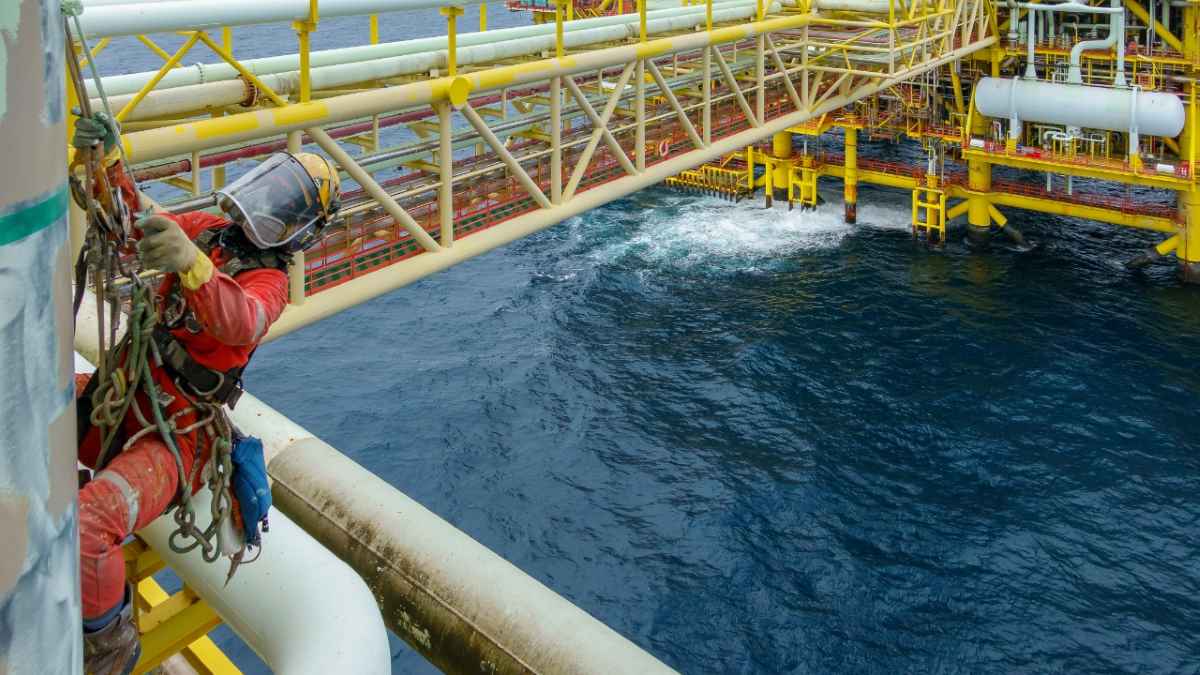
The report says investment in African upstream activities (defined as exploration, production, and development) will wrap up 2022 at about $33 billion, then grow as much as $15 billion more over the period 2023-2025 compared to year-end 2021 estimates. In addition to Namibia, greenfield spending — that is, foreign direct investment in new projects — is being driven by Mauritania, Senegal, Uganda, Congo, Mozambique, Ghana, Angola, and Cote d’Ivoire. In 2022, exploration alone was up 130% over 2021.
Deep Pockets
The twin discoveries by TotalEnergies and Shell came three weeks apart, but there are no overnight successes in oil and gas. Exploration by one company or another has been taking place in Namibia for more than 30 years, and first production from the giant find isn’t expected until 2028. Still, while this is the largest discovery to date, it’s just the latest in a series of new opportunities that include a high-impact onshore exploration program by Canadian oil company ReconAfrica (the basin is the size of Texas, and some are saying it could shape up to be the last great onshore oil discovery in the world) and developments by Atlantic Oil & Gas and Global Petroleum — projects the 2023 Outlook describes in some detail.
Could there be better proof that the world isn’t ready to abandon fossil fuels, especially given the push and pull of market conditions and the fact that renewables, while desirable, aren’t ready to replace hydrocarbons quite yet? And could there be more evidence that the “last frontier” fields onshore and offshore Africa are considered a fruitful alternative to the world’s legacy basins whose productivity is waning?
True, COP26 and its international fossil fuel finance bans took the wind out of certain sails. Lack of investment has delayed some projects and suspended others during the last year. But even climate agreements haven’t kept the United States International Development Finance Corporation (DFC), one of the primary funders of all types of overseas energy projects, from plowing far more support into African oil and gas development than into renewables. The Guardian recently reported that DFC and Exim — the Export-Import Bank of the United States — have invested more than $9 billion in hydrocarbons compared to just $682 million in wind and solar, Together, they have bankrolled oil facilities in Senegal and Equatorial Guinea and invested in an Egyptian gas pipeline. And in 2019, Exim agreed to provide a $4.7 billion loan to finance a project in northern Mozambique overseen by TotalEnergies.
The truth, plain and simple, is that the world needs more energy. And Africa needs it even more than most.
Experts say energy demand in Africa is expected to be 30% higher over the next two decades
Powering Progress
Africa is ripe for increased energy development, hydrocarbons, and renewables alike, especially as the continent undergoes dramatic demographic shifts, chiefly staggering population growth, sustained urbanization, and greater industrialization. Consider this: In 1950, less than 10% of the world’s population lived in Africa, but by 2050, that figure will be closer to 25%. Between now and then — less than 30 years — the populations of more than half of Africa’s nations are expected to double. In real numbers. This means Africa will be home to 2.5 billion people by 2050, and its urban areas alone will have added 950 million people. In fact, Africa’s cities are the fastest growing on the planet. Generally speaking, that’s good news. City life is associated with better economic outcomes for individuals as well as higher standards of living: greater access to education, jobs, services, infrastructure, and electricity. Progress in cities far outpaces rural areas by just about every metric.
Of course, it takes a lot of energy (and money) to power progress. Experts say energy demand in Africa is expected to be 30% higher over the next two decades (by contrast, global demand will only grow 10%), meaning it will easily outstrip supply. And although Africa has about 60% of the world’s best solar resources, its 1% installed solar capacity isn’t likely to keep many lights on or factories running. No wonder we’re seeing the kind of uptick we are in upstream activity.
Sub-Saharan Opportunity
While oil is still in play, much of the focus has pivoted to natural gas, which is considered a cleaner, even “green” fuel, even by the most ardent hydrocarbon proponents. Today, analysts believe that countries with significant gas production could expect their gas reserves to be more resilient under various energy transition scenarios than their oil reserves.
What does that mean for Africa? As discussed during African Energy Week in Cape Town, the 2023 Outlook notes that the continent holds more gas potential in the medium term than oil; more than 700 trillion cubic feet (tcf) of natural gas resources have been discovered in Africa but are yet to be approved for development. Many of these discoveries are planned to be developed as liquified natural gas (LNG) projects. In fact, most of the gas projects sanctioned in Africa are related to supplying LNG either within Africa or to markets like China and Europe, which is diversifying away from Russian gas. With the exception of developments in Libya, the LNG projects are largely in sub-Saharan Africa. As such, this is where CAPEX spending is centered. The AEC report estimates that 80% of the 2022 – 2025 cumulative greenfield spending from Africa is expected to come from sub-Saharan projects.
While some decry those investments because they generate energy for export outside the continent, government officials say their economies — and, therefore, their citizens — depend on resource wealth. And intraregional trade within Africa is destined to grow, especially as investment increases in gas infrastructure required to support domestic industrialization — pipelines, processing facilities, and LNG regasification plants, and the like.
A Template for the Future?
Regardless of whether they’re onshore or offshore, the Namibian discoveries aren’t just important — they’re transformational. ReconAfrica’s huge, conventional oil play is already providing well-paying jobs to 200 people from the Kavango region, where 40% of the people live in generational poverty, and local hiring is expected to continue as the project advances. The company has also made it a priority to provide clean water to the region; they’ve drilled four water wells and have permits for 16 more.
And, as we’ve seen time and time again, in the energy business, success breeds success. In this case, Namibia shares the same geological sedimentary basin with South Africa — and Shell, TotalEnergies, PetroSA, Sezigyn, and Impact Africa all hold exploration acreage in the South African sector. South Africa needs to move with a petroleum legislation immediately and ensure stability so more investment can come into the country. The hydrocarbon potential of the region is tremendous, suggesting the economic potential is as well — as long as development is allowed to continue.
Distributed by APO Group on behalf of African Energy Chamber.













 Hospitality4 days ago
 Business4 days ago
 Business4 days ago
 Energy4 days ago
 Business4 days ago
 Energy4 days ago
 Business3 days ago
 Business4 days ago