Connect with us
Anglostratits

Business

Liberia Lays the Infrastructure Foundation for Offshore Petroleum Sector Ahead of 2026 Exploration Push

Published

on

Etu Energias

Liberia expands ports, petroleum storage and regulatory capacity as TotalEnergies and BluEnergies accelerate offshore exploration ahead of potential drilling

CAPE TOWN, South Africa, October 1, 2026/APO Group/ –Liberia is entering a new phase of offshore exploration as international companies advance seismic and geological programs while the government strengthens the infrastructure and institutions needed to support a growing petroleum sector. Activity is accelerating in the Harper Basin, while port modernization, petroleum storage and regulatory capacity are developing in parallel.


TotalEnergies and BluEnergies are already advancing a technical work program across Blocks LB-26, LB-30 and LB-31 in the Harper Basin. Announced in July 6, the program includes seismic reprocessing, seabed surveys and geochemical work aimed at identifying drillable prospects and potential drilling locations.

Port Infrastructure Enters a New Modernization Cycle

Liberia’s port system is being upgraded as offshore activity gains momentum. The National Port Authority (NPA), which oversees the Freeport of Monrovia and Port of Buchanan, is implementing its RESET Strategic Plan for 2025–2030, focused on port modernization, operational efficiency, safety and international maritime cooperation.

Buchanan already provides an established industrial logistics platform, with a commercial quay, open storage areas, warehouse facilities and heavy-lift capabilities. The NPA is now pursuing broader modernization and planning initiatives designed to improve the country’s maritime infrastructure and operating standards.

In July, the NPA also concluded a cooperation agreement with France’s HAROPA PORT, covering operational efficiency, technical cooperation and maritime modernization. The partnership forms part of the authority’s wider effort to bring Liberia’s ports closer to international standards.

Storage Expansion Builds Downstream Capacity

Liberia is also expanding petroleum storage capacity. In 2024, the Liberia Petroleum Refining Company (LPRC) completed a new gasoline storage tank, increasing national petroleum storage capacity by approximately 17,000 m3.

The next expansion phase is set to be substantially larger. In June, President Joseph Boakai reviewed the LPRC’s proposal for a new 50,000-ton tank farm at the company’s Product Storage Terminal. The project is intended to strengthen fuel security, expand strategic storage and improve Liberia’s petroleum distribution capacity.

The investment comes as exploration activity moves forward offshore, giving Liberia additional storage and logistics capacity as petroleum sector activity expands.

Strengthening Liberia’s Petroleum Institutions

Regulatory capacity is developing alongside the physical infrastructure, with the Liberia Petroleum Regulatory Authority – led by Director General Marilyn T. Logan -and Ghana’s Petroleum Commission having signed an MoU in June covering regulatory cooperation, knowledge sharing, stakeholder engagement and institutional capacity building. The agreement provides for cooperation in areas including petroleum-sector governance and technical expertise.

Liberia’s production-sharing framework also embeds local content and workforce development requirements into upstream contracts, creating mechanisms for Liberian workers and companies to participate as exploration and production activity expands.

With TotalEnergies and BluEnergies advancing offshore technical work in 2026, Liberia is simultaneously expanding port infrastructure, petroleum storage and regulatory capacity. The developments are giving the country’s emerging offshore sector a broader operational foundation as exploration moves toward potential drilling activity.

The Launch of the Liberia 2026 Offshore Direct Negotiation Licensing Round – organized by Energy Capital and Power – will take place at African Energy Week (AEW) 2026 on October 14 at The Orchid, CTICC 2. Visit, https://apo-opa.co/4rHXpMI for more information.

Distributed by APO Group on behalf of Energy Capital & Power.


Business

De-Risking a Frontier Basin: Why Liberia’s Offshore Opportunity is Defined by Certainty, Not Speculation

Published

on

Etu Energias

Regulatory reform, disciplined licensing and advanced subsurface data are reshaping how investors assess frontier risk in Liberia’s offshore petroleum sector

CAPE TOWN, South Africa, October 1, 2026/APO Group/ –For decades, “frontier basin” has been synonymous with uncertainty. Investors have typically associated frontier exploration with limited geological data, unclear regulatory frameworks, speculative acreage allocation and elevated commercial risk. That perception no long accurately reflects Liberia.


The country’s offshore sector is entering a fundamentally different phase. Risk has not disappeared – no frontier basin is without it – but it has become increasingly identifiable, measurable and manageable. Through institutional reform, structured licensing and one of the most comprehensive offshore data acquisition campaigns in Liberia’s history, the country is systematically reducing the uncertainties that have historically constrained investment.

Regulatory certainty forms the first pillar of this strategy.

The Amended Petroleum (Exploration and Production) Act of 2019 clearly separates regulatory oversight from commercial participation. The Liberia Petroleum Regulatory Authority (LPRA) independently administers licensing, compliance and petroleum agreements, while the National Oil Company of Liberia (NOCAL) manages the state’s commercial interests. Distinct institutional mandates create transparent decision-making and reduce governance risk for investors.

The market has responded. In September 2025, TotalEnergies signed PSCs for Blocks BL-6, LB-11, LB-17 and LB-29, generating a $16 million signature bonus and ending more than a decade of limited upstream activity. In January 2026, the company extended into the Harper Basin through a Joint Study and Application Agreement with BluEnergies covering Blocks LB-26, LB-30 and LB-31 across 8,924 km2.

Liberia’s second competitive advantage is geological visibility.

Frontier exploration has historically relied on limited subsurface information. Today, operators are evaluating Liberia using modern seismic imaging and geochemical analysis designed to identify the highest-confidence drilling opportunities before exploration wells are committed.

TGS has surpassed the halfway mark in reprocessing more than 6,100 km2 of legacy 3D seismic using advanced pre-stack depth migration workflows that preserve direct hydrocarbon indicators. Since June 2026, GeoPartners has simultaneously conducted a 4,045 km2 seabed survey aboard the R/V GYRE, integrating bathymetric mapping, water-column imaging and piston coring across water depths of 500‒3.500 meters. Combined datasets scheduled for completion in the fourth quarter of 2026 will significantly improve target definition and reduce subsurface uncertainty.

Liberia is also de-risking investment through disciplined licensing.

Rather than allocated acreage to the highest bidder, the LPRA’s targeted direct negotiation framework prioritizes companies with proven technical capability, financial capacity and long-term commitment. Applicants are expected to demonstrate access to more than $50 million in liquidity per block alongside ultra-deepwater operating experience before negotiations advance.

Equally important are Liberia’s “drill-or-drop” provisions. Exploration licenses require operators to execute agreed work programs or relinquish acreage, preventing speculative block holding and ensuring continuous investment across the basin.

Institutional reforms have continued alongside technical progress. During 2025 and 2026, the LPRA strengthened regulatory cooperation with the U.S., signed a strategic partnership with Ghana’s Petroleum Commission and worked with NOCAL to enhance judicial capacity for petroleum dispute resolution. Meanwhile, the government expects active mining and petroleum agreements to mobilize $4.8 billion in investment, including approximately $800 million dedicated to upstream exploration.

No frontier basin is without risk. Commodity prices fluctuate, exploration can disappoint and deepwater developments require significant capital. Investors understand those realities.

The difference is that Liberia is systematically addressing the risks it can control. Strong regulation, transparent licensing, active data acquisition and disciplined contract enforcement are transforming uncertainty into informed investment decisions. For companies seeking exposure to one of the last underexplored basins along the West Africa Transform Margin, Liberia’s greatest asset is not longer simply its geology. It is the confidence created by a regulatory framework deliberately built to support responsible, long-term investment.

The Launch of the Liberia 2026 Offshore Direct Negotiation Licensing Round – organized by Energy Capital and Power – will take place at African Energy Week (AEW) 2026 on October 14 at The Orchid, CTICC 2. Visit, https://apo-opa.co/4y0VlRB for more information.


Distributed by APO Group on behalf of Energy Capital & Power.


Continue Reading

Business

Liberia to Launch 2026 Offshore Direct Negotiation Licensing Round in Q4, Liberia Petroleum Regulatory Authority (LPRA) Said at Investor Showcase

Published

on

Liberia will launch its 2026 offshore licensing round in Q4, backed by expanded seismic data, technical studies and regulatory reforms

HOUSTON, United States of America, October 1, 2026/APO Group/ –Liberia will launch its 2026 offshore direct negotiation licensing round in the fourth quarter of 2026, with the Liberia Petroleum Regulatory Authority (LPRA) using a Houston investor event to outline acreage opportunities, regulatory terms and data supporting the next exploration cycle.


The strategy was presented in Houston during Liberia Investor Day, organized in partnership with Energy Capital & Power, where LPRA Director General Marilyn Logan outlined the authority’s mandate, licensing framework and approach to attracting companies with different levels of tactical readiness.

“Frontier exploration requires agreements that can work over time,” Logan said, adding that the process would give companies already familiar with Liberia a route to advance quickly while allowing others time to obtain data and complete technical evaluations.

The system is grounded in the 2014 Petroleum Exploration and Production Act and 2019 amendments. Agreements require joint execution with the Minister of Finance and Development Planning, reinforcing fiscal oversight and regulatory separation.

Frontier exploration requires agreements that can work over time

Liberia enters the campaign after eight deepwater PSCs were awarded and ratified in 2025, generating more than $27 million in signature bonuses and $14.6 million in surface rentals. TotalEnergies is advancing work across LB-06, LB-11, LB-17 and LB-29, while Oranto Petroleum is progressing programs across LB-15, LB-16, LB-22 and LB-24.

Special Envoy for U.S. Trade and Investments for Liberia’s Ministry of Foreign Affairs Isaac E. Taggart Jr. emphasized Liberia’s focus on attracting serious investors and strategic partners to develop its petroleum sector. The country, he said, is seeking to move “from potential to execution” through capital, technology and long-term partnerships.

During the showcase, TGS announced that data coverage of up to 44,800 km2 across the Liberia and Harper Basins is being designed for frontier imaging, spanning deep- and ultra-deep environments. Business Development Manager Johnny Chigbo said, “access to data is the key to unlocking prospectivity,” with wide-tow acquisition, long offsets and frontier-imaging technology supporting exploration decisions.

The portfolio includes more than 50,000 line-km of 2D seismic and 31,000 km2 of 3D data.

TGS Geoscience Director Henri Houllevigue said Liberia’s petroleum system was proven by Narina oil discoveries in Upper and Lower Cretaceous plays. The basin architecture includes Early Cretaceous syn-rift structures and late Cretaceous basin-floor fans, creating multiple exploration targets.

The showcase also featured presentations by Core Laboratories and KC Geoscience Consulting, adding shallow-water analysis. Core Laboratories Vice President Joe Ramoin said Liberia has “a lot of data to reduce the risk and uncertainty,” while Geoscience Advisor Karen Carlson said KC is targeting “missed exploration plays” in shallow-water areas that have seen little activity for more than 40 years. The data and technical work presented in Houston are expected to support investor evaluation ahead of the Q4 licensing round, strengthening Liberia’s case as companies assess its next offshore exploration opportunities.

The Launch of the Liberia 2026 Offshore Direct Negotiation Licensing Round – organized by Energy Capital and Power – will take place at African Energy Week (AEW) 2026 on October 14 at The Orchid, CTICC 2. Visit, https://apo-opa.co/4xSJWms for more information.

Distributed by APO Group on behalf of Energy Capital & Power.


Continue Reading

Business

Solar adoption increasingly hinges on finance, not technology

Published

on

Solar

Access to flexible and appropriate financing structures is playing a dominant role in determining which projects proceed and which remain on hold

CAPE TOWN, South Africa, October 1, 2026/APO Group/ –For many businesses, the decision to use solar power to reduce electricity costs is taking a backseat to how the project will be funded.

After several years of rapid renewable energy uptake driven by load shedding concerns, the commercial solar market is entering a more measured phase. While the economics of solar remain attractive for many organisations facing rising electricity tariffs, access to flexible and appropriate financing structures is playing a dominant role in determining which projects proceed and which remain on hold.


As such, for project developers, installers and commercial energy customers, understanding the funding landscape has become as important as understanding system design and energy generation. Financing arrangements can influence project affordability, risk allocation, cash flow and the speed at which projects reach implementation.

“Our reporting this year shows that African businesses are, in effect, building their own grid. Roughly 80% of distributed solar capacity on the continent now serves commercial and industrial customers. The challenge now for this market to understanding whether the funding structure behind a project fits the business that must live with it for the next ten or twenty years,” says Nicolette Pombo-van Zyl, Editor-in-Chief of ESI Africa.

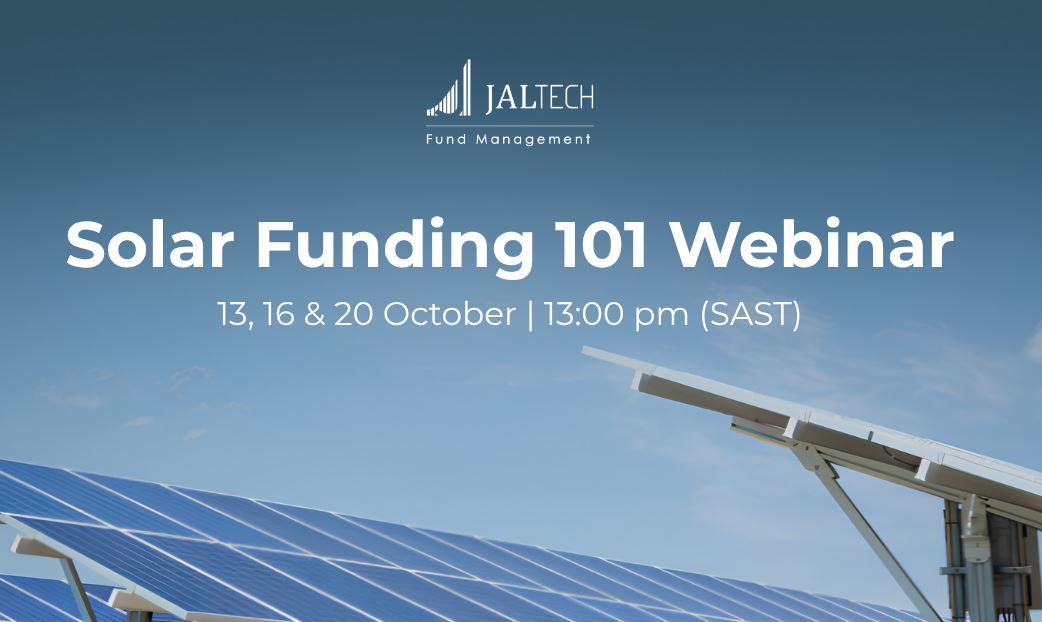
These considerations will be explored in an upcoming webinar hosted by Jaltech, in partnership with ESI Africa. This discussion will examine how businesses can navigate the commercial solar funding market and identify financing solutions that align with their operational and financial requirements.

The growing importance of funding choices

As energy users look to manage long-term electricity costs, they are faced with a range of funding structures, each with distinct advantages and trade-offs. Selecting the right option requires balancing project economics with organisational objectives, capital availability and customer expectations.

The webinar will provide a practical overview of the funding options available for commercial solar projects, examining the strengths and limitations of different financing approaches and how businesses can assess which model is most suitable for their circumstances.

The session will also consider what funders assess when evaluating projects and the steps businesses and project developers can take to improve the likelihood of securing finance.

“Across ESI Africa’s coverage of energy infrastructure funding, one theme keeps coming up: capital is available, but it goes to projects that are prepared for it. That holds for a utility-scale plant and for a rooftop system on a factory. Partnering with Jaltech on this webinar is about giving developers and energy users the practical knowledge to turn a sound solar business case into a project a funder will back,” says Pombo-van Zyl.

Moving projects from planning to implementation

While solar technology has become more widely understood and accessible, project funding remains a common point of uncertainty within the commercial and industrial energy sector.

“A power purchase agreement, a lease, a bank loan or an upfront capital investment can each be the right answer, depending on a company’s cash flow, its appetite for risk and who it wants carrying the operational burden. Upfront cost is still the biggest hurdle we hear about, and the businesses that move fastest are the ones that understand these trade-offs before they approach a funder,” says Pombo-van Zyl.

Capital is available, but it goes to projects that are prepared for it

For developers and energy professionals, the ability to match customer requirements with the right financing structure can influence project viability and accelerate decision-making. Equally, businesses considering solar investments need a clearer understanding of how commercial finance is accessed, what information funders require and where different funding models are most effective.

These practical considerations sit alongside broader industry discussions around energy affordability, investment readiness and the commercial pathways required to support continued growth in distributed renewable energy. Similar themes are being explored across ESI Africa’s energy coverage and industry engagement activities as organisations seek to balance cost certainty, energy security and long-term sustainability objectives.

Webinar details

Solar Funding 101 with Jaltech

Presenter: Jonty Sacks, Partner at Jaltech

Dates: 13, 16 and 20 October 2026

Time: 13:00 (SAST)

Duration: 30 minutes

Platform: Zoom

During the session, participants will gain practical insight into:

Commercial solar funding options currently available in the market

The advantages and disadvantages of different funding structures

How to assess customer requirements and align them with suitable funding solutions

What funders look for when evaluating projects

The process of securing commercial solar finance

Register here (https://apo-opa.co/4ANlUfC)

Those unable to attend the live session are encouraged to register to receive access to the webinar recording after the event.

As ESI Africa, created by VUKA Group, continues to examine the commercial realities shaping renewable energy adoption, access to finance remains a central factor in determining how quickly businesses can move from energy ambitions to implemented projects.

Distributed by APO Group on behalf of VUKA Group.


Continue Reading

Trending