Connect with us
Anglostratits

Business

Rituals unlock access to consumers’ deep emotional behaviours to support meaningful brand-building
Published

on

WARC Advisory

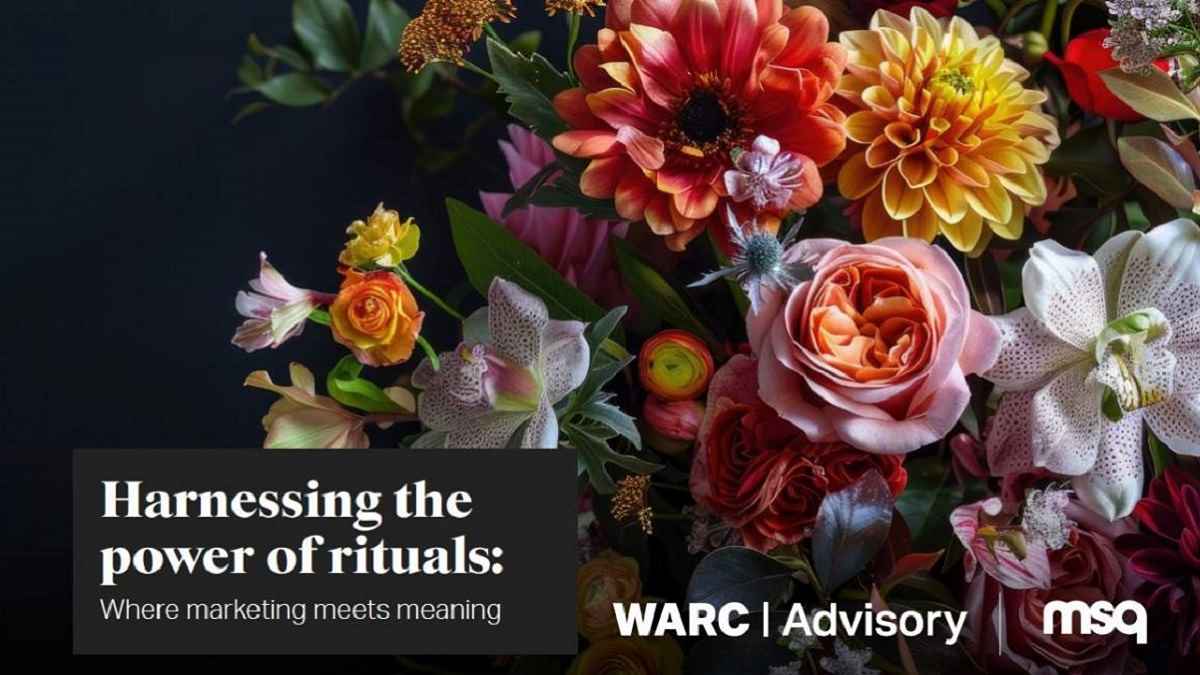
Breakthrough research by WARC Advisory and MSQ presented in new whitepaper: ‘Harnessing the power of rituals: Where marketing meets meaning’

72% of consumers incorporate brands into their rituals at least some of the time, and 39% feel more positively toward brands that become a part of ritual

Rituals are driven by personal meaning even when providing practical benefit: 44% of rituals are centred around daily routine, 25% around self care. For 33% rituals provide structure, escape (32%) and control (31%)

17 September 2024 – WARC Advisory and creative, technology and media group, MSQ have released a whitepaper today, Harnessing the power of rituals: Where marketing meets meaning.

This breakthrough research examines the role of rituals in consumers’ lives, how people participate in them and why, and explores the potential opportunities that brands can unlock: 72% of consumers surveyed incorporate brands into their rituals at least some of the time, 70% are very, or somewhat, open to adopting new rituals, and 39% feel more positively toward brands that become a part of rituals, the report finds.

As brands battle to connect more meaningfully with consumers, the report outlines how rituals – defined as a succession of behaviours designed to induce an emotional transformation – can enrich understanding of consumer behaviours, unlocking access to more meaningful brand building. This allows brands to unleash deeper connections and generate longer relationships. The whitepaper outlines marketing opportunities through engaging in rituals.

The analysis combines a WARC Advisory survey of 4000 consumers across Germany, France, UK and the US, and in-depth expert interviews with marketers, culture experts, behavioural scientists and neuroscientists including: Dr. Marcus Collins, Professor at the Ross School of Business, University of Michigan, Author of For the Culture; and Sian Davies Global Founder, The Behavioural Architects.

In addition, through utilising its Texture tool to analyse over 688,000 social media data sources and 200 million search data points, Freemavens (an MSQ agency) has unearthed eight ritual types that show a range of individualised and collective behaviours within three specific categories – Personal Care, Alcoholic Beverages, Finances – outlined within the report: Security, Maintenance, Celebration, Identity, Commencement, Connection, Enhancement and Calming.

Kate Howe, Executive Director, MSQ, said: “This whitepaper reveals that rituals offer more than just a glimpse into consumer behaviour—they provide a roadmap to creating long-lasting brand relationships. By understanding the emotional transformations that rituals are designed to induce, brands can align their strategies to resonate more deeply with consumers’ emotional needs.”

Imaad Ahmed, Head of Advisory, EMEA & Americas, WARC, commented: “Our research found that seventy two percent of consumers incorporate a specific brand into their rituals for reasons of familiarity, better experiences and convenience. Brands who actively observe customer behaviour, facilitate enhanced ritual experiences when customers allow, and participate in those rituals as much or as little as the customer chooses, tend to win. Brands grow in emotional value to consumers if they become part of their rituals. By growing a brand’s emotional value, marketing meets meaning.”

The whitepaper provides a set of guiding principles on rituals to help marketers identify and understand their role in consumers lives:

Principle 1. Rituals are driven by personal meaning even when providing practical benefit

One in four people surveyed say that, “creating the rules or beliefs for living my life” best describes the impact of their rituals, and nearly the same number agree that “rituals give my life purpose and meaning.” Rituals are most often connected to mindfulness and self-care, the report finds.

Principle 2. Rituals offer support for the individual in an atomised society

Rituals are often thought of as something that individuals do to connect to others and create a sense of community, whether through religion, culture, sports, or other shared experiences. While those rituals are just as important today, the data showed how often rituals are used to support the individual. 56% of rituals centre around personal care, or deepening connections with others. Beyond being concentrated in our daily routines, these rituals are focused on nurturing self and relationships. The research finds that rituals are most often carried out inside the home, and twice as often individually, than with friends or family. Also 50% of consumers surveyed involve others in their rituals at least some of the time.

3. Rituals provide structure and control in a volatile environment

One of the core functions of rituals is to provide a stabilising mechanism to counteract the forces which may create an individual’s sense of losing control. Of those surveyed, structure (33%), escape (32%) and control (31%) were the top three benefits of rituals.

4. Rituals create meaning in a world obsessed with efficiency

In a technology-driven culture that is hyper-focused on efficiency, people’s lives are more efficient than ever, resulting in a struggle to achieve a balance with mental and physical health, and overall happiness. In marketing, efficiency is by no means a bad thing. However, meaning and emotion in marketing messages and customer experience can often be lost in the quest for endless automation and efficiency. Rituals can enhance experiences and help to create rules and beliefs in people’s lives, the analysis finds.

Alongside presenting key insights, the whitepaper explores key macro forces and trends that are shaping rituals: Declining faith in institutions, influence of social media on ritual discovery and sharing, shifting priorities in the post-pandemic economy, and new rituals forming across generational divides.

While marketing campaigns built entirely around rituals are rare, the report provides case studies of brands that have optimised ritual behaviour to solve a business challenge, from KFC to The Guardian. The study also offers actionable insights for brands wanting to tap into the power of rituals.

Experts interviewed for this report:

Dr. Marcus Collins, Professor at the Ross School of Business, University of Michigan, Author of For the Culture
Sian Davies, Global Founder, The Behavioural Architects
Leila Fataar, Founder, CEO & CSO, Platform13
Samori Gambrah, Global Brand Director, Captain Morgan, Diageo
Matthew Graham, Chief Marketing Officer, Global Food & Nutrition, Mars
Ellesha Kirby, Global Executive in Consumer Health and Beauty and previously Global Head, Skin Health & Beauty and Design at Kenvue
Samrat Saran, Head of Client Solutions, Neuro-Insight US & Europe
John Starkey, President Family Care North America, Kimberly-Clark
Eli Velez, Managing Director, Partner Agencies & Superette, DoorDash
Jelina Wan, General Manager, Mars Taiwan & Hong Kong
Natalie Wills, VP of Brand Marketing, Booking.com


Business

Sierra Leone Set to Showcase Offshore Ambitions with Petroleum Directorate of Sierra Leone (PDSL) Joining African Energy Week (AEW) 2026 as Strategic Partner

Published

on

African Energy Chamber

Sierra Leone is advancing offshore exploration, preparing a new licensing round and finalizing the formation of a new national oil company ahead of its Strategic Partnership with AEW 2026

CAPE TOWN, South Africa, March 26, 2026/APO Group/ –The Petroleum Directorate of Sierra Leone (PDSL) has joined African Energy Week (AEW) 2026 – scheduled to take place in Cape Town from October 12–16 – as a Strategic Partner. The Directorate will be positioned to leverage the event to highlight its open acreage, competitive fiscal framework and upstream integration plans to international investors, signaling Sierra Leone’s emergence as a frontier exploration hotspot in the MSGBC basin and across the wider Gulf of Guinea.


Italian energy major Eni and other international players have engaged in detailed geological studies across Sierra Leone’s offshore basin, underscoring rising confidence in the country’s hydrocarbon potential. Backed by enhanced 3D seismic reprocessing and basin-wide prospectivity studies, the PDSL is accelerating data-led de-risking efforts to unlock prospects such as Vega and attract fresh upstream capital.


A central focus for investors is the anticipated resumption of offshore drilling in 2026 – the country’s first campaign in nearly a decade. Following the conclusion of its fifth licensing round, which offered 56 offshore blocks, Sierra Leone is preparing to drill new wells targeting an estimated multi-billion-barrel resource base, supported by improved subsurface imaging and strengthened regulatory oversight.


PDSL’s participation at AEW 2026 reflects Sierra Leone’s serious commitment to unlocking its offshore potential through transparency, strong fiscal terms and data-driven de-risking

Sierra Leone is also in the final stages of establishing its first state-owned national oil company, which will hold a mandatory 10% carried interest in all exploration licenses. The government is targeting an overall 25–30% participation in projects, balancing national value capture with competitive terms for international operators.


Downstream integration is also gathering pace, with the 105–126 MW Nant gas-to-power plant in Freetown, developed by Anergi Group and TCQ Power, expected to nearly double national generation capacity when it comes online in 2027. In parallel, PDSL is spearheading plans for Sierra Leone’s first refinery to reduce reliance on roughly 15,000 barrels per day of imported refined products.


“PDSL’s participation at AEW 2026 reflects Sierra Leone’s serious commitment to unlocking its offshore potential through transparency, strong fiscal terms and data-driven de-risking,” said NJ Ayuk, Executive Chairman, African Energy Chamber, adding, “Their strategic vision aligns with Africa’s broader push for energy security, industrialization and investor partnership.”


With drilling set to resume, a national oil company nearing launch and integrated gas-to-power and refining projects advancing, Sierra Leone is entering a defining phase. At AEW 2026, PDSL is expected to present a clear message: the basin is open, the data is ready, and the opportunity is real.

Distributed by APO Group on behalf of African Energy Chamber.

Continue Reading

Business

Critical Mineral Projects to Watch Ahead of Invest in African Energy (IAE) 2026

Published

on

Energy Capital

The Uganda Chamber of Energy and Minerals, with both its CEO and governing council chairperson confirmed for Paris, will serve as the primary interface for investors seeking access to Uganda’s licensing framework and project pipeline

CAPE TOWN, South Africa, March 26, 2026/APO Group/ –Governments from West, Central and Southern Africa, with delegations confirmed for the Invest in African Energy (IAE) Forum in Paris next month, are each advancing critical mineral projects that span processing deals, development-stage assets and frontier exploration plays, giving investors a range of entry points across the minerals value chain.

Nigeria – Alumina Refinery & Lithium Processing

Nigeria struck a $1.3 billion deal with the Africa Finance Corporation in early March covering three components: construction of a one-million-ton-per-year alumina refinery, a national geoscience mapping program, and a joint investment vehicle to accelerate exploration and production across priority leases. Projected at 95% utilization over 20 years, the refinery is expected to add $1.2 billion to GDP annually and generate approximately $8 billion in foreign exchange earnings over its lifespan.

Separately, a $600 million lithium processing plant in Nasarawa State is at the commissioning stage, backed by ongoing mapping of lithium-bearing pegmatite belts across Kwara, Ekiti and Kaduna states. New mining licenses now require a local processing commitment covering at least 30% of output before export, a condition that directly shapes the investment structures available to foreign partners. Nigeria’s energy minister is among the confirmed delegations at IAE in Paris.

Zambia – Copperbelt Expansion & Cobalt Refinery


Copper output in Zambia is on course to clear one million tons in 2026, supported by First Quantum Minerals’ completed $1.25 billion S3 plant expansion at Kansanshi and Barrick Gold’s $2 billion program to double output at Lumwana by 2028. Several additional projects, including Sinomine’s Kitumba Mine and KoBold Metals’ Mingomba deposit, are also coming online this year, making Zambia one of the few places globally adding significant incremental copper supply in the near term.

Africa’s first cobalt sulfate refinery is targeting commissioning in Zambia in 2026, adding downstream processing capacity alongside the copper ramp-up. The Lobito Corridor, backed by a $553 million US Development Finance Corporation loan for Angola’s Benguela rail link, reduces export costs across the Copperbelt and improves project bankability for both mines and processing facilities seeking long-term offtake commitments.

Senegal – Falémé Integrated Iron Project

Senegal’s Falémé iron district in the Kédougou region holds over 600 million tons of probable reserves, including oxide ore at around 59% iron content and primary magnetite at roughly 45% Fe. The government launched the Falémé Integrated Iron Project as a phased program targeting 15 to 25 million tons per year at peak output, with national iron ore company MIFERSO conducting ongoing reserve verification.

The mineral export port at Bargny is operational and rail rehabilitation linking Kédougou to the coast is progressing under the Emerging Senegal Plan. The project is actively seeking a technical development partner. With port and rail infrastructure advancing independent of any single mining operator, Falémé carries lower logistics risk than comparable iron ore projects requiring greenfield corridor construction, which affects how financiers assess project bankability and timelines to first revenue.

Equatorial Guinea – Rio Muni Mineral Exploration

Equatorial Guinea’s Rio Muni mainland offers early-stage exposure to gold, bauxite, base metals, coltan and iron ore across largely underexplored onshore territory. The Ministry of Mines and Hydrocarbons has been opening the sector since its first public tender in 2019, with exploration contracts now in place and state geological mapping advancing in partnership with Rosgeo. Minister Antonio Oburu Ondo will address investors at IAE, with the minerals program expected to feature in bilateral meetings.

Uganda – Rare Earths & Minerals Sector Opening

Uganda holds rare earth deposits in ionic adsorption clay formations — a deposit type the IEA has flagged for low capital intensity relative to hard rock alternatives — alongside gold mineralization across greenstone belts in the West Nile, Karamoja and Mubende regions. The Uganda Chamber of Energy and Minerals, with both its CEO and governing council chairperson confirmed for Paris, will serve as the primary interface for investors seeking access to Uganda’s licensing framework and project pipeline, at the same time as the country’s Tilenga and Kingfisher oil developments move toward first oil.

Distributed by APO Group on behalf of Energy Capital & Power.

Continue Reading

Business

APO Group Takes Gold at 2026 SABRE Awards – Second Consecutive Win Across Different Clients and Sectors

Published

on

Recognition spans technology, global sport, and culture, reflecting APO Group’s cross-sector communications performance across Africa

JOHANNESBURG, South Africa, March 26, 2026/APO Group/ –APO Group (www.APO-opa.com), the pan-African communications consultancy integrating advisory, execution, and proprietary news distribution, has won gold in the Northern Africa category at the 2026 Africa SABRE Awards for its campaign, GITEX Africa Morocco 2025: A Media-Fuelled Journey for Tech Excellence.


Delivered for GITEX Africa, the campaign generated more than 3,600 media clippings across African and global outlets, positioning the event as the continent’s leading technology and startup platform, while reinforcing Morocco’s emerging status as a regional technology hub.

Being honoured at the SABRE Awards is particularly meaningful because it reflects the impact of communication designed specifically for how African markets work

APO Group was a finalist in two additional categories for campaigns delivered for international organisations operating across Africa:

  • The Africa Flag 2025 Tournament: Raising the Game in Cairo – National Football League (Media Relations category)
  • Broadcasting Greatness: Elevating African Hoops and Culture at BAL 2025 – Basketball Africa League (BAL) (Media, Arts & Entertainment category)

The SABRE Awards recognise excellence in branding, reputation management, and engagement across the global communications industry. This latest accolade adds to APO Group’s growing record at these prestigious awards, following its win in 2025 for a campaign delivered for Canon Central and North Africa, as well as multiple finalist placements for campaigns supporting leading institutions such as GITEX Africa, Africa’s Business Heroes, and the Global Africa Business Initiative.


“Being honoured at the SABRE Awards is particularly meaningful because it reflects the impact of communication designed specifically for how African markets work,” said Bas Wijne, Chief Executive Officer at APO Group. “Successful pan-African campaigns combine strategic planning and strong local execution, together with a clear understanding of how different markets, media environments, and audiences connect with a story. It’s about designing communications that deliver measurable outcomes and help organisations engage effectively and confidently across Africa’s diverse media landscape.”

In addition to its SABRE Awards success, APO Group has received multiple major industry honours over the past year, including Gold and Bronze at the Davos Communications Awards for excellence in strategic communications and campaign execution. The company was also named Africa’s Leading PR Agency – 2025 by Brands Review Magazine and Best Public Relations & Media Consultancy Agency of the Year – 2025 by World Business Outlook.Operating across 54 African countries, APO Group provides communications advisory services, public relations, and media distribution through its proprietary newswire, Africa Newsroom, which places content on more than 250 Africa-focused news platforms worldwide.

Distributed by APO Group on behalf of APO Group.

Continue Reading

Trending