Connect with us
Anglostratits

Business

Zero-Carbon Village Rises in Tujia Countryside

Published

on

Tudianzi

WUHAN, CHINA – Media OutReach Newswire – 22 April 2025 – During April’s Pear Blossom Festival, Tudianzi village, nestled deep in the mountains of central China’s Hubei Province, has welcomed over 50,000 visitors in just two days. In Tudianzi Village, tourists marveled at innovations like solar-storage integrated streetlights illuminating country paths, high-power EV charging stations eliminating range anxiety, and traditional Tujia cuisine cooked in all-electric kitchens — a vivid showcase of sustainable rural revitalization.

From Tudianzi Village, perched 1,200 meters above sea level, the mist-shrouded Wu Gorge stretches into the distance, while terraced pear blossoms blanket the slopes. A light breeze carries the delicate floral fragrance, marking the most picturesque season for this Tujia ethnic mountain village.

“The table actually charges my phone wirelessly!” exclaimed tourist Ms. Tan, surprised when her phone began charging on a solar-powered bench in the food corridor.

Located in Badong County, Enshi Tujia and Miao Autonomous Prefecture, Tudianzi Village earned its name during the Ming Dynasty as a rest stop for merchants on the ancient Tea Horse Road. Long secluded in the mountains, the village has now gained fame as a model for rural energy revolution, achieving 24/7 zero-carbon operations and 100% green electricity supply.

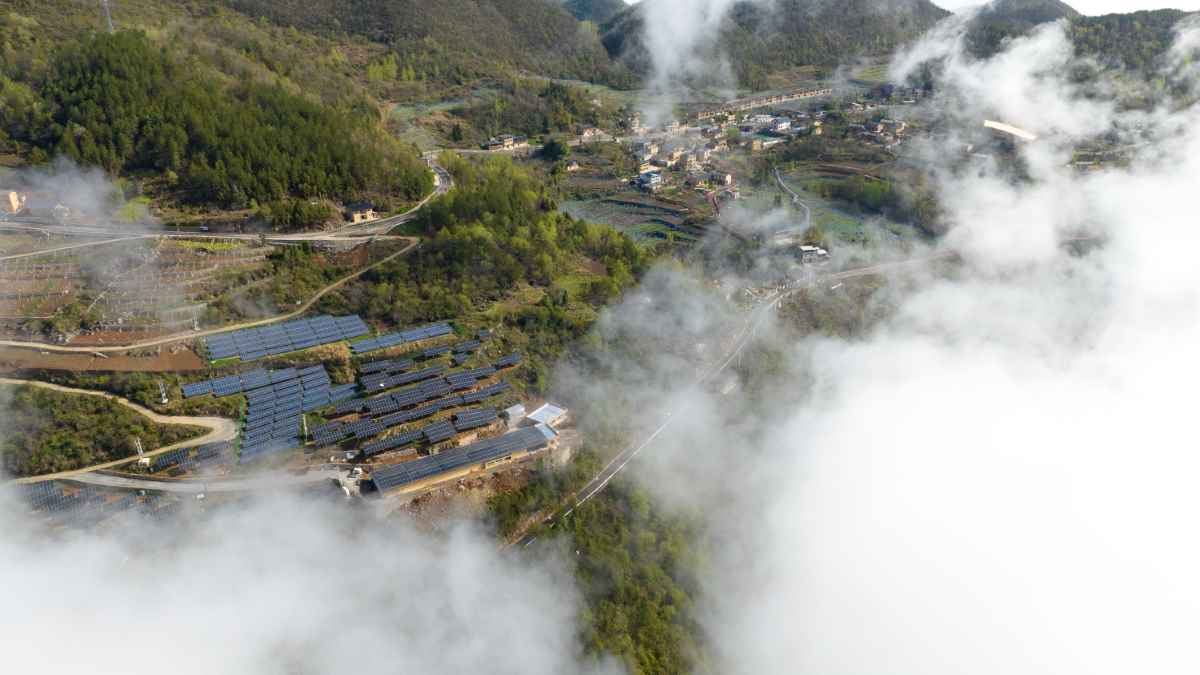
Solar panels are ubiquitous here — on rooftops, pavilions, plaza corridors, chicken coops, and pigsties. “The village’s solar capacity reaches 1,800 kW. At full capacity for one hour, it can generate 1,800 kWh, enough to power the entire village for a day,” said Chen Wentao, person in charge of the State Grid Enshi’s development department.

Reliable electricity was once a distant dream for villagers. Aging power infrastructure — characterized by extensive grid coverage, outdated single-radial network designs, and seasonal load fluctuations — left communities vulnerable to frequent and prolonged outages, particularly during extreme weather.

“Whenever thunderstorms struck, power lines would fail, plunging the entire village into darkness,” recalled 75-year-old Hu De’an. Like many residents, Hu once relied entirely on firewood for light and heat. “Our homes were filled with smoke, but seeing firewood piled under the eaves was the only way we felt secure,” he said.

In September 2020, China unveiled its ambitious “dual carbon” goals to the world: achieving peak carbon emissions by 2030 and carbon neutrality by 2060.

Studies showed that traditional biomass fuels like firewood, burned through direct combustion, operate at a mere 10-15% efficiency while generating heavy carbon emissions. This inefficiency has thrust rural China into a critical dilemma — how to build resilient, clean energy networks that meet growing demand without compromising sustainability.

A breakthrough came in March 2023 when China’s National Energy Administration and three other ministries launched a landmark initiative. The plan prioritizes pilot projects to accelerate rural energy transitions, coupling clean power adoption with broad rural revitalization objectives. By August 2023, State Grid Hubei Electric Power had spearheaded a flagship demonstration project in Tudianzi Village, targeting three pillars: stable clean energy supply, efficient resource utilization, and green industrial development.

During a recent visit to Tudianzi’s black pig breeding base — an operation producing over 4,000 hogs annually — reporters observed a model of integration. Solar panels crowned the spotless pigsty roofs, while odor-free pathways defied backward farm.

The transformation stems from a 30-kilowatt biogas plant constructed adjacent to the facility. Engineered by local power authorities, the system collects manure from the breeding base and kitchen waste from nearby households, channeling them into a closed-loop cycle of “biomass resources – biogas – electricity – fertilizer”.

“Biogas is converted into electricity, while its byproducts — digestate and residues — are processed into fertilizers for farmland, achieving circular biomass utilization and clean energy supply,” said Su Lei, senior engineer of State Grid Hubei Electric Power Research Institute. Notably, the installation of an 80-cubic-meter gas storage tank ensures nighttime green power supply and enables off-grid operations when integrated with flexible energy storage systems.

For local farmer Feng Cailong, the project has brought tangible economic gains. “Previously, disposing pig waste cost over 40,000 yuan annually. Now, delivering it directly to the biogas plant not only cuts disposal expenses but also saves more than 60,000 yuan yearly in electricity, disinfection, and fertilizer costs for forage cultivation,” he informed.

These developments epitomize Tudianzi’s rural energy transformation. After nearly two years of construction, the village has established a low-carbon energy system dominated by wind and solar power, featuring agile microgrid-distribution network interactions and coordinated “source-grid-load-storage” operations. A multidimensional industrial ecosystem integrating renewable energy, livestock farming, and eco-tourism is taking shape.

In 2024, the village’s electricity consumption surged to 537,000 kWh, a 188% increase from 2022. Since launching its energy revolution, Tudianzi’s annual renewable energy output reaches 1.44 million kWh, equivalent to saving 472 tons of standard coal while reducing CO₂ emissions by 1,436 tons and SO₂ by 43 tons annually.

“With the village’s total installed renewable energy capacity now reaching 1,871 kilowatts, we not only achieve full green power supply for the entire village but also export substantial surplus electricity to external grids,” explained Yang Lin, official of the Development and Reform Commission of Enshi Tujia and Miao Autonomous Prefecture.

Business

Aurionpro expands its multi-country transaction banking engagement with Diamond Trust Bank (DTB)

Published

on

Aurionpro

Aurionpro’s upgraded iCashpro platform for DTB delivers a unified digital experience across payments, trade, virtual accounts, and real-time reporting, enhancing straight-through processing, visibility, and control for both the bank and its corporate customers

MUMBAI, India, April 30, 2026/APO Group/ –Aurionpro Solutions Limited (www.AurionPro.com) (BSE: 532668 | NSE: AURIONPRO)a global leader in banking technology, announced the expansion and upgrade of its transaction banking engagement with Diamond Trust Bank (DTB), to modernize and enhance the bank’s corporate transaction banking capabilities across multiple countries.

Download Document: https://apo-opa.co/4edHUaC

This multi-country transaction banking upgrade covering Kenya, Uganda, and Tanzania aligns with DTB’s intent to enhance customer experience, streamline operations, and support growing transaction volumes as it expands its regional corporate banking footprint. DTB continues to focus on building a more agile, ‘digital-first’ banking experience, particularly around payments for its corporate customers across Africa, and is now well positioned to scale these capabilities. As part of its broader transformation agenda, the bank has been steadily investing in platforms that enhance scale, reliability, and service consistency across markets.

Through this partnership, we are proud to lead the next era of transformation in transaction banking, helping DTB enhance operational agility

Aurionpro’s upgraded iCashpro platform for DTB delivers a unified digital experience across payments, trade, virtual accounts, and real-time reporting, enhancing straight-through processing, visibility, and control for both the bank and its corporate customers. By enabling DTB to standardize and scale its transaction banking operations across countries, the platform ensures consistent service levels, stronger control, and improved efficiency. It also supports enhanced user experience, advanced security, and the flexibility to introduce new features as DTB expands its regional transaction banking footprint.

Murali Natarajan (https://apo-opa.co/48trPdk), Managing Director & CEO, DTB Kenya   commented: “We are delighted to strengthen and broaden our partnership with Aurionpro Solutions as part of DTB’s ongoing digital transformation journey across multiple markets. Our focus on innovation, operational excellence, and customer-centricity continues to guide our technology investments. This upgrade strengthens our transaction banking capabilities, enabling us to deliver greater value to our customers through robust digital channels and seamlessly integrated experiences.”

Ashish Rai, Group CEO, Aurionpro Solutions, commented: “We are pleased to deepen our multi-country engagement with Diamond Trust Bank and support the next phase of its transaction banking modernization. As DTB continues to scale across markets, platform resilience and consistency become paramount. Through this partnership, we are proud to lead the next era of transformation in transaction banking, helping DTB enhance operational agility, deliver superior experiences to corporate customers, and create long-term value across geographies.”

He added, “Aurionpro’s iCashpro lays a strong digital foundation for transaction & wholesale banks across the globe to grow their corporate and SME client portfolio today, while creating a clear roadmap for next- generation capabilities in AI-driven insights, advanced automation and API-led connectivity for businesses in Kenya and across Africa.”

Distributed by APO Group on behalf of Aurionpro Solutions Ltd.


Continue Reading

Business

Minerals Council Chief Executive Officer (CEO) Joins African Mining Week (AMW) as South Africa Improves Sectorial Investment Climate

Published

on

Energy Capital

Minerals Council CEO to share insights on policy, infrastructure and investment trends shaping South Africa’s mining industry

CAPE TOWN, South Africa, April 30, 2026/APO Group/ –The upcoming African Mining Week (AMW) conference will feature Mzila Mthenjane, CEO of the Minerals Council of South Africa, as a speaker. Scheduled for October 14 – 16, 2026 in Cape Town, the event will bring together global investors, policymakers and industry leaders, with Mthenjane’s participation highlighting the council’s commitment to engaging international stakeholders and promoting investment across South Africa’s mining sector.

His participation comes at a critical moment as the Minerals Council works closely with government on finalizing the Mineral Resources Development Bill 2025, a policy framework aimed at strengthening the country’s mining investment climate and the sector’s contribution to GDP. According to the council, the revised legislation will support new investment across the value chain as South Africa seeks to mobilize R2 trillion over the next five years to unlock its critical minerals potential.

The policy reforms come amid shifting production trends in the sector. In 2025, South Africa recorded declines in gold and platinum group metals output of 1.9% and 4.1%, respectively. The new regulatory framework is expected to strengthen public-private partnerships and stimulate investment, enabling South Africa to increase production and capitalize on strong global commodity prices. Increased private sector investments is crucial with South Africa seeking targeting to unlock an estimated R40 trillion in untapped iron ore potential as well as maintain its position as the world’s leading producer of chrome and manganese.

At AMW 2026, Mthenjane is expected to outline these trends, providing insights into how the council is contributing to addressing challenges disrupting the sector. Infrastructure and energy costs remain key concerns for industry players. To support the energy-intensive sector, South Africa approved a 35% reduction in electricity tariffs for major ferrochrome producers, helping stabilize an industry that has faced significant cost pressures after electricity prices surged by roughly 900% since 2008.

Logistics constraints are also a priority area for reform. South Africa’s economy is losing an estimated R1 billion per day due to inefficiencies across rail and port infrastructure. As a result, the government is considering measures supported by the Minerals Council to increase private sector participation in logistics. Planned reforms include rail modernization initiatives targeting 250 million tons of freight capacity by 2029, alongside port upgrades and private operator participation aimed at strengthening mineral exports and improving supply chain efficiency.

Beyond infrastructure and policy reforms, the Minerals Council is advocating for stronger exploration investment to support long-term industry growth.

At AMW, Mthenjane is expected to highlight these developments and outline the steps required to reinforce South Africa’s position in the global minerals supply chain. His insights will offer investors and stakeholders a timely perspective on opportunities within the country’s mining sector.

Distributed by APO Group on behalf of Energy Capital & Power.

Continue Reading

Energy

Seychelles Targets Energy Investment Push as Minister Jérémie Joins African Energy Week (AEW) 2026 as a Speaker

Published

on

African Energy Chamber

Seychelles energy minister will speak at AEW 2026, positioning her to highlight reforms, renewable projects and investment opportunities as the island nation advances its transition toward a diversified energy system

CAPE TOWN, South Africa, April 29, 2026/APO Group/ –Marie-May Jérémie, Minister of Environment, Climate, Energy and Natural Resources for Seychelles will participate as a speaker at this year’s African Energy Week (AEW) 2026, taking place from October 12–16 in Cape Town. Her participation underscores the country’s growing role in shaping Africa’s small-island energy transition agenda.

Minister Jérémie’s presence at AEW 2026 comes at a critical time as Seychelles accelerates efforts to reduce its heavy reliance on imported fossil fuels. The event provides a platform to attract investment, strengthen policy alignment and showcase bankable projects, positioning the country as a viable destination for private-sector participation in island energy systems.

Seychelles is demonstrating how policy reform and innovation can unlock investment in constrained environments

In May last year, international finance institution the World Bank approved the Renewable Energy Acceleration Program, a seven-year initiative aimed at modernizing the grid and increasing renewable energy penetration to 15% by 2030. The program focuses on unlocking private capital while strengthening transmission infrastructure to accommodate variable renewable energy sources.

Project development is gaining traction in the country, particularly in innovative technologies suited to Seychelles’ land constraints. The 5.8 MW Seysun Lagoon floating solar PV project, developed by independent renewable power producer Qair, is under construction and expected online in 2026.

Alongside renewables, Seychelles continues to pursue upstream opportunities to diversify its economy. The government approved new exploration entrants in 2025 and extended exiting petroleum agreements, while securing an infrastructure partnership with China. Multilateral estimates suggest over $800 million in investment will be required over the next 25 years.

Regulatory reform is central to this transition, with Seychelles introducing an independent power producer framework to open the market to private developers. Standardized power purchase agreements, grid access reforms and strengthened public-private partnership structures are being implemented to improve transparency, reduce risk and accelerate project bankability across solar, storage and emerging wind opportunities.

“Minister Jérémie’s participation highlights the strategic importance of island nations in Africa’s broader energy transition,” says NJ Ayuk, Executive Chairman, African Energy Chamber. “Seychelles is demonstrating how policy reform and innovation can unlock investment in constrained environments. Her insights will be critical to advancing dialogue on resilient, low-carbon energy systems across the continent.”

Distributed by APO Group on behalf of African Energy Chamber.

Continue Reading

Trending