Connect with us
Anglostratits

Travel & Tourism

The successful test flight at Shengle International Airport highlights Hohhot’s emergence as a key hub on the “Air Silk Road”

Published

on

Hohhot Shengle

HOHHOT,CHINA – Media OutReach Newswire – 12 December 2025 – On November 25, the calibration aircraft landed smoothly, marking the successful completion of the on-site verification test flight at Hohhot Shengle International Airport. This important milestone indicates that Inner Mongolia’s first 4F-class airport has moved from the construction phase to the final stages of preparation for its official opening.

As Inner Mongolia’s first 4F-class airport—the highest standard in civil aviation airfields—this airport is fully equipped to accommodate the world’s most advanced commercial aircraft.

Moreover, it functions as a regional aviation hub, a primary alternate landing site within the Beijing-Tianjin-Hebei airport cluster, a Class I international aviation port, and a key transportation node in China’s national “Belt and Road Initiative”. Its essential role is to connect domestic and international destinations while linking eastern and western regions.

“Where heaven and earth meet, all things communicate.” Thanks to its unique geographic location, Hohhot has long served as a vital transportation center. During the Northern Wei Dynasty, Shengle, the capital city, controlled the critical passage between the Central Plains, the grasslands, and the desert, fostering thriving commerce and travel. In the Tang Dynasty, Shengle also served as a major commercial route extending north from Baidouchuan to present-day Erenhot, Manzhouli, and further into Russia and Mongolia. During the Qing Dynasty, Guisui City was a key node on the Grassland Silk Road. From the late 17th to early 20th century, the 13,000-kilometer Tea Road began at Wuyi Mountain in Fujian Province in the south, passed through Hohhot in Inner Mongolia, continued north to Mongolia, and ultimately reached Russia. In modern times, Hohhot has emerged as a crucial transportation hub under the “Belt and Road Initiative,” linking the mainland of China with Russia, Mongolia, and the heart of Europe. For centuries, merchants from home and abroad have gathered here, fostering vibrant trade and rich cultural exchanges.

The echoes of history continue to resonate. This ancient route, once bustling with camel caravans and travelers, is now being revitalized with new significance for the modern era. Shengle International Airport is dedicated to becoming a key hub on the new “Air Silk Road,” serving as a vital gateway across North China and connecting Eurasia. It aims to make a unique and meaningful contribution to this important legacy.

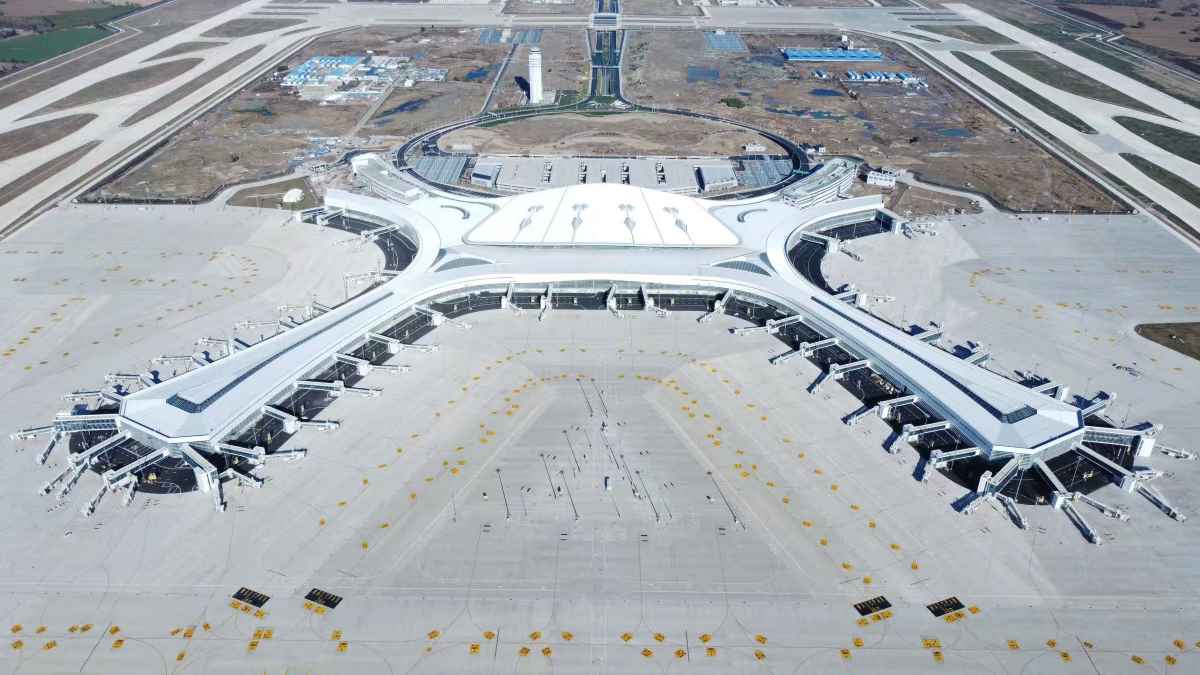
From above, the airport’s terminal is designed to resemble a finely crafted saddle, reflecting the dynamic heritage of the horse-riding cultures in the region. The main facade of the terminal features a 600-meter-long eave inspired by the flowing khata scarf, offering a warm and inviting welcome to visitors from around the globe. The terminal’s skylights are thoughtfully crafted using spindle columns, cables, and inflatable membranes, creating an atmosphere reminiscent of a traditional Mongolian yurt. Looking upward, travelers can enjoy views of the expansive grassland sky and clouds, celebrating Inner Mongolia’s rich cultural heritage and sharing the distinctive beauty of grassland culture with the world.

Shengle Airport’s appeal extends beyond its striking design to its thoughtfully planned interior layout. More than just a transportation hub, it serves as a vital platform connecting the world. As a key node on the “Belt and Road” land corridor and the northern gateway of the China-Mongolia-Russia economic corridor, Hohhot is utilizing this state-of-the-art airport to accelerate its integration into the global network.

In the near term, Shengle International Airport aims to achieve an annual passenger capacity of 28 million, handle 320,000 tons of cargo and mail, and manage 244,000 aircraft movements by 2030. Looking further ahead to 2050, these figures are expected to grow to 65 million passengers, 800,000 tons of cargo and mail, and 511,000 aircraft movements.

To enhance the travel experience for international passengers, Shengle International Airport has proactively upgraded its communication infrastructure. Previously, the construction of civil communication facilities at Hohhot Shengle International Airport was successfully completed. To meet the demands of international travelers and business passengers, the regional communication system has implemented a “seamless access” plan in advance. All three major telecom operators share a jointly built network, ensuring passengers enjoy “uninterrupted” connectivity from arrival through boarding and departure.

Looking forward, Shengle Airport will continue to expand its international routes with exceptional performance. By 2025, Hohhot Airport will establish strong partnerships with Xi’an and Qingdao airports. Leveraging Qingdao Airport’s connections to Japan and South Korea, and Xi’an Airport’s access to Northwest China, Central Asia, and Southeast Asia, new transfer services will be launched connecting Hohhot via Xi’an or Qingdao to other domestic and international destinations.

Additionally, capitalizing on Hohhot’s strategic location facing Russia and Mongolia and linking Northeast and Northwest China, transfer services will be introduced from Xi’an or Qingdao through Hohhot to various regional cities as well as Russia and Mongolia. These initiatives will create aerial bridges fostering economic exchange and cultural communication across regions.

As the morning sun brightens the northern frontier, Shengle International Airport stands out like a shining gem above the grasslands. This young and dynamic airport is not only Hohhot’s new gateway but also a crucial hub connecting China to the world. From here, Inner Mongolia’s high-quality development will gain fresh momentum, and China’s northern frontier will embrace broader opportunities for global engagement.


Business

Plant-powered plates: Emirates shifts focus for vegan cuisine to meet customers’ desire for minimally processed food

Published

on

Emirates

Emirates now has 488 vegan recipes in rotation across 140 destinations, representing a 60% increase in total recipes from 2024 and showing dedication to vegan customers

DUBAI, United Arab Emirates, January 21, 2026/APO Group/ –As global consumers increasingly focus on nutrition, health and wellbeing with a back-to-basics approach of consuming minimally processed food, this Veganuary Emirates (www.Emirates.com) confirms new concepts are in development to celebrate real, whole, and farm-to-fork plant foods. The current development project sees a team of chefs create dishes that feel authentic, vibrant and rooted in culinary tradition, without replacing typical proteins with engineered plant-based meats and substitutes. The new dishes are set to be onboard for customers in 2027.

Emirates Vice President of Food & Beverage Design, Doxis Bekris, confirms the philosophy;

‘Our focus now is on legumes, grains, nuts, seeds, and seasonal vegetables as the heroes of the plate. These ingredients offer natural depth of flavour, texture, and nutrition without relying on ultra-processed alternatives. Instead of replicating meat, we want to draw from cuisines that have always been plant-forward like Mediterranean mezze, Levantine grain salads, Asian noodle bowls, and African stews such as South African chakalaka, Kenyan sukuma wiki, Ugandan groundnut stew, Tunisian lablabi, Senegalese thieboudienne, Ivorian attiéké with vegetables, Guinean peanut stew, , Egyptian koshari, and Tanzanian mchicha. In our view, this approach feels genuine and culturally rich.

‘Although there are many commendable lab-based alternatives available, real food aligns with our sustainability goals and guest expectations for health-conscious choices. It’s about transparency for our customers who want to know what they’re eating, as well as have confidence that it’s good for them and the planet. We want to shift from substitutes to a celebration of plants, where it’s not about what’s missing – but instead what is gained in authenticity, flavour, and creativity.’

Emirates serves half a million vegan meals each year across Africa and globally

Emirates now has 488 vegan recipes in rotation across 140 destinations, representing a 60% increase in total recipes from 2024 and showing dedication to vegan customers.

Emirates currently serves half a million vegan meals each year. Vegan meal consumption grows in line with passenger volume increases, and last year the top destinations with customers ordering vegan meals were London in first place, followed by Sydney, Bangkok, Melbourne, Frankfurt, Manchester, Mumbai, Bali and Singapore. Emirates attributes some of the demand to non-vegan customers opting for vegan cuisine when flying, as a lighter option often considered easier to digest. Across its African markets, Emirates notes growing demand for vegan meals in South Africa, Kenya, Uganda, Tunisia, Senegal, Côte d’Ivoire, Guinea, , Egypt and Tanzania, reflecting increased interest in plant-based cuisine across the continent.

Vegan options are available to order and pre-order onboard, as well as in Emirates Lounges. Customers can request vegan meals on all Emirates flights and across all classes of travel up to 24 hours before departure. However, on high-demand routes, plant-based meals are also provided as part of the main menu options.

We want to shift from substitutes to a celebration of plants, where it’s not about what’s missing – but instead what is gained in authenticity, flavour, and creativity

Emirates’ vegan cuisine in every class

Highlighting its commitment to culinary excellence for all customers, Emirates offers vegan meals across all classes, as well as complementary products like vegan milk. Supporting the farm-to-fork philosophy, Emirates incorporates fresh produce from Bustanica – the world’s largest hydroponic vertical farm. The farm is a joint venture with Emirates Flight Catering that delivers pesticide and chemical-free leafy greens like lettuce, arugula, mixed salad greens, and spinach, directly to Emirates’ catering facilities.

In Economy class, Emirates customers can enjoy dishes like pumpkin frittata with sautéed mushrooms and tomato concassé, or spinach cannelloni served with tomato basil sauce, toasted crumbs and parsley, and desserts like vegan chocolate mousse cake drizzled in chocolate sauce and biscuit crumbs, or carrot cake dashed with coconut cream.

In Premium Economy class, customers choosing vegan cuisine will be served dishes like kimchi fried rice served with roasted pumpkin and sautéed oyster mushrooms, followed by desserts like coconut cake with pineapple compote and pistachios.

In Business class, a range of creatively curated dishes is offered, including braised mushrooms with vegetables in five-spice soy sauce, served with steamed jasmine rice and blanched pak choi. Customers who have room for dessert can feast on coconut panna cotta with raspberry mousse with fresh berries or chocolate tofu cheesecake.

In First class, customers will be treated to elevated vegan cuisine like pumpkin and barley risotto served with rocket, caramelised walnuts, vinaigrette and vegan cheese. Dishes offering a burst of flavours include quinoa salad with grilled aubergine, courgette, sautéed Swiss chard and red pepper coulis. Decadent desserts include strawberry tart with vanilla custard and pistachios, served with berry compote, or a tempting sticky date pudding served with salted caramel sauce, vegan cream cheese, candied pecans and almond butter.

Crafted vegan options in Emirates’ Lounges Dubai

At Dubai International Airport, Emirates has 7 lounges located in its flagship Terminal 3 – 3 for First Class and 3 for Business Class customers, as well as the Emirates’ Lounge catering to all premium customers. The lounges offer a wide array of vegan options, from Baharat and turmeric-spiced kofta in coconut gravy at the buffet area, to an à la carte breakfast of warm amaranth porridge with compressed green apples, red grapes, raspberries and walnuts in the First-Class Lounge, amongst many others. In addition to an array of popular vegan salads, the most in-demand vegan dish in the lounges is the Emirates Green Burger – a soya and flaxseed green burger, with a signature sauce and pickled cucumbers.

Distributed by APO Group on behalf of The Emirates Group.

Continue Reading

Travel & Tourism

Emirates to operate next-gen A350 on the third daily service to Cape Town, its first deployment in Southern Africa

Published

on

Emirates

Emirates (www.Emirates.com) will continue rolling out its retrofitted Boeing 777 and new A350 aircraft to key destinations across Europe, North America, Asia, the Middle East, Africa, and Australia, bringing Premium Economy and its latest onboard products to more cities across its network.

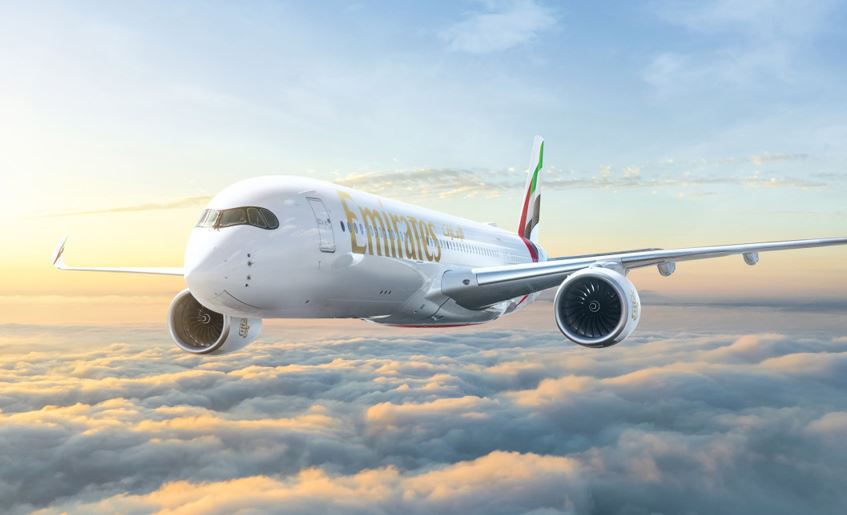
The recently-announced third daily service on the Dubai-Cape Town route will now be served by an A350, bringing Emirates latest aircraft type to the market for the very first time. The deployment enhances travel options between South Africa and Dubai, with Emirates’ full suite of products and services available for customers to enjoy – from the iconic A380 and the fully-retrofitted Boeing 777 to the next-gen A350.

Commenting on the deployment, Emirates’ Regional Manager of Southern Africa, Afzal Parambil said, “With the deployment of the next-gen A350 on the third daily service between Dubai and Cape Town, South Africa becomes the only African nation on our network to be served by all three aircraft types on the Emirates fleet. This fleet mix provides the greatest flexibility for our customers to travel in and out of our three gateways, while still providing travellers with the world-renowned Emirates’ experience, on every flight.”

Emirates also announced additional A350 deployments on new daily services to Copenhagen and Phuket, offering customers greater connectivity alongside an elevated onboard experience, ahead of the anticipated surge in winter travel demand. The airline will deploy its Premium Economy retrofitted A380, Boeing 777 and A350 aircraft with the latest cabin interiors on more than 84 routes by 1 July, underscoring its focus on delivering a premium and consistent experience across its network.

Additional flights and capacity to Copenhagen, Phuket and Cape Town

From 1 June, a second daily service will be introduced between Dubai and Copenhagen; a third daily service between Dubai and Phuket and the third daily to/from Cape Town will come into effect from 1 July. All three services will be operated with the airline’s latest A350 aircraft, featuring its award-winning Premium Economy, in addition to the latest Business and Economy Class cabins.

From 1 June, Emirates’ flight EK153 will depart Dubai to Copenhagen at 14:50hrs, arriving at 19:45hrs. The return flight, EK154, will depart Copenhagen at 21:35hrs, arriving in Dubai at 5:55hrs the following day.** The new service is optimally timed to provide seamless connections from Copenhagen to popular destinations via Dubai, to East Asia including, Bangkok, Bali, Manila, Tokyo Haneda and Phuket as well as convenient links to Colombo and Male. In addition, the service introduces new connections to key African cities such as Nairobi and Entebbe. Passengers travelling from key global cities, such as Taipei, Kuala Lumpur, Melbourne, Brisbane, Sydney, Auckland, Delhi and Bangalore will also benefit from the additional frequency to the Danish capital, with convenient onward connection times through Dubai.

From 1 July, Emirates’ flight EK778 departing Dubai at 10:25 hrs, arriving in Cape Town at 18:05 hrs; the return flight, EK779, will depart Cape Town at 20:00 hrs and arrive in Dubai at 07:25 hrs the following morning. The third frequency offers travel options with optimised connections from/to London, Dublin, Bombay, Brussels, Australasia and key Asian markets, serving both leisure and corporate travel demand.

Emirates’ double daily Cape Town service has seen consistently high load factors over the past year, particularly during peak periods. Inbound demand from the GCC continues to grow, while outbound traffic to Europe and the US East Coast remains strong.

From 1 July, Emirates’ flight EK390 will depart Dubai to Phuket at 22:40hrs, arriving at 08:10hrs the following day. The return flight, EK391, will depart Phuket at 10:00hrs, arriving in Dubai at 13:05hrs. Travellers will benefit from additional travel options to the popular resort destination, which offers an early morning arrival ideal for those connecting from Europe including Manchester, Amsterdam, London, Paris and Frankfurt as well as Kuwait and Bahrain via Dubai. The new flight will also provide convenient onward connection times from Phuket to key gateways across Europe and the Middle East, including Madrid, Munich, Birmingham, Brussels, Dusseldorf, Hamburg, Edinburgh, Zurich and Amman.

The airline will also operate its A350 to Rome and Taipei from 1 May.

This fleet mix provides the greatest flexibility for our customers to travel in and out of our three gateways

Planned Premium Economy route expansions:

Africa 

  • Addis Ababa: From 1 March*, the retrofitted 3-class Boeing 777-200LR will operate daily on EK723/724.
  • Cape Town: the third daily flight on the Dubai-Cape Town route, announced at the 2025 Dubai Airshow, will now operate with a next-gen Emirates A350 from 1 July 2026.


Europe & North America

  • Barcelona and Mexico City: Emirates will operate its EK187/188 service with a retrofitted Boeing 777-300ER aircraft from 1 February. EK255/256, the linked service between Barcelona and Mexico City, will operate with a Premium Economy retrofitted three class Boeing 777-200LR daily from 15 February* onwards.
  • Rome: The EK099/100 daily service will operate with A350 aircraft from 29 March.
  • Copenhagen: Addition of a second daily service from 1 June with an Emirates A350, as EK153/154.


Asia

  • Cochin: From 29 January, two of the seven-weekly services (Thursday and Sunday) on EK530/531 between Dubai and Cochin will operate with a retrofitted Boeing 777-200LR.
  • Karachi: Starting 1 March*, Emirates’ retrofitted three-class Boeing 777-200LR will begin operating daily on EK606/607.
  • Taipei: Emirates will operate its retrofitted Boeing 777-200LR on the EK386/387 daily service from 15 March* until 30 April and, from 1 May onwards, those services will operate with the airline’s A350 aircraft.
  • Phuket: A third daily service between Dubai and Phuket will come into effect from 1 July on EK 390/391.


Australia

  • Brisbane: From 29 March, daily flights on EK EK430/431 will be operated by a retrofitted four-class Boeing 777-300ER, joining the A380 retrofitted service introduced last year.


Middle East

  • Basra: The Thursday service on EK947/948 will transition to a retrofitted four-class Boeing 777-300ER from 29 January.
  • Kuwait City: The EK859/860 daily service between Dubai and Kuwait City will operate with a retrofitted Boeing 777 from 1 February until 30 April and from 1 May onwards the service will operate with an Emirates A350.
  • Tehran: Effective 29 March, the retrofitted B777 in a four-class configuration will operate daily flights on EK979/980.


Tickets can be booked on www.Emirates.com, the Emirates App, or via both online and offline travel agents as well as Emirates’ retail stores.

* Aircraft deployment may be advanced if released earlier from refurbishment.

** All times are local.

Distributed by APO Group on behalf of The Emirates Group.

Continue Reading

Business

Emirates SkyCargo charts flightpath into 2026, following a milestone year

Published

on

Emirates

Emirates SkyCargo (www.Emirates.com) wraps the year with a clear roadmap to success in 2026, following significant investment in enhancing its fleet and network, forging new strategic partnerships, reshaping the digital landscape and launching all-new products over the last 12 months. As the cargo arm of the world’s largest international airline, Emirates SkyCargo is on track to seamlessly connect the globe, keeping goods flowing quickly, reliably and efficiently.

Badr Abbas, Divisional Senior Vice President, Emirates SkyCargo, “In 2025, we built the runway for what comes next. We strengthened the core pillars of our business by expanding our network and innovating with our product portfolio and operations to deliver what our customers need today – and tomorrow. 2026 is set to be a pivotal year for our fleet expansion, with the expected delivery of up to 10 Boeing 777Fs by December, fuelling our next era of growth. This influx of capacity unlocks opportunities for network and scheduling expansions, offer more flexibility to scale our solutions and enable us to deliver even greater value across our global network.”

STRONGER FLEET, WIDER NETWORK, BIGGER IMPACT

At the start of the year, the first of Emirates SkyCargo’s Boeing 777Fs were delivered with another two in the following months, allowing the airline to retire older aircraft and deliver on its commitment to operate one of the youngest fleets in the sky. The fleet currently stands at 11 Boeing 777Fs and 5 wet-leased Boeing 747s. The first Emirates’ passenger aircraft entered the conversion programme, with the view to start operations as a fully-fledged freighter in 2026. By the end of next year, Emirates SkyCargo aims to operate a fleet of at least 21 freighters, adding significantly more cargo capacity to current operations.

Delivering on its long-term vision to add more freighter destinations to its network, in 2025 the airline launched freighter services to eight new destinations: Copenhagen, Narita, Bangkok, Mumbai, Beirut, Conakry, Phnom Penh (KTI) and Hanoi, while high-volume destinations such as Guangzhou, Shanghai, and Johannesburg were better served with additional weekly frequencies. The recently launched Hanoi was swiftly bolstered to a four-weekly service, to cater to the demand. As of year’s end, Emirates SkyCargo reaches 42 global destinations across six continents with freighter services.

Throughout 2025, Emirates SkyCargo strengthened its network of over 180 global interline partners, inking new agreements to expand its global footprint. In February, the airline signed with Africa-based Astral Aviation and then in April, with Southeast Asia’s Teleport, to create seamless connectivity into primary, secondary and tertiary airports in two regions that are burgeoning with trade opportunities. The airline continues to reinforce its existing strategic partnerships with global airlines such as Air Canada, United and Virgin Atlantic, to reach every corner of the globe.

FUTURE-FIT OPERATIONS

Even as Emirates SkyCargo draws up plans for its all-new facility at Al Maktoum International Airport (DWC), it continued to invest in its current operations to deliver peak performance. The airline upgraded its on-road fleet by taking delivery of 40 Euro 6 trucks from MAN Trucks, bringing the latest low-emissions and driver-centric technology to the region. By Q1 2026, the fleet will be bolstered with the delivery of five hydrogen-powered trucks, marking a key milestone in the company’s gradual transition to alternate fuel vehicles.

2026 is set to be a pivotal year for our fleet expansion, with the expected delivery of up to 10 Boeing 777Fs by December, fuelling our next era of growth

Exploring next-gen cargo delivery solutions, Emirates SkyCargo and LODD Autonomous (http://apo-opa.co/4pjXXFz) will collaborate on the development and feasibility of VTOL (Vertical Take Off and Landing) aircraft for first and last mile delivery throughout 2026.

The rise in digital bookings – coupled with the decline in manual bookings – continued to grow throughout the year, as more customers opted for seamless and efficient processes. By December 2025, almost 80% of all shipments on Emirates SkyCargo are booked digitally, driven predominately by eSkyCargo, and followed by the third-party digital marketplaces where the airline is present and direct customer API integrations. Digitising other critical cargo processes, Emirates SkyCargo become the first carrier in the region to adopt PayCargo’s solution, introducing instant payments via credit card or direct debit, as opposed to the traditional and inefficient cash transactions. Looking ahead to 2026, the airline will explore further enhancements to its digital toolbelt, such as adding new features and products that refine the customer journey.

SOLVING TRANSPORTATION CHALLENGES WITH NEW PRODUCTS

Emirates SkyCargo remained airline of choice for all types of shipments – from moving over 14,600 beloved family pets to transporting the first ever prototype of the Koenigsegg supercar to Mille Miglia in the UAE.

2025 saw the landmark launch of Emirates Courier Express (http://apo-opa.co/4jt51i0), the airline’s door-to-door delivery solution, that sets new benchmarks in cross-border delivery. Within months, the solution had already scaled to launch in Australia and Germany, with a roadmap of upcoming launches into the world’s largest economies throughout 2026. To date, the solution has delivered over 50,000 packages with an average delivery time across its network of 3 days, and an average of 1 day between the UK and UAE.

Harnessing the technical expertise of its team, Emirates SkyCargo launched the Aerospace and Engineering (http://apo-opa.co/3NcKEJJ) vertical, featuring an optimised AOG (http://apo-opa.co/4jyC3xm) service and an all-new Aircraft Engines (http://apo-opa.co/4qFzwUe) offering, meticulously balancing speed and security into specialised solutions. Emirates SkyCargo has recorded a 100% increase in the movement of individual engines, compared to the same time period last year, with demand continuing to grow – something the airline will be better placed to serve with the future aircraft deliveries. Earning its stripes, the airline transported Arab Satellite 813 from Al Ain to Shanghai, showcasing the new vertical’s precision, care and reliability.

Fresh (http://apo-opa.co/4qFI51p), dedicated to the movement of food, flowers and other perishables and the airline’s biggest vertical by tonnage, grew by 10% uplifting an additional 25,700 tonnes in comparison to 2024 – the equivalent of 275 million apples. As the UAE’s Comprehensive Economic Agreements (CEPAs) come into effect, the airline will continue to keep perishables moving from farm to table in as little as 24 hours.

With the burgeoning global demand for critical and personalised patient treatments such as clinical trials or cell and gene therapies, Emirates SkyCargo recorded a 54% increase in volume on Vital (http://apo-opa.co/4qEI91c), the airline’s dedicated white glove service for the most sensitive pharmaceutical shipments. Emirates SkyCargo continues to invest in its infrastructure, technology and processes to reinforce its reputation as an undisputed market leader in the life sciences and healthcare vertical, moving 2,000 tonnes of pharma every week.

The increased volume of mobile phones and other personal electronic devices being manufactured in Vietnam and India drove a 30% uptick in the airline’s Secure (https://apo-opa.co/4qDTXRt) solution. Emirates SkyCargo met the demand with a mixture of freighter services and SEA-AIR (http://apo-opa.co/4qFI65t).

Emirates SkyCargo continues to set benchmarks for excellence in global logistics. In 2026, the airline will build on this strong foundation to deliver on its long-term strategy which includes doubling its current capacity, adding 20 new freighter destinations to its network and shaping the future of the industry with smart, digital-first products and services.

Distributed by APO Group on behalf of The Emirates Group.


Continue Reading

Trending