Connect with us
Anglostratits

Travel & Tourism

The successful test flight at Shengle International Airport highlights Hohhot’s emergence as a key hub on the “Air Silk Road”

Published

on

Hohhot Shengle

HOHHOT,CHINA – Media OutReach Newswire – 12 December 2025 – On November 25, the calibration aircraft landed smoothly, marking the successful completion of the on-site verification test flight at Hohhot Shengle International Airport. This important milestone indicates that Inner Mongolia’s first 4F-class airport has moved from the construction phase to the final stages of preparation for its official opening.

As Inner Mongolia’s first 4F-class airport—the highest standard in civil aviation airfields—this airport is fully equipped to accommodate the world’s most advanced commercial aircraft.

Moreover, it functions as a regional aviation hub, a primary alternate landing site within the Beijing-Tianjin-Hebei airport cluster, a Class I international aviation port, and a key transportation node in China’s national “Belt and Road Initiative”. Its essential role is to connect domestic and international destinations while linking eastern and western regions.

“Where heaven and earth meet, all things communicate.” Thanks to its unique geographic location, Hohhot has long served as a vital transportation center. During the Northern Wei Dynasty, Shengle, the capital city, controlled the critical passage between the Central Plains, the grasslands, and the desert, fostering thriving commerce and travel. In the Tang Dynasty, Shengle also served as a major commercial route extending north from Baidouchuan to present-day Erenhot, Manzhouli, and further into Russia and Mongolia. During the Qing Dynasty, Guisui City was a key node on the Grassland Silk Road. From the late 17th to early 20th century, the 13,000-kilometer Tea Road began at Wuyi Mountain in Fujian Province in the south, passed through Hohhot in Inner Mongolia, continued north to Mongolia, and ultimately reached Russia. In modern times, Hohhot has emerged as a crucial transportation hub under the “Belt and Road Initiative,” linking the mainland of China with Russia, Mongolia, and the heart of Europe. For centuries, merchants from home and abroad have gathered here, fostering vibrant trade and rich cultural exchanges.

The echoes of history continue to resonate. This ancient route, once bustling with camel caravans and travelers, is now being revitalized with new significance for the modern era. Shengle International Airport is dedicated to becoming a key hub on the new “Air Silk Road,” serving as a vital gateway across North China and connecting Eurasia. It aims to make a unique and meaningful contribution to this important legacy.

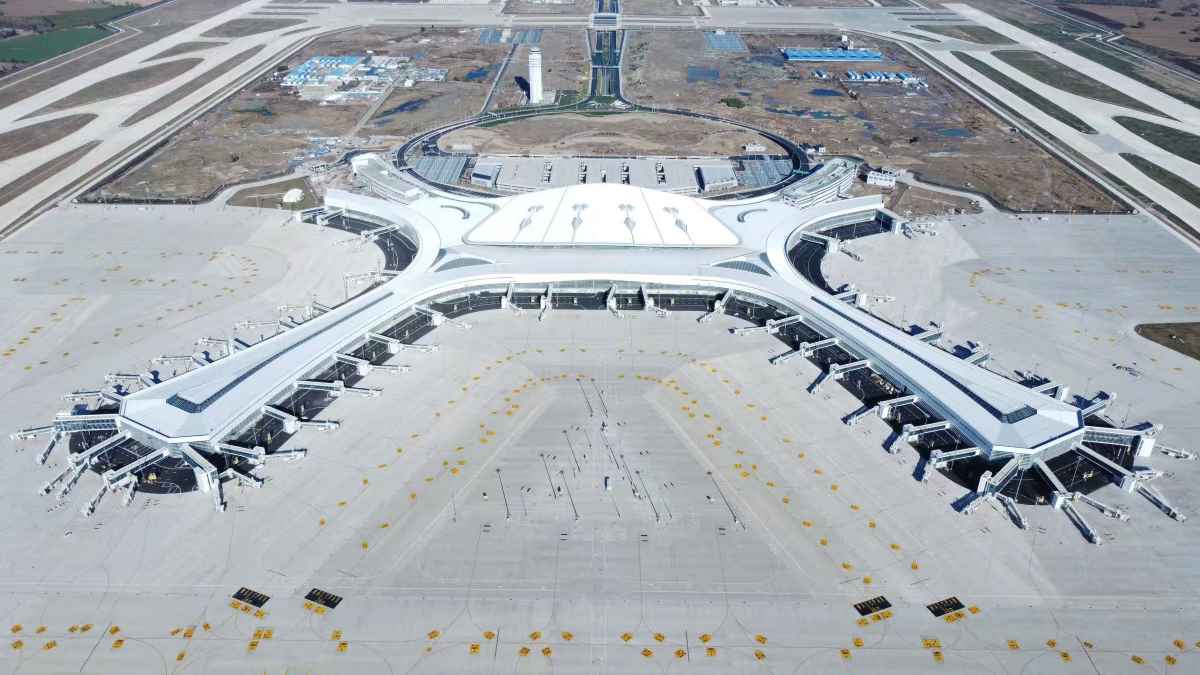
From above, the airport’s terminal is designed to resemble a finely crafted saddle, reflecting the dynamic heritage of the horse-riding cultures in the region. The main facade of the terminal features a 600-meter-long eave inspired by the flowing khata scarf, offering a warm and inviting welcome to visitors from around the globe. The terminal’s skylights are thoughtfully crafted using spindle columns, cables, and inflatable membranes, creating an atmosphere reminiscent of a traditional Mongolian yurt. Looking upward, travelers can enjoy views of the expansive grassland sky and clouds, celebrating Inner Mongolia’s rich cultural heritage and sharing the distinctive beauty of grassland culture with the world.

Shengle Airport’s appeal extends beyond its striking design to its thoughtfully planned interior layout. More than just a transportation hub, it serves as a vital platform connecting the world. As a key node on the “Belt and Road” land corridor and the northern gateway of the China-Mongolia-Russia economic corridor, Hohhot is utilizing this state-of-the-art airport to accelerate its integration into the global network.

In the near term, Shengle International Airport aims to achieve an annual passenger capacity of 28 million, handle 320,000 tons of cargo and mail, and manage 244,000 aircraft movements by 2030. Looking further ahead to 2050, these figures are expected to grow to 65 million passengers, 800,000 tons of cargo and mail, and 511,000 aircraft movements.

To enhance the travel experience for international passengers, Shengle International Airport has proactively upgraded its communication infrastructure. Previously, the construction of civil communication facilities at Hohhot Shengle International Airport was successfully completed. To meet the demands of international travelers and business passengers, the regional communication system has implemented a “seamless access” plan in advance. All three major telecom operators share a jointly built network, ensuring passengers enjoy “uninterrupted” connectivity from arrival through boarding and departure.

Looking forward, Shengle Airport will continue to expand its international routes with exceptional performance. By 2025, Hohhot Airport will establish strong partnerships with Xi’an and Qingdao airports. Leveraging Qingdao Airport’s connections to Japan and South Korea, and Xi’an Airport’s access to Northwest China, Central Asia, and Southeast Asia, new transfer services will be launched connecting Hohhot via Xi’an or Qingdao to other domestic and international destinations.

Additionally, capitalizing on Hohhot’s strategic location facing Russia and Mongolia and linking Northeast and Northwest China, transfer services will be introduced from Xi’an or Qingdao through Hohhot to various regional cities as well as Russia and Mongolia. These initiatives will create aerial bridges fostering economic exchange and cultural communication across regions.

As the morning sun brightens the northern frontier, Shengle International Airport stands out like a shining gem above the grasslands. This young and dynamic airport is not only Hohhot’s new gateway but also a crucial hub connecting China to the world. From here, Inner Mongolia’s high-quality development will gain fresh momentum, and China’s northern frontier will embrace broader opportunities for global engagement.

 

Travel & Tourism

Smooth take-off for new Terminal 2 at Hong Kong International Airport

Published

on

Hong Kong

HONG KONG SAR – Media OutReach Newswire – 29 May 2026 – Hong Kong International Airport (HKIA) embarked on a new era on 27 May, with the successful launch of the expanded Terminal 2 (T2), further boosting the city’s position as global aviation hub.

In 2025, HKIA handled 61 million passenger trips, representing a year-on-year growth of 15%. It has recently garnered several prestigious recognitions for its outstanding performance in areas including security processing, aviation infrastructure, passenger services, and continuous enhancement of passenger facilities.

HKIA was crowned “Best Airport in the World” at the Global Travel Awards 2026, and was voted “Best Airport in China” in the 2026 TTG China Travel Awards for the third year in a row.

Spanning 300,000 square metres, the new T2 is designed and equipped to serve both departing and arriving passengers. The departures hall of T2 features eight check-in aisles, with 68 express self-bag drop counters, 58 smart check-in kiosks and 108 hybrid check-in counters.

Large LED displays are installed at different levels of T2, with 3D contents and ocean-themed videos creating a vibrant atmosphere. The food court at the departures hall serves passengers with eight catering outlets, four of which operate around the clock, while 12 shops offer a variety of products, including travel necessities and souvenirs.

Speaking at the opening ceremony on 22 May, Michael Wong, Acting Financial Secretary of the Hong Kong Special Administrative Region Government, said, “The government will continue to adopt a multi-pronged approach to strengthen HKIA’s position as an international aviation hub, including accelerating the expansion of the aviation network, enhancing intermodal connectivity with the (Guangdong-Hong Kong-Macao) Greater Bay Area, and advancing the development of the Airport City. In particular, we will proactively align with and work on the National 15th Five-Year Plan, and fully support Hong Kong’s role as an international aviation hub.”

Fred Lam, Chairman of Airport Authority Hong Kong (AAHK), said the opening of T2 is another milestone of the airport’s development. “Positioned as a terminal for leisure travel, T2’s design prioritises efficiency and passenger comfort. We attend to every detail, leveraging technology extensively to enable efficient self-check in, self-bag drop and smooth immigration clearance,” he said.

Vivian Cheung, Chief Executive Officer of AAHK said the Authority was delighted to see the smooth relocation of airline partners to T2 and the positive passenger response to the new facilities.

“We have a lot of LED, animation, and new designs emphasising technology, and we have our in-house design for self-check in system, which only requires 45 seconds to go through the entire process. We want to help the airlines to migrate to a full-automation process, which will actually help passengers have better experiences and also reduce the labour needs,” she said.


Continue Reading

Business

Emirates is reconnecting the world through Dubai with 96% of its global network restored

Published

on

Emirates

From 8 May to 31 August 2026, Emirates Skywards members can enjoy accelerated access to the programme’s premium tiers through reduced tier requirements and Bonus Tier Miles on Emirates and flydubai flights

DUBAI, United Arab Emirates, May 4, 2026/APO Group/ –Emirates (www.Emirates.com) is marking a near-full return to operations, with 96% of its global network now restored, following a period of disruption. In the past weeks, the airline has progressively resumed services across the Americas, Europe, Africa, West Asia, the Middle East/GCC, the Far East and Australasia.


Today, the airline operates to 137 destinations across 72 countries, with over 1,300 weekly frequencies, representing 75% of pre-disruption capacity. The airline is offering more flights, more seats and more options each day while reaffirming Dubai’s position as a vital hub through which global travel moves.

Even as it operated with a reduced schedule, Emirates carried 4.7 million passengers* during the disruption, a testament to the enduring demand for travel and the trust that travellers continued to place in the airline to get them where they needed to go.

The Emirates experience, wherever you’re going 

Wherever Emirates customers choose to fly, they can expect a best-in-class onboard and onground experience, defined by exceptional comfort, genuine hospitality, and a level of service that has set the standard for long-haul travel.

Onboard, customers enjoy a unique culinary experience, with regionally inspired, multi-course menus developed by a team of award-winning chefs and complemented by a wide selection of premium beverages. Emirates’ award-winning ice inflight entertainment system offers more than 6,500 channels of the best global content in almost 40 languages, including movies, TV shows, music, podcasts, games, audiobooks and more, ensuring there is no such thing as a long flight.

And for those who need to stay connected, high-speed Wi-Fi keeps customers reachable at 40,000 feet. Emirates now has Starlink connectivity live on 28 aircraft, delivering ultra-fast, reliable internet in the air.

Enjoy flexible travel and rewards 

Emirates is giving customers more reasons to travel with confidence with flexible rebooking, Dubai Connect stopover experiences and enhanced Skywards benefits:

  • Flexible bookings: Customers booked from 2 April will enjoy added flexibility, with one free date change included across all cabin classes. Customers who have booked with Emirates can also hold a fare for 24 hours free of charge.
  • Dubai Connect: For customers with extended transit times in Dubai from 6 to 26 hours, Emirates’ Dubai Connect programme turns a long layover into a comfortable stopover, courtesy of the airline. Eligible customers will enjoy complimentary hotel accommodation at a 4 or 5-star property, airport transfers, meals, and, where required, a UAE entry visa. Available to passengers across all cabin classes with qualifying connection times, Dubai Connect can be booked up to 12 hours ahead via Manage Your Booking (https://apo-opa.co/49amBmQ) on www.Emirates.com. Terms and conditions apply (https://apo-opa.co/4tPG197)
  • Skywards: From 8 May to 31 August 2026, Emirates Skywards members can enjoy accelerated access to the programme’s premium tiers through reduced tier requirements and Bonus Tier Miles on Emirates and flydubai flights.

Emirates operates three daily flights to Johannesburgten weekly flights to Cape Town (with EK772 currently operating three times a week), and four weekly flights to Durban, ensuring strong and consistent connectivity for customers travelling to and from South Africa.

Passengers can explore flight schedules and book their journey from South Africa by visiting Emirates’ official website: https://apo-opa.co/4w7cfxZ

*Between 1 March and 30 April 

Distributed by APO Group on behalf of The Emirates Group.

Continue Reading

Tech

Its Time! Emirates’ iconic A380 returns to Dubai with world-first Starlink Wi-Fi onboard

Published

on

Emirates

Emirates customers will soon enjoy a transformative leap in onboard connectivity with the ability to stream, game, browse, and work throughout their journey on personal devices

DUBAI, United Arab Emirates, April 27, 2026/APO Group/ –Emirates’ (www.Emirates.com) flagship A380, long celebrated as one of aviation’s most iconic aircraft, is set to reach new heights as the first installation of next-generation Starlink Wi-Fi onboard has just been completed.

The Emirates A380 was one of the first commercial aircraft in the world to offer internet to its customers, with first generation systems offering a total aircraft bandwidth of less than 1 Mbps.  Emirates’ installation of three Starlink antennas on each A380 will improve the Wi-Fi available onboard a thousand-fold – offering a ‘better than at home’ connectivity experience for customers, while flying at 40,000 feet.

The first Emirates A380 aircraft equipped with Starlink made its return to Dubai this week, after its installation and certification was accomplished in Newquay, UK. With more A380s scheduled for accelerated installation throughout 2026, Emirates customers will soon enjoy a transformative leap in onboard connectivity with the ability to stream, game, browse, and work throughout their journey on personal devices. The service will be complimentary for all customers, across all cabins, with easy sign up and access. Future enhancements will include Live TV streaming over Starlink, initially on personal devices and later integrated into seatback screens.

From its celebrated Onboard Lounge to its signature First Class Shower Spa, the Emirates A380 has consistently redefined long-haul travel, beloved by customers from all corners of the globe. With the addition of Starlink’s seamless connectivity across all cabin classes, the Emirates A380 experience evolves once more, delivering a fully connected journey in the sky.

A technical first for the world’s largest passenger aircraft

As the world’s largest passenger aircraft, the A380 presents unique engineering challenges and opportunities. This industry-first Starlink configuration is designed to meet the demands of the A380’s ‘double-decker’ layout and high passenger capacity and is capable of delivering more than 2 Gbps of total aircraft bandwidth across the cabin.

Compared with the Emirates Boeing 777, the Emirates A380 features additional wireless access points and a third antenna to deliver an enhanced connectivity experience for its higher passenger capacity. Optimised inter‑deck integration supports a seamless Wi‑Fi experience, with customers able to enjoy high speeds depending on usage and device capability.

Accelerated rollout across an industry-leading fleet

Starlink installations will soon begin at Emirates Engineering facilities in Dubai to accelerate deployment across the fleet. Emirates is committed to bringing the best possible connectivity to its entire fleet at the earliest opportunity, with 25 Boeing 777-300ER aircraft already equipped with Starlink and the first A380 now joining service.

So far, more than 650,000 Emirates customers have already flown on Starlink‑equipped flights, experiencing the benefits of next‑generation onboard connectivity firsthand.

Emirates continuous investment into elevating customer experience

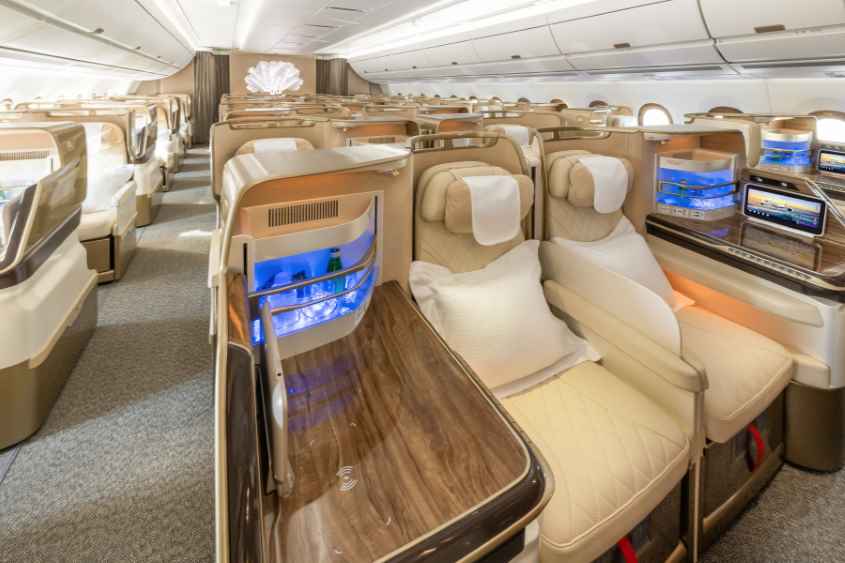
The introduction of Starlink on the A380 builds on Emirates’ ongoing investment into redefining the customer journey, including one of the most ambitious retrofit programmes in aviation history. To date, 93 Emirates aircraft have been fully refurbished (https://apo-opa.co/4d9Ldyo) featuring the installation of the widely acclaimed Premium Economy cabins, an enhanced Business Class, refreshed First Class suites, upgraded interiors and finishes in Economy Class and throughout all aspects of the cabin, and expanded and upgraded inflight systems that can offer more than 6,500 channels of entertainment.

To complement the significant upgrades across all hardware, Emirates also continues to invest in its training programmes and facilities that are instrumental to customer experience. In mid-2025, Emirates opened an US$ 8 million facility – ‘Centre of Hospitality Excellence’ (https://apo-opa.co/3QpE9VP) to train its 25,000 cabin crew in the art of hospitality onboard – bringing together both the tangible and intangible elements of an outstanding travel experience.

Distributed by APO Group on behalf of The Emirates Group.

Continue Reading

Trending