AI-focused accelerator program brings African startups to Silicon Valley to jumpstart technology innovation
LAGOS, Nigeria, September 21, 2023/APO Group/ —
Flapmax (https://Flapmax.com/), a leading data and AI technology company, announced today the twelve companies selected for the second cohort of the FAST Accelerator (https://apo-opa.info/3sYswcx) startup program, created in partnership with Microsoft to help strengthen and scale Africa’s digital ecosystem. Following the conclusion of its 2-week Online Bootcamp, which saw 60+ tech companies participate in an intensive online training with experienced mentors, FAST Accelerator’s cohort of 12 startups will progress to a 5-week comprehensive acceleration experience in Silicon Valley, California starting in October.
“Microsoft believes that African startups and small and medium-sized enterprises (SMEs) are well-positioned to become a bedrock for the African digital economy, with relevant solutions to local societal and economic challenges. Participation in the FAST Accelerator program will help these entrepreneurs capture growth opportunities and expand their market reach,” said Mame-Fatou Gueye, SME Program Manager, Microsoft Africa Transformation Office.
The FAST Accelerator program received over 1200 applications from 35 countries in Africa, spanning a diverse range of industry sectors, including Financial Services (128 applications), Healthcare (95 applications), Agriculture (235 applications), Transportation & Logistics (60 applications), Clean Technology & Energy (57 applications), and Creative Media & Entertainment (40 applications). Applicants represented a broad mix of cloud-based products and services serving businesses throughout Africa, harnessing AI to drive innovation, enhance efficiency, and address critical challenges in their respective domains.
“At Flapmax, our mission is to build societally impactful solutions that harness the power of AI to transform multiple industries through long-term partnerships with startups, SMEs, and global enterprises,” said Dr. Dave Ojika, founder and CEO of Flapmax. “Collaborating with technology partners like Microsoft and Intel, we are assembling a unique fusion of cutting-edge AI technologies, business development strategies, and global-scale growth opportunities for Africa and other emerging markets. Our objective is to empower startups and underrepresented entrepreneurs to rapidly and sustainably scale their businesses and create new job opportunities using AI as a catalyst.”
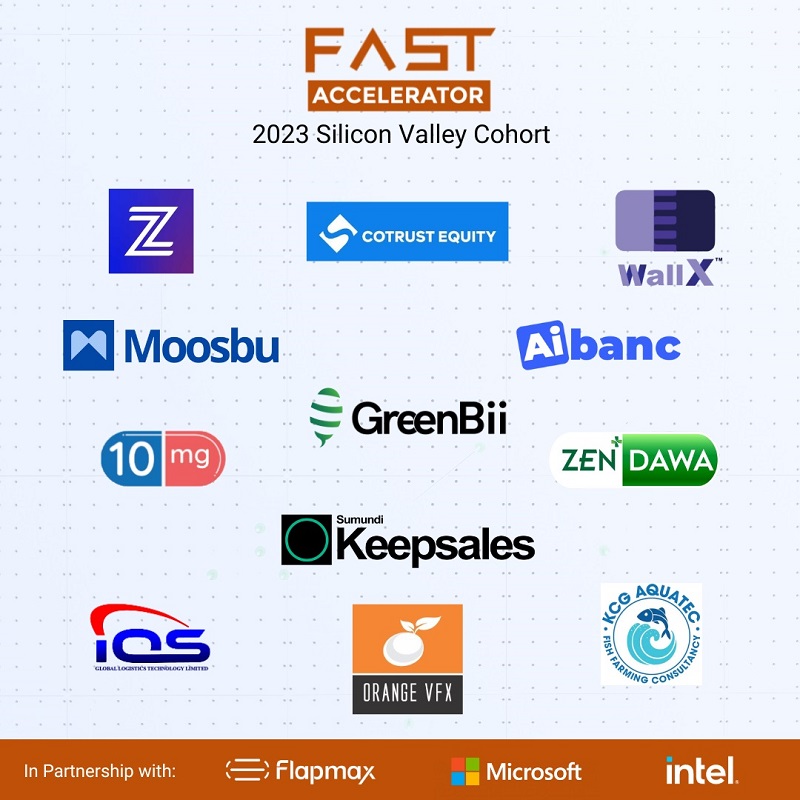
FAST Accelerator 2023 (FA23) applicants had to be based in Africa, ready to scale or expand within the continent, and have an established product-market fit while addressing one or more of the United Nations Sustainable Development Goals (SDGs). The FA23 cohort features the following startups:
Zeeh Africa (FinTech) (https://www.Zeeh.Africa/): AI-powered open banking platform connecting businesses to financial data
Sumundi (eCommerce) (https://Sumundi.com/): Intelligent eCommerce platform for Africa’s retail businesses
Cotrust Equity (FinTech) (https://Cotruste.com/): The Uber for micro-lending in Africa
Orange VFX (Creative Media) (https://OrangeVFX.com/): Delivering high-quality animation and visual effects that help African businesses
10mg Pharma (HealthTech) (https://10mg.co.uk/): AI-driven cost savings on medications for chronic pain patients
Wallx (FinTech) (https://www.Wallx.co/): Payment and business solution for small business owners
Moosbu (FinTech) (https://Moosbu.com/) : Empowering SMEs with AI for sales and financing
KCG Aquatec Fish Farming (AgTech) (https://KCGaquatec.com/) : Aquaculture infrastructure helping fish farmers grow their businesses sustainably
Aibanc (FinTech) (https://Aibanc.co/): AI-powered Banking for High Earners Not Rich Yet (HENRY)
Zendawa Africa (HealthTech) (https://Zendawa.Africa/): Enabling neighborhood pharmacies to sell online
Greenbii (FinTech) (https://www.Greenbii.com/): AI-driven asset financing and software management platform for SMEs
Beginning October 23, the FA23 cohort will participate in a wide array of activities, including training, AI integration, business development, fundraising, and various other events. They will work closely with Intel and Microsoft on co-innovation projects, receive sales and marketing support, and gain go-to-market enablement to broaden their audience reach. Additionally, members of the Flapmax engineering team will assist startups in applying optimized Large Language AI models (LLMs), as well as in scaling and fine-tuning these models on Microsoft Azure and Intel platforms.
Previous participants of the Online Bootcamp program had the following to say:
“It is inspiring to learn what is happening in the AI and tech space across sectors and to interact with cohort members and speakers who are experts in their fields.” – Cohort member HealthX Africa
“This [will] provide us with mentorship, networking and fundraising opportunities with global startups. This is a huge one for us and we are more than excited to embark on this adventure!” – Dataleum.
“It was such a great privilege participating in the FAST Accelerator program! Thank you for the phenomenal classes and the opportunity to build new cross-national networks with other amazing entrepreneurs creating global solutions to local problems with one single aim to make the world a better place for everyone!” – Michael Oboh, Co-Founder and Creative Director of Orange VFX Studios
Flapmax has also announced the launch of its digital matching platform, FAST Portal (https://portal.FASTAccelerator.com/), designed to connect investors with startups. FAST Portal will be leveraged to facilitate introductions between investors, partners, and startups within the FAST Accelerator community. Corporate partners and organizations are invited to join us in our mission to empower entrepreneurs and innovators in underserved markets around the world.
The publication provides a comprehensive overview of the environmental, social and economic impact of its operations
DUBAI, United Arab Emirates, July 21, 2026/APO Group/ —
Spiro’s inaugural Sustainability Report provides the first comprehensive overview of the environmental, social and economic impact of Spiro’s operations.
The company also unveils ambitious objectives and targets net-zero Scope 1 and 2 emissions by 2040 and up to 0.7 million tonnes of CO₂ emissions avoided from product use annually by 2030.
SPIRO (www.Spironet.com), Africa’s leading electric mobility company, today published its inaugural Sustainability Report. The publication provides a comprehensive overview of the environmental, social and economic impact of its operations and aims at establishing a baseline, to track future progress on its path to scale clean transport infrastructure and affordable mobility solutions.
Having grown up in India, I have witnessed firsthand the impact of vehicle emissions on public health and urban environments. At SPIRO, our responsibility as founders is not only to scale innovation, but to ensure that the systems we build endure economically, socially, and environmentally for generations to come”, said Gagan Gupta, Founder of SPIRO and Chairman of Equitane.
“This report reflects how far SPIRO has come—not only in terms of growth, but in our ability to measure and improve our impact. As we expand across Africa, sustainability will remain a core business driver, shaping how we invest, manufacture, innovate and partner for the long term”, highlighted Anant Badjatya, Group Chief Executive Officer, SPIRO.
This report reflects how far SPIRO has come—not only in terms of growth, but in our ability to measure and improve our impact
“By establishing our first comprehensive ESG baseline, including Scope 1, 2 and 3 emissions, we are creating the foundations needed to track progress, set measurable targets and strengthen transparency as SPIRO continues to scale across Africa. Sustainability is not a standalone initiative—it is integrated into how we operate, innovate and create long-term value”,saidImtinen Hamlaoui, Head of ESG and Sustainability.
Among key highlights :
As part of its sustainability roadmap, SPIRO completed its first end-to-end greenhouse gas inventory, covering Scope 1, Scope 2 and Scope 3 emissions across its operations and value chain.
Among others, operational efficiency measures taken last year delivered an estimated 15–25% reduction in energy use at assembly facilities, reinforcing SPIRO’s commitment to continuously improving energy efficiency and reducing the environmental footprint of its operations.
The report outlines SPIRO’s long-term sustainability roadmap, including its ambition to achieve net-zero Scope 1 and Scope 2 emissions by 2040. As the company expands, its electric mobility ecosystem is projected to help avoid approximately 700,000 tonnes of CO₂ emissions annually by 2030. To further strengthen energy resilience and reduce grid dependency, SPIRO is evaluating the deployment of 80–125 KVA on-site solar solutions across selected battery-swapping stations, while smart energy management initiatives implemented at its assembly facilities have already delivered an estimated 15–25% reduction in energy consumption.
The report highlights SPIRO’s growing investment in people and local capabilities. Through the Spiro Academy, the company trained more than 4,000 individuals across Africa in 2025 in areas including EV maintenance, battery management and technical operations. Initiatives such as Africa’s first women electric motorcycle assembly line further reinforce SPIRO’s commitment to skills development, workforce inclusion and local industrial growth.
Beyond environmental performance, the report underlines the growing economic benefits of electric mobility. Commercial riders using SPIRO motorcycles reduce operating costs by 70–80% compared with petrol-powered alternatives, while benefiting from lower maintenance costs and reduced exposure to fuel price volatility.
eWAKA Joins the Cartier Women’s Initiative to Accelerate Africa’s Transition to Clean Mobility
NAIROBI, Kenya, July 21, 2026/APO Group/ –eWAKA (www.eWAKA.tech) today announced the company’s Co-founder and CEO, Céleste Tchetgen Vogel, has been selected as a 2026 Cartier Women’s Initiative Fellow. Vogel was recognized for her work to electrify Africa’s last mile, giving riders clean vehicles they can own and a better way to earn. Chosen from applicants around the world, Vogel represents the Anglophone and Lusophone Africa category of the 2026 Cartier Women’s Initiative Awards, which celebrate women entrepreneurs using business as a force for positive change.
eWAKA is an early-stage company with a clear ambition: to make Africa’s last mile clean, affordable, and within reach of the people who move it. Today it provides electric motorcycles and cargo bikes, financing that lets riders own their vehicles affordably, and charging and battery-swap to keep them moving. It coordinates deliveries and fleet operations through its own software. It aims to grow this into a managed electric delivery network, where businesses get reliable, lower-cost delivery and riders earn a steady living. Operating in Kenya and Rwanda, eWAKA is actively expanding into Burundi and the Democratic Republic of Congo, demonstrating its confidence in regional growth and impact.
eWAKA at a Glance
Nearly 1,500 active riders in Kenya and Rwanda
More than one million deliveries completed, up by over 80,000 on the prior year
More than 550 vendors onboarded onto the company’s merchant ordering platform
Approximately Ksh 25 million (about US$190,000 or CHF 150,000) earned by riders, up more than Ksh 6 million on the prior year
More than 1,500 jobs were created, with over 85% of riders aged 18 to 30
More than 3000 metric tons of CO₂ emissions avoided through clean mobility operations
Woman-founded and woman-led, with women working as riders, vendors, and agents across the network
We are delighted to welcome Céleste Tchetgen Vogel to the Cartier Women’s Initiative community
By bringing electric vehicles, financing, and software together in a single operation, eWAKA is building a model it can carry from one city to the next, so that each new market means more riders earning, more businesses served, and cleaner air to breathe. The company’s early backers include the Swiss State Secretariat for Economic Affairs (SECO), through its Start-up Fund, alongside impact investors and development finance partners.
eWAKA Co-founder and CEO Céleste Tchetgen Vogel said, “Mobility should open doors, not close them. When a rider can own a clean vehicle and earn a living with it, a whole family moves forward, and the city breathes a little easier. That is the future eWAKA is building, one electric mile at a time. To be welcomed into the Cartier Women’s Initiative, in its twentieth year, tells us the path is real, and gives us the resolve to walk it much further.”
eWAKA is building Africa’s next-generation electric mobility platform, operating in Kenya and Rwanda and expanding into Burundi and the Democratic Republic of Congo. Originally from Cameroon, Vogel is an African entrepreneur who co-founded eWAKA in 2021 after a career in senior legal and executive roles at Credit Suisse, ABB, and Swiss Re. She holds a degree in economics and international relations from Ohio Wesleyan University and a law degree from Northwestern University’s Pritzker School of Law, both in the United States. She was named among the Most Influential Women in Mobility in 2024 and to the Meaningful Business 100 in 2025. eWAKA works with ETH Zurich as a technical partner on battery and fleet data.
Cartier Women’s Initiative Director Kiyo Taga-Witkin commented, “We are delighted to welcome Céleste Tchetgen Vogel to the Cartier Women’s Initiative community. Through eWAKA, she exemplifies how entrepreneurship can drive meaningful, positive change. We look forward to supporting her journey and celebrating the impact she is creating.”
The Cartier Women’s Initiative is an international entrepreneurship program established in 2006 to support women impact entrepreneurs who are building a more inclusive society for generations to come. Since its inception, the program has been dedicated to identifying and accompanying women whose businesses address the world’s most pressing social and environmental challenges. Through a comprehensive approach combining financial support, access to a global network, and tailored leadership development, the Cartier Women’s Initiative enables fellows to scale their businesses while strengthening their capacity to lead and create lasting impact.
Over the years, the initiative has grown into a vibrant international community of more than 520 community members, united by a shared ambition to drive meaningful change within their respective ecosystems. At its core, the Cartier Women’s Initiative is guided by a set of enduring convictions: the belief that women are powerful agents of transformation, that talent is universal, while opportunities are not, that continuous learning is essential to progress, and that sustainable impact is rooted in a deep commitment to the communities it serves.
As African banks and investors take larger stakes in mining deals across the continent, Moore Infinity’s Danie Dorfling tells African Mining Week why domestic capital will be critical to financing Africa’s next generation of mineral projects
CAPE TOWN, South Africa, July 21, 2026/APO Group/ –As demand for critical minerals accelerates and governments push to capture more value from their resources, African banks and investors are stepping into larger roles financing the projects that will define the continent’s next mining era.
The latest example came in July, when Kropz subsidiary Kropz Elandsfontein secured a R200 million loan from Ubuntu-Botho Investments, the indirect controlling shareholder of African Rainbow Capital, to strengthen its phosphate mining operations in South Africa’s Western Cape. The transaction reflects growing confidence among domestic investors in Africa’s mining sector and signals a broader trend: regional capital is increasingly moving from the sidelines into the center of mining development.
In an exclusive interview with Energy Capital & Power, organizers of African Mining Week (AMW), Danie Dorfling, Head of Business Development at Moore Infinity – a partner of AMW – said the growing participation of domestic capital marks a fundamental shift in how Africa finances mining projects.
“Domestic capital is no longer an optional supplement to foreign investment. It is becoming a test of whether Africa can convert its mineral wealth into durable domestic financial capacity,” he said.
Dorfling pointed to the $700 million financing package secured in April 2026 for Phase 2 of South Africa’s Platreef Mine by Nedbank, Absa and France’s Société Générale as an example of African financial institutions partnering with global lenders to finance complex, large-scale mining developments.
Domestic capital is no longer an optional supplement to foreign investment
“The significance is that African banks were not asked to replace international capital; they participated alongside it in a major, complex mining financing. That hybrid model is likely to be more scalable than expecting large projects to be funded exclusively from either domestic or international balance sheets,” said Dorfling.
The trend extends beyond South Africa. As Africa seeks to mobilize its estimated $2 trillion in non-bank domestic capital to finance strategic infrastructure and industrial development, regional financial institutions are expanding their role across the mining value chain.
Tharisa recently secured a R750 million revolving asset finance facility from Nedbank to acquire specialized underground mining equipment for its Apollo Mine in South Africa’s Bushveld Complex. Meanwhile, Absa is supporting major projects including Pensana’s Longonjo Rare Earth Project in Angola and the Kamoa Copper Mine in the Democratic Republic of the Congo alongside Rawbank and Nigeria’s FirstBank.
According to Dorfling, Rawbank’s participation demonstrates how domestic African institutions are building the expertise and balance sheet capacity required to participate in increasingly complex regional mining transactions.
Collectively, these developments reflect a broader evolution in Africa’s mining finance landscape. Rather than relying solely on international development finance institutions and foreign commercial lenders, projects are increasingly being supported through blended financing structures combining domestic banks, regional financial institutions and global investors. This approach diversifies funding sources, strengthens local capital markets and enables African institutions to capture greater value from the continent’s expanding mining industry.
These trends will take center stage at AMW 2026, taking place from October 14–16 in Cape Town under the theme “Mining the Future: Unearthing Africa’s Full Mineral Value Chain.” Bringing together regional financiers, international investors, mining companies and market intelligence firms, the event will explore how African capital can be integrated with global financing to accelerate project development and strengthen the continent’s mining investment ecosystem.
Financial institutions including Absa, Standard Bank, the Industrial Development Corporation, Africa50, the Africa Finance Corporation, Trade and Development Bank, U.S. International Development Finance Corporation, World Mining Investment and Aperoin Investment Group will join industry experts such as Moore Global to examine financing models capable of unlocking Africa’s next generation of mining projects.
Distributed by APO Group on behalf of Energy Capital & Power.
We use cookies on our website to give you the most relevant experience by remembering your preferences and repeat visits. By clicking “Accept”, you consent to the use of ALL the cookies.
This website uses cookies to improve your experience while you navigate through the website. Out of these, the cookies that are categorized as necessary are stored on your browser as they are essential for the working of basic functionalities of the website. We also use third-party cookies that help us analyze and understand how you use this website. These cookies will be stored in your browser only with your consent. You also have the option to opt-out of these cookies. But opting out of some of these cookies may affect your browsing experience.
Necessary cookies are absolutely essential for the website to function properly. These cookies ensure basic functionalities and security features of the website, anonymously.
Cookie
Duration
Description
cookielawinfo-checkbox-analytics
11 months
This cookie is set by GDPR Cookie Consent plugin. The cookie is used to store the user consent for the cookies in the category "Analytics".
cookielawinfo-checkbox-functional
11 months
The cookie is set by GDPR cookie consent to record the user consent for the cookies in the category "Functional".
cookielawinfo-checkbox-necessary
11 months
This cookie is set by GDPR Cookie Consent plugin. The cookies is used to store the user consent for the cookies in the category "Necessary".
cookielawinfo-checkbox-others
11 months
This cookie is set by GDPR Cookie Consent plugin. The cookie is used to store the user consent for the cookies in the category "Other.
cookielawinfo-checkbox-performance
11 months
This cookie is set by GDPR Cookie Consent plugin. The cookie is used to store the user consent for the cookies in the category "Performance".
viewed_cookie_policy
11 months
The cookie is set by the GDPR Cookie Consent plugin and is used to store whether or not user has consented to the use of cookies. It does not store any personal data.
Functional cookies help to perform certain functionalities like sharing the content of the website on social media platforms, collect feedbacks, and other third-party features.
Performance cookies are used to understand and analyze the key performance indexes of the website which helps in delivering a better user experience for the visitors.
Analytical cookies are used to understand how visitors interact with the website. These cookies help provide information on metrics the number of visitors, bounce rate, traffic source, etc.
Advertisement cookies are used to provide visitors with relevant ads and marketing campaigns. These cookies track visitors across websites and collect information to provide customized ads.