Connect with us

Events

Hong Kong hosts first LEAP East, drawing 35,000 global innovators

Published

on

LEAP East 2026

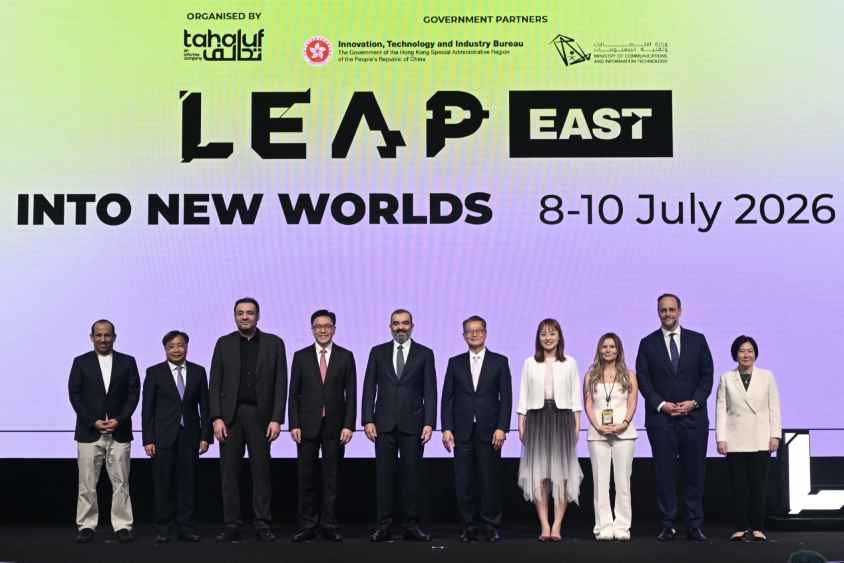
HONG KONG SAR – Media OutReach Newswire – 10 July 2026 – The inaugural LEAP East 2026 was held at the Hong Kong Convention and Exhibition Centre (8-10 July), gathering more than 35,000 technology professionals, policymakers and investors from 30 countries and regions. The three-day event, the first LEAP summit staged outside Saudi Arabia, featured over 340 speakers, 450 exhibitors and over 400 investors, covering cutting-edge fields such as artificial intelligence, deep tech, smart cities and new energy industries.

“This turnout speaks volumes about the global appeal of LEAP East and the strength of our shared vision,” said Paul Chan, Financial Secretary of the Hong Kong Special Administrative Region Government (HKSARG) at the opening ceremony of the event. “I am particularly delighted to note that this conference will continue to be held in Hong Kong in the coming three years.”

Other top government officials attending the opening ceremony included Professor Sun Dong, Secretary for Innovation, Technology and Industry of the HKSARG and Abdullah Alswaha, Minister of Communications and Information Technology of Saudi Arabia.

The event underscored the deepening partnership between Hong Kong and Saudi Arabia, and highlighted Hong Kong’s role as a unique gateway connecting the Chinese Mainland with the world.

“Hong Kong is perhaps the only city in the world that connects seamlessly to both the Chinese Mainland and the rest of the world at the same time,” Mr Chan said. “Working under the common law system, we have robust protection for intellectual property. As a free port, capital, goods, talent and data freely flow in and out of this city. Simple, low tax is a standing feature of our regime. And we are one of the safest, most stable cities anywhere in the world. These are the foundations on which businesses, talent and creativity thrive.”

Mr Chan invited Saudi and Gulf enterprises to use Hong Kong as an international fundraising and risk-management platform, and expressed the HKSAR’s commitment to further strengthening co-operation with Saudi Arabia in innovation, infrastructure, green technology, healthcare, advanced manufacturing and professional services.

“Innovation needs capital, and Hong Kong is where capital and ideas meet. This is the heart of our ‘Finance+’ strategy – using finance as a powerful enabler to drive the real economy,” Mr Chan said.

Professor Sun noted that the HKSARG’s efforts in promoting innovation and technology (I&T) are bearing fruit. He said the number of start-ups in Hong Kong has surged by 40% since 2021, reaching 5,200 in 2025. The Shenzhen-Hong Kong-Guangzhou innovation cluster was ranked first globally in the Global Innovation Index 2025 and Hong Kong ranked fourth globally in the World Digital Competitiveness Ranking 2025, and second globally in the World Competitiveness Yearbook 2026.

Hong Kong also topped the world in IPO (initial public offering) in 2025, with 119 listings raising some US$35 billion, including many world tech champions.

Professor Sun also met with Mr Alswaha to exchange views on I&T collaborations between Hong Kong and Saudi Arabia.

“This international gathering reflects the rising global I&T momentum, and Hong Kong is proud to serve as a ‘super connector’ and ‘super value-adder’ for international exchanges,” Professor Sun said.

Meanwhile, Mr Chan revealed that he plans to lead a Hong Kong delegation to Saudi Arabia later this year, bringing leading companies in infrastructure, green tech, healthcare and advanced manufacturing, plus professionals in the finance, investment and professional services sector, to explore concrete projects and further partnership.

Business

African Economic Conference 2026 opens in Abidjan to explore pathways for a more influential Africa in a multipolar world

Published

on

Key topics under discussion include strengthening the continent’s financial agency, developing domestic capital markets and addressing the impact of international tensions on African economies

ABIDJAN, Ivory Coast, July 12, 2026/APO Group/ –African countries must act collectively to shape their own future in an increasingly multipolar world. This was the central message at the opening of the 2026 African Economic Conference (AEC) in Abidjan, Côte d’Ivoire, hosted at the headquarters of the African Development Bank Group (www.AfDB.org) under the theme: “Strengthening Africa’s Geopolitical Agency and Trade Resilience in a Multipolar World.”


Jointly organized by the African Development Bank Group (AfDB), the United Nations Development Programme (UNDP) and the Organisation for Economic Co-operation and Development (OECD), this year’s conference brings together leading economists, researchers, policymakers and experts from regional and international development institutions from 10 to 12 July.

Souleymane Diarrassouba, Côte d’Ivoire’s Minister of Planning and Development and Governor of the Bank for Côte d’Ivoire, called for deeper reflection on Africa’s place amid shifting geopolitical dynamics.

“Africa can no longer be viewed merely as a reservoir of raw materials. We must be recognized as a key player in global supply chains, a hub for industrialization, and a force capable of defending its interests within international economic governance,” he said.

Urging participants to move from analysis to action, African Development Bank Group President Dr Sidi Ould Tah stressed the need for a new narrative centred on African agency and influence.

“For decades, discussions about Africa have focused on dependency, vulnerability and adaptation. Today, we must focus on autonomy, resilience, competitiveness and influence. Africa’s geopolitical autonomy will be measured by its ability to negotiate from a position of strength, shape the rules of the game, translate its collective interests into collective action and ultimately influence outcomes,” he said.

Dr Ould Tah added that this vision is fully aligned with the strategic framework he has outlined through the Four Cardinal Points and the New African Financing Architecture for Development (NAFAD).

Africa’s role is no longer to adapt to rules made by others, but to help define the rules of tomorrow

Against a backdrop of mounting global challenges, speakers emphasized the urgent need to redefine international rules and arrangements to strengthen Africa’s strategic position, enhance its economic resilience and enable the continent to seize opportunities emerging from a rapidly changing global order.

Echoing these remarks, Ahunna Eziakonwa, UN Assistant Secretary-General and Director of the UNDP Regional Bureau for Africa, underscored Africa’s growing role in shaping global governance.

“The world is being rewritten. Africa’s role is no longer to adapt to rules made by others, but to help define the rules of tomorrow. Geopolitical influence will not be granted to us; it must be earned through stronger institutions, deeper regional integration, resilient trade and the courage to act together. This conference is where ideas become strategic assets for Africa,” she said.

In a video address, OECD Secretary-General Mathias Cormann highlighted the changing global development financing landscape, arguing that development assistance must be used more effectively while leveraging broader sources of investment.

“For many partner countries, aid is no longer a reliable or growing source of financing. This reality should prompt reflection, but it should strengthen—not weaken—our resolve. We must preserve and prioritize official development assistance where it is most needed while mobilizing significantly larger volumes of development finance from all available sources,” OECD Director of International Development Cooperation, Pilar Garrido added.

The conference’s opening day featured in-depth discussions on industrialization, human capital development, transformation of the informal sector, women’s and youth employment, natural resource governance, digital transformation of public administration and the fight against corruption. Researchers presented their findings before panels of experts and decision-makers, fostering constructive dialogue between academia and public policymakers.

Over the course of the three-day event, participants are drawing on rigorous analysis and evidence-based research to identify practical solutions to Africa’s most pressing challenges. Key topics under discussion include strengthening the continent’s financial agency, developing domestic capital markets and addressing the impact of international tensions on African economies.

Since its inception in 2006, the African Economic Conference has established itself as one of the continent’s premier platforms for policy dialogue and development thinking. It promotes collaboration among researchers, government officials, development partners and private-sector actors to generate innovative solutions to Africa’s socio-economic challenges.

The conference also demonstrates how collaboration among development institutions—including the UNDP, OECD and African Development Bank—can add value by supporting evidence-based policy discussions that accelerate Africa’s development agenda.

The 2026 edition further hosts the annual meeting of the Global Network of Chief Economists of Development and Financing Institutions and will feature the launch of the African Chief Economists Network (ACE Network). In addition, graduates of the second cohort of the Public Finance Management Academy for Africa and the inaugural cohort of the Macroeconomic Policy Management Academy for Africa will receive their diplomas during a special ceremony.

Distributed by APO Group on behalf of African Development Bank Group (AfDB).

Continue Reading

Energy

Nigerian Operators to Bring Upstream Know-How to African Energy Week (AEW) in Cape Town

Published

on

Senior executives from Oando, Seplat, Aradel Holdings, Heirs Energies and Shoreline Energy International have joined the conference to strengthen collaboration with regional partners

CAPE TOWN, South Africa, July 14, 2026/APO Group/ –Nigeria’s largest indigenous oil and gas operators have joined the African Energy Week (AEW) Conference and Exhibition, taking place in Cape Town from October 12-16, 2026, to strengthen regional collaboration and advance Africa’s next wave of upstream projects. Speakers include the companies at the center of a structural shift in Nigeria’s upstream sector, where local operators have acquired more than $6 billion in assets divested by international majors and now account for approximately 60% of the country’s crude production.


Oando PLC Group Chief Executive Wale Tinubu will attend alongside Dr. Alex Irune, Executive Director of Oando PLC and Managing Director of Oando Energy Resources. Oando completed its acquisition of Eni’s former NAOC onshore assets in a deal valued at approximately $800 million, adding acreage across the Niger Delta and establishing Oando as one of the largest indigenous operators in Nigeria by production volume.

Seplat Energy, Nigeria’s largest independent producer, will be represented by incoming CEO Engr. Effiong Okon, who takes over from Roger Brown on August 1, 2026. Seplat’s 2030 strategy targets 200,000 barrels of oil equivalent per day and more than one billion standard cubic feet per day of domestic gas production following its acquisition of ExxonMobil’s Nigerian subsidiary.

The ANOH gas processing plant, which Okon helped deliver as Managing Director, achieved first gas in January 2026. Okechukwu Mba, Director of Gas and New Energy, will also participate, contributing to discussions on gas commercialization and the country’s energy transition strategy.

Nigeria’s indigenous operators have acquired billions of dollars in assets and are now running them, financing them and expanding them

Aradel Holdings, the largest oil and gas company listed on the Nigerian Exchange, will be represented by Adegbite Falade, MD and CEO. Aradel reported revenue of approximately N697.3 billion and 55% profit growth year-on-year for 2025, driven by increased crude and gas production across an expanding asset base. The company raised crude output to 14,100 barrels per day and achieved its highest-ever gas production rate of approximately 83.8 million standard cubic feet per day during the year.

Aradel is also a shareholder in Renaissance Africa Energy, the consortium that completed its $2.4 billion acquisition of Shell’s onshore Nigerian operations. The company operates a fully integrated upstream-to-downstream model at its flagship Ogbele field in Rivers State, combining production, gas processing and refining.

Heirs Energies MD and CEO Osayande Igiehon will attend the conference as the company continues to expand its upstream position and financing capacity. A recent flagship agreement included Heirs Energies’ $750 million dual-tranche reserve-based lending facility – arranged by the African Export-Import Bank. The company operates OML 17 in the Niger Delta, supplying gas that powers more than 350 MW of electricity, and its parent company Heirs Holdings holds a 20.07% stake in Seplat Energy following a $500 million investment.

Shoreline Energy International Group Managing Director and CEO Kola Karim will also join the conference. The company specialized in power, infrastructure, engineering and energy investments, with operations including OML 30 in the Niger Delta. The project has eight producing flow stations and five gas lift compression stations.

Collectively, these operators represent the companies that have reshaped Nigeria’s upstream ownership structure and are now working to scale production, integrate acquired assets and deploy capital into the infrastructure required to sustain long-term growth.

“Nigeria’s indigenous operators have acquired billions of dollars in assets and are now running them, financing them and expanding them. Their presence at AEW in force demonstrates that this is not a transition in name only but a fundamental shift in how Africa’s largest oil producer operates,” said NJ Ayuk, Executive Chairman of the African Energy Chamber.

AEW 2026 will convene the Nigerian delegation alongside heads of state, international operators and investors at the Cape Town International Convention Center from October 12-16.

Distributed by APO Group on behalf of African Energy Chamber.


Continue Reading

Energy

Mining Chambers to Highlight Africa’s Next Wave of Investment Opportunities at African Mining Week (AMW) 2026

Published

on

Representatives from chambers of mines across Zimbabwe, Zambia, Mali, Uganda, South Africa, Liberia and the DRC will showcase investment opportunities emerging from regulatory reforms and sector expansion at African Mining Week 2026

CAPE TOWN, South Africa, July 13, 2026/APO Group/ –As African countries advance reforms to unlock new mineral discoveries and strengthen mining investment, chambers of mines are playing an increasingly important role in connecting governments, investors and industry. Through policy advocacy, regulatory engagement and investment promotion, these organizations are helping shape the continent’s next phase of mining development.


That growing role will be on display at African Mining Week (AMW) 2026, taking place in Cape Town from October 14–16, where chamber executives will highlight the policies, partnerships and investment opportunities driving growth across Africa’s mining sector.

Zimbabwe offers a prime example of this expanding role. The Chamber of Mines of Zimbabwe has become an increasingly influential voice in addressing production constraints, including power shortages and foreign exchange challenges. Its recommendations align with recent government initiatives to expand coal-fired power generation, increase coal production and achieve 10% mining sector growth in 2026. At AMW 2026, CEO Isaac Kwesu will outline investment opportunities emerging as the country implements reforms to strengthen mining competitiveness.

In South Africa, the Minerals Council South Africa continues to advocate for improvements to rail, port and electricity infrastructure while supporting the implementation of the Mineral Resources Development Bill and measures to stimulate exploration. These priorities complement government initiatives such as the Junior Mining Exploration Fund and a broader strategy to mobilize R2 trillion in mining investment over the next five years. CEO Mzila Mthenjane will discuss efforts to revitalize exploration and unlock opportunities across the country’s platinum group metals, manganese and critical minerals sectors.

In Zambia, the Zambia Chamber of Mines has helped shape the Geological and Minerals Development Act of 2025, legislation designed to stimulate mineral exploration as the country works toward increasing annual copper production to three million tons by 2031. Zambia has already reached a key milestone in its nationwide geological mapping program, completing 55% of the survey, while the recent launch of the National Spatial Data Infrastructure Policy and Geoportal is improving investor access to geological data. At AMW 2026, CEO Sokwani Chilembo is expected to showcase investment opportunities as Zambia expands exploration and diversifies beyond copper.

As countries increasingly position mining as a driver of economic diversification, Fousseni Togola, President of the Mali Chamber of Mines, will present opportunities in the country’s gold and lithium sectors, highlighting how Mali’s 2023 Mining Code is supporting investment into emerging minerals.

In Uganda, Humphrey Asiimwe, CEO of the Uganda Chamber of Energy and Minerals, told AMW that the chamber will use the event to promote investment opportunities in gold, graphite and rare earths. The country’s mining sector forms a cornerstone of Uganda’s strategy to increase GDP from $59.3 billion to $500 billion by 2040.

Meanwhile, Amara Kamara, President of the Liberia Chamber of Mines, is expected to highlight reforms aimed at attracting new exploration investment, including plans to establish a national mining company as Liberia targets more than $3 billion in annual mining and energy revenues by 2029.

Regional collaboration will also feature prominently during AMW 2026. Thierry Naweji, Executive Chairman of the SA-DRC Chamber of Commerce, is expected to discuss opportunities to strengthen cooperation between South African and Congolese mining companies as both countries work to build more integrated regional mineral value chains.

With regulatory reforms gathering pace across the continent, AMW 2026 will highlight how chambers of mines are helping translate policy ambitions into investment opportunities, reinforcing their growing role in Africa’s mining development.

Distributed by APO Group on behalf of Energy Capital & Power.

Continue Reading

Trending

Exit mobile version