World’s largest tech and start-up show gathers best minds, advanced companies for the year’s most anticipated dialogue into a new tech paradigm
DUBAI, United Arab Emirates, October 10, 2023/APO Group/ —
Dubai will unleash a new era of global AI dominance next week, as the UAE hosts the world’s largest tech and start-up show, converging the best minds, future-focused governments, and most advanced companies to redraw the boundaries of the AI economy and shape the future of the globe’s next big technology shift.
For the first time, GITEX GLOBAL – independently rated globally as the best tech show in the world – shall take place in two mega venues as its 43rd edition prepares to welcome 6,000 exhibitors and 180,000 tech executives from 180 countries from 16-20 October 2023 at the Dubai World Trade Centre.
Its powerhouse start-up show, Expand North Star hosted by the Dubai Chamber of Digital Economy runs from 15-18 October 2023 at the stunning new Dubai Harbour venue. More than 1,800 start-ups across the events will explore rising opportunities in one of the world’s most agile, diversified, and technology-enabled digital economies.
The blockbuster duo, organised by DWTC, comprise a combined 2.7 million sq. ft of exhibition space, a 40 percent increase over the previous year, inviting the world to the year’s most anticipated dialogue and deep scrutiny into a new tech paradigm experimenting in AI, the cloud, Web 3.0, and a sustainable digital economy.
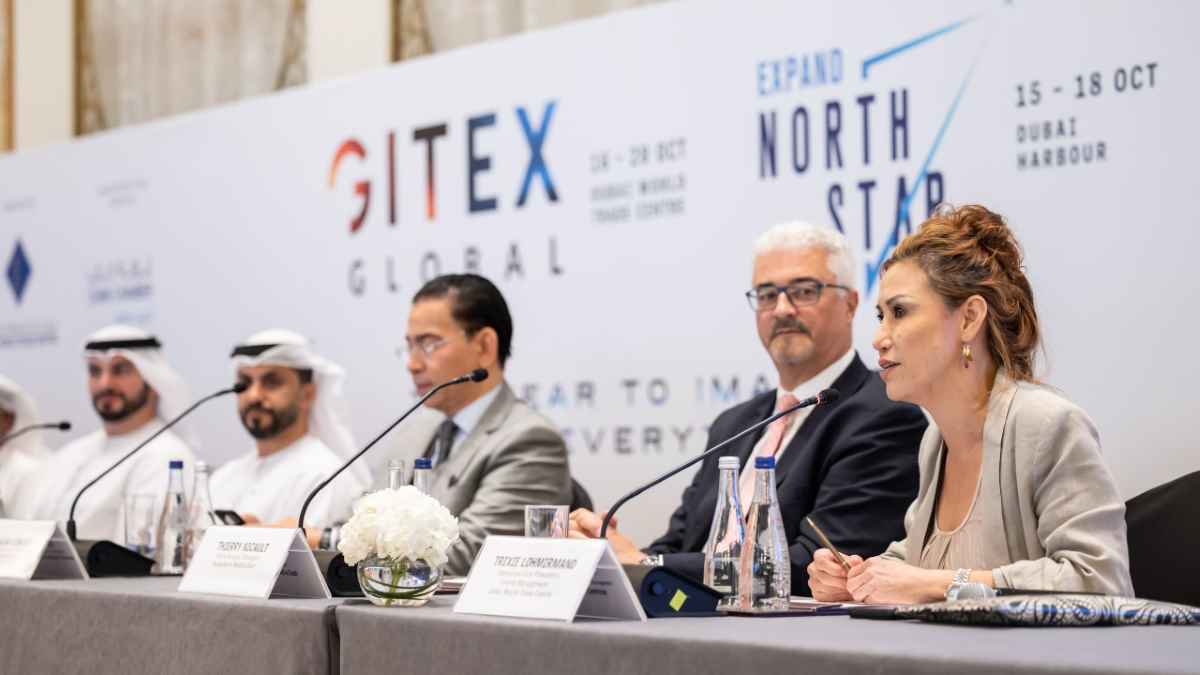
His Excellency Omar Sultan Al Olama, UAE Minister of State for Artificial Intelligence, Digital Economy and Remote Work Applications, and Chairman of Dubai Chamber of Digital Economy, spoke at the official GITEX GLOBAL and Expand North Star 2023 press conference today.
“We are working with AI policymakers to ensure that the world is better for everyone everywhere,” said H.E. Al Olama, who was named by TIME Magazine as one of the world’s top 100 most influential people in artificial intelligence in 2023. “GITEX GLOBAL is where the best and brightest minds come together to shape the future of technology. Dubai is a global market and through GITEX GLOBAL, we are pushing the envelope by showcasing new technologies including the transformational power of AI to inspire everyone and shape a better future.”
“We’ve seen a huge increase in the number of participants at GITEX GLOBAL and this growth really is a testament to the UAE’s status as a global leader in technology.”
Expand North Star 2023 accelerates global VC investment revival
The influx of global interest in the UAE will see Expand North Star host the largest line-up of 1,000 investors from 70 countries with $1 trillion under management, as they look to ramp up the global VC start-up investment revival.
It arrives as the UAE companies clinched the lion’s share of US$4 billion in start-up funding across the Middle East and North Africa in 2022, fetching investments to the tune of $1.85 billion across 250 deals, a five percent increase in value over the previous year.
“Expand North Star reflects Dubai’s strong commitment to enabling ambitious start-ups to thrive in the emirate,” said Saeed Al Gergawi, Vice President of Dubai Chamber of Digital Economy (DCDE), host of Expand North Star.
“We look forward to introducing several initiatives at the event including India Central, the biggest showcase of Indian start-ups ever assembled outside India; Asia Fast 100 and Africa Fast 100, the event’s largest showcases bringing together more than 100 leading start-ups from each continent for an intensive programme of conferences, networking events, and dedicated pitch competitions; and Launchpad Dubai, a first-of-its-kind initiative providing local and international tech businesses including start-ups, scaleups, and unicorns opportunities to accelerate their business and kickstart their operations in Dubai through a one-stop experience at DCDE’s booth at Expand North Star.
“Hosting this event enables us to harness the full potential of the digital economy by connecting stakeholders from the government sector, investors, and accelerators with the world’s leading industry experts, innovators, and tech start-ups,” added Al Gergawi.
“By bringing the global start-up ecosystem together in the emirate, Expand North Star supports our drive to transform Dubai into one of the world’s leading digital economies in line with the ambitions of the Dubai Economic Agenda (D33).”
Intense demand spurs new tech agendas, government participation rises
GITEX GLOBAL 2023 will see the highest involvement of public private partnerships yet as more than 250 government entities intensify their futuristic digital city visions and strategic collaborations amplified by bold commitments toward digital excellence.
The annual five-day event will deep dive into the biggest reflections of the AI era with the return of AI Everything – the year’s largest showcase of AI solutions and concepts – and the Global DevSlam coder and developer meet-up, while the hyper popular GITEX Cyber Valley will take the fight directly to the dark cyber-criminal underworld.
“We have not seen this hyper level of fervour and anticipation of GITEX GLOBAL in recent years,” said Trixie LohMirmand, Executive Vice President of Events Management at Dubai World Trade Centre. “GITEX is synonymous with AI this year, especially when excitement over the emergence of generative AI is shadowed by a sense of trepidation and cautiousness.
“We are aggregating the year’s largest AI in Everything showcase and the most powerful AI architects across businesses. GITEX GLOBAL has not merely expanded in scale. It has totally upsized the big AI ethical conversation and commercial exploration to new dimensions.”
The dilemma to encourage innovation whilst balancing regulation and controls have perplexed policy makers. AI’s meteoric development has triggered debates on the vulnerability of systems to cyber-attacks which has prompted the genesis of GITEX Cyber Valley to corral the AI security agenda.
The expansion of the global digital economy towards the deep tech revolution and green tech world missions has also propelled the genesis of GITEX CTO World Congress, the year’s largest gathering of tech architects and disruptors; GITEX Impact on advancing a net zero carbon future through green technologies; and Future Urbanism Expo moulding the future smart cities of the world.
Democratising AI, empowering the planet
More than 1,800 start-ups across the events will explore rising opportunities in one of the world’s most agile, diversified, and technology-enabled digital economies
Tech titans spearheading the AI charge at GITEX GLOBAL 2023 include regular exhibitors Huawei and Microsoft, while cloud-based software giant Salesforce debuts. They’ll be among more than 1,000 AI-infused companies at the year’s largest AI showcase and summit revealing how the new force of supercharged tech stacks are advancing economies and transforming lives, governments, businesses, and society.
Microsoft, which in 2023 injected $10 billion of fresh capital into OpenAI, the creator of the ubiquitous large language model-based chatbot ChatGPT, will deliver a powerhouse showcase of the company’s commitment to democratising AI and empowering everyone on the planet to achieve more.
The American tech giant has been working with governments, businesses, developers, students, and start-ups so that they can build their own AI applications to drive sustainable economic growth and improve the lives of citizens across the region.
“We envision a future where AI is enhancing the capabilities of people across all professions to find innovative ways of solving pressing challenges and creating a positive impact in their communities,” said Naim Yazbeck, General Manager of Microsoft UAE.
“We’re proud to highlight this vision at GITEX GLOBAL, where we are showcasing our latest AI solutions that not only improve productivity and streamline business processes across the public sector and all industries, but also unleash creativity and drive innovation.”
Huawei will reaffirm its commitment at GITEX GLOBAL to help all industries make the most of intelligence, digitalisation, and the strategic opportunities presented by AI, supported by cloud, advanced network capabilities, and digital power technologies.
Dr. Alaa Elshimy, Managing Director & Senior Vice President, Huawei Enterprise Business Group, Middle East & Central Asia Region, said: “AI is the key to unlocking the full potential of digital transformation and creating new value for our customers and partners. At Huawei, we are committed to providing innovative and intelligent ICT solutions that advance industry transformation, enhance cybersecurity, and support sustainability goals.”
Salesforce, the global leader in customer relationship management (CRM), will meanwhile fuel the AI mania with its new Einstein 1 AI assistant for all CRM enterprise applications. Thierry Nicault, Area Vice President and General Manager of Salesforce Middle East, said attendees will see first-hand how the new AI platform enables organisations to safely connect any data and build AI-powered apps with low-code no-code capability.
“It’s important for organisations in the UAE and the wider MENA region to recognise the importance of Generative AI and its role in digital transformation, enabling them to develop digital strategies that promote efficiency, innovation, and resilience,” said Nicault.
“Organisations must build a single source of truth, and integrate every consumer encounter to deliver tailored experiences, and make their entire business smarter, faster, and more productive. This will open new opportunities and help them to achieve growth.”
Influential UAE challengers enter the epic AI innovation race
UAE entities have also entered the epic AI innovation race, accelerating government economic diversification strategies centred around bold digital transformation agendas. G42, Advanced Technology Research Council (ATRC) and Masdar City are among the UAE-based research and tech innovation hubs at GITEX GLOBAL 2023 shaping the future of AI and its transformative application across all spheres of life.
The Technology Innovation Institute (TII), the applied-research arm of ATRC last month released Falcon 180B, the world’s most powerful open source AI model impressing technologists across the globe. Its sister company ASPIRE is now stepping into the future mobility landscape, as it prepares to unveil for the first time at GITEX GLOBAL 2023 its autonomous racing car that clocks speeds in excess of 300km/h.
The Dallara Super Formula car is a flagship racing car of ASPIRE’s Abu Dhabi Autonomous Racing League (A2RL), launching in April 2024 as a series of high-profile autonomous races including racing cars, drones and dune buggies. The A2RL, according to Dr. Tom McCarthy, Executive Director at ASPIRE, will bring together the exciting impact of AI on humanity and its incredible potential for autonomy.
“A2RL, the Abu Dhabi Autonomous Racing League, is a ground-breaking initiative that has captured the interest of industry experts and university researchers,” said Dr. McCarthy. “We’re thrilled to unveil the autonomous racing car model at GITEX GLOBAL, which is built on the renowned Italian manufacturer Dallara’s Super Formula car.
“It has been adapted with an autonomy stack, allowing the vehicle to perceive its environment and race autonomously at the Abu Dhabi Yas Marina Circuit. The introduction of A2RL marks a significant milestone for Abu Dhabi and the wider UAE, setting the stage for disruptive innovations in mobility through the medium of extreme sports.”
Elsewhere, G42, a champion of AI and cloud technologies, is returning to GITEX GLOBAL 2023 to contribute to the dynamic dialogue on AI under the theme ‘Imagination in Action.’ “Imagination in Action isn’t just a slogan but a reflection of the active steps we’ve taken to transforming theoretical AI concepts into tangible solutions, commented Hasan Al Hosani, Managing Director of Bayanat, a G42 company.
“Visitors to our stand will have an opportunity to explore our portfolio companies’ cutting-edge innovations across multiple domains, from data centres, supercomputing and government services, to healthcare, BFSI and smart mobility.
“Together, we look forward to forging meaningful connections, igniting collaborative efforts, and driving societal advancement through the combination of imagination and technology. I’m personally very excited to welcome visitors and introduce them to Bayanat’s latest advancements in the Geospatial AI domain.”
Masdar City, another debut exhibitor at GITEX GLOBAL 2023, will meanwhile elevate its mission to realise greener, more sustainable urban living in the UAE, highlighted through several innovations at its stand, including three leading-edge net-zero energy buildings currently under construction.
“Masdar City is, at its heart, a place of innovation,” said Mohamed Al Breiki, Executive Director of Sustainable Real Estate at Masdar City. “We’ve been pioneering sustainable urban development for more than 15 years, and sustainable development depends heavily on innovation and technology.
“This is the foundation of our free zone, where more than 1,000 companies, from start-ups to multi-nationals, are ushering us into the future. We’ll be highlighting several innovations at our stand, including the three leading-edge net-zero energy buildings we currently have under construction, and some of the climate-change solutions that Masdar City start-ups have created.”
Power-packed conference line-up explores 2023’s pressing tech challenges
GITEX Global and Expand North Star will also feature 21 conference tracks with more than 1,500 expert speakers from 80-plus countries delivering 900 hours of immersive mind-stretching content, as they unpack and demystify 2023’s pressing tech challenges and controversies, from delivering the world’s fasters AI supercomputer, or driving the green energy revolution, to scaling autonomous driving tech, and the assessing the impact of AI tools on cybersecurity.
More information is available at www.GITEX.com and www.ExpandNorthStar.com.
Distributed by APO Group on behalf of GITEX Global.















 Business4 days ago
 Business4 days ago
 Energy5 days ago
 Business4 days ago
 Events4 days ago