



Business
GE’s New Technical Solution for its Mobile Gas Turbines Further Reduces Emissions to Low Single Digits

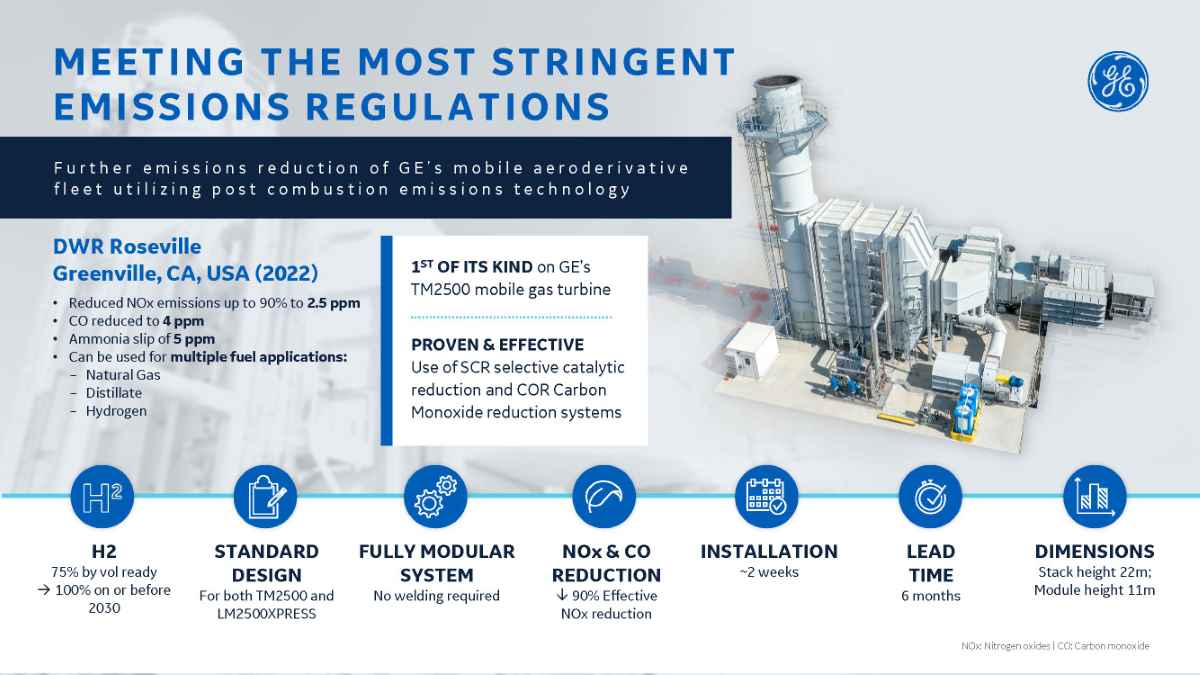
GE developed an innovative technical solution on four TM2500* aeroderivative gas turbines deployed at the Department of Water Resources’ (DWR) sites in Yuba City and Roseville
LAGOS, Nigeria, December 8, 2022/APO Group/ —
GE’s (GE.com) mobile aeroderivative gas turbines can now meet the most stringent emissions standard requirements; First system successfully installed on four GE TM2500* aeroderivative gas turbines in California; The developed solution is now available for GE TM2500* units globally; It includes proven Selective Catalytic Reduction (SCR) technology, and effective post-combustion control systems to help lower emissions from thermal power generation.
By responding to emergency needs tied to natural disasters and more needs for power to mitigate expected soaring electricity demand during the winter and summer seasons, or possible power restrictions due to the security of power supply issues, providing energy “in a pinch” is becoming increasingly important in the transition towards a lower-carbon power generation. GE (NYSE:GE) announced today GE’s mobile gas power technology, typically used for emergency use, can meet not only the emissions requirements in line with World Bank Standards, but even surpass them and meet the most stringent emissions standard requirements.
In the State of California, GE developed an innovative technical solution on four TM2500* aeroderivative gas turbines deployed at the Department of Water Resources’ (DWR) sites in Yuba City and Roseville. The solution reduced nitrogen oxide (NOx) and carbon monoxide (CO) emissions by over 90%, surpassing World Bank Emissions Standards. It marked the world’s first of a kind solution on a GE mobile TM2500. The technology helped lower emissions while supporting the statewide energy grid during extreme climate-driven events including drought or wildfires.
“GE’s aeroderivative mobile technology, typically used for emergency power, represents a perfect complement to renewable energy and peaking power use cases worldwide,” said Clive Nickolay, CEO of GE Gas Power’s Aeroderivative business line. “We’re excited about GE’s efforts to provide power plant operators with a technical solution that will allow them to quickly install peak power when needed, while drastically reducing NOx and CO emissions levels to low single digits.
The technical solution includes engineering studies for the integration and installation of a Selective Catalytic Reduction (SCR) technology system—a proven and effective solution to limit post-combustion emissions. The technology works by removing common emissions through a catalytic converter transforming the nitrogen oxides contained in the exhaust gas into water vapor and nitrogen. The new solution unlocks dramatic enhancements to emissions performance while ensuring the TM2500 can provide reliable, affordable, and lower carbon electricity to the grid.
GE’s aeroderivative mobile technology, typically used for emergency power, represents a perfect complement to renewable energy and peaking power use cases worldwide

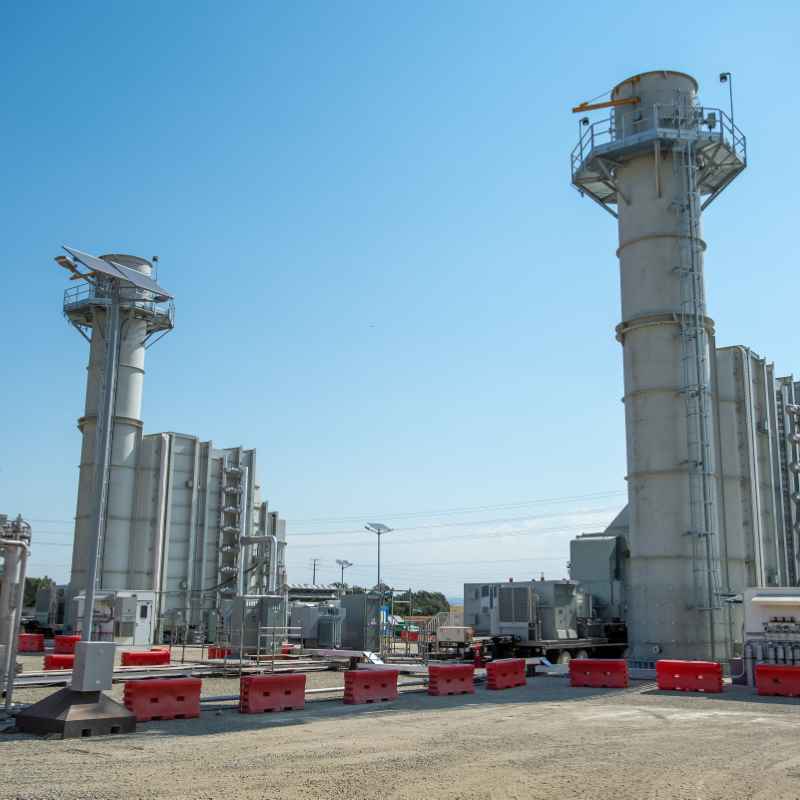
At Yuba and Roseville, GE worked with the engineering, procurement, and construction company Kiewit Power Constructors Co. to install this world’s first of this kind solution on a GE mobile gas power turbine to solve DWR’s emissions challenge. The emissions control solution includes 11-meter-high modules and a 22-meter-high stack. Each of the four TM2500 can produce up to 34 megawatts (MW) of electricity for a total of 136 MW and is now equipped with a system to reduce pollutants to 2.5 parts per million, the legal limit set by the state of California.
“Sub-Saharan Africa has one of the world’s fastest growing populations, and natural gas offers a solution that’s more efficient and flexible to enable the integration of more renewables to the grid and ultimately reduce emissions,” said Nosizwe Dlengezele, Regional Sales Executive for GE Gas Power business in Sub-Saharan Africa. “Our TM2500 aeroderivative gas turbines are installed in countries such as Nigeria, Angola, and Ghana, to provide much needed power because of its enhanced mobility, easy installation and critical grid backup. It also has lower emissions than diesel generators when operating on gas, and the availability of an SCR solution will now enable our customers to further reduce NOx and CO emissions by 90%.”
A key feature of the TM2500 units is its fast start ability providing full power in five minutes. This provides utilities and grid operators like California Independent System Operator (CAISO) or the Western Area Power Authority (WAPA) the ability to quickly support the grid in case of emergencies or loss of intermittent power. The quick start capability was successfully put to use when the units were brought online to support a strained statewide energy grid during California’s extreme heat wave on Sept 6, 2022.
GE’s trailer-mounted TM2500 is derived from jet-engine technology powering the world’s airlines and is mounted on a wheeled trailer for ultimate mobility. With more than 20 years of experience and over 300 units installed around the world, GE’s TM2500 is a proven solution for providing a baseload bridge to permanent power installations, or for generating backup/peak power in the wake of natural disasters, plant shutdowns, grid instability or in isolated locations.
GE powers plants that deliver flexible, efficient, and reliable power to millions of people around the world. With almost 70 years of presence in Sub-Saharan Africa, GE has been collaborating with energy stakeholders to deploy innovative technologies tailored to respond to the needs of the Sub-Saharan Africa region with reliable baseload and flexible power. GE delivers across the entire energy ecosystem from generation to transmission and distribution and throughout the region, GE-built technologies are supported by GE local service and maintenance teams working together to help ensure access to reliable and sustainable energy.
*Trademark of General Electric Company
Distributed by APO Group on behalf of GE.














Business
Creative Africa Nexus (CANEX) WKND 2026 opens in Lagos, bringing together leading African and diaspora creatives, investors and policymakers

Business
Coca-Cola system invests USD 1.22 million to strengthen water security in Namibia

Business
‘Power, Protect, Purchase’: Africa Made It unveils blueprint to capture USD 34B in GDP and accelerate African industrial sovereignty


Africa Practice research shows that Africa exports up to 98% of its raw cotton overseas and captures only 2% of its total value while incurring a USD 35 billion annual trade deficit


African culture, design, and storytelling influence global fashion, music, and media like never before
Africa Made It is driven by a consortium of leading pan-African organisations, advocacy groups, and media organisations who are positioning Africa as a global investment hub. Its flagship campaign, spotlighting the fibre-to-fashion value chain, presents a clear roadmap for continental industrialisation: securing competitive energy power for local industrial mills, enacting policy measures to protect emerging domestic manufacturers from unfair foreign imports, and rallying African consumers to purchase locally manufactured apparel. Together, these three pillars ensure that value created from African resources remains on African soil.
Africa Practice research shows that Africa exports up to 98% of its raw cotton overseas and captures only 2% of its total value while incurring a USD 35 billion annual trade deficit. Building the continent’s domestic processing capacity in spinning, weaving, and sewing locally produced cotton will sustain nearly two million permanent industrial jobs and inject approximately USD 33 billion directly into domestic household incomes every year, in addition to a recurring contribution of USD 34 billion to the continent’s GDP.
While these figures reveal the immense macro-economic potential of the value chain, the true heart of this transformation lies in its human impact. Industrial wages and local lint purchases leading to increased capital circulation in rural communities can drive community micro-economic vitality and contribute to rural poverty reduction. Additionally, formal employment opportunities can expand drastically for women, as they currently make up between 70-90% of garment factory workers on the continent.
Realising this vision and changing the lives of millions of people requires a deliberate combination of targeted investments, supportive trade policies, and consumer mobilisation. A USD 1.8 billion capital allocation toward critical structural enablers for garment transformation is the foundation for bridging Africa’s missing middle in the fibre-to-fashion value chain.
Marie Wilke, editor-in-chief of the Africa Made It magazine, said, “African culture, design, and storytelling influence global fashion, music, and media like never before. Yet, without domestic manufacturing infrastructure, Africa’s creative authority yields very little economic return. Linking raw cotton harvest directly to local processing ensures that the intellectual property, commercial margins, and industrial jobs remain on the continent. It is time to wear our power.”
To learn more about the potential of Africa’s fibre to fashion value chain, watch the campaign video (https://apo-opa.co/4BKAIvY) or read the Africa Made it (https://apo-opa.co/4zvA5VF)magazine (https://apo-opa.co/4zvA5VF). Access the campaign website and resources in English (https://apo-opa.co/4zvA5VF) and French (https://apo-opa.co/4zrK8e2).
Distributed by APO Group on behalf of Africa Made It.
-

 Business4 days ago
Afreximbank supports Veenocks’ US$145 million project for industrial expansion and regional growth
-

 Business4 days ago
Visa and Senegal join forces to accelerate digital transformation and the development of digital payments
-
Business4 days ago
Afreximbank Country Brief Explores Gabon’s Reform Momentum and Diversification Drive
-

 Business4 days ago
Oando Production Hits 42,985 boepd as Revenue Grows 9% in 9M 2026
-
 Business4 days ago
5 Investment Opportunities Putting Congo Energy & Investment Forum (CEIF) 2027 on the Map for Central Africa
-
 Energy4 days ago
Energy costs, storage value and industrial competitiveness led Day 2 of C&I Energy + Storage Summit
-
Business4 days ago
Afreximbank Country Brief Charts Côte d’Ivoire’s Rise as a Regional Growth Leader in West Africa
-

 Business4 days ago
Smarter power systems bring new demands for integration, security and infrastructure