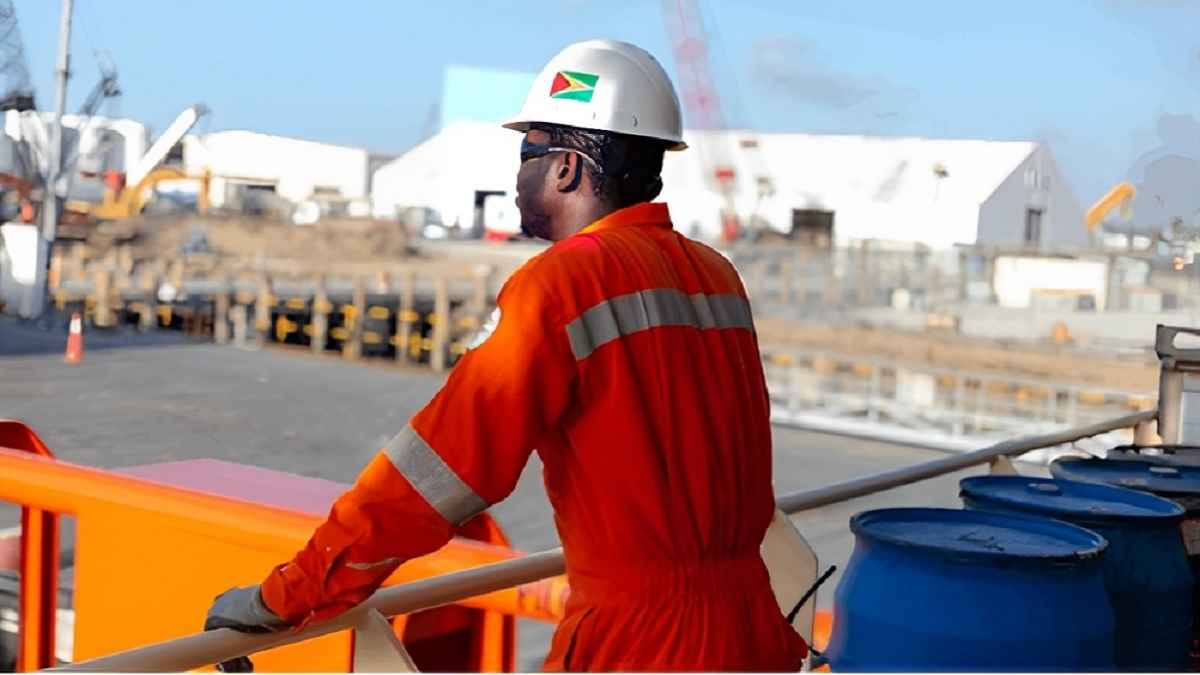
Not only have oil and gas companies been drawn to Guyana’s vast hydrocarbon resources, but they’ve also taken note of the country’s attractive regulatory and fiscal regimes
JOHANNESBURG, South Africa, July 10, 2023/APO Group/ —
By NJ Ayuk, Executive Chairman, African Energy Chamber (www.EnergyChamber.org)
Recently, a number of headlines recently have referred to the world’s “hottest frontier oil play,” a site of massive oil and gas finds with great promise for investors.
Not long ago, the media would have been talking about Namibia. When France’s TotalEnergies and the United Kingdom’s Shell announced large discoveries in Namibia’s offshore Orange Basin last year, there was nearly wall-to-wall press coverage.
But the headlines I’m referring to now aren’t about Namibia, or even Africa.
Instead, they’re about Guyana, on the northern coast of South America next to Venezuela.
More than 30 significant offshore oil discoveries have been made in Guyana’s Stabroek Block alone since 2015. U.S. energy major ExxonMobil, the first to announce a discovery there, estimates that the block holds at least 11 billion barrels of recoverable resources. And as recently as late June, Canadian companies CGX Energy and Frontera Energy announced that their joint venture discovered oil in Guyana’s Corentyne block, which also was the site of a light oil and gas condensate discovery in May 2022.
Not only have oil and gas companies been drawn to Guyana’s vast hydrocarbon resources, but they’ve also taken note of the country’s attractive regulatory and fiscal regimes. As a result, we’re seeing extensive activity there, prompting energy industry media outlets like Oil and Gas 360 to describe Guyana as “Latin America and the Caribbean’s latest drilling hotspot” while Bloomberg declares “Guyana Is the Most Exciting Story in the World Oil Market,” and Reuters calls Guyana an “oil powerhouse.”
I’m not saying Namibia is yesterday’s news, far from it. The Orange Basin is believed to hold up to 3 billion barrels of oil and 5.5 trillion cubic feet of natural gas. But Guyana’s positive press is an important reminder: As far as oil and gas companies are concerned, Namibia is not the only game in town. There is no guarantee that the excitement generated by Namibia’s petroleum resources will result in the country fully realizing all of the socioeconomic opportunities they represent, from eradicating energy poverty to growing the economy. Having significant hydrocarbon reserves certainly will get energy companies’ attention, but holding the companies’ interest — and convincing them to continue investing billions of dollars in exploration and production activities — requires deliberate, strategic measures on the part of a host country’s leadership.
The African Energy Chamber is pleased to see Namibia’s government working to provide an enabling environment for upstream activity and updating its tax laws. But Namibia must not stop there. To ensure ongoing exploration and production, Namibia’s leaders will need to do everything possible, as quickly as possible, to demonstrate that Namibia is investor friendly. That’s what Guyana has been achieving quite successfully. I encourage Namibia to follow its lead.
During African Energy Week in Cape Town from October 16-20, 2023 Namibia will take center stage and there will be many discussions about moving from discoveries to production but also the legal, commercial and geopolitical aspects of oil and natural gas development.
Guyana Offers Investors Fiscal Guarantees
For one thing, Guyana includes wording in its petroleum contracts to help oil and gas companies protect their investments; Namibia does not. I’m referring to a fiscal stability clause, which states that if the host country makes legislative or regulatory changes, such as new tax codes, the contracting energy company will be protected from negative economic impacts.
This isn’t the first time I’ve urged Namibia to begin including fiscal stability clauses in its petroleum agreements, but the point is so important that it bears repeating. Energy exploration is risk-intensive. Failing to provide a fiscal stability clause only adds to investing companies’ exposure and makes them more likely to consider channeling their efforts — and investment dollars — elsewhere. Failing to offer a fiscal stability clause also opens the door to prolonged contract negotiations and costly project delays. That would create a lose-lose for Namibia and the energy companies there.
The African Energy Chamber is pleased to see Namibia’s government working to provide an enabling environment for upstream activity and updating its tax laws
Guyana Fast-Tracks Development
I have written extensively this year about how delayed African oil and gas projects in Africa can rob countries of opportunities. Guyana has made a point of avoiding such pitfalls. Less than five years after ExxonMobil’s initial Stabroek Block discovery with partners Hess (U.S.) and China National Offshore Oil Corporate (CNOOC) in 2015, their Liza Phase I project began producing oil. That’s considered downright speedy in the oil and gas industry.
Since then, a second project, Liza Phase 2, went online, and production at their third project, Payara, is expected to get started this year. What’s more, ExxonMobil has made a final investment decision on two additional projects: Production at Yellowtail is scheduled to begin in 2025, to followed by the Uaru development coming online in 2026.
The president and CEO of the Energy Chamber of Trinidad and Tobago, Dax Driver, recently praised Guyana for developing its oil and gas resources at a record pace.
“For countries like Guyana and Suriname, with these massive oil resources in place, and some of them transitioning into reserves and some being produced, priority has to be to fast-track development of those resources,” Driver said. “This is something which Guyana has done extremely well since its first discovery. It is a world leader in fast-tracking its discoveries.”
And Driver understands what capitalizing on oil and gas can do: His country has become another valuable example for nations with petroleum resources like Namibia. As I wrote in my 2019 book, “Billions at Play: The Future of African Energy and Doing Deals,” Trinidad and Tobago, a twin-island nation off the coast of Venezuela, has made natural gas monetization an art form since the 1970s. With less than 1% of known global gas reserves, Trinidad and Tobago became the world’s leading exporter of two gas-based products, ammonia and methanol, and went on to become one of the world’s top five liquefied natural gas (LNG) exporters. Today, Trinidad and Tobago has one of the highest gross national incomes (GNI) per capita in Latin America and the Caribbean (USD17,640 in 2015). Guyana is well on its way to following Trinidad and Tobago’s example, and I hope African nations like Namibia will do the same.
Guyana Continues to Drive its Energy Industry Forward
I agree with Driver’s assessment: Guyana is serious about moving its energy industry forward, and it wisely recognizes the value of monetizing its natural gas resources. Guyana’s Vice President Bharrat Jagdeo has spoken of the importance of monetizing the country’s natural gas resources and creating new revenue streams sources before the global energy transition reduces demand for fossil fuels. Guyana’s leadership is working with technicians and consultants on a national strategy for using natural gas as a feedstock for petrochemicals and liquefied natural gas (LNG).
At the same time, Guyana’s government has been updating the country’s oil and gas regulations to help ensure ongoing investment and benefits for the Guyanese people. The proposed Petroleum Activities Bill includes safety and emergency response measures, along with supervision and monitoring requirements, capacity-building requirements for energy companies, and a framework for permitting petroleum product transportation and treatment. It also includes cross-border unitization, a legal framework for developing and allocating petroleum reserves that span across Guyana’s maritime boundaries with other countries.
In addition, the government passed strong local content legislation in 2021 and is fine-tuning it with input from the Ministry of Natural Resources. The resulting policy will include an effective framework for international oil companies to communicate their needs to local businesses, making it easier for Namibian businesses to grow and create jobs. This is another lesson that Namibia, and African countries in general, can learn from.
Perhaps one of the best examples that Guyana is setting is that it approaches its oil and gas industry with a sense of urgency. Urgency to get as much value as possible from its petroleum resources. Urgency to get policies right, so the country can continue attracting investments and reaping the benefits they offer. And urgency to prevent project delays that could prevent Guyana from achieving its energy industry goals.
This sense of urgency, as much as the oil and gas resources beneath the ground, is why Guyana
is making headlines for being an oil and gas hotspot.
I’m looking forward to watching Namibia achieving similar results and, like Guyana, becoming a role model for other nations with petroleum resources.
Distributed by APO Group on behalf of African Energy Chamber.












 Business4 days ago
 Business4 days ago
 Energy4 days ago
 Business4 days ago
 Events4 days ago