Connect with us

Business

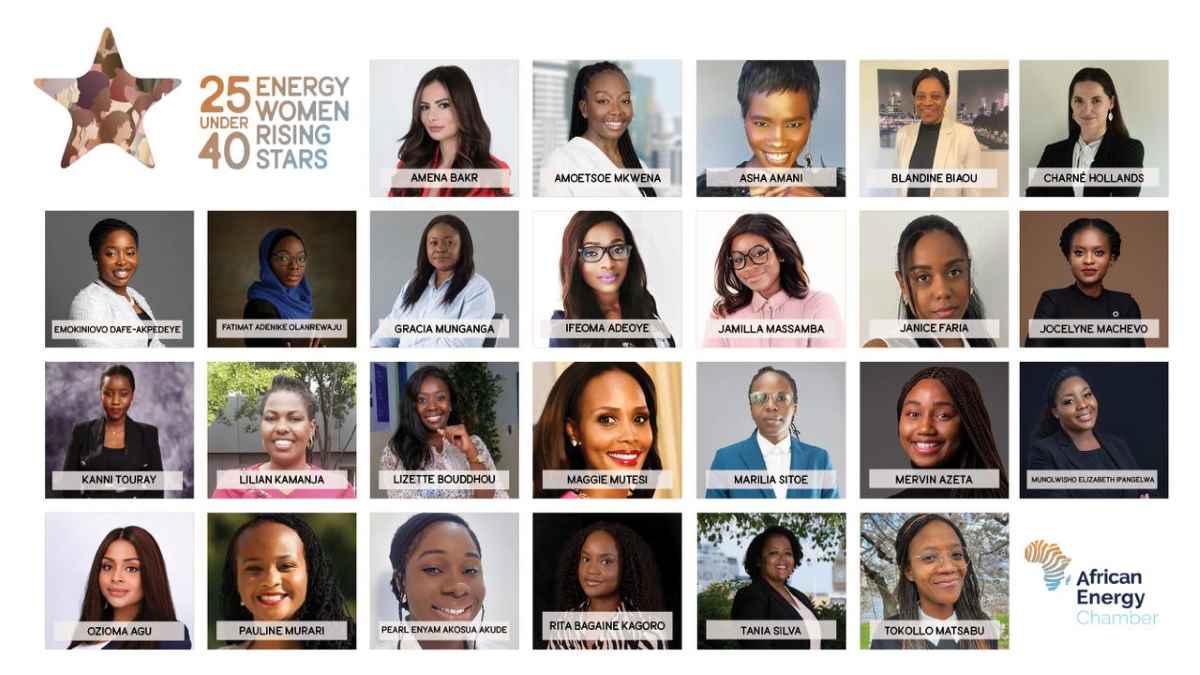
Celebrating this Year’s 25 Under 40 Energy Women Rising Stars

Published

on

African Energy Chamber

The African Energy Chamber proudly announces the 25 Under 40 women who are playing an instrumental part in strengthening Africa’s energy industry

CAPE TOWN, South Africa, September 21, 2024/APO Group/ — 

As Africa’s energy sector continues to grow, a new generation of women is breaking barriers and redefining leadership in this critical industry. The African Energy Chamber (AEC) (www.EnergyChamber.org) proudly announces the 2024 edition of the 25 Under 40 Energy Women Rising Stars – a group of outstanding individuals whose innovation, perseverance and passion are transforming the landscape of African energy. These trailblazers are not only reshaping a traditionally male-dominated field but are also playing a vital role in the journey to end energy poverty by 2030. The AEC proudly honors these women as they lead the charge toward a more sustainable and equitable energy future.

In alphabetical order:

Amena Bakr, Senior Research Analyst, Energy Intelligence

Amena Bakr is a Senior Research Analyst at Energy Intelligence. Specializing in the energy transition, corporate strategy and market analysis, Bakr leads insights on oil markets, OPEC policies and political trends in the Middle East and Gulf Arab region. Her previous roles include Chief OPEC Correspondent and Dubai Deputy Bureau Chief, where she earned accolades such as the OPEC Award for Best Journalist and the IAEE Excellence in Written Journalism Award. Bakr holds a BA in Business Administration from the Arab Academy for Science, Technology & Maritime Transport, Egypt.

Amoetsoe Mkwena, Senior Associate, Watson Farley & Williams (Middle East)

Amoetsoe Mkwena is a Senior Associate at Watson Farley & Williams, specializing in energy and infrastructure with a focus on Africa. She advises on international projects, including the $15 billion Simandou project in Guinea. Mkwena’s expertise includes power, renewables, oil and gas, and mining. Her legal skills and ability to bridge cultural divides make her a key player in Africa’s energy sector.

Asha Amani, General Manager, INTERAFCON

Asha Amani is the General Manager at INTERAFCON, where she blends strategy and leadership to drive growth in complex energy projects. With seven years in Industrial Engineering and five years in the energy sector, Amani excels in business strategy, opportunity identification and project management. Her previous role as a Business Development Consultant at Tetco Consulting focused on delivering tailored solutions for the energy, engineering, and construction sectors.

Blandine Biaou, Geological Engineer, Head of Research and Prospection Department, SNH-Benin

Blandine Biaou, Head of the Research and Prospection Department at SNH-Benin, specializes in hydrocarbon exploration. She has optimized Benin’s energy sector through resource management and contract revisions. Biaou has developed a modern data center and interactive database, contributing to national projects and representing Benin in international conferences, positioning it as a hydrocarbon hub.

Charné Hollands, Deputy Editor, Energy Capital & Power

Charné Hollands is the Deputy Editor at Energy Capital & Power, the leading investment platform for the African energy sector. She produces content on the entire energy value chain in Africa, with a focus on oil, gas, renewable energy and energy policy. Hollands holds a Master’s in Media Studies from the University of Cape Town and has co-authored African Energy Chamber: Road to Recovery.

Emokiniovo Dafe-Akpedeye, Managing Partner, Compos Mentis Legal Practitioners

Emokiniovo Dafe-Akpedeye, a leading dispute resolution lawyer, specializes in complex oil and gas cases. She has represented Shell Petroleum and serves as company secretary for the Ebendo Host Community Trust Board. With degrees from Oxford and Bristol, she shapes oil and gas law and is implementing digital solutions to streamline board operations.

Fatimat Adenike Olanrewaju, General Field Engineer, SLB

Fatimat Adenike Olanrewaju, a Chemical Engineering graduate, is a General Field Engineer at SLB, focusing on wellhead installations and emissions reduction. She excels in a male-dominated field and leads community service through SLB’s SEED initiative, advocating for gender diversity and mentoring.

Gracia Munganga, Senior Technical Advisory, ABT Global

With a Master’s degree in Chemical Engineering from the University of Cape Town, Gracia oversees operations for the company, which has been designing and commissioning solar PV systems across sub-Saharan Africa since 2018. Her career includes roles at GreenCape, Anaergia Africa, the Climate Innovation Centre South Africa (CIC-SA), and the Carbon Trust.

Ifeoma Adeoye, CEO, IMSE Energy Resources Limited

Ifeoma Adeoye, CEO of IMSE Energy Resources Limited, leads the company in EPCI services and innovative crude evacuation technology. A graduate of the University of Manchester and Warwick, she also founded Business Nest Investments and BNI Insurance Brokers Limited, to empower and protect people and businesses through microfinance and insurance.

Jamilla Massamba, Health Safety and Environment Manager, SLB Congo

Jamilla Massamba, Health, Safety & Environment Manager at SLB Congo, leads HSE initiatives across Africa. With a Master’s in Environmental Management Sciences, she has conducted over 100 audits and received awards for her work. Massamba also mentors young women in STEM and leads green energy projects.

Janice Faria, CEO, Enagol: Energias de Angola

As CEO of Enagol, Janice Faria has elevated the company’s national and international profile. Under her leadership, Enagol competes globally and services International Oil Companies, setting a precedent for local enterprises in the global market.

Jocelyne Machevo, Communication, Commercial & Marketing Manager, Vivo Energy Mozambique

Jocelyne Machevo, formerly with Eni Mozambique, played a key role in the Coral FLNG Project and led the company’s local brand transformation. Now at Vivo Energy Mozambique, she focuses on energy transition and decarbonization projects.

Lilian Kamanja, Electrical Engineer, Kenya Power

Lilian Kamanja is a Renewable Energy Specialist at Kenya Power with over nine years of experience in electrical engineering, network operations, and renewable energy development. She holds a BSc from the University of Nairobi and an M.Tech from IIT Delhi, focusing on renewable energy projects that enhance power accessibility and reliability.

Kanni Touray, Deputy Director General, Petroleum Commission, The Gambia

Kanni Touray, The Gambia’s youngest and first female Deputy Director General at the Petroleum Commission, has enhanced the organization’s efficiency and visibility. She champions sustainable development and energy transition, positioning The Gambia as a growing player in the global energy market.

Lizette Bouddhou, Human Resources Manager, SLB Congo and Gabon SLB

Lizette Bouddhou, HR Manager at SLB Congo and Gabon, drives diversity and workforce development. She leads recruitment and training initiatives, boosts employee engagement, and advances community outreach through educational partnerships, supporting women in STEM.

Maggie Mutesi, Managing Editor, Mansa Media

Maggie Mutesi is the Managing Editor at Mansa Media, with over 15 years of experience in major media outlets including CNN, BBC and CNBC. Her reporting spans over 30 African countries, focusing on trade and investments. At the BBC, she managed BBC Africa’s daily live program, Money Daily. Mutesi has also extensively covered the Africa Continental Free Trade Agreement, working with the African Union and Afrochampions Initiative to enhance awareness among Africa’s private sector.

Marilia Sitoe, Subsea Engineer, Eni Rovuma Basin

Marilia Sitoe, a Subsea Engineer at Eni Rovuma Basin, focuses on optimizing Mozambique’s gas sector. Her work includes deep-water gas production and subsea infrastructure for Coral South FLNG. Sitoe’s research supports Mozambique’s economic growth and sustainability goals.

Mervin Azeta, Engineer, SLB

Mervin Azeta, a leader at SLB, has advanced from field engineer to corporate strategist. Recognized for her impact on African communities and the global industry, she is active in non-profit boards and connects young Africans with top leaders, fostering learning and inspiration.

Munolwisho Elizabeth Ipangelwa, Green Hydrogen Advisor, GIZ

Munolwisho Elizabeth Ipangelwa, Green Hydrogen Advisor at GIZ, advocates for women in oil and gas and green hydrogen development in Namibia. She has educated over 200 Namibians and leads green industrialization studies to boost local industries and reduce youth unemployment.

Ozioma Agu, Partner, Stren & Blan Partners

Ozioma Agu, a Partner at Stren & Blan Partners, excels in high-profile energy and infrastructure transactions. Her work includes advising on Mobil and Shell divestments and renewable projects. Agu has earned awards for her expertise in oil and gas and green hydrogen.

Pauline Murari, Contracts Manager SLB Angola, Central and East Africa

Pauline Murari, Contracts Manager at SLB, is known for her negotiation skills and leadership. She has driven growth in SLB’s regional portfolio and contributed to projects like the East African Crude Oil Pipeline. Murari supports STEM education and local development.

Pearl Enyam Akosua Akude, Business Line Job Delivery Lead, SLB

Pearl Enyam Akosua Akude, with over 35 wells drilled, is a leader in the energy sector. She handles complex projects, trains engineers, and has contributed to innovations like TerraSphere and Net Zero Development in Africa, impacting the region’s energy landscape.

Rita Bagaine Kagoro, Talent Acquisition Manager SLB: Angola, Central and East Africa

Rita Bagaine Kagoro, a Ugandan Petroleum Engineer, has seven years of experience and holds degrees from China University of Petroleum and Delft University of Technology. Her roles include Measurements and Logging While Drilling Engineer and Drilling Product Engineer. Kagoro has innovated drilling technologies to enhance efficiency and reduce CO2 emissions. She is passionate about leadership, mentorship, and advocating for diversity in hiring and women in energy.

Tania Silva, CEO, Angola LNG Marketing

Tânia Silva is the CEO of Angola LNG Marketing, the company’s first female and youngest CEO. She oversees LNG sales, liquids contracts, and the shipping fleet. Previously, Silva was Head of Non-Operated Assets at Sonangol Gás e Energias Renováveis, S.A., where she managed non-operated assets and contributed to renewable energy projects. Her career is marked by leadership and innovation in the energy sector.

Tokollo Matsabu, Women Leader in Energy & Climate Fellow, Atlantic Council

Tokollo Matsabu is a 2024 Women Leaders in Energy and Climate Fellow and Director at Patlong Advisory, a consulting firm focused on energy programs and carbon sequestration in Africa. She is pursuing an MS in Global Energy and Climate Policy at the University of London’s School of Oriental & African Studies, with a focus on critical minerals. Matsabu has a background in financial journalism and has conducted risk analyses for various stakeholders in the Global South. She holds a Bachelor’s degree in International Relations, Media and Writing from the University of Cape Town.

Distributed by APO Group on behalf of African Energy Chamber.

Business

Nigeria’s Upstream Reform Program Captures 40% of Africa’s Final Investment Decision (FID) Activity After a Decade on the Margins

Published

on

A government three-year review documents how executive action under President Tinubu reversed a decade of upstream decline

JOHANNESBURG, South Africa, May 8, 2026/APO Group/ –Nigeria has gone from capturing 4% of Africa’s upstream final investment decisions (FIDs) to commanding 40% in two years, according to Nigeria’s Energy Sector Reforms 2023-2026: A Three-Year Review, published by the Office of the Special Adviser to the President on Energy and spearheaded by Special Adviser Olu Verheijen. The $50 billion project pipeline now in development beyond 2026 points to sustained capital commitment at a scale not seen in the Nigerian upstream for at least a decade.


Between 2014 and 2023, Nigeria was among the continent’s weakest performers for upstream FIDs despite holding 37.5 billion barrels of proven oil reserves, the second-largest endowment in Africa. Algeria captured 44% of African upstream FIDs during that period, Angola held 26%, while Nigeria trailed Mozambique, Ghana, Senegal and Namibia. In the third quarter of 2022, crude production briefly dropped below one million barrels per day, as years of underinvestment, pipeline vandalism and regulatory ambiguity compounded each other. However, reforms instituted by Nigeria’s President Bola Tinubu have dramatically turned this trend around. Through deliberate and coordinated steps, the government has reset the trajectory.

Addressing Fiscal Terms, Regulatory Scope and Contracting Speed

President Bola Tinubu’s administration moved simultaneously on fiscal terms and regulatory architecture. Policy directives in 2023 clarified the boundary of jurisdiction between the Nigerian Upstream Petroleum Regulatory Commission (NUPRC) and the Nigerian Midstream and Downstream Petroleum Regulatory Authority (NMDPRA), resolving an ambiguity that had complicated project sanctioning. Presidential Directive 40 introduced targeted tax incentives, and a separate Notice of Tax Incentives for Deep Offshore Production in 2024 was designed to draw international oil companies (IOCs) back into capital-intensive, long-cycle deepwater projects. The VAT Modification Order 2024 and Upstream Cost Efficiency Order 2025 addressed the cost structures that had rendered marginal projects uneconomic. NNPCL contracting timelines were compressed from 36 months to a maximum of six months.

Four Divestments Transferred Onshore Control to Indigenous Operators

In parallel, the administration deployed targeted security directives and accelerated ministerial consents for four IOC asset transfers. Renaissance acquired Shell’s onshore portfolio. Seplat Energy completed its acquisition of ExxonMobil’s Nigerian upstream interests. Oando took over from Agip, and Chappal acquired Equinor’s local assets. The four transactions totaled approximately $4 billion. The transfer of onshore and shallow-water blocks to indigenous operators contributed directly to production recovery. Output rose by approximately 400,000 barrels per day between 2023 and 2025 to reach 1.6 million barrels per day, the highest onshore production level in 20 years.

When a government rebuilds fiscal competitiveness and regulatory predictability at the same time, capital responds

Signed Projects Total $10 Billion, With a $50 Billion Pipeline Beyond

The reforms produced a concrete FID response from Shell and TotalEnergies. Shell Nigeria Exploration and Production Company (SNEPCo) sanctioned the $5 billion Bonga North deepwater development in December 2024 and committed a further $2 billion to the HI Non-Associated Gas (NAG) project. TotalEnergies and NNPCL took a joint FID on the $550 million Ubeta gas field development in June 2024.

Together those three commitments account for more than $10 billion in signed investment after a decade of near-zero sanctioning activity. The pipeline beyond 2026 spans a further $50 billion across 11 projects including Bonga South West, Owowo, Usan and Erha. Nigeria approved 28 field development plans valued at $18.2 billion in 2025 alone, targeting an estimated 1.4 billion barrels of reserves.

“When a government rebuilds fiscal competitiveness and regulatory predictability at the same time, capital responds,” said NJ Ayuk, Executive Chairman of the African Energy Chamber. “Nigeria has done both, and the FID numbers are concrete proof.”

The Counterfactual Illustrates How Much Was at Stake

The presentation includes a no-reform projection that puts the gains in context. Without intervention, total crude and condensate production was on track to fall from 1.371 million barrels of oil equivalent per day in 2022 to 579,000 by 2030. Under the reform trajectory, output reached 1.77 million barrels of oil equivalent per day in 2026, with a stated government target of 3 million barrels per day. Export gas utilization rose 39% over the same period, while domestic utilization grew by 7%.

The durability of these gains will be tested by two factors: whether the institutional architecture put in place under the Tinubu administration holds over the long term, and whether the deepwater commitments signed in 2024 and 2025 advance to execution on schedule. The project pipeline is large enough that partial delivery would still represent a generational shift in Nigeria’s upstream output profile.


Distributed by APO Group on behalf of African Energy Chamber.

Continue Reading

Business

Angola Strengthens Global Investment Drive Across Oil, Gas and Mineral Resources

Published

on

With sweeping reforms across the extractive sector, Angola is entering a new phase defined by transparency, regulatory modernisation, value addition, and international partnership

LONDON, United Kingdom, May 8, 2026/APO Group/ –At a defining moment in Angola’s economic transformation, the Critical Minerals Africa Group (CMAG) (https://CMAGAfrica.com), together with the Government of Angola and the Ministry of Mineral Resources, Petroleum and Gas of the Republic of Angola (MIREMPET), will convene global investors, policymakers, and industry leaders in London for the Angola Oil, Gas & Mining Investment Conference on 14 May 2026.


More than a conference, this gathering represents a strategic international engagement at a time when Angola is actively reshaping its economic future and positioning itself as one of Africa’s most compelling destinations for long-term investment in natural resources, infrastructure, and industrial development.

With sweeping reforms across the extractive sector, Angola is entering a new phase defined by transparency, regulatory modernisation, value addition, and international partnership. The country’s leadership is sending a clear message to global markets: Angola is open for investment and ready to build transformational partnerships that support sustainable growth and economic diversification.

This is not simply about resource development, it is about building long-term industrial growth, strengthening energy and mineral supply chains, and shaping Angola’s future

The event will be headlined by H.E. Diamantino Azevedo, Minister for Mineral Resources, Oil and Gas of Angola, whose leadership since 2017 has been central to advancing Angola’s mineral and hydrocarbons agenda. Under his stewardship, Angola has accelerated institutional reform, strengthened governance frameworks, promoted private sector participation, and prioritised sustainable resource development.

As global demand intensifies for critical minerals, energy security, and resilient supply chains, Angola is uniquely positioned to become a strategic partner to international investors and industrial economies. The country’s vast untapped mineral wealth, significant oil and gas reserves, expanding infrastructure ambitions, and commitment to economic diversification present a rare investment window for global stakeholders.

Speaking ahead of the event, Veronica Bolton Smith, CEO of the Critical Minerals Africa Group said:

“Angola stands at a pivotal point in its national development. The reforms taking place across the country’s extractive sectors are creating unprecedented opportunities for responsible international investment and strategic partnership. This is not simply about resource development, it is about building long-term industrial growth, strengthening energy and mineral supply chains, and shaping Angola’s future as a globally competitive investment destination. We believe this moment represents one of the most important opportunities for international partners to engage with Angola’s leadership and participate in the country’s next chapter of economic transformation.”

The event is expected to attract a distinguished international audience, including sovereign representatives, institutional investors, mining and energy executives, infrastructure developers, development finance institutions, and strategic partners seeking direct engagement with Angola’s leadership.

Distributed by APO Group on behalf of Critical Minerals Africa Group (CMAG).


Continue Reading

Business

The Islamic Development Bank (IsDB) Group Successfully Concludes Private Sector Roadshow in Baku

Published

on

Bringing together a diverse range of stakeholders, the Forum showcased IsDB Group services, activities, and initiatives across its 57 member countries, with particular emphasis on Azerbaijan

BAKU, Azerbaijan, May 7, 2026/APO Group/ –The Islamic Development Bank Group (IsDB) affiliates (www.IsDB.org) – namely the Islamic Corporation for the Insurance of Investment and Export Credit (ICIEC), the Islamic Corporation for the Development of the Private Sector (ICD), and the International Islamic Trade Finance Corporation (ITFC) – in cooperation with the Islamic Development Bank Group Business Forum (THIQAH), organized the “IsDB Group Private Sector Roadshow” in Baku, Azerbaijan, in close collaboration with the Ministry of Economy of the Republic of Azerbaijan and the Export and Investment Promotion Agency of the Republic of Azerbaijan (AZPROMO).


The high-profile event which took place on Thursday, 7th May 2026, at Azerbaijan’s Ministry of Economy, came as part of ongoing preparations for the upcoming IsDB Group Annual Meetings and Private Sector Forum (PSF 2026), scheduled to take place from 16 to 19 June 2026, under the high patronage of His Excellency President Ilham Aliyev, the President of the Republic of Azerbaijan.


Bringing together a diverse range of stakeholders, the Forum showcased IsDB Group services, activities, and initiatives across its 57 member countries, with particular emphasis on Azerbaijan. It highlighted the Group’s ongoing support for private sector development and its efforts to stimulate promising investment and trade opportunities in the Azerbaijani market.


The event also served as a unique opportunity inviting the audience to participate actively in IsDB Group Annual Meetings and the Private Sector Forum (PSF 2026). The program included panel discussions and specialized workshops on ways to enhance economic partnerships and the role of IsDB Group’s institutions in supporting the needs of member countries. The spectra of services, solutions and financial tools were also presented, including lines and modes of Islamic financing, trade finance and trade development solutions, corporate private sector financing, as well as risk mitigation solutions plus investment insurance and export credit insurance services.


Keynote speakers, in their speeches, underlined strong commitment to deepening engagement with the private sector and fostering meaningful partnerships that drive sustainable economic growth in light of the upcoming IsDB Group Annual Meetings in Baku, all to showcase integrated solutions especially in Islamic finance, trade, investment, and risk mitigation while working closely and collectively with private sector partners to unlock new opportunities, support innovation, and empower businesses contributing to inclusive and resilient development across IsDB Group member countries.

Distributed by APO Group on behalf of Islamic Development Bank Group (IsDB Group).


Continue Reading

Trending

Exit mobile version