Connect with us

Energy

Caribbean Energy Week 2026 Ignites Regional Oil and Renewables Dialogue

Published

on

CEW

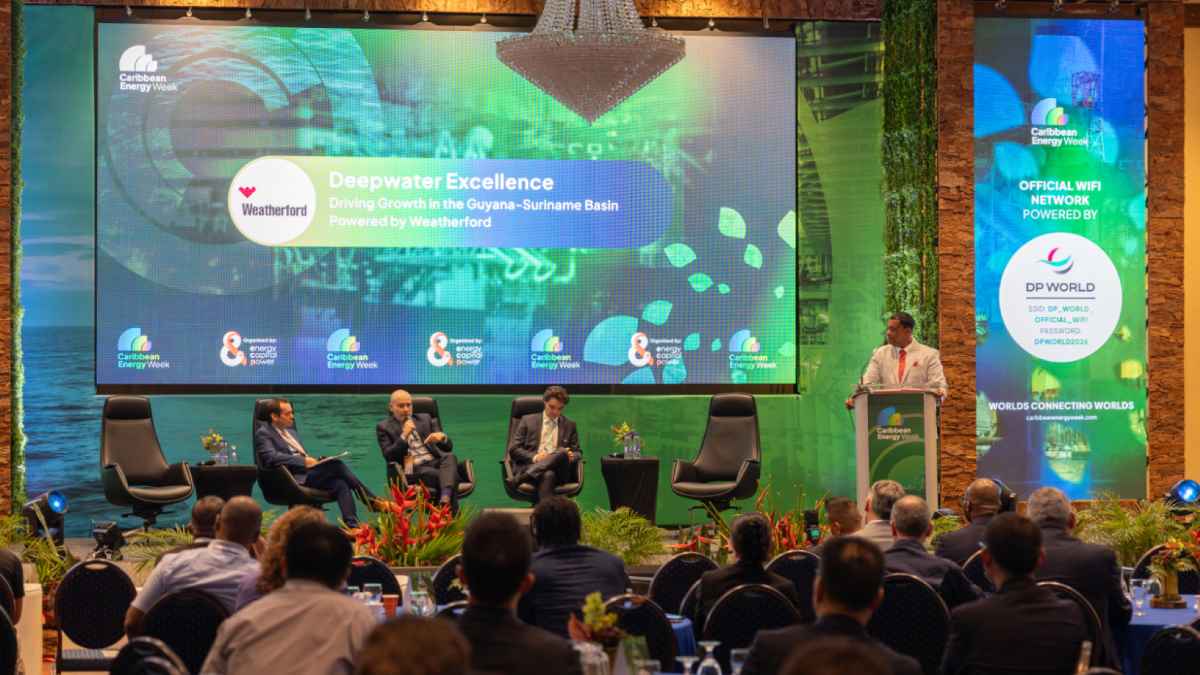
Caribbean Energy Week 2026 in Paramaribo gathered leaders, investors and national oil companies to discuss hydrocarbons, renewables, infrastructure, mining and carbon credits, spotlighting the region’s evolving energy landscape

PARAMARIBO, Suriname, April 2, 2026/APO Group/ –Caribbean Energy Week (CEW) 2026 kicked off in Paramaribo, Suriname, uniting government officials, investors and industry leaders to explore the region’s evolving energy landscape on 30 March. Day 1 highlighted discussions on hydrocarbons, renewables, power infrastructure, mining and carbon credits, featuring keynotes and panels with the Caribbean Community (CARICOM) and regional energy ministers, alongside executives from major national oil companies.


Caribbean Doubles Down on Oil

Caribbean leaders at CEW advocated a balanced energy strategy that embraces both oil and gas development alongside renewables, arguing that global demand growth necessitates a pragmatic mix. Surinamese Foreign Affairs Minister Melvin Bouva and Oil and Gas Minister Patrick Brunnings, as well as Trinidad and Tobago’s Energy Minister Ernesto Kesar highlighted the need to convert major discoveries – such as Guyana’s Stabroek Block and Suriname’s GranMurgu project – into sustained production. The ministers also said the projects have the potential to attract investment, enhance regional cooperation and build local capacity, while emphasizing that hydrocarbons will remain central to the region’s energy outlook for the foreseeable future.


Suriname is positioning itself as a key investment destination by advancing new frameworks to boost certainty and streamline project development, with first oil expected by 2028 and gas by 2030. Officials stressed that energy transition goals should be realistic, balancing decarbonization with immediate economic and energy needs, and ensuring that oil and gas revenue supports broader economic growth through workforce development, stronger local content and private sector participation.


Grenada Hydrocarbon Tender Launch

Grenada plans to launch a selective offshore hydrocarbon tender by the end of 2026 or early 2027, inviting oil and gas companies to bid on exploration blocks. Lead Consultant at the Grenada Hydrocarbon Technical Working Group Gilbert Yevi said the move aims to kick-start development of the nation’s unexplored offshore potential, backed by extensive seismic data and a technical working group focused on building the industry responsibly and competitively.


Afreximbank $5 Billion Caribbean Mandate

The African Export-Import Bank (Afreximbank) plans to use its expanded $5 billion CARICOM financing mandate to support Caribbean oil and gas development, local content growth and energy sector collaboration, especially as new producers emerge. The bank’s Caribbean head Okechukwu Ihejirika highlighted past financing – including backing Suriname’s Staatsolie stake in GranMorgu – and said the bank is building interregional platforms with CARICOM to attract capital and expertise to the region.


Caribbean Energy Financing Expansion

The Caribbean’s energy financing landscape is strengthening as the Afreximbank boots its CARICOM financing capacity from $3 billion to $5 billion, aiming to narrow the region’s funding gap for energy, infrastructure and industrial projects. Officials at CEW stressed that broad access to capital is critical to turning energy ambitions into reality, with the expanded facility set to support a variety of regional developments.


This expanded commitment signals a shift toward locally anchored financing structures capable of backing energy and logistics projects across Caribbean markets, while Caribbean authorities push to address infrastructure challenges and strengthen regional ties. Speakers also highlighted the importance of local content and workforce development in ensuring that resource development translates into domestic economic growth and cross-Atlantic cooperation with African partners is gaining momentum to share expertise and financing models.


U.S. Caribbean Energy Partnerships

The U.S. is intensifying energy partnerships in the Caribbean, focusing on Suriname’s expanding oil and gas sector and broader regional energy security. U.S. officials emphasize modern infrastructure, workforce development and sustainable investment aligned with long-term growth, while cautioning against unsustainable external financing. They highlighted U.S. firm’s role in exploration, citing APA Corporation’s work in Suriname and potential opportunities across the energy value chain.


Suriname’s GranMorgu Project Gains Momentum

Industry leaders expressed that Suriname’s offshore GranMorgu development is progressing quickly toward first oil in 2028, with TotalEnergies advancing FPSO construction, subsea testing and upcoming drilling campaigns while new infrastructure and supply chain capacity are built. Companies including SBM Offshore, Shell and Weatherford emphasized that beyond production, the project’s success will rely on workforce training, stronger local participation and long-term planning as Suriname’s offshore sector continues to mature.

Distributed by APO Group on behalf of Energy Capital & Power.

Energy

Ghana Boycotts Africa Energies Summit as Industry Pushes Back Against Discrimination

Published

on

Ghana’s decision to withdraw from the London-based Africa Energies Summit signals a growing industry stance against discrimination, exclusion and the sidelining of African stakeholders in conversations about Africa’s energy future

JOHANNESBURG, South Africa, April 3, 2026/APO Group/ –Ghana has moved to boycott the upcoming Africa Energies Summit in London this May, a decision that reflects growing frustration across the African oil and gas industry over discrimination, exclusion and the marginalization of African voices at events that claim to represent the continent’s energy future. Energy Chamber Ghana has released a statement calling on Ghanaian energy authorities to reconsider their participation in the summit, expressing deep concerns regarding discriminatory hiring practices and the continued exclusion of African professionals. The move sends a strong signal: Africa’s energy industry must be shaped with African institutions and companies at the center of the conversation.


The decision to withdraw mirrors similar actions taken by other African industry stakeholders in recent months and reflects a broader shift across the sector, where governments, national oil companies and indigenous firms are increasingly pushing back against platforms that exclude African participation. Mozambique made the decision to withdraw from the summit in March 2026, while petroleum ministers from the African Petroleum Producers Organization also moved to boycott the event. Ghana’s boycott is not simply about one event; it is about principle, representation and ensuring that African countries are treated as equal partners in discussions about their own resources.

The announcement by Energy Chamber Ghana follows careful consultation with stakeholders across the country’s petroleum, gas and broader energy ecosystem, with the Chamber calling on Ghanaian institutions, policymakers, engineers, investors and academics to take the approach – at least until corrective action is demonstrated by Frontier Energy Network, the organizers of the summit. The Chamber highlighted that “Ghana is not a spectator in Africa’s energy story,” and that, “Africa cannot be treated as a marketplace for attendance while Africans are treated as optional participants in execution.”

Africa’s energy sector cannot accept a future where conferences built on African participation exclude African professionals from meaningful roles behind the scenes

“Ghana has invested heavily in building engineers, economists, regulators and nnovators who are shaping this continent’s energy trajectory. Platforms that carry Africa’s name must reflect Africa’s people. Until we see transparency and measurable inclusion, it is both reasonable and responsible for stakeholders across our ecosystem to reconsider participation,” Joshua B. Narh LLM, MBA and Executive Chairman of the Energy Chamber Ghana said on LinkedIn.

Ghana’s decision to boycott the event comes at a critical time for the country. With goals to stabilize oil production, monetize gas and shift capital toward infrastructure that anchors long-term industrial growth, the country is promoting African-led investment and development across its market. In 2026, the country is seeing consolidation by IOCs as well as accelerated expansion by indigenous operators. Around $3.5 billion has been committed to infill drilling and reservoir management to stabilize output, while efforts are underway to unlock new frontiers in the Voltaian Basin. The Jubilee and TEN licenses have been expanded to 2040, while advancements at the Second Gas Processing Plant, the 1.2 GW Thermal Power Plant and downstream LPG are anchoring Ghana’s gas strategy. These projects showcase a market that is moving in the right direction and eager to unlock more value from its resources.

Despite this momentum, the actions of international conference producers to continue excluding African professionals’ risks undermining the very partnerships and growth the industry is trying to build. At a time when African countries are working to attract capital, build local capacity and strengthen regional energy cooperation, industry platforms should be supporting these goals – not creating barriers to participation. Energy Chamber Ghana highlighted valid concerns surrounding Frontier’s discriminatory approach to hiring Black professionals, emphasizing that Africa must not be invited to events to simply attend conversations about itself. According to the Chamber, local content must not be positioned as a conference theme, but reflected in practice by conference organizers themselves.

“Africa’s energy sector cannot accept a future where conferences built on African participation exclude African professionals from meaningful roles behind the scenes,” he noted.

Ultimately, Ghana’s call to boycott the Africa Energies Summit is about more than a single summit in London. It reflects a broader industry movement toward African-led development, African-led dialogue and African-led investment strategies. If Africa is to fully develop its oil, gas and energy resources, the continent must not only control its resources, but also its narrative, its platforms and its partnerships.

Distributed by APO Group on behalf of African Energy Chamber.

Continue Reading

Energy

Rift Over Oil and Gas Discrimination Claims Evident in Institutional Boycott of London African Energy Summit

Published

on

The African oil industry – led by the continent’s petroleum ministers – will continue to boycott the upcoming Africa Energies Summit in London until the organizers address concerning policies around discrimination and local content

JOHANNESBURG, South Africa, March 31, 2026/APO Group/ –The industry-wide boycott of the upcoming Africa Energies Summit will continue as the conference organizers Frontier Energy Network refuse to abandon their policy of discrimination. The Mozambique oil industry alongside petroleum ministers from the African Petroleum Producers Organization have already withdrawn from the conference, citing concerns over the treatment of Black professionals and broader local content issues. With Frontier – led by Daniel Davidson – refusing to address the company’s decision to not hire Black professionals and the continued exclusion of Black voices, the African Energy Chamber (AEC) (https://EnergyChamber.org) calls on the continued boycott of the event.


“Our narrative and voices matter. Any company that wants to operate in the continent with a mindset of excluding Africans will fail. That’s why Africans are staying away from Africa Energies Summit 2026 and I am pleased that the petroleum ministers I have talked to have supported us by staying away from being part of the anti-African meeting in London,” states NJ Ayuk, Executive Chairman, AEC. “We thank the leadership of African ministers in their fight against this unjust behavior.”

Frontier’s discrimination sends an important message to the industry: now, more than ever, we have to prioritize local content and continue fighting for equality, skills development and fair practices. Several large-scale projects across the continent have already embedded local content within their developments. In the Republic of Congo, Wing Wah committed to boosting local content through the development of a training center aimed at equipping Congolese with skills to access to new jobs across the industry. Namibia’s cabinet approved an Upstream Local Content Policy to ensure that oil operations are inclusive and Africa-focused.

Any company that wants to operate in the continent with a mindset of excluding Africans will fail

The East African Crude Oil Pipeline – spearheaded by TotalEnergies and China National Offshore Oil Corporation – has taken a holistic approach to local content by prioritizing three pillars: employment and training, procurement of local goods and services and proposals for technology transfer and capacity building. Recent industry moves reflect the impact of local content in Africa, with African entrepreneurs buying IOC assets. Oando acquired operatorship of Angola’s Block KON 13. Renaissance Africa Energy Holdings acquired Shell’s Nigerian assets. These highlight a growing trend of IOC-trained entrepreneurs taking over projects.

Nowhere has local content been more visible than Africa’s emerging natural gas sector. As Equinor looks at developing the $42 billion Tanzania LNG project, the company is already integrating local content within the project dynamics. Engagement with the Petroleum Upstream Regulatory Authorities is underway to develop Local Content Plans, while efforts to prioritize local contractors, suppliers and employees are in motion. The Greater Tortue Ahemyim project in Senegal and Mauritania – operating since 2025 – also featured specific local content components. A national technician training program was established, over 300 local companies were contracted with 3,000 jobs created, while community investment and knowledge transfer formed the backbone of the project.

Mozambique is showing similar momentum. All of the country’s major LNG projects – Coral, Mozambique LNG and Rovuma LNG – are prioritizing local content. Mozambique LNG alone plans to spend $4.5 billion on services contracted by Mozambican suppliers. South Africa’s recently introduced Draft Upstream Petroleum Resources Development Regulations reinforce mandatory local participation, requiring operators to submit plans for skills development, employment equity and procurement. These moves signal a continental push towards inclusion and collaborative energy partnerships.

“Across all of these projects, the AEC has been there fighting. International oil companies such as ExxonMobil, Chevron, bp and Eni have been some of the greatest champions of local content and STEM in Africa. Imagine if, after all the work they have done, conference producers send a message that the industry has no place for someone because of their skin color?” states Ayuk, adding “Seismic companies should also do their part. They have a horrible track record of not hiring and promoting Africans. I hope they change.”

During times such as this, legacy producers such as Angola, Nigeria, the Republic of Congo and Libya must continue championing local content, setting a strong example for other countries. On the other hand, emerging and frontier markets such as Liberia, Namibia, The Gambia, Sierra Leone and more have a strategic opportunity to embed local content within their regulatory and energy systems from the start. They must avoid the mistake of starting on the wrong foot.

“We can’t stop our relentless support for the oil industry. We must be 100% pro oil and pro local content,” Ayuk concluded.

Distributed by APO Group on behalf of African Energy Chamber.

Continue Reading

Energy

Africa Mining Week (AMW) 2026 to Spotlight Regional Policy Alignment as Africa Unlocks $8.6T Minerals Potential

Published

on

As global demand for critical minerals surges, African Mining Week will bring together mining ministers and investors to showcase Africa’s investment opportunities and highlight how regional partnerships are driving sector growth

CAPE TOWN, South Africa, March 31, 2026/APO Group/ –With demand for critical minerals set to triple by 2030 and Africa holding 30% of global reserves, African countries are accelerating plans to align policies, share infrastructure and form regional consortia to address sector challenges and unlock the continent’s $8.6 trillion in untapped mineral resources. To highlight policy initiatives and regional collaboration measures underway, the upcoming African Mining Week (AMW) 2026 – scheduled for October 14–16 in Cape Town – will host a Ministerial Forum titled ‘Regional Policy Alignment: Mining Code Reforms to Unlock Value’.

The forum will convene African mining ministers to explore how intergovernmental policy coordination can enable cross-border trade in minerals and advance the continent’s local beneficiation agenda.

Reforms Driving Regional Integration

With intra-African trade accounting for only 16% of the continent’s total, several African nations are rolling out policies to strengthen regional market integration. Namibia is finalizing a new Mining Code designed to position the country as a regional hub, connecting southern African markets with global buyers of high-value minerals.

In February 2026, AMW organizers reported remarks from Nangula Frienda Ithete, Namibia’s High Commissioner to South Africa, highlighting the country’s strategic approach.

“We are fully aligned with AfCFTA [African Continental Free Trade Area] and global market trends. Namibia is ready to serve as a gateway between SADC and international markets for critical minerals,” Ithete said, underscoring Namibia’s focus on regional integration and local value addition.

Namibia is ready to serve as a gateway between SADC and international markets for critical minerals

Similarly, Ghana – Africa’s largest gold producer – is leveraging the AfCFTA to strengthen trade and investment flows. In early 2026, Ghana partnered with South Africa’s Rand Refinery to enhance local gold processing, advancing artisanal mining empowerment, local beneficiation and regional collaboration.

In February 2026, Ghana’s Minister of Lands and Natural Resources, Emmanuel Armah-Kofi Buah, emphasized: “Africa’s integration is not only a political move but a strategic economic vision. Natural resources require harmonized policies. Isolated legal frameworks disrupt continental coordination and limit growth potential.”

Meanwhile, Nigeria, which has 44 identified minerals and is reopening over 2,000 mines to unlock its mining sector potential, is also advancing regional integration through frameworks such as the African Mining Vision and the Africa Mineral Strategy Group, according to Henry Alake, Minister of Solid Minerals Development.

“Finance institutions should not invest narrowly; capital should flow across the region. We need corridors linking multiple countries, from Lagos to Maputo, to enable cross-border factories, jobs, and value creation,” stated Alake in Cape Town last month.

The country’s focus on regional partnership stretches back to 2025 when Nigeria signed a strategic partnership agreement with South Africa to strengthen its underdeveloped solid minerals sector using South African expertise. Similarly, South Sudan is collaborating with South Africa to accelerate national geomapping and mineral exploration, as the country seeks to diversify its economy from petroleum.

AMW 2026: A Platform for Regional Cooperation

These examples underscore a growing focus among African markets to deepen regional cooperation, enhance trade and optimize mineral sector growth. The Ministerial Forum will provide a platform for African mining ministers to provide an update on these and many more regional cooperation initiatives while showcasing investment prospects for global investors across the continent’s mining value chain.

AMW serves as a premier platform for exploring the full spectrum of mining opportunities across Africa. The event is held alongside the African Energy Week: Invest in African Energies 2026 conference from October 12-16 in Cape Town. Sponsors, exhibitors and delegates can learn more by contacting sales@energycapitalpower.com.

Distributed by APO Group on behalf of Energy Capital & Power.

Continue Reading

Trending

Exit mobile version