Connect with us
Anglostratits

Business

Canon Miraisha Programme Partners with Debra’s Palace Initiative, Empowering Nigerian Youth through Skills Development and Mentorship

Published

on

Canon

The Creative Summer School equips young men aged 18 to 25 with hands-on technical training, mentorship, and essential life skills to help them thrive in the growing creative economy

DUBAI, United Arab Emirates, September 24, 2025/APO Group/ —

  • Canon Miraisha Programme and Debra’s Palace Initiative join forces for the second edition of the Creative Summer School in Nigeria.
  • The initiative has empowered over 7,000 creatives across 11 African countries, with a goal to train 10,000 by 2030.

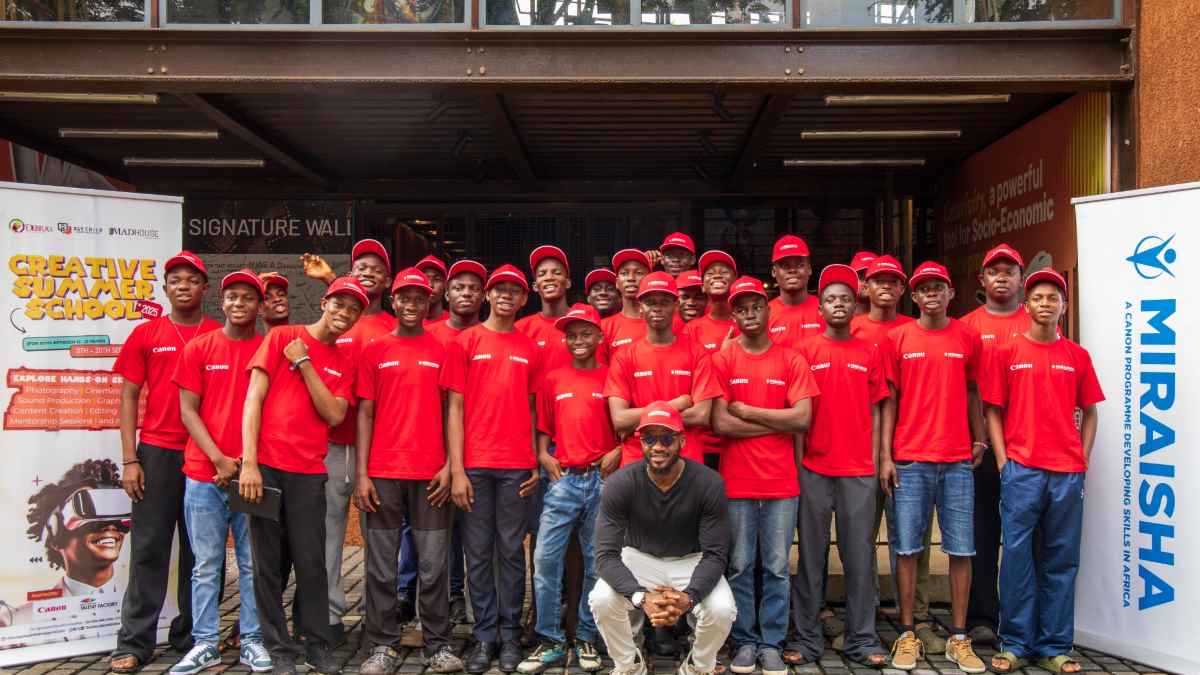
Canon Central & North Africa (CCNA) (https://en.Canon-CNA.com), a leading provider of printing and imaging solutions, in partnership with Debra’s Palace Initiative, successfully held the second edition of the Creative Summer School from 8 to 20 September 2025 in Lagos.

As part of the Canon Miraisha Programme, the Creative Summer School equips young men aged 18 to 25 with hands-on technical training, mentorship, and essential life skills to help them thrive in the growing creative economy.

The initiative reflects Canon’s longstanding Miraisha mission of empowering African youth with creative skills and career opportunities, while aligning with Debra’s Palace Initiative’s vision of raising the next generation of leaders, innovators, and changemakers.

Participants gained exposure to a wide range of creative and professional skills, including photography, cinematography, sound editing, Financial Literacy, Business of Creativity and etiquette training, as well as daily mentorship. Sessions on graphic design and content creation were also held. Additionally, Canon Miraisha delivered a three-day basic photography course combining classroom learning with outdoor photo shoots and project-based assignments. Two outstanding students each received a Canon Selphy CP1000 printer.

Our ongoing collaboration with Debra’s Palace Initiative reflects our belief that creativity is not only a pathway to employment but also a driver of positive social change

Twenty-five young men participated in the daily sessions at MADhouse by Tikera Africa, with a further 50 to 100 participants attending the opening and closing ceremony. Programme mentors and facilitators, including Femi Odugbemi, Bayo Omoboriowo, Daniel Etim Effiong, Osarume Akenzua, Tayo Adetunji, Precious Eniayekan, Uncle Sele and David Adetola, shared their invaluable industry expertise and insights, enriching the learning experience.

Somesh Adukia, Managing Director, Canon Central and North Africa, said: “Through the Miraisha Programme, Canon is deeply committed to investing in Africa’s youth by equipping them with the skills, confidence, and support needed to succeed in today’s creative industries. Our ongoing collaboration with Debra’s Palace Initiative reflects our belief that creativity is not only a pathway to employment but also a driver of positive social change. Together, we’re building opportunities that will inspire the next generation of African storytellers and leaders.”

Speaking on the impact of the collaboration, Damilola Chinedu, Founder, Debra’s Palace Initiative, said“We believe every boy deserves the opportunity to develop his talent and grow into a man of vision, impact, and integrity. The Creative Summer School provides a safe and inspiring space where participants develop the skills and confidence to pursue their dreams. Partnering with Canon Miraisha allows us to prepare boys not just for careers, but for meaningful lives of leadership.”

Building Sustainable Impact

The Miraisha Programme is Canon’s award-winning corporate responsibility initiative dedicated to nurturing the next generation of African creative professionals through hands-on training in photography, filmmaking, and other digital arts. With a strong emphasis on mentorship, sustainability, and community impact, it is rooted in Canon’s philosophy of Kyosei – living and working together for the common good. Miraisha has empowered thousands of participants across Africa, often in collaboration with organisations like the Kings & Queens Art Academy in Nigeria, with Maono Africa in Kenya to empower youth in Dandora and the Lens on Life Project in Cameroon.

Empowering Africa’s Next Generation

Debra’s Palace Initiative is a non-profit organisation committed to empowering young boys to lead productive and fulfilling lives. Addressing the often-overlooked challenges faced by boys in society, the organisation has successfully engaged more than 3,500 participants through initiatives such as the Boy Child Conversation Conference (BCC), BCC Mentorship School Tours, JAMB Scholarship Programmes, and the Creative Summer School with Canon. By providing mentorship and skills development in safe spaces, it aims to shape boys into confident young men who can make positive contributions to their communities, aligning perfectly with Miraisha’s objectives.

With the launch of the second Creative Summer School, Canon Central & North Africa and Debra’s Palace Initiative reaffirm their shared commitment to nurturing Africa’s youth, building not just careers but futures for a new generation of African creatives, storytellers, and changemakers.

Distributed by APO Group on behalf of Canon Central and North Africa (CCNA).

Business

What Human Resource (HR) Professionals Gain from Automation

Published

on

HR

Four examples of automation supporting HR staff

JOHANNESBURG, South Africa, June 9, 2026/APO Group/ –Human resource people are concerned. As automation becomes more featured in modern digital technologies, many HR staff are asking the same question: will automation replace me?


Their fears are not unfounded. According to surveys conducted by Gartner (https://apo-opa.co/4uo4fGQ), some companies are using AI as an excuse to reduce HR headcounts, and 79% of Chief HR Officers told AMS (https://apo-opa.co/4xj8Qg9) that they see notable concerns about job security among their teams.


Supporting human abilities


However, a report published last year by the International Labour Organisation (https://apo-opa.co/3SaBQGM) found that AI and automation are unlikely to replace HR staff. Instead, automation is producing significant productivity improvements for HR staff, says Mignon Wolmarans, HR Product Manager at Deel Local Payroll.


“HR jobs require people with complex problem-solving, creativity, and strong interpersonal skills. These are not abilities that a machine or software can replace. But HR people spend most of their time on manual tasks that actually reduce their ability to focus on priorities where their skills are needed the most.”


This observation comes from working with clients who adopt automation in their HR environments, she adds.


“We sometimes encounter reluctance when we bring up automation, and the resistance is usually around a comfort with manual processes or gaps in training and skills that reduce people’s confidence in technology. But when we work with them to overcome those concerns, they love what automation does and how it gives them more autonomy and focus.”


How automation supports HR


Modern HR platforms, cloud software, can automate many routine HR tasks, either as processes designed by HR teams or as ready-to-use native features. These latter features match frequent HR tasks that would otherwise require significant manual processing, input from multiple people, or both.

People are most reluctant to adopt automation because of skills gaps, which feeds into fears that the technology will replace them


Some examples include:


  • Leave management: Automate accruals based on length of service, salary grade, or a combination of the two. Automation applies forfeiture rules automatically, and if an employee’s tenure ends, leave encashment is calculated and processed in a single automated action.


  • Claims: Self-service custom forms and document attachments streamline overtime and travel claims. These are processed through established rules and approvals, pushed to the responsible managers or heads of departments. As soon as a claim is approved, it automatically updates payslip information.


  • E-onboarding: Instead of HR practitioners capturing new employee information manually, ‌newcomers use online forms to complete their basic profile and address information, and attach key documents, all of which are loaded onto their profile and only require approval from HR.


  • Performance management: Set up different performance review layouts, forms, and templates for various roles, objectives, and indicators. Participants can attach supporting documents, while reviewers, managers, and other staff can submit their contributions. All the performance data feeds into central dashboards for complete control and visibility of the company’s performance.


These automations reduce manual workloads and errors while extending features to other stakeholders in different departments. Crucially, they don’t replace HR staff and instead give them the capacity to focus on intricate and human-centric activities that require more than capturing data and compiling reports. As mentioned, HR teams can also create automated processes and customised forms.


Creating digital confidence


The best HR software vendors offer training and skills honing for customers. For example, Deel Local Payroll provides training staff and extensive learning resources for its customers, helping them take charge of automation.


“People are most reluctant to adopt automation because of skills gaps, which feeds into fears that the technology will replace them. That’s why we have a dedicated training department, one-to-one training, and e-learning courses that help fill those gaps,” says Wolmarans.


The fear that automation will replace HR people is overstated, even if some company leaders consider it an option. Software cannot compare to what skilled HR professionals do best. But those same professionals focus overwhelmingly on manual tasks, taking time better spent on more complex and strategic priorities.


Automation doesn’t replace HR professionals. When the right platform and vendor support them, it makes them better at their jobs.

Distributed by APO Group on behalf of Deel Local Payroll, powered by PaySpace.


Continue Reading

Business

Spiro Appoints Former Indofast Energy Chief Executive Officer (CEO) Anant Badjatya as Group CEO to Lead its Next Phase of Growth

Published

on

Spiro

Anant joins Spiro with more than two decades of leadership experience across India, the Middle East and Africa

DUBAI, United Arab Emirates, June 9, 2026/APO Group/ —

  • Following its most recent landmark US$215 million equity raise, Spiro is strengthening its leadership team to execute its next phase of pan-African expansion and appoints Anant Badjatya as Group CEO of Spiro.
  • Anant Badjatya previously spearheaded Indofast Energy, the IndianOil × SUN Mobility joint venture, where he built one of India’s largest battery-swapping networks with more than 1,800 stations serving approximately 90,000 vehicles daily.

Spiro (http://www.Spironet.com), Africa’s leading electric mobility company, today announced the appointment of Anant Badjatya as Group Chief Executive Officer.

Anant will consolidate the Group’s strategic initiatives and guide the company through its next chapter of growth and execution in mobility, energy and tech

Anant joins Spiro with more than two decades of leadership experience across India, the Middle East and Africa, building and scaling businesses across electric mobility, energy and industrial sectors.

Most recently, he served as CEO of Indofast Energy, the joint venture between IndianOil and SUN Mobility, where he led the development of one of India’s largest battery-swapping networks, comprising more than 1,800 stations and serving nearly 90,000 vehicles daily.

The appointment comes at a pivotal moment for Spiro following its landmark US$215 million financing round, one of the largest investments ever made in Africa’s electric mobility sector. Anant’s broad mandate will span battery swapping, leasing, logistics, energy, and vehicle manufacturing.

Gagan Gupta, Founder and Chairman of Spiro said: 

As Spiro is accelerating on its mission to transform mobility across Africa through clean, affordable and accessible electric transportation solutions, Anant will consolidate the Group’s strategic initiatives and guide the company through its next chapter of growth and execution in mobility, energy and tech.”

Commenting on his appointment, Anant Badjatya said:

Africa represents the most exciting frontier for electric mobility.  Spiro has built a unique platform and is exceptionally well positioned to accelerate the transition to cleaner and more accessible mobility across the continent. I look forward to working with our teams, partners and stakeholders to drive the next phase of growth and impact.

Distributed by APO Group on behalf of Spiro.


Continue Reading

Energy

Gwede Mantashe Joins African Energy Week (AEW) 2026 as South Africa’s Petroleum Reforms Open the Orange Basin to Drilling

Published

on

African Energy Chamber

A new petroleum law and the prospect of fresh Orange Basin drilling is resetting South Africa’s upstream, and Minister Mantashe is taking the AEW host nation’s case to the global market

CAPE TOWN, South Africa, June 8, 2026/APO Group/ –Gwede Mantashe, Minister of Mineral and Petroleum Resources of the Republic of South Africa, has been confirmed as a featured speaker at the upcoming African Energy Week (AEW) 2026 Conference and Exhibition, where he is expected to lay out the reform agenda reshaping the country’s upstream oil and gas sector and its drive to convert long-stranded offshore gas into production.


South Africa is pursuing one of the most significant upstream overhauls in its history, anchored by a new law that gives oil and gas their own regulatory regime for the first time. The reforms position the host nation as both a destination for exploration capital and a future producer along an Atlantic margin that has drawn the world’s largest oil companies to the region.

At the center of the shift is the Upstream Petroleum Resources Development Act (UPRDA), which President Cyril Ramaphosa signed into law in October 2024. The Act separates petroleum from the mining statute that has long regulated both sectors. It also creates a single petroleum right covering exploration and production along with a 20% carried interest for the state. The UPRDA awaits a presidential proclamation to take effect, and implementing regulations that went through a further round of industry comment in early 2026 are now being finalized.

A clear petroleum framework and a credible state partner are what international capital needs to commit to the Orange Basin

Mantashe has emerged as the most forceful advocate for accelerating the sector. He has long-argued that South Africa must shift from importing refined products to producing its own, warning that dependence on foreign supply leaves the economy exposed to global price shocks. This shift becomes increasingly more importance in the current global climate, where supply security has become a major challenge – particularly for import-reliance economies such as South Africa. As such, Mantashe has repeatedly pressed for faster licensing and fewer legal delays to exploration. AEW 2026 is a key platform to bring this discussion to a global audience.

“South Africa has the geology for exploration. Now it is building the regulatory certainty it needs to turn discoveries into bankable projects,” said NJ Ayuk, Executive Chairman of the African Energy Chamber. “A clear petroleum framework and a credible state partner are what international capital needs to commit to the Orange Basin.”

Offshore, TotalEnergies – operator of Block 3B/4B in the Orange Basin – is preparing to begin drilling in South African waters in 2026 pending final regulatory approvals. The acreage sits on trend with the Venus discovery in neighboring Namibia, where TotalEnergies is developing the basin’s first oil project.

Onshore, momentum is building in Mpumalanga, where gas developer Kinetiko Energy’s Amersfoort project has logged sustained high-flow results and is advancing plans for an LNG pilot plant. Mantashe has also signaled that government is moving to lift the long-standing moratorium on shale gas development, with the Petroleum Agency of South Africa (PASA) estimating recoverable Karoo reserves at 209 tcf.

Mantashe is also expected to report on successes of the South African National Petroleum Company (SANPC), the state entity formed in May 2025 through the merger of PetroSA, iGas and the Strategic Fuel Fund. Positioned as the country’s petroleum champion, SANPC is intended to anchor state participation across the value chain as South Africa works toward 6 GW of gas-fired power by 2030.

As AEW 2026 prepares to convene policymakers, investors and operators at the Cape Town International Convention Centre from October 12-16, Mantashe’s address carries added weight as the host nation’s signal to the market. His message is expected to be direct: South Africa is open for upstream investment and ready to move from potential to production.

Distributed by APO Group on behalf of African Energy Chamber.

Continue Reading

Trending