The 5-colour printers are ideal for printing computer-aided design (CAD) and geographic information system (GIS) applications, as well as posters
DUBAI, United Arab Emirates, October 8, 2024/APO Group/ —
Adding to the successful imagePROGRAF TZ and TX series, Canon (www.Canon-CNA.com)today launches the imagePROGRAF TZ-32000 and the imagePROGRAF TX-4200/TX-3200. The 5-colour printers are ideal for printing computer-aided design (CAD) and geographic information system (GIS) applications, as well as posters. These new models will serve a number of markets, including architects, engineering, construction and manufacturing companies (AEC&M), print service providers (PSPs) and public sector bodies.All models offer enhanced productivity, deliver improved poster quality with vivid colours and are available with an optional scanner[1].
Printing large volumes of CAD drawings at high speed, the imagePROGRAF TZ-32000 is ideal to meet the high-productivity needs of the AEC&M market. The 36” printer achieves a print speed of 4 A1 pages per minute[2], the highest printing speed in the imagePROGRAF series. Productivity is enhanced with a new and improved, easy paper loading process and a Top Delivery Tray (TDT) that stacks up to 100 CAD drawings of various sizes, or up to 10 posters, for continuous printing. The dual roll input allows users to reduce the frequency of media loading, making it possible to switch between two sizes of media automatically for different size printouts, ideal for complex CAD applications. Production time is maximised by faster paper loading and unique hot-swap ink tanks that can be replaced during operation for uninterrupted printing.
The imagePROGRAF TX-4200/TX-3200 meet a wide range of printing needs, including CAD and GIS drawings, as well as posters, which are ideal for the distribution/retail industries. The imagePROGRAF TX-4200 has a width of 44” while the TX-3200 has a width of 36” and both models have a higher printing speed than previous models printing up to 3.3 A1 pages per minute[3]. High productivity is achieved through a range of productivity features such as a dual roll media input[4] with a fast paper exchange and easy paper loading process.
Enhanced print features for high-definition and brighter-coloured printing
All new models of the TZ and TX series are equipped with a number of improvements including sharpened line quality and colour calibration for bolder, consistent colours. The enhanced image quality features enable detailed CAD prints, from line drawings to maps, to be printed accurately – ideal for the AEC&M industries as well as public sector bodies. The newly designed image processing technology maximises the colour development performance of the ink to reproduce deep and bright colours and, by adopting Canon’s latest magenta ink, prints are more vivid compared with previous models[5], enabling bolder and brighter-coloured prints even on plain paper. The pigment inks are robust and prevent smudging, making the print-outs ideal for use outdoors.
Increased productivity and efficiency
The new imagePROGRAF printers incorporate several features to help increase productivity and efficiency. All models are equipped with the advanced easy paper loading process, which automatically detects paper width and type and estimates the remaining amount of paper. It speeds up the paper feed process and reduces roll paper set time[6] by roughly 30% compared with previous models. In addition, high image quality is maintained thanks to the ink sensing system, which automatically optimises the ink landing position by regularly monitoring the ink ejection, and also to the colour calibration function, which automatically corrects variations in output colour due to individual printhead differences and aging. As a result, both the labour time required for printing and device downtime are reduced, allowing users to produce large numbers of drawings and posters quickly and efficiently.
Designed with environmental considerations
All new models across the TZ and TX printer series have been designed for lower power consumption compared with previous models5; the TZ-32000 consumes 29% less power while in use and the TX-4200/TX-3200 uses 25% less power. Environmental considerations have also been extended to the printers’ packaging, with expanded polystyrene (EPS) eliminated. Both the TZ and TX series are registered as “EPEAT” gold products in the United States under the international EPEAT eco-label, established by Global Electronics Council (GEC), a non-profit organisation evaluating electronic products.
Engineered for peace of mind
From encrypted communications and secure PIN code printing, through to the advanced authentication process and secure hard drive erasure, the imagePROGRAF TZ and TX series printers include an array of security features to safeguard sensitive information so only the right people can access the printer, take prints, and manage data storage.
Mathew Faulkner, Director, Marketing & Innovation, Wide Format Printing Group, Canon EMEA, comments: “The new TZ and TX imagePROGRAF printers strengthen our imagePROGRAF range offering a comprehensive solution for large-format CAD/GIS and poster printing and provide our customers, across the AEC&M market, print service providers and public sector bodies, with the productive and reliable printers they need. With enhanced printing features, these new models deliver high-quality, accurate and sharp CAD/GIS prints with vivid colours making technical drawings easy to read, even when on-site and exposed to varied weather conditions thanks to the pigment inks which prevent smudging.”
The new imagePROGRAF models will be available from accredited Canon Partners and directly from Canon from the 1st October.
For more information about the imagePROGRAF TZ-32000 and the imagePROGRAF TX-4200/TX-3200, please visit:
https://apo-opa.co/4gYJw6U
https://apo-opa.co/4eUWYXD
With enhanced printing features, these new models deliver high-quality, accurate and sharp CAD/GIS prints with vivid colours making technical drawings easy to read
[1] The optional scanner Z36 is manufactured by Global Scanning.
[2] A1 landscape, uncoated paper, Fast Economy mode.
[3] A1 landscape, plain paper drawing, fastest print setting.
[4] The second roll unit is optional.
[5] The predecessor model of the TZ-32000 is the imagePROGRAF TZ-30000 (released in May 2021), and predecessor models of the TX-4200/3200 are imagePROGRAF TX-4100/3100 (released in February 2021).
[6] For the purpose of the paper loading process Canon describes here, it refers to the following: for the TZ-32000, it refers to the time it takes for the operator to replace the printer paper rolls in the main unit feed section to closing the roll cover so the printer is ready to resume printing; for the TX series, it refers to the time from placing the roll paper in the main unit feed section to being ready for printing.
Distributed by APO Group on behalf of Canon Central and North Africa (CCNA).
New facility expands in-country drilling and completion fluids capability, advancing the next phase of SLB’s growth in Mozambique
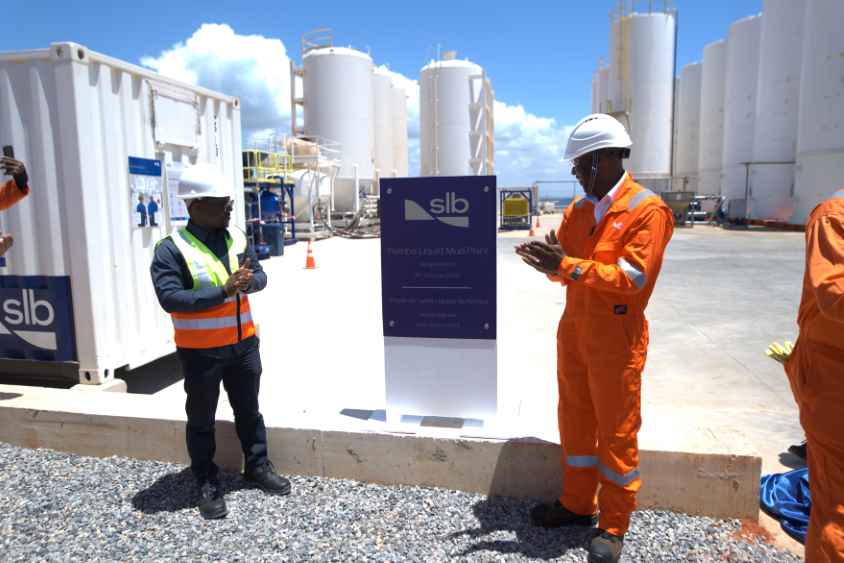
PEMBA, Mozambique, October 9, 2026/APO Group/ –SLB (NYSE: SLB) (www.SLB.com) announced the opening of a new fluids systems plant in Pemba, Mozambique. The new facility strengthens in-country capacity to prepare, store and deliver drilling and completion fluids for offshore operations, reinforcing the infrastructure needed as Mozambique’s offshore activity grows and its role as a strategic energy hub for East Africa continues to expand.
The commissioning of the plant, also known as a liquid mud plant, coincides with SLB marking 70 years of operations in Mozambique. It reflects the company’s long-term commitment to investing in people, infrastructure and capability that support the country’s long-term offshore energy development plans.
With an initial storage capacity of 21,000 barrels, the liquid mud plant provides a scalable platform for future growth, supporting multiple customers and rising offshore activity while improving logistics and enhancing operational flexibility.
As SLB marks 70 years in Mozambique, this investment reflects our confidence in the country’s future and our commitment to supporting its energy ambitions
“As SLB marks 70 years in Mozambique, this investment reflects our confidence in the country’s future and our commitment to supporting its energy ambitions,” said Miguel Baptista, Central, East and Southern Africa, Managing Director, SLB. The new liquid mud plant strengthens local energy infrastructure, expands opportunities for local content development, and enhances our ability to support customers as they deliver some of Africa’s most significant offshore energy resources.”
The liquid mud plant project was delivered with strong local participation and that momentum is expected to continue into operations. During project delivery, more than 100 jobs were created in Pemba with nationals representing 80% of the workforce, reflecting a focus on building local capability.
The project was delivered with a strong focus on safety, operational integrity, and quality, achieving more than 67,000 hours worked without a recordable safety incident.
This key infrastructure strengthens SLB’s ability to support consistent service quality and enhance supply chain readiness for increasing offshore activity across Mozambique, supporting customers execute safely and efficiently while developing local skills and expertise.
Key Points:
SLB has commissioned a new fluids system plant in Pemba, expanding in-country drilling and completion fluids capability for offshore operations.
With an initial storage capacity of 21,000 barrels, the facility provides a scalable platform to support growing offshore activity in Mozambique.
The investment marks the next phase of SLB’s growth in Mozambique, strengthening local capability and supporting long-term offshore energy development.
Battery energy storage systems (BESS) are becoming critical system infrastructure, supporting flexibility, reducing avoidable curtailment, shifting energy into periods of demand and strengthening security of supply
JOHANNESBURG, South Africa, October 9, 2026/APO Group/ –The South African Energy Storage Association (SAESA) (www.SAESA.org.za) welcomes the prioritisation of 4,600 MW of battery energy storage under the first Integrated Resource Plan (IRP) 2025 Section 34 determination.
The timing is significant. Recent Integrated Energy Plan (IEP) modelling and assumptions discussions highlighted a fundamental shift that South Africa’s energy planning now needs to capture: we cannot plan the future power system by counting megawatts of generation alone.
We must plan for when energy is available, where it is available, how it moves through a constrained grid and how it is stored and dispatched when the system needs it most.
The announcement reinforces that shift. Battery energy storage systems (BESS) are becoming critical system infrastructure, supporting flexibility, reducing avoidable curtailment, shifting energy into periods of demand and strengthening security of supply.
For SAESA, the message for the IEP is clear: storage, flexibility and system services must be modelled as integral components of South Africa’s future electricity architecture, with their contribution considered from the outset of generation planning.
“The IEP must plan the power system we are becoming, not simply model the power system we have inherited,” says SAESA.
The IEP must plan the power system we are becoming, not simply model the power system we have inherited
Partnership with C&I Energy + Storage Summit
SAESA is an association partner of the C&I Energy + Storage Summit, created by VUKA Group, taking place on 28–29 October 2026 at The Maslow Hotel, Sandton, Johannesburg.
The summit brings together commercial and industrial energy users, project developers, financiers, regulators and solution providers to explore practical approaches to energy security, procurement and storage deployment.
For businesses assessing how storage can support their operations, the event offers an opportunity to meet SAESA and engage with the wider energy community on the decisions shaping South Africa’s evolving electricity system.
Commercial and industrial energy decision-makers are invited to apply to attend as hosted buyers. Qualifying buyers receive complimentary summit access and curated opportunities to engage with industry partners.
Meet SAESA at C&I Energy + Storage Summit: Join the Hosted Buyer Programme
The Hosted Buyer Programme connects commercial and industrial energy decision-makers with solution providers shaping South Africa’s evolving private energy market.
Qualified energy buyers receive complimentary access to the summit and curated engagement with industry partners exploring energy procurement, storage deployment and project development.
Expanding credible rating coverage can improve the information available to investors and support the development of deeper domestic and regional capital markets
PORT LOUIS, Mauritius, October 8, 2026/APO Group/ –African Export-Import Bank (Afreximbank) (www.Afreximbank.com) welcomes today’s launch of the Africa Credit Rating Agency (AfCRA), an important milestone in strengthening Africa’s financial architecture and expanding the continent’s capacity to generate credible, independent analysis of African credit risk.
Credit ratings play an important role in determining access to capital, influencing investor perceptions and shaping the cost at which governments, institutions and businesses can finance development. It is therefore essential that assessments of African credit risk are independent, rigorous and evidence-based, while reflecting a complete understanding of the structures, institutions and economic realities being assessed.
The establishment of AfCRA adds an important African-led source of credit opinion to the market. Its value will not be measured by whether it produces more favourable ratings, but by the credibility of its analysis, the quality of its data and transparency of its methodology, and its ability to deepen understanding of African sovereigns, sub-sovereigns and corporate credit.
This is particularly important given that many African issuers remain unrated, while local-currency and sub-sovereign markets continue to have limited rating coverage. Expanding credible rating coverage can improve the information available to investors and support the development of deeper domestic and regional capital markets.
AfCRA must set a new benchmark for the continent, maintain its independence, and remain wholly owned and controlled by Africans
Alongside fellow members of the Alliance of African Multilateral Financial Institutions (AAMFI), Afreximbank has consistently maintained that African Multilateral Financial Institutions should be assessed on the basis of their fundamentals, performance, legal frameworks, mandates and operating models. Ensuring that these institutional characteristics are properly understood is essential to achieving informed, balanced and credible assessments of African risk.
Commenting on the uniqueness of the African market, and need for AfCRA’s rating methodology to reflect this, Mr Denys Denya, Senior Executive Vice President, Afreximbank, said: “The rating methodology AfCRA develops must recognise the uniqueness of our environment and its institutional structures. The Agency must set its own standards and not follow those set elsewhere — it must build a unique identity that conforms to an ‘African best practice.”
Highlighting the need for the autonomy of the Africa Credit Rating agency as it takes off, Mr Denya added: “Most importantly, AfCRA must set a new benchmark for the continent, maintain its independence, and remain wholly owned and controlled by Africans. We must all use it, and in return expect a complete assessment of where we (Africa) stand: the strengths the market has ignored, and the weaknesses we still need to fix.”
AfCRA should therefore be seen as complementary to existing international and regional rating agencies, broadening the range of credible analysis available to investors and issuers while strengthening competition, transparency and analytical capacity within Africa’s credit markets.
As Africa seeks to mobilise the scale of capital required for industrialisation, trade, infrastructure and economic transformation, credible African institutions that improve information, strengthen market confidence and deepen the continent’s financial markets will become increasingly important.
Afreximbank congratulates the African Union, the African Peer Review Mechanism (APRM) and all those involved in bringing AfCRA from concept to launch, and looks forward to the contribution the Agency will make to deeper, more transparent and more efficient African capital markets.
Distributed by APO Group on behalf of Afreximbank.
We use cookies on our website to give you the most relevant experience by remembering your preferences and repeat visits. By clicking “Accept”, you consent to the use of ALL the cookies.
This website uses cookies to improve your experience while you navigate through the website. Out of these, the cookies that are categorized as necessary are stored on your browser as they are essential for the working of basic functionalities of the website. We also use third-party cookies that help us analyze and understand how you use this website. These cookies will be stored in your browser only with your consent. You also have the option to opt-out of these cookies. But opting out of some of these cookies may affect your browsing experience.
Necessary cookies are absolutely essential for the website to function properly. These cookies ensure basic functionalities and security features of the website, anonymously.
Cookie
Duration
Description
cookielawinfo-checkbox-analytics
11 months
This cookie is set by GDPR Cookie Consent plugin. The cookie is used to store the user consent for the cookies in the category "Analytics".
cookielawinfo-checkbox-functional
11 months
The cookie is set by GDPR cookie consent to record the user consent for the cookies in the category "Functional".
cookielawinfo-checkbox-necessary
11 months
This cookie is set by GDPR Cookie Consent plugin. The cookies is used to store the user consent for the cookies in the category "Necessary".
cookielawinfo-checkbox-others
11 months
This cookie is set by GDPR Cookie Consent plugin. The cookie is used to store the user consent for the cookies in the category "Other.
cookielawinfo-checkbox-performance
11 months
This cookie is set by GDPR Cookie Consent plugin. The cookie is used to store the user consent for the cookies in the category "Performance".
viewed_cookie_policy
11 months
The cookie is set by the GDPR Cookie Consent plugin and is used to store whether or not user has consented to the use of cookies. It does not store any personal data.
Functional cookies help to perform certain functionalities like sharing the content of the website on social media platforms, collect feedbacks, and other third-party features.
Performance cookies are used to understand and analyze the key performance indexes of the website which helps in delivering a better user experience for the visitors.
Analytical cookies are used to understand how visitors interact with the website. These cookies help provide information on metrics the number of visitors, bounce rate, traffic source, etc.
Advertisement cookies are used to provide visitors with relevant ads and marketing campaigns. These cookies track visitors across websites and collect information to provide customized ads.


















 Business4 days ago
 Energy4 days ago
 Business4 days ago
 Business4 days ago
 Events4 days ago