Connect with us
Anglostratits

Business

Canon celebrates 20th consecutive year of number one share of global interchangeable-lens digital camera market

Published

on

Canon

Further expanding its lineup Canon managed to secure the number one share of the global market for the 20th consecutive year

DUBAI, United Arab Emirates, March 29, 2023/APO Group/ — 

Canon Europe announced today that the company’s interchangeable-lens digital cameras (digital SLR and mirrorless cameras) have maintained the number one share of the global market for 20 consecutive years1 from 2003 to 2022.

Canon develops the key imaging system components featured in its EOS series of digital interchangeable-lens cameras – CMOS image sensors, image processors and interchangeable lenses – under the core concept of, “Speed, Comfort and High Image Quality.” Putting together a wide-ranging product lineup – from high-performance flagship models that are highly trusted by professionals to entry-level models that allow users to enjoy high image quality shooting with easy operation, as well as a rich selection of RF and EF series lenses that make possible a wealth of creative expression – Canon continues to support the diverse needs of customers.

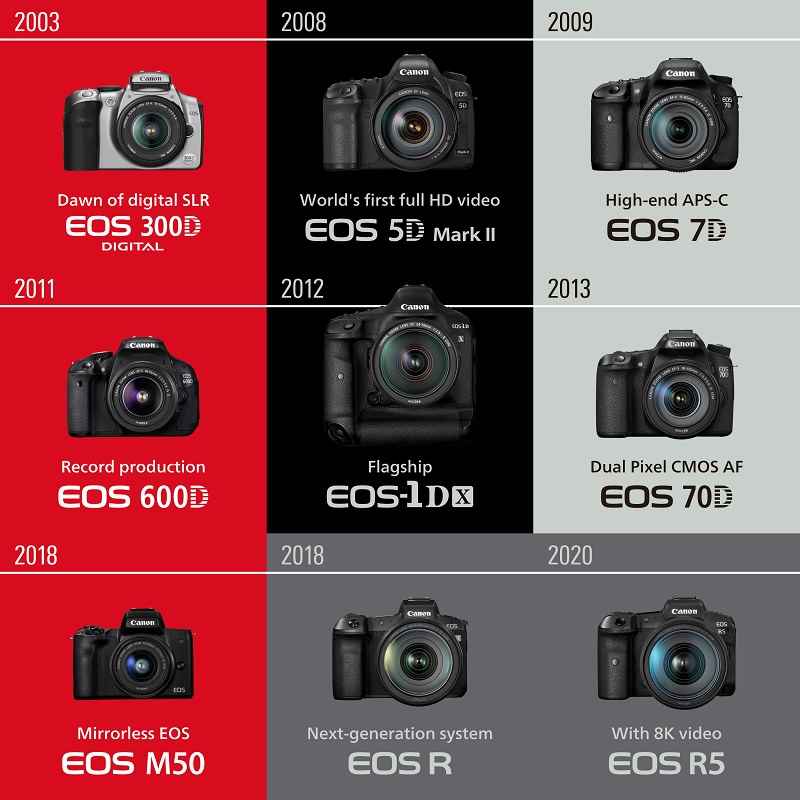
During the dawn of digital SLR cameras, Canon introduced its breakthrough EOS 300D (EOS Kiss Digital or EOS Digital Rebel in other regions) in September 2003. This groundbreaking camera, which was competitively priced and featured a compact, lightweight design, became the engine for growth in the digital SLR market, capturing the top share of the global market and heralding the age of digital SLR cameras. Since that time, Canon has continued to launch a range of groundbreaking products, including the professional-model EOS-1D series and the EOS 5D series, which paved the way for digital SLR video recording. Canon’s desire to further expand the boundaries of visual expression led to its next-generation EOS R System, launched in October 2018, that includes the EOS R5 – the first camera to feature 8K video recording2 – released in July 2020 and the EOS R3 in November 2021, which features tracking of fast-moving subjects and continuous shooting performance. In addition, Canon launched the EOS VR System, designed to record video for virtual reality content, in December 2021.

In 2022, Canon announced the EOS R7 (released in June 2022) and EOS R10 (released in July 2022) the first APS-C size models in the EOS R Series, and the EOS R6 Mark II full-frame camera (released in December 2022) that features advanced AF functionality and superb video capabilities, alongside six new RF lenses3. While further expanding its lineup Canon managed to secure the number one share of the global market for the 20th consecutive year.

Canon will continue to refine its proprietary imaging technologies while further strengthening and expanding the EOS series of cameras and lenses, opening new avenues of image and video capture.
Canon

Canon will continue to refine its proprietary imaging technologies while further strengthening and expanding the EOS series of cameras and lenses


[1] Based on a Canon survey and shipment figures published by CIPA.

[2] Among digital interchangeable-lens cameras released prior to 8th July 2020.

[3] In 2022, Canon released the following six digital interchangeable lenses: RF 800mm F5.6 L IS USM (May), RF 1200mm F8 L IS USM (May), RF-S 18-45mm F4.5-6.3 IS STM (June), RF-S 18-150mm F3.5-6.3 IS STM (June), RF 24mm F1.8 MACRO IS STM (August), RF 15-30mm F4.5-6.3 IS STM (August).

Distributed by APO Group on behalf of Canon Central and North Africa (CCNA).

Business

Power, water and resilience reshape the future of African mining
Published

on

Energy security may dominate conversations around African mining operations, but power is only one part of a bigger infrastructure challenge

CAPE TOWN, South Africa, September 30, 2026/APO Group/ –ESI Africa’s Powering Mines & Industry Volume examines the infrastructure decisions that are now critical to competitive and sustainable mining operations.

Energy security may dominate conversations around African mining operations, but power is only one part of a bigger infrastructure challenge.


Reliable electricity, affordable energy, secure water supply, effective rehabilitation and access to investment are interconnected considerations for mines looking to protect production while responding to sustainability, regulatory and cost pressures.

These issues sit at the centre of ESI Africa’s Powering Mines & Industry Volume, bringing together industry analysis and practical perspectives on the infrastructure realities shaping mining operations.

Published by ESI Africa, part of VUKA Group, the volume explores the technologies, strategies and partnerships influencing energy, water and long-term operational resilience.

Explore Powering Mines & Industry Volume (https://apo-opa.co/4AFlSGx)


The mine resilience equation is getting more complex 

For energy-intensive operations, security of supply and affordability directly affect productivity and competitiveness. At the same time, water scarcity, rehabilitation requirements and infrastructure constraints are pushing water management further into strategic planning.

Three ESI Africa webinars explore these challenges from practical operational perspectives.

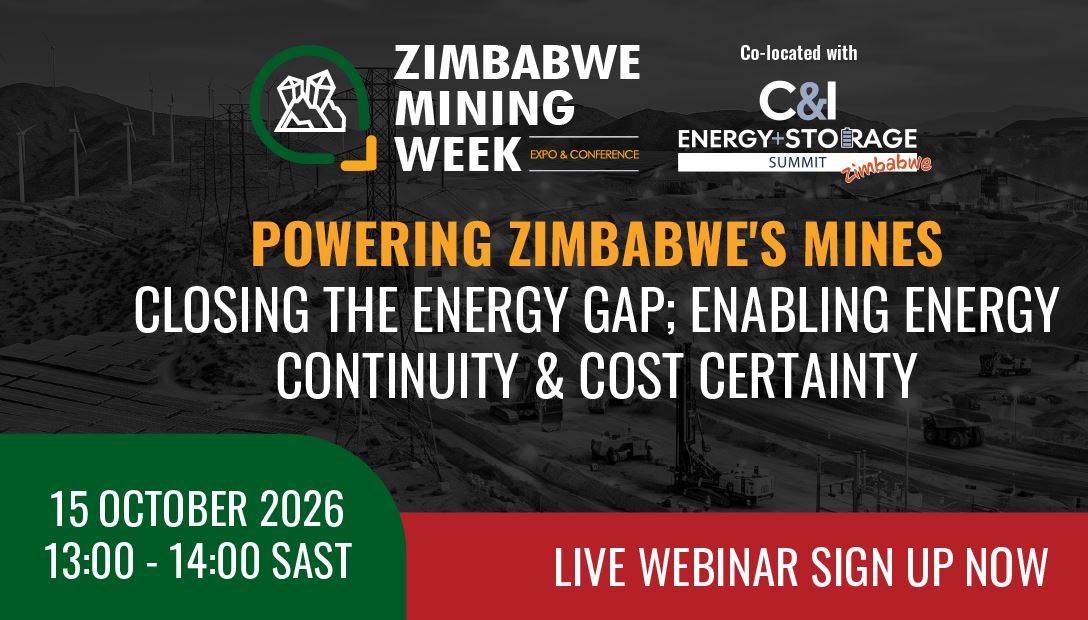
  1. Powering Zimbabwe’s mines: Closing the energy gap, enabling energy continuity and cost certainty

This webinar will bring together mining and energy stakeholders to discuss practical solutions for powering Zimbabwe’s mining future and explore the investments, partnerships, and policy frameworks needed to close the energy gap. Register for the webinar (https://apo-opa.co/4yd8OG5)

  1. From pit to plant: Scalable mine water rehabilitation and reuse

Explore approaches to managing mine water across the operational lifecycle, with a focus on scalable rehabilitation and reuse. Watch on-demand  (https://apo-opa.co/4dwGDuf)

  1. From water risk to water resilience

Explore how water-intensive organisations can move from identifying supply risk to implementing practical resilience strategies. Watch on-demand  (https://apo-opa.co/4hnPaly)

Zimbabwe puts the power-mining relationship into focus

The relationship between energy capacity and mining development moves from digital discussion to an in-person platform in Harare this November.

The C&I Energy + Storage Summit Zimbabwe takes place on 17 November 2026 at Rainbow Towers, Harare, co-located with Zimbabwe Mining Week.

The one-day summit brings together mining companies, energy users, developers, investors, policymakers and solution providers to explore renewable energy, storage, project development, finance, cost containment and secure power supply.

For Zimbabwe’s mining industry, these are fundamental commercial questions. New production and industrial growth depend on the infrastructure needed to develop mineral resources reliably and competitively.

Explore C&I Energy + Storage Summit Zimbabwe (https://apo-opa.co/3VY48WN)


Connecting projects with capital

Solving infrastructure constraints requires viable projects and access to the organisations that can finance and deliver them.

The Project & Investment Network, in partnership with the African Infrastructure Elites annual magazine, connects project owners with investors, financiers and solution providers across Africa’s power, energy and infrastructure sectors, helping create pathways from project opportunity to implementation.

Explore the Project & Investment Network (https://apo-opa.co/46N5I09)


Recognising African infrastructure excellence

Across mining, power, water and transport, organisations are already delivering projects that solve operational challenges, introduce new technologies and demonstrate what effective infrastructure delivery can achieve.

The African Infrastructure Elites: Projects and People annual magazine, hosted by ESI Africa, recognises the projects, partnerships and leaders contributing to infrastructure development across the continent.

Nominations are open for industry to put forward the projects and people whose work deserves wider recognition.

Explore the African Infrastructure Elites and submit a nomination (https://apo-opa.co/3TZsqPJ)

The Powering Mines conversation continues

The next Powering Mines & Industry Volume continues examining the infrastructure, operational and investment solutions shaping mining and C&I markets’ energy, water and transport.

Join the Powering Mines & Industry 2026 waiting list (https://apo-opa.co/4d91Yd0)


Meet ESI Africa at Mining Indaba 2027

ESI Africa will be at Mining Indaba from 8 to 11 February 2027 at the CTICC in Cape Town, meeting mining, energy and infrastructure leaders from across the continent.

Companies and industry leaders attending the event can book an interview with ESI Africa to discuss projects, developments and the issues shaping Africa’s mining and energy sectors.

To arrange an interview, contact Nicolette Pombo-van Zyl, ESI Africa Editor-in-Chief: nicolette@wearevuka.com

Distributed by APO Group on behalf of VUKA Group.


Continue Reading

Business

United Nations (UN) Critical Minerals Initiatives Target African Value Addition as African Mining Week (AMW) 2026 Approaches
Published

on

Etu Energias

New UN programs are expanding policy, technical and institutional support for African countries seeking to capture greater value from critical mineral production

CAPE TOWN, South Africa, September 30, 2026/APO Group/ –Five African mineral producers – Guinea, Madagascar, Nigeria, Zambia and Zimbabwe – have been selected to participate in the United Nation’s (UN) Country Support Mechanism on Critical Energy Transition Minerals program, strengthening international support for efforts to develop domestic mineral value chains.


https://apo-opa.co/4AH5p4s

Announced in September 2026, the initiative comes as critical mineral investment and value addition take center stage at African Mining Week (AMW) 2026, taking place October 14–16 in Cape Town. Under the theme Mining the Future: Unearthing Africa’s Full Mineral Value, AMW 2026 will connect African governments and project developers with investors and technical partners seeking opportunities across mineral production, processing and supporting infrastructure.

The UN mechanism will provide tailored support for countries as they seek to translate mineral resources into broader economic development, prioritizing areas such as policy advice, legal and regulatory expertise, environmental and social safeguards, and greater coordination across domestic mineral value chains.

The program comes as participating countries increasingly pursue domestic processing and industrialization strategies. Zambia is seeking to capture greater value from its copper industry, while Zimbabwe is expanding lithium processing. Madagascar is advancing efforts to expand value addition around rare earths and graphite, while Guinea and Nigeria are seeking to develop broader mineral value chains.

https://apo-opa.co/4hm1dj7

The program adds to a growing portfolio of African mining projects receiving UN and international financial, technical and institutional support, reflecting the continent’s increasing role in shaping global supply chains.

In June 2026, the UN Economic Commission for Africa launched a five-year regional program aimed at strengthening environmentally and socially responsible critical mineral value chains across the Southern African Development Community (SADC).

The initiative is being implemented in the DRC, Mozambique, Namibia, South Africa, Zambia and Zimbabwe and focuses on increasing local value retention while supporting industrialization and responsible mineral development.

Led by the UN Economic Commission for Africa through the African Minerals Development Centre and supported by Germany’s International Climate Initiative, the program brings together technical and development partners to address constraints including limited beneficiation capacity, ESG compliance and weak regional value-chain integration.

The UN Development Program (UNDP) is also developing a continental flagship initiative on Africa’s critical minerals under its 2026-2029 Regional Program for Africa. The initiative focuses on how mineral-producing countries can use their resource base to support economic transformation while making investment and value-addition strategies appropriate to their individual infrastructure, financing and industrial capabilities.

https://apo-opa.co/4rFbElr

https://apo-opa.co/3VD8VwL

Technology-led mining development is also receiving support. Through the UNDP MineTech Accelerator, five African mining innovators – Anchor Machines in Uganda, Zanfi Enterprise in Zambia, Milsat Technologies in Nigeria, Tukutech in Tanzania and SYNCHROS in the Democratic Republic of Congo – are receiving seed funding to accelerate technology-driven mining solutions.

https://apo-opa.co/4AHolAd

Together, these initiatives reflect a broader shift toward developing domestic value chains across Africa’s mining sector. For African producers, expanding international partnerships unlock capital, technical expertise and local processing capacity. For global investors, Africa’s rich resource base offers access to essential critical minerals while helping diversify supply chains for energy technologies and manufacturing.

These developments will form part of the wider critical mineral discussion taking place at AMW 2026. For more information, visit www.African-MiningWeek.com

Distributed by APO Group on behalf of Energy Capital & Power.


Continue Reading

Business

Benin mobilises €500 million in international financing with African Development Fund support
Published

on

African Development Bank

The 12-year financing benefits from an innovative credit enhancement mechanism, including a partial credit guarantee issued by the African Development Fund and second-loss insurance provided by the insurance subsidiary of the Islamic Development Bank Group

ABIDJAN, Côte d’Ivoire, September 29, 2026/APO Group/ –The Republic of Benin has secured €500 million (approximately CFAF 328 billion) in international bank financing, supported by the African Development Fund, for priority investments in education, health, water access, infrastructure, renewable energy, agriculture, and job creation for young people and women.


This transaction is fully aligned with the Bank’s new strategic vision for supporting our clients, particularly Cardinal Point 1

This landmark transaction, completed on 18 September 2026, follows the 17th replenishment of the African Development Fund (ADF-17), agreed in December 2025 as the largest in the Fund’s history. It builds on the first financing concluded in 2023 with support from the Fund, the concessional window of the African Development Bank Group. The transaction demonstrates the pan-African institution’s capacity to support countries across the continent in developing innovative, highly leveraged financing solutions that deliver tangible benefits for communities.

The 12-year financing benefits from an innovative credit enhancement mechanism, including a partial credit guarantee issued by the African Development Fund and second-loss insurance provided by the insurance subsidiary of the Islamic Development Bank Group.

“This transaction is fully aligned with the Bank’s new strategic vision for supporting our clients, particularly Cardinal Point 1, which seeks to mobilise capital-market resources at scale, as well as with the New African Financial Architecture for the continent’s development,” said Robert Masumbuko, Country Manager for the African Development Bank Group in Benin.

“This second operation (https://apo-opa.co/4yqZZJw) demonstrates the potential of guarantees to mobilise private capital more effectively. By combining the African Development Fund guarantee with complementary risk-sharing mechanisms, it enables Benin to secure substantial long-term financing on competitive terms,” said Ahmed Attout, Director of the Financial Sector Development Department at the African Development Bank Group.

Distributed by APO Group on behalf of African Development Bank Group (AfDB).


Continue Reading

Trending