Connect with us
Anglostratits

Business

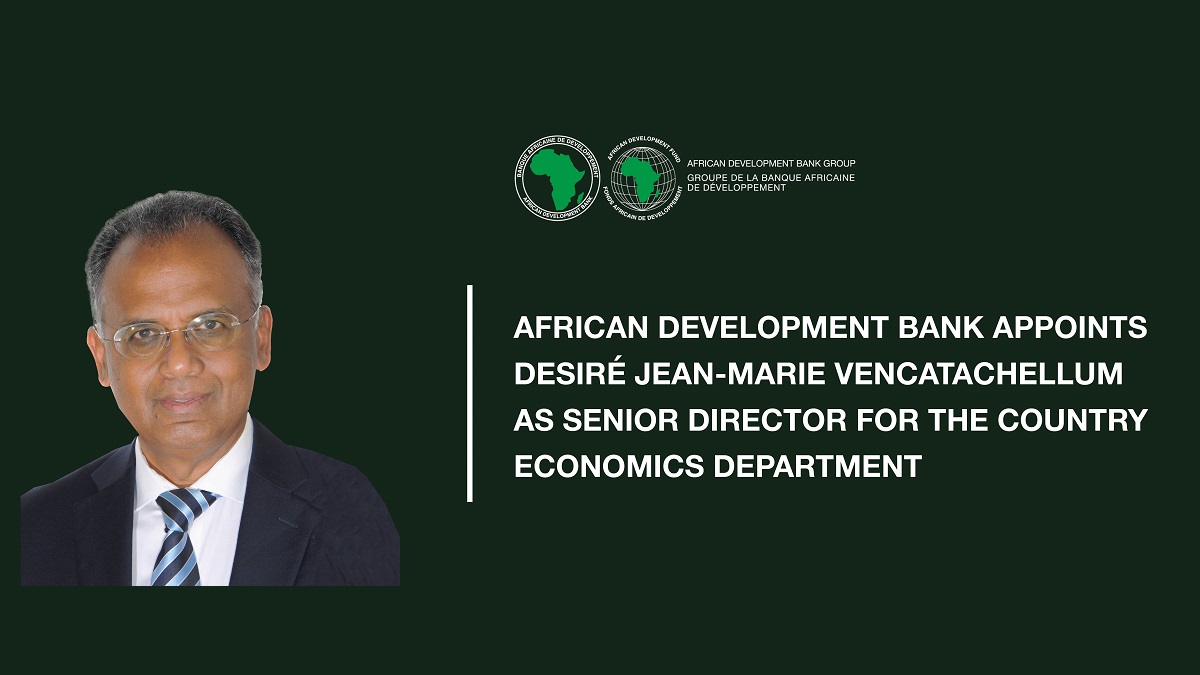
African Development Bank appoints Desiré Jean-Marie Vencatachellum Senior Director, Country Economics Department

Published

on

African Development Bank

Over the past decade Vencatachellum has played a key role in resource mobilization and partnerships

ABIDJAN, Ivory Coast, October 18, 2023/APO Group/ — 

The African Development Bank (www.AfDB.org) has appointed Desiré Jean-Marie Vencatachellum Senior Director of the Country Economics Department, effective 1st November 2023.

A Mauritian national and seasoned development banker, Vencatachellum has more than thirty years of experience in strategic leadership on development economics and finance issues, particularly in Africa. He has excelled in leading large and diverse teams interfacing with senior stakeholders to deliver on high-stakes mandates under tight deadlines. He is also recognized as a leader in raising and managing development capital.

Vencatachellum joined the African Development Bank Group in 2005 as a Principal Research Economist and since 2011 has served in senior positions, leading departments, such as Director of Research (2011-2012), Director of Operational Policies (2012-2013), and Director for Resource Mobilization and Partnerships Department from 2013 until this appointment. In 2020 he received the Best Mentor Award from the Staff Council of the African Development Bank Group, in recognition of the career and professional guidance he has continuously provided to his colleagues and teams.

Over the past decade Vencatachellum has played a key role in resource mobilization and partnerships. Under his leadership, the 16th replenishment of the African Development Fund (ADF), the concessional window of the African Development Bank Group for 37 low- income African countries, reached the highest level ever at $8.9 billion in December 2022. The replenishment saw contributions from 31 donors. He also led the ADF-15 replenishment in which resources increased by 32%.

Mr. Vencatachellum has done an excellent job at raising development capital for the African Development Bank

Vencatachellum has led, managed and overseen trust funds and special funds, and introduced many innovations. He led the development of the 2021 African Development Bank Group Trust Fund Policy, which prioritized multi-donor trust funds and ensured that all trust funds are fully aligned with the Bank’s strategic priorities. He pioneered a number of firsts such as establishing the Bank’s first Trust Fund with a foundation, the Bill and Melinda Gates Trust Fund, and framework agreements with the European Commission which since 2015 have led to the European Commission approvals of more than EUR 1 billion worth of co-financed projects and guarantee agreements.

As Director of the Research Department, Vencatachellum expanded coverage of the African Economic Outlook to all African countries. He conceived and led the team which implemented the pioneer ex-ante Additionality and Development Outcome Assessment (ADOA) of all non-sovereign operations at the African Development Bank. He has delivered high impact operational policies such as the Bank amended Credit Policy and the Bank Group Energy Policy.

Prior to joining the African Development Bank Group, Vencatachellum was at HEC Montréal, Université de Montréal. He has published extensively in peer-reviewed journals in economic development, economic history, econometrics and research and development. He holds a Ph.D. in Economics (Queen’s University, Canada) and a Magistère Ingénieur Economiste (Université d’Aix Marseille II, France).

Commenting on his appointment, Vencatachellum said: “I would like to thank Dr. Adesina for appointing me to this position. I see it as an extraordinary opportunity to further position Africa’s premier development institution as the provider of knowledge- based solutions for a sustainable, inclusive and prosperous Africa. I look forward to working with senior management, talented and dedicated colleagues, and all stakeholders to help implement the president’s inspiring vision for the Bank and for Africa.”

The President of the African Development Bank, Dr. Akinwumi Adesina said: “I am pleased to appoint Mr. Vencatachellum to the position of Senior Director, Country Economics Department. Mr. Vencatachellum has done an excellent job at raising development capital for the African Development Bank. His expertise spans development economics, economic policy and policy dialogue, country-level studies, resource mobilization, project finance and development effectiveness. I am confident that he will bring this blended and extensive experience to bear on strengthening the country economic analysis underpinning the Bank’s support to economic reforms in regional member countries, with a view to improving support to economic reforms in regional member countries, with a view to improving the development impact of this support.”

Distributed by APO Group on behalf of African Development Bank Group (AfDB).

Business

Afreximbank Africa Trade Report shows Africa can turn geopolitical disruptions into long-term growth opportunity

Published

on

Afreximbank

The report highlights Africa’s continued growth resilience despite significant headwinds occasioned by escalating geopolitical tensions and ensuing economic shifts

CAIRO, Egypt, June 24, 2026/APO Group/ –African Export-Import Bank (Afreximbank) (www.Afreximbank.com) has launched the 2026 edition of its flagship African Trade Report themed “Leveraging Geopolitics for Trade and Industrialisation in Global Africa.” The report presents a comprehensive review of trade and economic developments across Africa and globally in the context of the 2025 operating environment, while outlining available strategic options for Africa to transform ongoing geopolitical tensions and associated supply chain disruptions into long-term resilience for growth and shared prosperity across the continent.


The report highlights Africa’s continued growth resilience despite significant headwinds occasioned by escalating geopolitical tensions and ensuing economic shifts. Reflecting the continent’s growth resilience, the report shows that while global economic growth slowed to 3.4 percent in 2025 and is projected to further ease to 3.1 percent in 2026, Africa’s real GDP growth strengthened from 3.4 percent in 2024 to 4.5 percent in 2025. This performance not only surpasses the global average but also highlights the continent’s improving economic fundamentals in a fractured world economic order.

Africa’s merchandise trade also delivered strong performance, expanding by 6.1 percent to reach approximately US$1.5 trillion, while aggregate inflation declined sharply from 21.6 percent in 2024 to 13.1 percent 2025. These outcomes reflect the stabilising effects of prudent macroeconomic management, ongoing policy and institutional reforms, and the countercyclical interventions of development finance institutions across the continent.

Commenting on the Africa Trade Report’s findings, Dr Yemi Kale, Group Chief Economist and Managing Director of Research and Trade Intelligence at Afreximbank, said:

By strategically leveraging these shifts, Africa can build a more resilient, competitive and inclusive economic future

Africa stands at a critical juncture. Geopolitical tensions and economic fragmentation are reshaping global trade patterns, but they also present a historic opportunity for the continent. By strategically leveraging these shifts, Africa can build a more resilient, competitive and inclusive economic future.

Afreximbank

“It is imperative for the continent to act decisively to strengthen regional value chains, deepen industrial capacity, expand access to trade finance, and accelerate continental integration. Through coordinated policy action, strategic infrastructure investment, and stronger development finance institutions, Africa can build a more resilient, inclusive, and value-added trade ecosystem. Africa cannot afford to delay.”

The report further highlights that Africa’s export performance remains constrained by a persistent trade finance gap, estimated at approximately US$74 billion in 2025. The challenge is exacerbated by limited foreign exchange liquidity and the continued decline in correspondent banking relationships, factors that restrict the continent’s capacity to fully realise its trade and industrial potential.

At the same time, evolving shipping routes and prolonged disruptions to global logistics networks continue to extend delivery timelines and increase freight and trading costs. These pressures are particularly acute for African economies that remain heavily reliant on imported inputs and external markets, even as global supply chains increasingly reconfigure toward resilience, diversification, and emergence of alternative production hubs.

The report also outlines several strategic priorities, including the accelerated implementation of the African Continental Free Trade Area (AfCFTA), the expansion of digital payments infrastructure through the Pan-African Payment and Settlement System (PAPSS), and coordinated reforms to the global financial architecture. It further underscores the growing role of African financial institutions in strengthening economic resilience. Afreximbank, a founding member of the Alliance of African Multilateral Financial Institutions (AAMFI), disbursed US$17.5 billion in 2024 and is working to double intra-African trade finance by 2026. Meanwhile, Pan African Payment and Settlement System (PAPSS) is already helping to reduce transaction costs and lessen reliance on foreign currencies across the continent.

As geopolitical tensions continue to reshape global supply chains and trade patterns, the continent’s ability to leverage these shifts will depend on strengthening industrial ecosystems, expanding intra-African trade, and sustaining coordinated financial support. Ultimately, a combination of adaptive policy frameworks, strategic trade positioning, and robust direct foreign investment interventions will be central to driving a resilient, inclusive, and sustainable industrialisation pathway for Global Africa. The imperative now is to act with ambition and urgency. This would require accelerating the implementation of the African Continental Free Trade Area (AfCFTA), expanding intra-African trade finance, strengthening transport and logistics infrastructure, and deepening digital payment systems through the Pan-African Payment and Settlement System (PAPSS).

The full report can be downloaded here:  https://apo-opa.co/4xNkbFx

Distributed by APO Group on behalf of Afreximbank.


Continue Reading

Business

Islamic Development Bank (IsDB) Institute Strengthens Global Partnerships through Strategic Bilateral Engagements at 2026 Group Annual Meetings

Published

on

IsDBI

The meetings reaffirmed IsDBI’s commitment to advancing Islamic economics and finance as a catalyst for sustainable development, innovation, financial inclusion, and economic transformation across Member Countries and beyond

BAKU, Azerbaijan, June 24, 2026/APO Group/ –The Islamic Development Bank Institute (IsDBI) (https://IsDBInstitute.org/) successfully conducted a series of bilateral meetings with government institutions, multilateral organizations, financial regulators, academic institutions, development agencies, and industry leaders on the sidelines of the 2026 IsDB Group Annual Meetings in Baku, Azerbaijan.


The meetings reaffirmed IsDBI’s commitment to advancing Islamic economics and finance as a catalyst for sustainable development, innovation, financial inclusion, and economic transformation across Member Countries and beyond.

The engagements covered a wide spectrum of strategic themes, including Islamic finance ecosystem development, regulatory and legislative reform, capacity building, sukuk market development, Islamic social finance, digital transformation, fintech, sustainable finance, waqf innovation, and knowledge partnerships.

Among the key engagements were discussions with representatives from the Governments of Tajikistan, Libya, Maldives, Türkiye, Ethiopia, and Sierra Leone on strengthening Islamic finance ecosystems through technical assistance, regulatory enhancement, and institutional capacity development.

The Institute also met with leading international organizations and standard-setting bodies, including the Islamic Financial Services Board (IFSB), AAOIFI, the Eurasian Development Bank, and the Islamic Microfinance Development Fund (FDMI). The meetings explored avenues for collaboration in research, standards development, capacity building, and strategic initiatives aimed at broadening the global reach and impact of Islamic finance.

Several meetings focused on innovation and emerging opportunities, including discussions with Rosatom State Corporation on sustainable financing solutions and sukuk structures, Islamic Money Australia on digital Islamic banking models, and INCEIF University on Islamic social finance data, waqf tokenization, and applied research collaboration.

The Institute also explored partnerships with organizations from Brazil, Palestine, Somalia, Senegal, Djibouti, and the private sector to advance knowledge dissemination, capacity-building programs, blended Islamic finance solutions, cash waqf digitalization initiatives, and investment-related research.

Commenting on the outcomes of the engagements, the Institute’s team, led by Acting Director General, Dr. Sami Al-Suwailem, noted that the meetings reflected the growing global interest in leveraging Islamic economics and finance to address contemporary development challenges and unlock new opportunities for inclusive and sustainable growth.

The discussions generated a pipeline of follow-up initiatives, including technical assistance programs, joint research projects, capacity-building activities, policy advisory support, and collaborative knowledge-sharing platforms.

The 2026 IsDB Group Annual Meetings provided a valuable platform for strengthening existing partnerships, establishing new strategic relationships, and advancing the Institute’s mission of promoting innovative, impactful, and development-oriented Islamic economics and finance solutions worldwide.

Distributed by APO Group on behalf of Islamic Development Bank Institute (IsDBI).


Continue Reading

Energy

Nigeria Accelerates $750B Mining Vision Ahead of African Mining Week (AMW) 2026

Published

on

Etu Energias

African Mining Week will showcase opportunities within Nigeria’s mining value chain as the country seeks capital to unlock its $750 billion worth of untapped mineral deposits

CAPE TOWN, South Africa, June 24, 2026/APO Group/ –Nigeria’s mining sector is entering a new phase of growth as regulatory reforms, downstream investments and international partnerships strengthen investor confidence in one of Africa’s largest untapped mineral markets. The country’s solid minerals sector has secured approximately $3 billion in investments over the past three years, reflecting growing investor confidence as the West African nation seeks to bridge the financing gap hindering large-scale mining development.


The investment milestone comes as Nigeria deepens engagement with investors to unlock its estimated $750 billion in untapped mineral resources. The country is targeting an increase in mining’s contribution to GDP to 10%, creating lucrative investment opportunities for global mining industry players.

These developments come as African Mining Week (AMW) 2026 – Africa’s Most Influential Mining Conference, taking place in Cape Town from October 14-16 – prepares to showcase Nigeria’s expanding project pipeline and investment opportunities. Through dedicated country sessions, project showcases and executive networking, the event will connect international investors with Nigerian policymakers, mining companies and service providers driving the country’s mining transformation.

Nigeria’s expanding investment pipeline is a testament to its drive to strengthen partnerships. In June 2026, indigenous company Romulus Mining announced plans to increase investments across its gold and lithium portfolio from approximately $50 million to $150 million over the next three years, underscoring growing private sector confidence in the country’s mining outlook.

A partnership deal signed with Turkey in May 2026 is expected to support cooperation in geological exploration, mining technologies, digitalization and capacity building, while creating new opportunities for Turkish investment and technical expertise across Nigeria’s mining value chain.

Meanwhile, the advancement of several downstream projects – including a $600 million lithium processing facility in Nasarawa State and a $200 million lithium processing plant in Abuja – underscores Nigeria’s commitment to boosting mineral production and supporting industrialization.

Amid these developments, AMW 2026 provides a timely platform for investors seeking to capitalize on one of Africa’s most promising mining markets. The event will facilitate strategic partnerships that support exploration, mineral processing and long-term industry growth, reinforcing Nigeria’s ambition to develop a $1 billion economy by 2030 on the back of its mining industry.

Distributed by APO Group on behalf of Energy Capital & Power.

Continue Reading

Trending