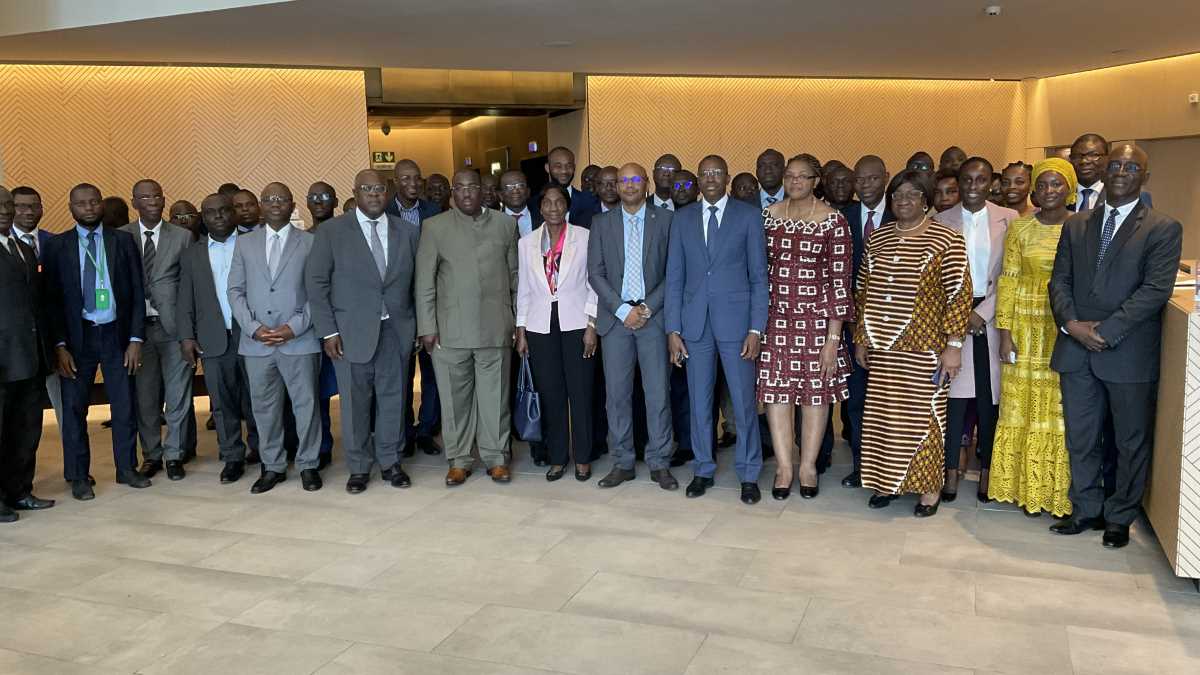
The discussions focused on the first version of the country diagnostic note, prepared by the Bank for Côte d’Ivoire, and the completion report of the Bank’s 2018-2022 Country Strategy Paper (CSP)
ABIDJAN, Ivory Coast, August 1, 2022/APO Group/ —
The African Development Bank (www.AfDB.org) and the government of Côte d’Ivoire initiated a preliminary dialogue in Abidjan on July 18-22, 2022, to lay the foundations for the Bank’s strategy in Côte d’Ivoire over the next five years.
Led by the Bank’s Deputy Managing Director for West Africa, Joseph Ribeiro, the Bank’s delegation held weeklong discussions with various stakeholders and partners in Côte d’Ivoire, including senior government officials from the Prime Minister’s office, the Ministry of Planning and Development, Ministry of Economy and Finance, and technical departments of the main ministries concerned with the Bank’s work in Côte d’Ivoire. Technical and financial partners of Côte d’Ivoire also took part in the meetings, as did representatives of the Ivorian private sector and civil society.
The discussions focused on the first version of the country diagnostic note, prepared by the Bank for Côte d’Ivoire, and the completion report of the Bank’s 2018-2022 Country Strategy Paper (CSP) (https://bit.ly/3zg0B7e) for Côte d’Ivoire, which expires at the end of the year. The dialogue also included a performance review of the portfolio of projects financed by the Bank in Côte d’Ivoire during 2022. Lessons were learnt regarding cooperation between the Bank and Côte d’Ivoire, and a number of strategic and operational recommendations were formulated with a view to improving future projects.
“Côte d’Ivoire is a strategic partner of the Bank and this dialogue with government and other stakeholders has enabled a complete diagnosis of our actions in Côte d’Ivoire and identification of strategic directions for the future Country Strategy Paper, which will cover the period 2023-2027 and will be linked to priorities of the government’s National Development Plan for 2021-2025,” Ribeiro said.
“The Bank has successfully adjusted its interventions through the use of more appropriate tools and mechanisms, as shown by the Covid-19 Rapid Response Facility, which provided a cycle of general and sectoral support for the national budget, and the Emergency Food Production Programme, which provides FCFA 96 billion ($159.33 million) of budget support to deal with consequences of the crisis in Ukraine,” said the head of the office of the Minister of Planning and Development, Yéo Nahoua, who led the Ivorian delegation.
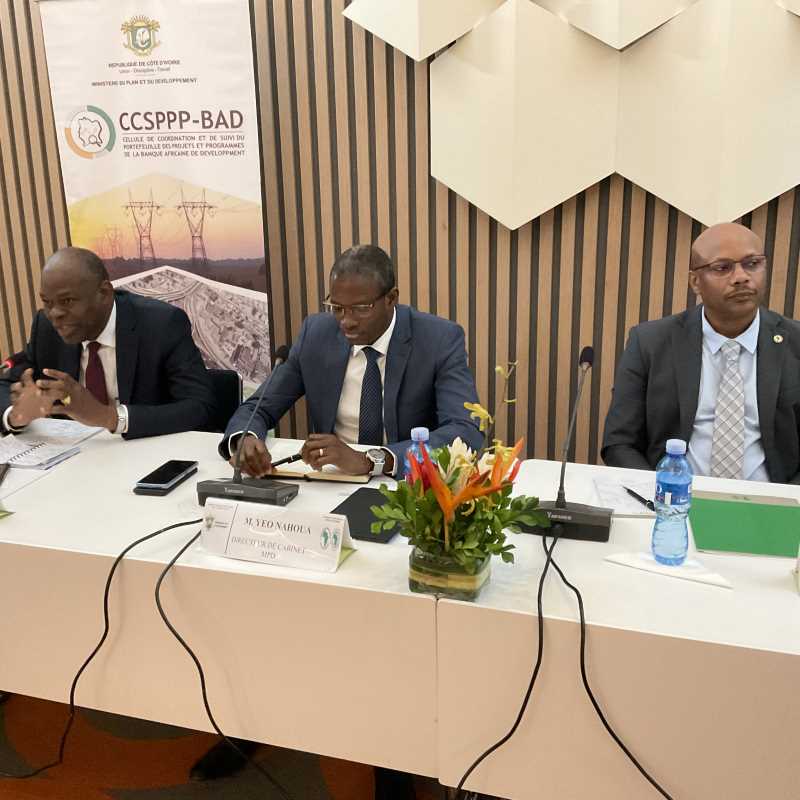
From right to left, Joseph Ribeiro, Deputy Managing Director of the Bank for West Africa, Yéo Nahoua, Chief of Staff to the Ivorian Minister of Planning and Development, Siélé Silué, Special Advisor to the Prime Minister with responsibility for projects co-financed by technical and financial partners
The Bank is ready to support Côte d’Ivoire in implementation of its National Development Plan and provide necessary resources in the priority sectors identified by the government
“I take this opportunity to thank the Bank authorities, on behalf of the Minister of Planning and Development, which acts as the Bank’s governor for Côte d’Ivoire, for their contribution to the resilience of our economy and for further improvement in the quality of our cooperation,” he added.
The Bank’s current Country Strategy Paper (CSP) for Côte d’Ivoire, which runs to the end of 2022, supports implementation of the Ivorian government’s National Development Plan for 2016-2020. The two pillars of the plan are: strengthening key infrastructure and governance for greater competitiveness and investment efficiency; and the development of agro-industrial value chains to promote inclusive and sustainable growth.
Achievements to date regarding the first pillar include progress in the transport and energy sectors. The Bank’s interventions have been instrumental in achieving a 3.4% increase in the extent of paved intercity roads and an 83% increase for urban highways, helping to lower domestic and international transport costs and to improve trade with neighbouring countries. In the energy sector, the Bank’s interventions helped to raise access to electricity by 8.6%, although failure to achieve the target of 20% shows that further efforts are required.
Participants of the Bank-government discussions noted that challenges remain for strengthening governance in sectors concerned with the first pillar, and that interventions are to be stepped up for improvement of the business climate and support to small and medium-sized enterprises.
Regarding the second pillar, the Bank’s operations have strengthened research management structures in the agricultural sector and improved productivity in several agricultural sectors (maize, rice, cassava and market gardening). But more work needs to be done to support the infrastructure of agricultural value chains, particularly agro-industrial processing of local products, which is a key element of the second pillar.
The Bank had a portfolio of 44 projects in progress at the end of June 2022 in Côte d’Ivoire, representing commitments of approximately FCFA 1,528 billion or $2.41 billion. The commitments are dominated by transport infrastructure (43.5%), followed by energy (23.6%), agriculture (19.4%), social (4.9%), governance (4.3%), finance (2.2%) and water and sanitation (2.1%). Total portfolio volume has quadrupled over five years, the disbursement level is 44% and the portfolio has an average age of 3.9 years. Portfolio performance is deemed satisfactory overall, with a rating of 3 on a scale of 1 to 4, but implementation challenges have included long execution times, partly related to the quality of project feasibility studies and extended response time. The discussions also focused on the share of non-performing projects, which now stands at 41% after falling below 30% at the end of 2021. The reasons for non-performing projects were noted. They include launch difficulties for new projects, implementation of timeframes beyond five years and low disbursement rates.
“The Bank is ready to support Côte d’Ivoire in implementation of its National Development Plan and to provide necessary resources in the priority sectors identified by the government. The discussions also focused on support for human capital and capacity building. We are ready to examine all this in discussions specifically focused on the Country Strategy Document for the period 2023-2027,” Ribeiro concluded.
Distributed by APO Group on behalf of African Development Bank Group (AfDB).

Aurionpro’s upgraded iCashpro platform for DTB delivers a unified digital experience across payments, trade, virtual accounts, and real-time reporting, enhancing straight-through processing, visibility, and control for both the bank and its corporate customers
MUMBAI, India, April 30, 2026/APO Group/ –Aurionpro Solutions Limited (www.AurionPro.com) (BSE: 532668 | NSE: AURIONPRO), a global leader in banking technology, announced the expansion and upgrade of its transaction banking engagement with Diamond Trust Bank (DTB), to modernize and enhance the bank’s corporate transaction banking capabilities across multiple countries.
This multi-country transaction banking upgrade covering Kenya, Uganda, and Tanzania aligns with DTB’s intent to enhance customer experience, streamline operations, and support growing transaction volumes as it expands its regional corporate banking footprint. DTB continues to focus on building a more agile, ‘digital-first’ banking experience, particularly around payments for its corporate customers across Africa, and is now well positioned to scale these capabilities. As part of its broader transformation agenda, the bank has been steadily investing in platforms that enhance scale, reliability, and service consistency across markets.
Through this partnership, we are proud to lead the next era of transformation in transaction banking, helping DTB enhance operational agility
Aurionpro’s upgraded iCashpro platform for DTB delivers a unified digital experience across payments, trade, virtual accounts, and real-time reporting, enhancing straight-through processing, visibility, and control for both the bank and its corporate customers. By enabling DTB to standardize and scale its transaction banking operations across countries, the platform ensures consistent service levels, stronger control, and improved efficiency. It also supports enhanced user experience, advanced security, and the flexibility to introduce new features as DTB expands its regional transaction banking footprint.
Murali Natarajan (https://apo-opa.co/48trPdk), Managing Director & CEO, DTB Kenya commented: “We are delighted to strengthen and broaden our partnership with Aurionpro Solutions as part of DTB’s ongoing digital transformation journey across multiple markets. Our focus on innovation, operational excellence, and customer-centricity continues to guide our technology investments. This upgrade strengthens our transaction banking capabilities, enabling us to deliver greater value to our customers through robust digital channels and seamlessly integrated experiences.”
Ashish Rai, Group CEO, Aurionpro Solutions, commented: “We are pleased to deepen our multi-country engagement with Diamond Trust Bank and support the next phase of its transaction banking modernization. As DTB continues to scale across markets, platform resilience and consistency become paramount. Through this partnership, we are proud to lead the next era of transformation in transaction banking, helping DTB enhance operational agility, deliver superior experiences to corporate customers, and create long-term value across geographies.”
He added, “Aurionpro’s iCashpro lays a strong digital foundation for transaction & wholesale banks across the globe to grow their corporate and SME client portfolio today, while creating a clear roadmap for next- generation capabilities in AI-driven insights, advanced automation and API-led connectivity for businesses in Kenya and across Africa.”
Distributed by APO Group on behalf of Aurionpro Solutions Ltd.
Minerals Council CEO to share insights on policy, infrastructure and investment trends shaping South Africa’s mining industry
CAPE TOWN, South Africa, April 30, 2026/APO Group/ –The upcoming African Mining Week (AMW) conference will feature Mzila Mthenjane, CEO of the Minerals Council of South Africa, as a speaker. Scheduled for October 14 – 16, 2026 in Cape Town, the event will bring together global investors, policymakers and industry leaders, with Mthenjane’s participation highlighting the council’s commitment to engaging international stakeholders and promoting investment across South Africa’s mining sector.
His participation comes at a critical moment as the Minerals Council works closely with government on finalizing the Mineral Resources Development Bill 2025, a policy framework aimed at strengthening the country’s mining investment climate and the sector’s contribution to GDP. According to the council, the revised legislation will support new investment across the value chain as South Africa seeks to mobilize R2 trillion over the next five years to unlock its critical minerals potential.
The policy reforms come amid shifting production trends in the sector. In 2025, South Africa recorded declines in gold and platinum group metals output of 1.9% and 4.1%, respectively. The new regulatory framework is expected to strengthen public-private partnerships and stimulate investment, enabling South Africa to increase production and capitalize on strong global commodity prices. Increased private sector investments is crucial with South Africa seeking targeting to unlock an estimated R40 trillion in untapped iron ore potential as well as maintain its position as the world’s leading producer of chrome and manganese.
At AMW 2026, Mthenjane is expected to outline these trends, providing insights into how the council is contributing to addressing challenges disrupting the sector. Infrastructure and energy costs remain key concerns for industry players. To support the energy-intensive sector, South Africa approved a 35% reduction in electricity tariffs for major ferrochrome producers, helping stabilize an industry that has faced significant cost pressures after electricity prices surged by roughly 900% since 2008.
Logistics constraints are also a priority area for reform. South Africa’s economy is losing an estimated R1 billion per day due to inefficiencies across rail and port infrastructure. As a result, the government is considering measures supported by the Minerals Council to increase private sector participation in logistics. Planned reforms include rail modernization initiatives targeting 250 million tons of freight capacity by 2029, alongside port upgrades and private operator participation aimed at strengthening mineral exports and improving supply chain efficiency.
Beyond infrastructure and policy reforms, the Minerals Council is advocating for stronger exploration investment to support long-term industry growth.
At AMW, Mthenjane is expected to highlight these developments and outline the steps required to reinforce South Africa’s position in the global minerals supply chain. His insights will offer investors and stakeholders a timely perspective on opportunities within the country’s mining sector.
Distributed by APO Group on behalf of Energy Capital & Power.
Seychelles energy minister will speak at AEW 2026, positioning her to highlight reforms, renewable projects and investment opportunities as the island nation advances its transition toward a diversified energy system
CAPE TOWN, South Africa, April 29, 2026/APO Group/ –Marie-May Jérémie, Minister of Environment, Climate, Energy and Natural Resources for Seychelles will participate as a speaker at this year’s African Energy Week (AEW) 2026, taking place from October 12–16 in Cape Town. Her participation underscores the country’s growing role in shaping Africa’s small-island energy transition agenda.
Minister Jérémie’s presence at AEW 2026 comes at a critical time as Seychelles accelerates efforts to reduce its heavy reliance on imported fossil fuels. The event provides a platform to attract investment, strengthen policy alignment and showcase bankable projects, positioning the country as a viable destination for private-sector participation in island energy systems.
Seychelles is demonstrating how policy reform and innovation can unlock investment in constrained environments
In May last year, international finance institution the World Bank approved the Renewable Energy Acceleration Program, a seven-year initiative aimed at modernizing the grid and increasing renewable energy penetration to 15% by 2030. The program focuses on unlocking private capital while strengthening transmission infrastructure to accommodate variable renewable energy sources.
Project development is gaining traction in the country, particularly in innovative technologies suited to Seychelles’ land constraints. The 5.8 MW Seysun Lagoon floating solar PV project, developed by independent renewable power producer Qair, is under construction and expected online in 2026.
Alongside renewables, Seychelles continues to pursue upstream opportunities to diversify its economy. The government approved new exploration entrants in 2025 and extended exiting petroleum agreements, while securing an infrastructure partnership with China. Multilateral estimates suggest over $800 million in investment will be required over the next 25 years.
Regulatory reform is central to this transition, with Seychelles introducing an independent power producer framework to open the market to private developers. Standardized power purchase agreements, grid access reforms and strengthened public-private partnership structures are being implemented to improve transparency, reduce risk and accelerate project bankability across solar, storage and emerging wind opportunities.
“Minister Jérémie’s participation highlights the strategic importance of island nations in Africa’s broader energy transition,” says NJ Ayuk, Executive Chairman, African Energy Chamber. “Seychelles is demonstrating how policy reform and innovation can unlock investment in constrained environments. Her insights will be critical to advancing dialogue on resilient, low-carbon energy systems across the continent.”
Distributed by APO Group on behalf of African Energy Chamber.
We use cookies on our website to give you the most relevant experience by remembering your preferences and repeat visits. By clicking “Accept”, you consent to the use of ALL the cookies.
This website uses cookies to improve your experience while you navigate through the website. Out of these, the cookies that are categorized as necessary are stored on your browser as they are essential for the working of basic functionalities of the website. We also use third-party cookies that help us analyze and understand how you use this website. These cookies will be stored in your browser only with your consent. You also have the option to opt-out of these cookies. But opting out of some of these cookies may affect your browsing experience.
Necessary cookies are absolutely essential for the website to function properly. These cookies ensure basic functionalities and security features of the website, anonymously.
Cookie
Duration
Description
cookielawinfo-checkbox-analytics
11 months
This cookie is set by GDPR Cookie Consent plugin. The cookie is used to store the user consent for the cookies in the category "Analytics".
cookielawinfo-checkbox-functional
11 months
The cookie is set by GDPR cookie consent to record the user consent for the cookies in the category "Functional".
cookielawinfo-checkbox-necessary
11 months
This cookie is set by GDPR Cookie Consent plugin. The cookies is used to store the user consent for the cookies in the category "Necessary".
cookielawinfo-checkbox-others
11 months
This cookie is set by GDPR Cookie Consent plugin. The cookie is used to store the user consent for the cookies in the category "Other.
cookielawinfo-checkbox-performance
11 months
This cookie is set by GDPR Cookie Consent plugin. The cookie is used to store the user consent for the cookies in the category "Performance".
viewed_cookie_policy
11 months
The cookie is set by the GDPR Cookie Consent plugin and is used to store whether or not user has consented to the use of cookies. It does not store any personal data.
Functional cookies help to perform certain functionalities like sharing the content of the website on social media platforms, collect feedbacks, and other third-party features.
Performance cookies are used to understand and analyze the key performance indexes of the website which helps in delivering a better user experience for the visitors.
Analytical cookies are used to understand how visitors interact with the website. These cookies help provide information on metrics the number of visitors, bounce rate, traffic source, etc.
Advertisement cookies are used to provide visitors with relevant ads and marketing campaigns. These cookies track visitors across websites and collect information to provide customized ads.